Your Pantone brief says 19-4150 Classic Blue. Your rPET fabric comes back looking like it went through a foggy morning filter. Sound familiar?
For brands shifting to recycled polyester activewear, this isn't a recycled polyester activewear supplier communication failure. It's a material science reality that most factories won't explain upfront.
Virgin polyester and rPET are not the same. rPET fibers carry a built-in gray-tone variance from post-consumer feedstock. That variance pushes batch-to-batch Delta E deviations as high as 1.5–3.0 — before dyeing even starts.
The result? Your brand's color identity erodes across seasonal collections. And you often don't catch it until bulk production is already running.
This guide covers the full technical and operational picture:
Why dye sublimation on recycled polyester performs differently than on virgin fabric
How to build a lab dip approval process that holds color accountable at scale
Technical Reality: rPET vs Virgin Polyester Color Matching Constraints
Recycled polyester and virgin polyester share the same chemical backbone. But they do not share the same color behavior.
The difference starts before a single gram of dye enters the picture. rPET fiber comes from post-consumer bottle feedstock — and that feedstock is inconsistent by nature. Mechanical recycling produces chips that range from crispy white to creamy yellow , depending on the bottle source, heat processing history, and filtration quality. Virgin polyester, by contrast, gets manufactured to tight chip specifications. Producers add optical brighteners to hit a stable, high-L* neutral white base every time.
That baseline difference creates direct, measurable problems for Pantone matching.
The Delta E Gap Is Real — And It Starts Before Dyeing
Metric | Virgin Polyester | rPET (Standard Control) |
|---|---|---|
Lot-to-lot ΔE | ≤ 0.8–1.0 | 1.5–3.0 |
Dye uptake variation | ~2–3% | ~5–8% |
Light shade ΔE drift | ≤ 0.8 | 1.8–2.5+ |
The gap isn't just statistical. It's built into the material itself. rPET fibers show higher variation in disperse dye uptake . This traces back to intrinsic viscosity (IV) shifts across different melt histories and bottle grades. IV controls fiber crystallinity. Crystallinity controls how deep and how evenly dye molecules move into the fiber. Throw in residual metal catalysts and contaminants from recycled feedstock, and you get a system that fights predictable color absorption at every step.
Shade Depth Changes Everything
Not all Pantone colors carry equal risk on rPET. Your position on the lightness scale makes a big difference.
Dark shades — navy, black, forest green, charcoal:
High dye concentration buries the rPET base's gray-yellow cast. With quality feedstock and controlled dye curves, rPET darks can hit ΔE ≤1.0–1.5 — close to the ≤0.8–1.0 standard for virgin PET. Cross-batch matching stays manageable here.
Medium shades:
The yellow and gray undertones start showing up in the chroma channel. This pushes a* and b* values away from target. Skip chip batch pre-screening, and medium-shade programs drift into ΔE 1.5–2.5 . That means more lab dip correction cycles before bulk production.
Light shades, pastels, and optical whites:
This is where rPET color matching gets genuinely hard. Chip-to-chip whiteness shifts — from "crispy white" to "creamy yellow" — mean the same dye recipe produces a visible, measurable difference between lots. Without aggressive chip pre-calibration, optical whites and pale grays exceed ΔE 1.8–2.5 between production runs. Virgin PET optical whites, by comparison, hold under ΔE 0.8–1.0 with standard controls.
Your brand palette includes icy lavender, powder blue, or off-white colorways? That puts you in the highest-risk category on rPET.
Dyeing Method Shapes Your Risk Profile
The method used to put color into the fiber decides how controllable that color is in practice.
Piece dyeing (jet or winch dyeing of greige rPET fabric) lets you correct shade per lot through recipe, temperature, and dispersant adjustments. It's the most flexible route for brands running a wide seasonal palette at small-to-medium volumes. The tradeoff is real though. IV and tone variation in rPET raises re-dye frequency — adding water, energy, and chemical load to each production cycle. rPET fabric color consistency is harder to lock down at scale with this method alone.
Solution dyeing (dope-dyed rPET) puts color masterbatch straight into the molten polymer before spinning. The pigment bonds inside the polymer matrix. So the residual chip undertone stops mattering, and lot-to-lot ΔE can fall to ≤0.5 with tight masterbatch dosing controls. This is the most reliable path to bulk dyeing color accuracy on rPET. The catch: minimum order quantities run 500–3,000 kg per color . That makes it practical for core brand colors only — black, navy, or a signature brand red.
Dye sublimation on recycled polyester adds a third layer of complexity. Sublimation transfers disperse dyes through heat (~190–210°C) into the fabric surface. But the ground shade of the rPET base changes printed color accuracy. A creamy-white base versus a neutral-white base shifts your printed Pantone target by a measurable ΔE. On rPET substrates with variable whiteness, printers often accept ΔE ≥2.0 unless the ground gets standardized to a locked L* / b* window. This is a real issue for brands building graphic-heavy activewear on lightweight rPET jerseys.
Ask your fitness activewear supplier which dyeing route they use. Check whether they have chip-level controls to back it up. That's the first real filter for judging rPET fabric color consistency at production scale.
Pantone System Selection & Color Brief Preparation for Activewear
Most color miscommunications between brands and rPET factories don't start on the production floor. They start in the color brief — the wrong Pantone system gets used as the production reference, and everything downstream suffers.
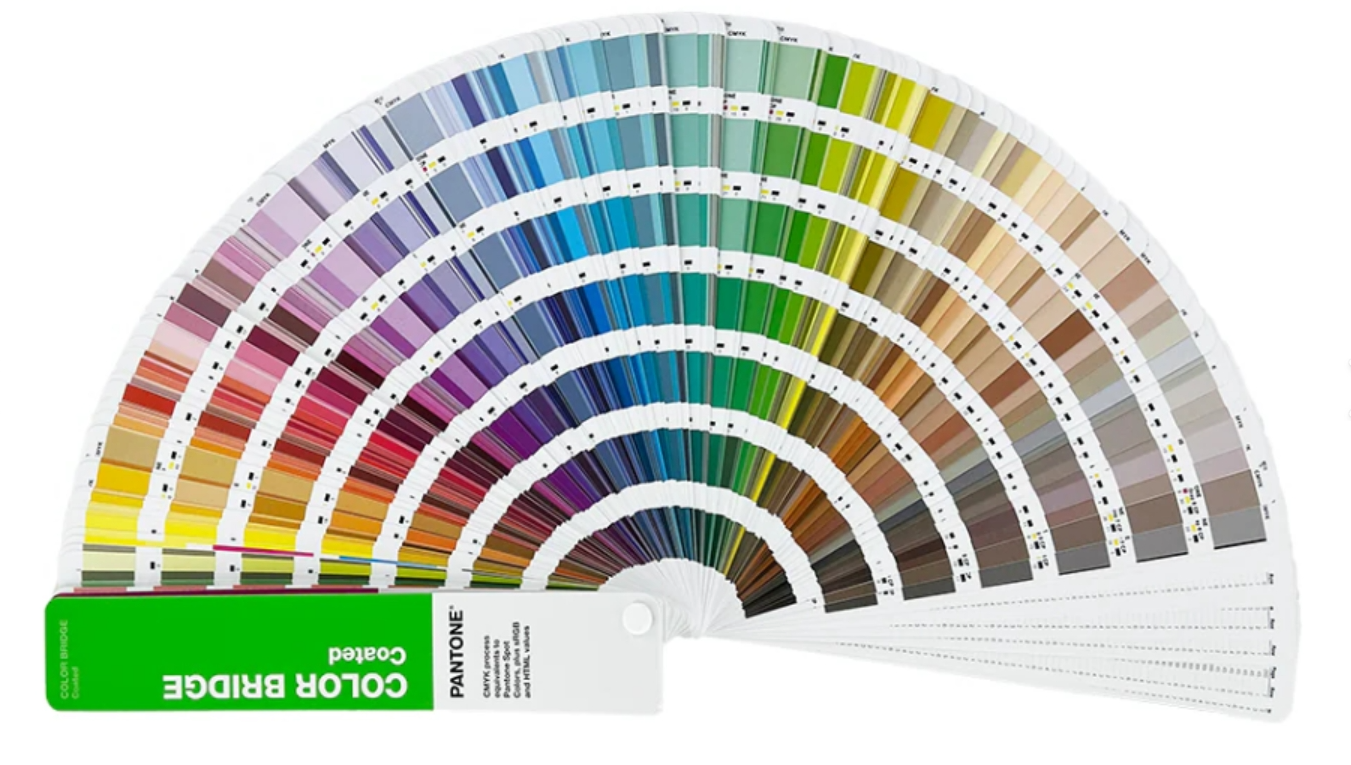
Here's the core problem: most brand identity manuals are built around Pantone FHI Cotton TCX . TCX is a matte, cotton-based standard. It looks great in brand decks and mood boards. But a factory trying to match that TCX reference on recycled polyester runs into trouble fast. Recycled polyester is smoother, reflects more light, and behaves differently as a substrate. You've introduced a system-level mismatch before a single lab dip gets pulled.
Use the Right Pantone System for Synthetic Fabrics
For activewear built on polyester and rPET, the Pantone hierarchy works like this:
Pantone FHI Polyester TSX — The primary standard for all synthetic activewear knits: leggings, performance tees, interlock, tricot, spacer fabrics. TSX is built for 100% polyester and rPET. It accounts for filament smoothness, higher light reflectance, and the dye uptake behavior of synthetic fibers. This is your production approval reference.
Pantone FHI Nylon TN — Use this for fluorescent or high-visibility colorways on nylon or nylon-blend substrates (windbreaker shells, neon trims, safety accents). TN is not a substitute for TSX on standard rPET jersey.
Pantone FHI Cotton TCX — Treat this as visual intent only. Your brand VI may be locked in TCX. If so, convert to the nearest TSX equivalent before you issue any polyester lab dip.
A practical routing rule for your tech packs:
Fabric Composition | Production Standard |
|---|---|
≥80% polyester or rPET | TSX |
≥60% nylon, or neon/hi-vis required | TN |
≥80% cotton / modal (lifestyle tops) | TCX |
Apply the same logic to trims and components. Sewing thread gets the closest TSX or TN match, plus a thread brand shade code (Coats, A&E). Heat transfers, silicone prints, and zippers target TSX where the substrate is polyester. Use TN for neon nylon trims.
Building the Color Brief That Controls Production
Confirm the correct Pantone system first. Then build your color brief around four required blocks — each one tied to rPET color behavior at scale.
1. Color Identification Block
State both systems where a TCX-to-TSX conversion applies:
"Brand VI: PANTONE 19-4150 TCX (visual reference only). Production standard: PANTONE 18-4250 TSX. All lab dip and bulk approvals measured against physical TSX swatch."
Include L*a*b* coordinates, illuminant D65 / 10° observer , and ΔE2000 tolerance (for core brand colors, target ≤1.0 ). Add a photo of the physical TSX swatch shot under both D65 and TL84 light sources as a visual reference.
2. Fabric and Construction Details
Color doesn't exist apart from fabric construction. Every colorway brief must specify:
Composition: e.g., 88% rPET / 12% elastane
Knit structure: single jersey, interlock, power mesh, spacer
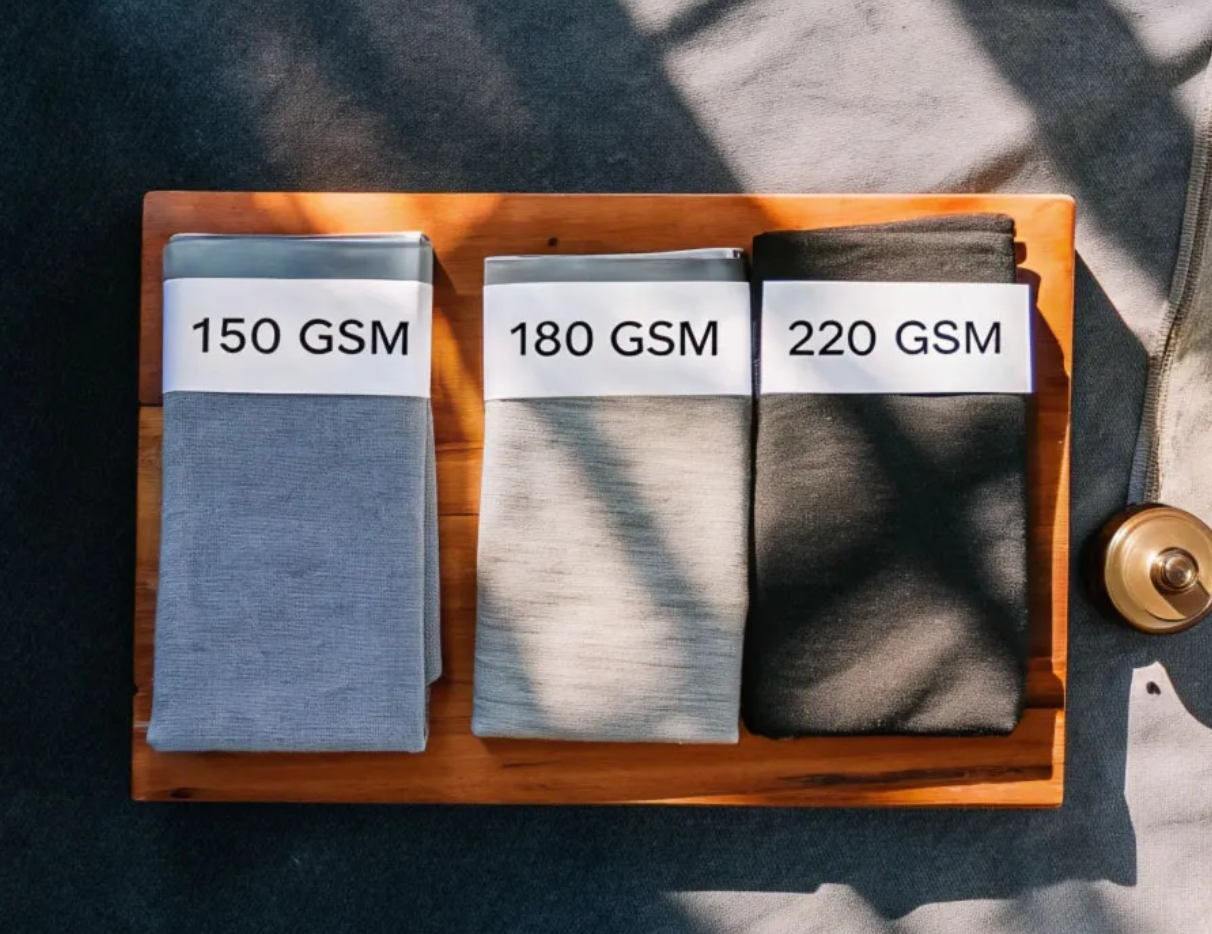
Weight (gsm): leggings run 220–280 gsm ; performance tees 130–180 gsm
Surface finish: peach, brushed, matte, micro-sheen
Yarn type: filament vs. textured, dope-dyed vs. piece-dyed
These details matter — they're not filler. Take two fabrics with the same fiber content: one matte peach finish, one micro-sheen. Run the same dye recipe on both. You'll get different ΔE readings. The fabric construction drives color outcome.
3. Performance and Fastness Parameters
Set fastness grades in the brief. Don't leave them to factory defaults:
Washing (ISO 105-C06): Grade 4–5 color change and staining
Perspiration (ISO 105-E04): Acid and alkaline, minimum Grade 4
Rubbing/crocking (ISO 105-X12): Dry ≥4 , Wet ≥3–4
Light fastness (ISO 105-B02): Outdoor/running gear Blue Wool 4–5 ; training/indoor minimum 4
One rPET-specific detail to flag: high elastane content can darken shade under stretch. For critical colors on 4-way stretch fabrics, request lab dips measured both relaxed and at 30% extension . Also, DWR, wicking, or antimicrobial finishes can shift final shade by ΔE 0.5–1.0 . Require those finishes applied at lab dip stage — not after approval.
4. GRS Certification Language
Sustainable sourcing claims must be verifiable at the color approval stage, not just at material sourcing. Add this language to your brief:
"Base yarn: 100% GRS-certified rPET. Activewear Supplier must provide valid GRS Scope Certificate and Transaction Certificates (TCs) covering polymer/chip, yarn spinning, knitting/weaving, dyeing/finishing, and garment making. No color approval or bulk booking issued without matching GRS TC for the greige and dyed lot."
This isn't administrative overhead. It closes the traceability gap that lets greenwashing enter the supply chain at the dyehouse level — which is exactly where it most often does.
Color Brief Checklist — Per Colorway
- [ ] Pantone hierarchy confirmed: TSX primary (or TN / TCX where justified)
- [ ] L*a*b* coordinates + D65 illuminant + ΔE2000 ≤1.0 tolerance stated
- [ ] Fabric: composition, gsm, knit/weave structure, surface finish, yarn type
- [ ] Fastness grades specified for all relevant tests
- [ ] Finishes (DWR, wicking, anti-odor) included at lab dip stage
- [ ] GRS scope certificate + TC requirements stated
- [ ] Note confirmed: "All visual approvals and bulk QC against physical TSX/TN/TCX swatch — not screens or printouts"
A brief built to this standard does more than communicate. It becomes your single source of truth through every lab dip cycle, strike-off review, and bulk production audit. It removes the ambiguity that causes most rPET color programs to drift off-standard by the third seasonal collection.
Lab Dip to Bulk SOP: Timeline, Tolerances, and Approval Workflow
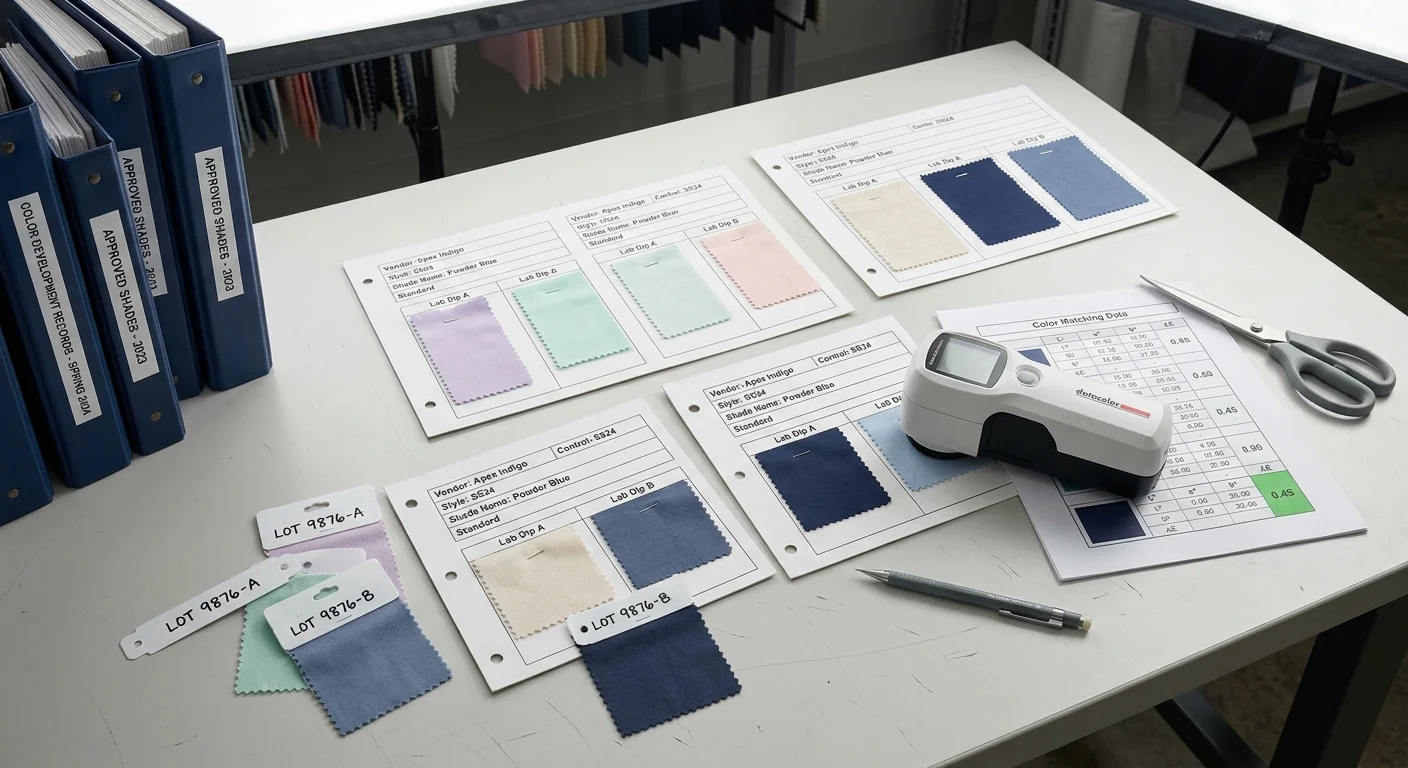
A color approval system is only as strong as the documentation holding it together. On rPET programs, batch-to-batch fiber variance is a reality. Your lab dip process isn't just a quality step — it's the framework that decides whether your brand color survives bulk production intact.
Here's the complete SOP, stage by stage.
Stage 1: Color Brief Dispatch & Greige Baseline (Days 1–3)
Start with a physical master standard — a signed-off Pantone TSX chip or prior-approved fabric cutting. Digital RGB or CMYK values are not accepted as production references at any stage.
On Day 1, dispatch the color brief and physical standard to the mill. By Days 2–3, the factory confirms receipt, measures the greige lot with a spectrophotometer, and records the L*a*b* baseline. That baseline does something important: it shows both sides how much risk the base fabric carries — and it does this before any dye work begins.
For rPET, this step isn't optional. A creamy-yellow chip base on a pastel colorway gets flagged here — before any dye is committed. The factory logs this on a Color Development Sheet with a note like:
"Pastel on off-white rPET base — expect minimum ΔE 1.2–1.5. Advise brand of achievable range before proceeding."
This is where realistic expectations get set. Not after three failed lab dip rounds.
One critical logistics point: wherever possible, source the same greige lot for lab dips and bulk production . Different greige lots create base-tone differences before the dyehouse touches a single recipe parameter. Lock the greige lot ID on the Color Development Sheet and keep it there.
Stage 2: Lab Dip Development Cycles (Days 4–33)
Each lab dip round delivers 3–5 physical options dyed on actual production fabric — not lab approximations. A standard submission looks like this:
LD-A — Direct match to master standard
LD-B — A shade lighter
LD-C — A shade darker
LD-D — Tone-corrected (e.g., reduced green cast, added warmth)
Each dip is mounted on a labeled card showing: color name and code, fabric construction, greige lot ID, dye recipe ID, submission date, ΔE reading, and viewing conditions. That card becomes a contract document.
Evaluating the dips:
Evaluate under a calibrated light box — minimum D65, TL84 (or CWF), and Tungsten A. Metamerism is an automatic rejection trigger. A dip that matches under D65 but shifts under store light TL84 fails. No exceptions.
The factory shares spectrophotometer data at the same time — L*a*b* values and ΔE versus master under all three illuminants. Working tolerances are:
Program Type | Target ΔE | Rejection Threshold |
|---|---|---|
Standard fashion | ≤ 1.5 | > 1.5 |
Brand-critical core colors | ≤ 1.0 | > 1.2 |
Visual grading runs alongside the numbers:
- Grade A — Approved for bulk
- Grade B — Acceptable with comments; suitable for non-hero SKUs
- Grade C — Rejected; requires resubmission
Feedback discipline matters here. Vague comments like "too dark" or "not right" waste an entire lab dip cycle. Good feedback is directional and axis-based:
"Too green. Reduce yellow, increase red-blue. Brightness acceptable — do not adjust."
Use color axes, not percentages: Red ↔ Green, Yellow ↔ Blue, Bright ↔ Dull, Light ↔ Dark.
Timeline per round:
- Round 1 (Days 4–15): Factory submits options; brand reviews and feeds back by Days 16–18
- Round 2 (Days 19–30): Dye ratios, auxiliaries, and temperature curves get refined
- Final approval (Days 31–33): Brand stamps the winning dip "Approved for Bulk," dates and signs the card
The factory keeps one signed master card in the dye lab. Your team archives a duplicate as the production control reference.
What gets locked at approval:
- Signed physical lab dip card
- L*a*b* data under D65, TL84, and A
- Full dye recipe (dyestuff types, % owf, auxiliaries, pH, temperature curve, liquor ratio)
- Machine parameter sheet (dye machine type, load, rotation speed, heating/cooling rate)
These four documents are not optional. They are the color contract for every bulk lot that follows.
Time-saving option: Digital color management platforms like DMIx or ColordesQ can replace at least one physical approval loop with ΔE-based digital review. This saves 5–10 days per round on international programs.
Stage 3: Pilot Run / Strike-Off Confirmation (Days 34–40)
High-risk colorways — pastels, complex prints, shades with post-dye finishing — need a pilot run before bulk commitment. A standard pilot covers 50–150 meters on the actual bulk dyeing machine, not the lab setup.
Evaluate cuttings from three positions: beginning, middle, and end of the run. Also run selvedge versus center checks. All readings go against the approved lab dip card — not back to the original Pantone chip. The approved dip is now your standard.
Acceptance criteria:
All spectrophotometer points fall within ±0.8 ΔE of the approved dip
Visually acceptable under D65 and at least one store light
No banding or side-to-center shade breaks
Any point that fails triggers recipe and process adjustments. A new pilot run follows before bulk proceeds.
The pilot approval deliverable is a signed Strike-Off Card recording: machine ID, lot number, date, ΔE readings across all measured positions, and the confirmed shade band.
Stage 4: Bulk Dyeing QC & Roll Segregation (Days 41–55)
Bulk production runs against the locked dye recipe and machine parameters from the approved lab dip. No deviations without written sign-off.
In-line QC checks happen every 300–500 meters , or per dye lot. Readings go under D65; premium brand programs also require TL84 data at each checkpoint.
Every roll gets graded and tagged at completion:
Grade | ΔE vs Approved Dip | Disposition |
|---|---|---|
A | ≤ 1.0 | Free for all purchase orders |
B | 1.0 – 1.5 | Allocated to less visible components or discounted programs (with buyer consent) |
C | > 1.5 or metameric failure | Quarantined; evaluated for re-dyeing, over-dyeing, or downgrade to non-PO SKUs |
C-rolls do not ship. Each one goes into quarantine and gets assessed on its own.
The final deliverable is a Bulk Color Approval Report per color: lot and roll numbers, ΔE readings, A/B/C grades, and confirmation that all shipped rolls fall within the agreed tolerance band.
For brands with tight VI standards, add a random shade re-check on fabric arrival at your facility — run it before garment cutting starts. Shipping and storage can shift shades between factory sign-off and your receiving dock.
Full SOP Timeline at a Glance
Phase | Timeline |
|---|---|
Color brief + standard dispatch | Day 1 |
Greige baseline & feasibility feedback | Days 2–3 |
Lab Dip Round 1 development + shipping | Days 4–15 |
Brand review + directional feedback | Days 16–18 |
Lab Dip Round 2 (if required) | Days 19–30 |
Brand final approval | Days 31–33 |
Pilot / strike-off run + approval | Days 34–40 |
Bulk dyeing + full A/B/C roll segregation | Days 41–55 |
For a three-colorway seasonal launch on rPET, plan for a minimum 8-week color development runway from brief dispatch to bulk sign-off. Cut this timeline short — skip or rush any stage — and the risk lands in your bulk production.
In-Line Color QC & Fastness Testing Protocols for Recycled Activewear
Bulk approval is not the finish line. It's the starting gate.
Sign the strike-off card and bulk dyeing begins — but color discipline doesn't stop there. It runs checkpoint by checkpoint, roll by roll. On rPET programs, this matters more than on virgin polyester. Fiber lot variance doesn't disappear after the lab dip gets approved. It surfaces mid-production, without warning, in ways that go unnoticed until garments are already cut.
Three Mandatory In-Line Checkpoints
Every rPET bulk lot needs spectrophotometer readings at three separate moments — not just once at the end of the run.
1. Dye jet exit (pre-unloading)
Before the fabric leaves the machine, verify the shade against your approved lab dip. A portable spectrophotometer does the job here. A reading that fails tolerance at this stage still leaves you with options — adjustment, re-shade, or pull. Move the fabric forward, and those options shrink fast.
2. Post-drying
Recycled fibers hold residual moisture in a way that virgin polyester does not. That moisture can shift the apparent shade reading. A dip that passed at the jet may drift after drying. Re-check here. Don't skip it.
3. Post-finishing
Softener, wicking treatments, DWR coatings, and heat-setting all alter surface chemistry. Each one can move L*a*b* values. The post-finish read is your last in-line control point before bulk release.
Working tolerance bands for rPET activewear:
Result | ΔE vs Approved Lab Dip | Action |
|---|---|---|
Pass | ≤ 1.0 (lot average) | Release |
Review | 1.0 – 1.5 (single roll) | Evaluate for secondary allocation |
Reject | > 1.5 or visible shift | Quarantine; assess for re-shade |
Metamerism Check — The Test Most Brands Skip
A fabric that looks correct under D65 daylight can shift under store lighting. That's metamerism. It's a real problem on rPET — lot changes or post-dye finishes can alter the fiber's reflectance profile and push that shift further.
Run a minimum 3-source metamerism protocol: D65 daylight + TL84 retail + A incandescent. Any inter-source reading above ΔE 0.5 sends the lot back for recipe correction. Not negotiation — correction.
Three scenarios make this check most critical:
- rPET feedstock lot changes between production runs
- Dark shades produced by overdyeing
- Wicking or antimicrobial finishes that change surface reflectance
Color Fastness Benchmarks for Recycled Activewear
Pantone accuracy and fastness are two separate problems. A shade that matches perfectly at approval can still fail your customer if the color breaks down through regular use.
Minimum fastness benchmarks for rPET performance activewear:
Test | Standard | Color Change | Staining |
|---|---|---|---|
Wash fastness | ISO 105-C06 | 4–5 | 4–5 |
Perspiration (acid + alkaline) | ISO 105-E04 | 4–5 | 4–5 |
Dry crocking | ISO 105-X12 | 4–5 | — |
Wet crocking | ISO 105-X12 | ≥ 3–4 | — |
Light fastness | ISO 105-B02 | Grade 4 minimum | — |
One detail worth flagging on wash fastness: ISO 105-C06 includes both Single (S) and Multiple (M) wash options. Activewear goes through many wash cycles — the M test simulates up to five of them. That's the standard that applies here. Require the M result. A single-wash pass is not enough.
The Documentation Package That Makes QC Auditable
Spectrophotometer readings and fastness reports are useful only if you can trace them back to their source. Every color-control record needs to link to a specific yarn lot, recycled content declaration, dye batch, finishing batch, and fabric roll ID.
Minimum documentation pack per color lot:
Full fastness report — wash, perspiration, crocking, light
Spectrophotometer batch log — ΔE + multi-source readings per roll
Shade tolerance sign-off sheet — lab dip, bulk lot, post-finish approvals
Recipe and machine traceability sheet — dyestuff %, auxiliaries, temperature curve, machine ID
This documentation pack does two things. It's your internal QC record. It's also the audit-ready evidence your brand needs when a retail partner or certification body asks how GRS certified polyester dyeing claims held up at the production stage — not just at fiber sourcing.
Vendor Screening Checklist: 9-Point Evaluation for rPET Pantone Matching
Most rPET color failures don't happen in the dyehouse. They happen at the RFQ stage. Brands hand development work to factories that look qualified on paper but lack the equipment, data discipline, or certification depth to deliver Pantone accuracy on recycled fiber at scale.
This checklist is a structured scorecard. Use it before you issue a single lab dip brief. Score each point 0–2. Set your minimum pass mark at 15/18. Require documentary proof for every item before granting development status.
Point 1: Spectrophotometer Equipment & Color Management Software
A factory without calibrated spectrophotometry is guessing. Full stop.
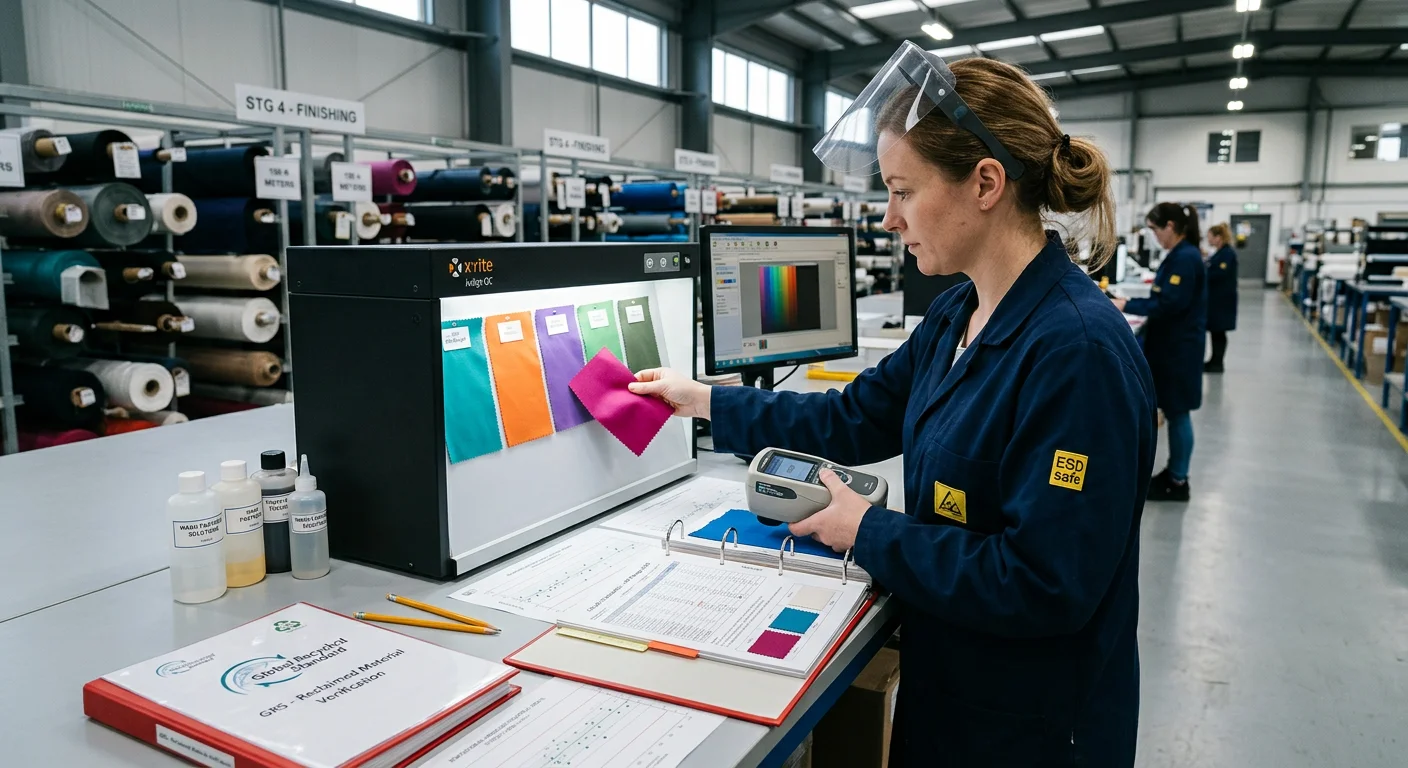
Look for a bench-top instrument built for textiles — Datacolor 650/850 or X-Rite Ci7000 series. It must be configured to d/8° geometry, D65 illuminant, 10° observer , with L*a*b* and CIEDE2000 output. Equipment alone isn't enough. The factory also needs recipe prediction software — Datacolor MATCH TEXTILE, Color iMatch, or equivalent. That software must include an rPET-specific substrate database and batch-correction capability using historical reflectance curves.
Ask for:
- Make and model of the instrument
- Last calibration date
- Example L*a*b* reports for 3–5 recent rPET Pantone matches
- Number of trained lab technicians and shift coverage
Benchmark: Leading performance mills in Asia run ≥2 spectrophotometers per site. They log every lab dip and bulk lot into a centralized color database with unique dye-lot IDs.
Point 2: GRS Certification Scope Depth
A GRS certificate with gaps is a supply chain risk. It is not a sustainability credential.
The certificate must cover the full vertical stack : rPET chip and filament yarn production, yarn spinning and texturizing, knitting or weaving, dyeing and finishing, and cut-and-sew for garment production. Partial coverage leaves gaps. A mill certified for greige knitting only leaves the dyehouse and garment stages unverified.
Ask for:
- Current GRS v4.0 scope certificate
- Transaction Certificates (TCs) for at least 3 recent rPET bulk POs
- Confirmation that facility names on the certificate match actual production locations
Benchmark: Established sportswear vendors in China and Vietnam hold multi-tier GRS scope. A mill that can certify greige fabric only is a red flag for GRS certified polyester dyeing programs with any brand VI accountability requirement.
Point 3: Historical rPET Pantone Match Rate
Ask for the number — not the story.
Request a 12-month report showing the first-submission lab dip approval rate on rPET programs (not generic polyester). The metric is straightforward: Round 1 approvals divided by total rPET color briefs submitted. Break it down by shade category — darks, brights, pastels.
Set your pass gate at ≥85% overall . Expect commodity colors — black, navy, white — to hit 90–95%. Brights and neons on rPET run 70–85%, and that range is reasonable. A factory that can't produce this data at all? That absence is the answer.
Ask for: A list of 5–10 brand clients and their stated first-time approval rate targets for rPET programs.
Point 4: Written Delta E Tolerance Policy
Visual grading without ΔE metrics is high-risk. Require a formal, written color tolerance matrix using CIEDE2000 (ΔE00), tiered by product category:
SKU Tier | ΔE00 Tolerance |
|---|---|
Flagship / hero colors | ≤ 0.8–1.0 |
Seasonal / fashion | ≤ 1.0–1.5 |
Light / pastel / melange | ≤ 1.5–2.0 |
The policy must do two things. First, it must separate lab dip tolerances from bulk tolerances. Second, it must state whether ΔE is measured at panel center or at the worst point on the garment.
Ask for: Example bulk inspection reports showing L*a*b* and ΔE readings for at least 5 rolls per dye lot. Pass/fail decisions and re-dye trigger criteria must be documented.
Point 5: Lab Dip Cycle Time & Capacity
The standard benchmark for the lab dip approval process on rPET knits is 10–15 calendar days per full round . That clock starts from receipt of the physical standard and confirmed substrate. Anything faster on a brand-new rPET quality deserves scrutiny — recipe development and correction time is real and can't be skipped.
Build a minimum of 3 full lab dip rounds into the color development calendar before strike-off approval or cancellation.
Ask for:
- Recorded average lab dip lead times over the last 6–12 months for rPET programs
- Lab capacity in dips per week
- Number of rPET-dedicated sample dye machines
- The escalation protocol used when a 3rd round still fails
Point 6: Multi-Illuminant Metamerism Protocol
Color fastness on recycled fabric starts with metamerism control. Most factories skip the formalized protocol entirely.
The vendor must run multi-illuminant checks on all approved lab dips and on at least one roll per bulk lot. Required light sources: D65 daylight, TL84 retail, and A incandescent . The viewing booth must be a calibrated unit — VeriVide or BYK-Gardner — with documented maintenance records.
Written rejection criteria must be direct: a lot that passes under D65 but shifts under TL84 fails. No negotiation. Re-dye.
Ask for:
- The metamerism evaluation SOP
- The sign-off authority chain (lab tech vs. QA vs. merchandiser)
- 2–3 anonymized case examples where lots were rejected for metamerism, including what corrective action followed
Point 7: Fastness Testing Infrastructure
Color accuracy at approval means nothing if the shade breaks down after five wash cycles in the field.
The factory must have an in-house textile testing lab or a verified partnership with an accredited third party — SGS, Intertek, or Bureau Veritas. Required test coverage:
Test | Standard | Minimum Grade |
|---|---|---|
Wash fastness | ISO 105-C06 (M option) | 4–5 change / 4–5 staining |
Perspiration | ISO 105-E04 | 4–5 |
Dry crocking | ISO 105-X12 | 4–5 |
Wet crocking | ISO 105-X12 | ≥ 3–4 |
Light fastness | ISO 105-B02 | Grade 4 minimum |
One note on wash fastness: require the Multiple (M) wash option — not the single wash. Activewear goes through repeated laundering. A single-wash pass tells you nothing about real-use performance.
Ask for: 6–12 months of test reports on similar gsm and knit structures in rPET. Also confirm that color bulk approval is directly tied to a minimum fastness package. No bulk release goes out without passing fastness results in hand.
Point 8: Dye Lot Traceability System
Every bulk dye lot needs a complete, auditable chain of records. Each lot must trace back to a greige batch ID — including knitting date, machine, and operator — plus dyestuff batch numbers, recipe version, and spectrophotometer logs showing L*a*b* and ΔE at both lab dip and bulk stages.
Look for ERP or MES integration that links lot → roll → garment for recall situations. The system must record who approved each stage, by name and role.
Ask for: A sample "color history" trace for one style, from rPET pellet or greige through bulk shipment. Also request the factory's policy on mixing dye lots within a single PO. The standard practice: a maximum of 2 lots per PO, segregated and labeled at roll level.
Point 9: Post-Consumer Recycled Content Verification
Post-consumer recycled polyester color consistency ties directly to feedstock quality. Feedstock traceability is also where greenwashing most often enters the supply chain.
Require a full declaration covering:
- PCR content percentage (100% PCR vs. virgin PET blends)
- Fiber source types (bottle-to-fiber, ocean-bound plastic, post-industrial)
- A named list of upstream rPET chip and filament suppliers — country, facility name, and GRS scope certificate numbers
Chain-of-custody controls matter here. Ask how the factory segregates rPET from virgin PET across warehouse, spinning, knitting, and dyeing stages. Mass-balance GRS chains in multi-product facilities are a known weak point — require mass-balance documentation where it applies.
Ask for: Transaction Certificates for 3–5 recent POs showing pellet → yarn → fabric → garment continuity. Also request evidence of internal or external GRS audit resolutions where non-conformances occurred.
Scoring Summary
Score each of the 9 points 0–2:
- 2 — Full documentary proof provided; meets or exceeds benchmark
- 1 — Criteria partially met; gaps exist but are addressable
- 0 — No documentation; fails benchmarkMinimum pass mark: 15 / 18 before granting rPET Pantone-critical development status.
Any vendor scoring 0 on Points 1, 2, or 4 is disqualified regardless of total score. These three points are non-negotiable infrastructure for bulk dyeing color accuracy on recycled fiber programs.
Troubleshooting: Resolving Common Color Deviation & Metamerism Issues in Bulk
Color problems in bulk don't announce themselves. They build up — roll by roll — until garments are stacked on the packing table and the shade shift is impossible to ignore.
Five failure patterns cause most rPET color rejections. Each has a clear root cause and a concrete fix.
Problem 1: Lot-to-Lot ΔE Drift on Light Shades
Light corporate colors — pale greys, soft pastels, powder blues — are the hardest test of rPET feedstock consistency. The same dye recipe on two different greige lots can return ΔE 0.8–2.0 between them. Under D65, this shows up as a "dirty" cast or a faint green-yellow undertone when rolls sit side by side.
The cause starts upstream, not in the dyehouse. Different rPET bale streams — clear bottle flakes versus slightly bluish or greenish ones — shift the substrate's a* and b* values by ±0.3–1.0 each. On pale shades dyed at 0.1–0.5% OWF , a whiteness index swing of just 1–2 WI points produces visible ΔE. On a navy or forest green, that same variation is invisible.
What to require from your recycled polyester activewear supplier:
Optical bottle-flake sorting to a b* tolerance of ±0.5 and a defined YI band, verified batchwise
Greige incoming shade control: any lot measuring ΔE > 0.7 vs master under D65 gets segregated or rejected — not blended into your dye batch
Strict greige lot segregation : never mix melt lots within a single bulk dye batch
Pre-bulk correction lab dips run against each new greige lot — the previous recipe is a starting point, not a guaranteed match
For permanent VI colors — brand-identity pastels that carry season after season — push for solution-dyed rPET . Dope-dyed programs target ΔE ≤0.5 lot-to-lot as standard practice. That's the one reliable route to light-shade consistency at scale.
Problem 2: Metamerism Under Retail Lighting
The lab dip passes under D65. Everyone signs off. Then the garments hit the shop floor under TL84 retail fluorescent. The color looks greener, duller, or warmer than anything the brand approved.
That's metamerism. It's more common on rPET than on virgin polyester. Feedstock variation changes the fiber's reflectance profile. Those changes interact across illuminants in ways that virgin polyester simply doesn't produce.
The root cause is almost always recipe construction. The dye mix got optimized for D65 and nothing else. Spectral curves cross under a different light source, and the color shifts. Mixing dye brands or dye lots between the mill and the brand standard makes it worse.
Protocol fixes:
Evaluate all lab dip and bulk approvals under D65, TL84, and A incandescent — at the same time, in a calibrated light booth
Set numerical targets: primary D65 at ΔE ≤0.75 for VI-critical shades; secondary TL84 and A at ΔE ≤1.0
Build recipes using the same dye class and fitness activewear manufacturer as the brand's standard chip — "nearby" dyes with different spectral curves create this exact problem
Use color-matching software to simulate multi-illuminant performance before the bulk run , not after
Pull shade bands from bulk and measure under all three sources before release. Any lot showing a visual mismatch under TL84 goes back — no negotiation
Problem 3: Center-to-Edge Shade Variation on Stretch Knits
High-stretch rPET/elastane fabrics — leggings at 220–280 gsm, compression knits — are prone to a specific jet-dyeing failure: darker center, lighter edges, or the reverse. Rack measurements show ΔE 0.8–2.5 center vs edge . Deep or bright shades make the effect worse.
Tension variation drives this problem. Elastane content of 8–15% reacts to overstretch and high flow speeds in the jet. The result is uneven dye uptake across the fabric width. Push the heating ramp above 3°C/min toward 130°C , and you lose the leveling window before fixation locks the shade in place.
Process corrections:
Reduce machine loading to 60–70% of rated capacity for high-stretch constructions
Slow the heating ramp to 1–2°C/min . Hold at an intermediate migration stage — 110–115°C for 15–20 minutes — before final fixation
Add a disperse leveling agent at 0.5–1.0 g/L in the main dye bath
For QC, measure L*a*b* at center, quarter-point, and edge positions. Set the pass threshold at ΔE ≤0.8–1.0 across width on critical programs
Problem 4: Dye Sublimation Mismatch on rPET vs Virgin Bases
Using the same transfer paper and press schedule on rPET that works on virgin polyester leads to failure. rPET prints come back muddier and less saturated — especially in dark and neutral tones — with ΔE differences of 2.0–4.0 vs virgin standard .
The cause sits in the material itself. rPET filament surface chemistry and residual contaminants slow ink diffusion. Base fabric whiteness variation — bluish versus yellowish chip undertones — amplifies color cast after sublimation. Dark or heather-grey bases make it worse. They suppress L* and flatten chroma before the ink even transfers.
Practical fixes:
Reserve direct sublimation for white or very light rPET bases with controlled WI and b*. Always approve on production rPET cloth — never on virgin lab fabric
For dark grounds or heathers, apply a white underbase coating to raise L* before transfer. This step is essential for logos and VI marks
Work with your ink activewear supplier to calibrate ink density curves for rPET . Expect +5–15% ink laydown on certain colors
Keep separate color standards and ICC profiles for virgin versus rPET. Cross-approving between the two substrates produces rejects
Problem 5: Fastness Drop After Wicking or Softener Finish
Shade approves clean after dyeing. Then the wicking treatment or softener goes on — and wash fastness drops from Grade 4–5 to Grade 3–4 on deep shades. You see bleeding into adjacent white in home laundry tests.
The cause is incomplete reduction clearing. Surface-bound disperse dye molecules stay on the fiber. Cationic softeners and silicone finishes then dissolve those molecules and move them. The finish exposes what the dyehouse missed.
Process discipline required:
Run reduction clearing at 70–80°C for 15–20 minutes — alkali at 1–2 g/L plus hydrosulfite at 1–2 g/L — after dyeing. Rinse to neutral pH. Check that the effluent runs clear before moving on.
Before bulk finishing, pull a post-dye, post-clearing sample. Run wash fastness and wet-crocking tests to target grades ( ≥4 ISO ). Proceed to finishing only once those pass.
Use nonionic or low-cationic wicking agents and softeners approved for disperse-dyed PET. Control stenter pickup at 60–70% to avoid over-application.
Run an A/B pilot — with and without softener — before committing to bulk finish. Compare both ΔE and fastness grades. That 30-meter trial prevents a full-lot rejection.
Conclusion
Matching your brand's Pantone colors on recycled polyester isn't a gamble. It's an engineering problem — and it has a clear solution.
The gap between a mood board and consistent bulk production comes down to three things:
Know rPET's dye absorption variability before you sign any contract
Hold recycled polyester activewear manufacturers to a structured lab dip approval process with clear Delta E tolerances on paper
Set up in-line QC checkpoints that catch color drift before it turns into a 10,000-unit loss
Brands that win at sustainable activewear don't cross their fingers and hope the factory figures it out. They show up with a color brief, a tolerance standard, and a vendor screening checklist. Then they hold the line on all three.
Start with the 9-point evaluation framework in this guide. Share it with your sourcing team. Add it to your RFQ template.
Getting the color right on rPET fabric goes beyond quality control. It's how you show that sustainability and brand integrity can work together — not against each other.