Finding a low MOQ yoga top supplier in Portugal — one that delivers on quality, sustainability, and fast turnaround — is a real sourcing challenge. Most boutique studio owners spend months on it without a clear answer.
You've already decided European manufacturing matters to your brand. So the next question is direct: which Portuguese factory is built for studios your size?
This guide profiles five of Portugal's most capable yoga apparel OEM manufacturers. For each one, you'll find:
Real MOQ numbers
Fabric credentials
Sample lead times
The studio type they serve best
Launching your first 50-piece branded collection? Or scaling a regional chain? Either way, you'll finish with a solid shortlist — not just a vague starting point.
Valérius 360
Most Portuguese activewear factories start with fabric. Valérius 360 starts with waste.
That's not a marketing line — it's a literal description of how this unit works. Located in Guilhabreu, inside Portugal's northern textile zone, Valérius 360 is the circular economy arm of the larger Valérius Group. The entire operation takes post-industrial cutting waste and used garments, then turns them into recycled yarns, knitted fabrics, and cotton paper products.
For boutique yoga studios that care about the eco-friendly yoga tops manufacturer story — not just the label — this is worth paying attention to.
What makes Valérius 360 different:
Closed-loop traceability : Recycled content comes with documented origin data from specialist sorting partners. Your brand gets verifiable recycled credentials — not marketing guesswork.
GRS + OEKO-TEX coverage : Standard across the group's output fabrics. Certifications are shared during project scoping.
Cotton-paper byproducts : Your branded hangtags and packaging can come from the same waste stream as your garments. That's a rare storytelling asset for boutique brands.
Carbon neutrality target : Committed to Carbono Zero by 2030 — on record.
Fabric MOQ and pricing benchmarks (ex-mill Portugal):
Material | MOQ | Price Range |
|---|---|---|
Recycled single jersey | ~500–1,000m/color | €4–€7/m |
Recycled fleece/sweatshirt knit | ~500–1,000m/color | €6–€10/m |
Basic tee (FOB, recycled cotton) | Mid-volume runs | €7–€15/unit |
Development lead time runs 4–8 weeks — from waste sorting to approved fabric. Production then takes 6–10 weeks after approval.
Best fit for : Established boutique studios or growing DTC yoga brands building a documented circular capsule collection. These are brands that want proof of sustainability, not just vague process descriptions. A 50-piece pilot run on a lean budget? This isn't the right entry point. But your brand is built around closing the loop? Valérius 360 gives you the supply chain to back that up.
🔗 Contact : valerius360.pt (B2B inquiries) or valerius360-store.com for finished product reference
yogavendor.com
Not every studio sourcing decision starts with Europe. For early-stage brands testing their first capsule collection, that's a rational call.
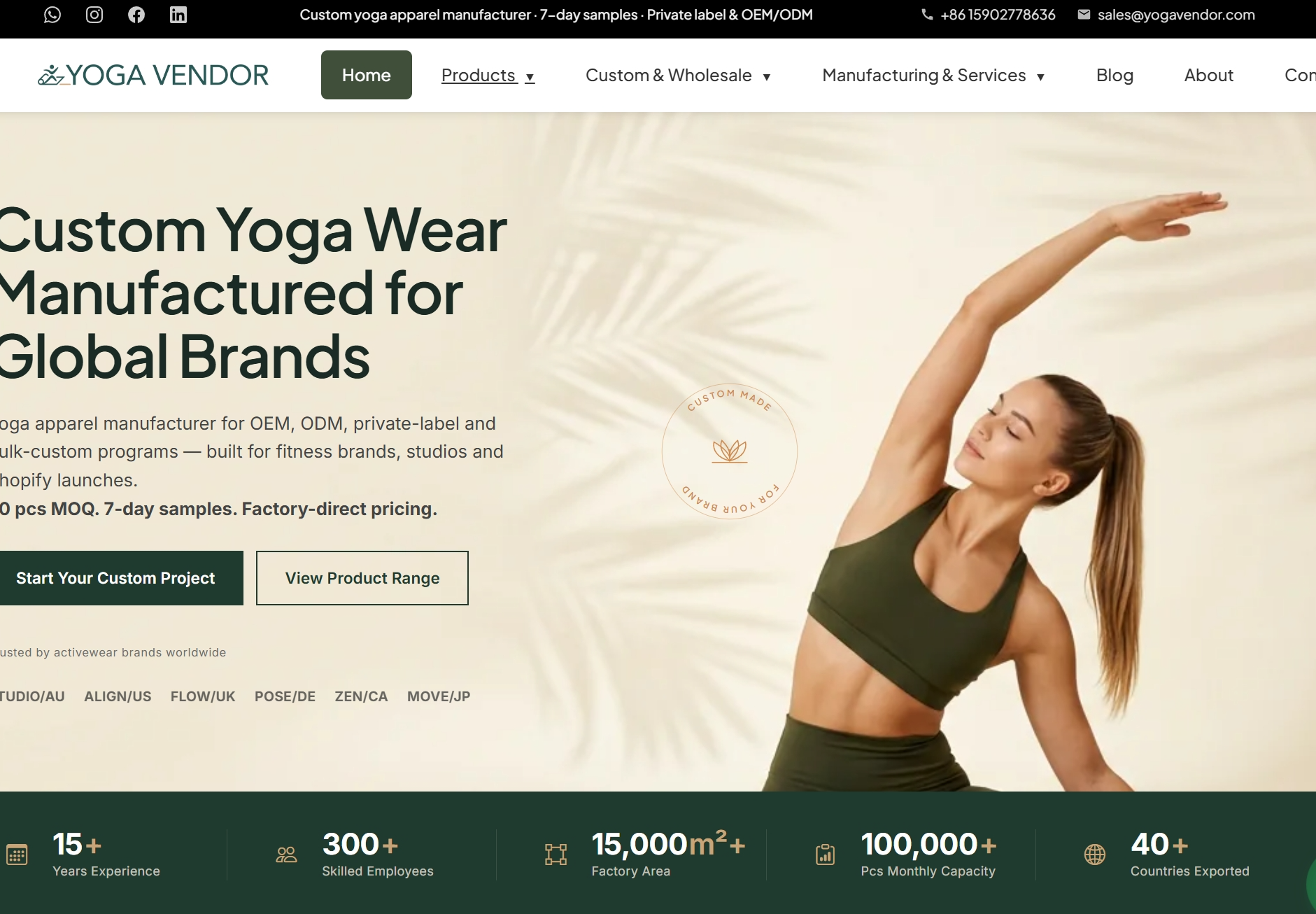
Yogavendor.com is a China-based OEM/ODM yoga apparel factory built for small-batch private label production. Their headline metric says everything: 100 pcs per SKU , quoted on the site before you submit an inquiry. No minimum relationship needed to get that number.
One brand testimonial on the site stands out: "launched our pilot capsule in 32 days from sample sign-off." That's a real timeline, not a vague promise:
Week 1–2 : First fit samples developed and approved
Week 3–6 : Bulk cutting, sewing, QC, packing, and dispatch
Testing 2–4 styles at once? That kind of cycle changes the math on launch planning.
What yogavendor.com produces for yoga studios:
Tank tops, crop tops, long-sleeve tops
Sports bras (low/medium/high support)
Matching sets (bra + legging, bra + biker short)
Studio cover-ups and zip jackets
Size-inclusive grading on request
Fabric options include nylon/spandex blends for a buttery-soft hand-feel, four-way stretch knit across all core styles, squat-proof opacity fabrics (230–280 g/m²), and recycled polyester for studios building an eco line. OEKO-TEX compliant materials are on offer — confirm availability during sampling.
Pricing benchmarks (FOB China):
Order Size | Tops / Sports Bras | 2-Piece Sets |
|---|---|---|
50–99 pcs/style | €10–€18 | €20–€38 |
100–299 pcs/style | ~5–10% below base | — |
300–500+ pcs/style | ~15–20% below base | — |
Color splitting is supported within a single style run. A 100-piece order can break across 2–3 colorways. That's useful for testing market response before you commit to one direction.
Best fit for:
- First-time studio owners launching a 1–5 SKU pilot with limited capital
- Influencer-led micro-brands that need fast concept-to-shelf cycles
- Boutique fitness spaces that want one yoga apparel supplier handling both development and production — no 500-piece commitment on day one
🔗 Contact : yogavendor.com — The B2B inquiry form takes tech packs, reference images, and target price ranges. WhatsApp/WeChat is available for fast quotes (first reply: 24–48 hours).
Tintex Textiles
Fabric is where the story either holds up — or falls apart.
Tintex Textiles S.A. started in 1998, based near the Porto textile belt in northern Portugal. From day one, they built their operation around a single idea: responsible dyeing and finishing technology belongs at the core of premium knit fabric — not added on at the end. They are a fabric mill. Not a cut-and-sew factory. That distinction matters when you're deciding where to source.
What Tintex makes:
GOTS-certified organic cotton and recycled fiber jersey fabrics
Bio-based blends: modal, lyocell (TENCEL™), organic cotton/elastane
Performance-finished knits — soft-touch, functional coating, reduced-impact dyeing
Their certifications are solid and well-documented. You get GOTS-listed status (SCO006686), active UN Global Compact participation, and alignment with OEKO-TEX and GRS for recycled content traceability. For boutique yoga brands building a "made in Portugal, certified fabric" story, that's a full documentation trail — not a loose collection of claims.
How garment production works:
Tintex sits upstream in the supply chain. They produce the fabric. Finished yoga tops come through their regional CMT partner network — a standard setup for the Porto textile cluster.
Program Size | MOQ | FOB Price Range |
|---|---|---|
Boutique capsule (stock fabric) | 100–250 pcs/color | €18–€25/top |
Custom design (engineered finish) | 300–500 pcs/color | €25–€40+ |
Sample lead time runs 2–4 weeks after color approval. Bulk production follows at 5–8 weeks ex-factory.
Best fit for : Premium yoga studios with a clear brand voice. You need to tell the organic fiber story with confidence and support a €20+ retail price point. Your studio is still testing SKUs at 50 pieces? The MOQ here is a bigger commitment than an early-stage order should carry.
🔗 Contact : tintextextiles.com | [email protected] | Exhibitor at Première Vision and Performance Days fabric fairs
Petratex
Petratex started in 1989. Over three decades, they built something most Portuguese factories can't match: real dual capability in haute couture construction and high-competition technical sportswear — all under one roof.
That's a rare combination. For boutique yoga studios that want branded tops with both a premium feel and certified sustainability credentials, here's what that means in practice.
Their Paços de Ferreira facility is the Portugal HQ. It handles the most complex work: technical health garments, performance sports gear, and couture-level production for elite luxury fashion clients. Tunisia and Morocco handle standard-volume production. The split is clear and open — it shows how seriously they treat quality tiers.
Certifications Petratex holds:
GOTS — covers every production stage, including transport
GRS — certifies products with >20% recycled fiber content
OCS — targets 95–100% organic content traceability
RCS — chain-of-custody tracking for recycled raw materials
ISO 9001 + ISO 14001 — quality and environmental management systems
Masters of FLAX FIBRE™ — Western European flax traceability, fiber to finished product
One gap worth noting: OEKO-TEX Standard 100 is not listed. For some studios, that certification is a hard requirement for retail positioning. Confirm with Petratex before you request samples.
Practical sourcing benchmarks (Portugal facility, industry-comparable):
Program | MOQ | FOB Price Range |
|---|---|---|
Standard in-house fabric styles | ~100–200 pcs/style/color | €15–€25/top |
Custom technical fabric styles | ~200–300 pcs/style/color | €25–€35+ |
Sample development runs 2–4 weeks after tech pack confirmation. Bulk production follows at 6–10 weeks after pre-production sample sign-off.
Best fit for : Established yoga studios or premium activewear labels that need documented organic and recycled fiber traceability — not vague sustainability claims. Their "On-Demand" production model offers some flexibility on batch sizing. Still, Petratex is built for brands ready to commit to technical product development. It's not the right fit for first-time 50-piece pilots.
🔗 Contact : petratex.com | +351 255 868 000 | Rua de Bande, nº 429, Carvalhosa, Paços de Ferreira, Portugal | New York office available for international commercial inquiries
Calvelex
Forty years of heritage doesn't shift without noise. Calvelex S.A. started in 1985, founded by a fourth-generation tailoring family. Today, brothers César and Marco Araújo run the business. It grew from a 20-person workshop in Lustosa, Lousada into a 600-worker, three-factory operation. They produce around 500,000 pieces per year — all within Portugal's northern textile corridor.
That scale matters. So does the specialization.
What Calvelex makes:
Structured womenswear: blazers, coats, formal dresses, trousers, skirts
High-construction pieces for middle-high and high-end European brands
Export reach across 50+ countries
This is not a knit activewear factory. There's no pivot into yoga-specific tops, recycled nylon jersey, or performance-stretch fabrication. Their B2B platform — Calvelex Net — carries 20,000+ pattern references and 100+ new styles per season. Almost all of it is woven tailoring.
Practical sourcing benchmarks (Portugal premium womenswear, comparable scale):
Program | MOQ | FOB Price Range |
|---|---|---|
Formal dresses / blazers | 200–400 pcs/style/color | €25–€60+ |
Trousers / skirts | 200–400 pcs/style/color | €18–€40+ |
Sample lead time: 4–6 weeks . Bulk: 7–10 weeks post-approval.
Best fit for : Premium womenswear labels or studio brands building a structured capsule . Think polished cover-ups, elevated outerwear, or a suiting drop alongside your core yoga line. Your studio's branded merch extends beyond leggings and sports bras into polished, high-construction pieces? Calvelex has the setup to deliver that at serious volume. For yoga tops? Look elsewhere on this list.
🔗 Contact : calvelex.com | calvelex.net | [email protected] | +351 255 880 320
Portugal vs. Other Origins: ROI & Sourcing Benchmark Framework
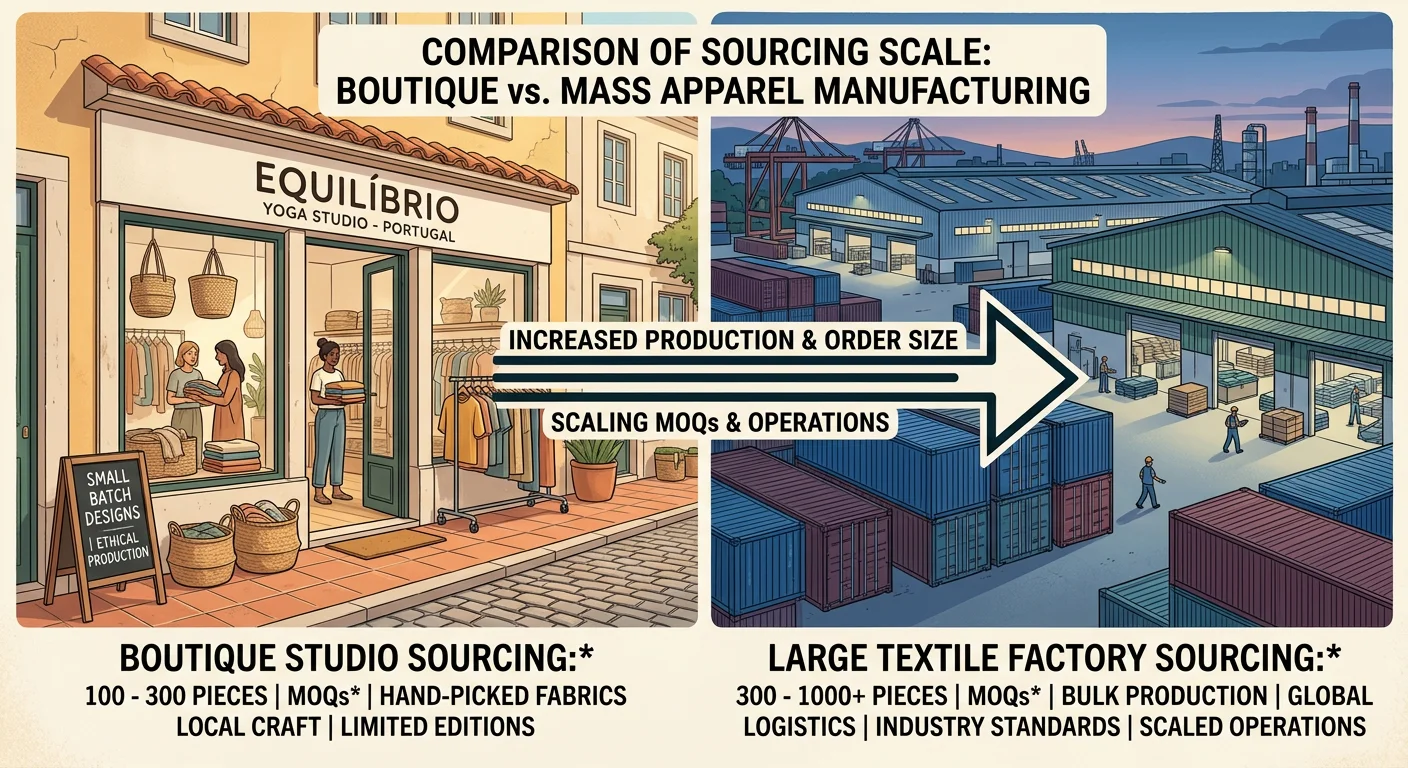
Here's a number that changes the math: Portuguese factories accept 100–300 pieces per style . Most Asian mass-market facilities won't move until you hit 300–1,000+.
That one difference reshapes the entire sourcing decision for a boutique yoga studio. And it's just the starting point.
Don't default to Asia because the FOB looks cheaper — run the full comparison first. Lower unit cost is real. But it's one variable in a five-factor equation.
The Side-by-Side Benchmark
Metric | Portugal | Asia (mass-market benchmark) |
|---|---|---|
MOQ / style | 100–300 pcs | 300–1,000+ pcs |
Sampling lead time | 2–6 weeks | 3–8 weeks |
Bulk production | 4–10 weeks | 6–16 weeks |
FOB price positioning | €18–€60/unit | Lower unit cost at scale |
Freight to EU | 1–4 days by truck | 4–6 weeks by ocean |
Intra-EU customs | None | Duties + broker + DDP complexity |
Compliance friction | Lower — EU traceability built in | Third-party audits, chemical testing, corrective follow-up |
The freight number matters more than it looks. A 6-week faster bulk cycle cuts your need for early-season inventory financing. It reduces markdown exposure on trend-sensitive drops. You also commit to orders later in the buying window. That's a cash conversion gain — not a soft benefit.
Where Portugal Wins on Margin Stability
Portuguese factories run at a premium — €18–€60 FOB, depending on fabric and construction. Premium brands target a 2.5x–4x retail markup on landed cost for DTC and selective wholesale yoga apparel. At that margin structure, "Made in Portugal" pays for itself through three mechanisms:
Lower deadstock rates : Small-batch production means fewer unsold units sitting in storage
Reduced markdown frequency : Premium positioning holds price integrity longer
Faster reorder cycles : 1–4 day EU trucking means you replenish what sells instead of guessing what will
The decision rule is straightforward. Portugal wins when gross margin stability matters more than the lowest landed cost per unit.
The 3-of-5 Decision Framework
Source from Portugal when at least 3 of these are true:
SKU demand is uncertain or strongly seasonal
You need sub-300 MOQ or frequent colorway refreshes
Speed to market outweighs FOB savings
EU-origin, sustainability, or recycled-content traceability is part of your brand story
Markdown risk is a bigger threat than unit-cost pressure
Source from Asia when at least 3 of these are true:
The style is a stable, high-volume basic
MOQ can support 1,000+ pieces per style without strain
The category is price-sensitive with thin retail margins
Lead time is long enough to absorb ocean freight without disrupting launch windows
Your brand already has QA and compliance infrastructure in place
One more factor that almost never shows up in sourcing spreadsheets: time zone alignment . Portugal sits within 0–2 hours of most Western European buyers. You get same-day fit call approvals, faster tech pack clarifications, and fewer revision cycles. That cuts development calendar slippage — which is hard to put a number on, but easy to feel when a launch is running late.
Selling into EU retail accounts? Claiming recycled content? Need OEKO-TEX and GRS documentation for wholesale compliance packs? Portuguese yoga wear suppliers strip out the extra audit layers and documentation overhead that Asian sourcing adds. That's a real compliance cost reduction — not a soft preference.
The bottom line: compare landed cost + duty + freight + delay buffer + compliance overhead — not FOB alone. Do that, and the Portugal premium shrinks fast.
Tiered Supplier Matching by Studio Scale & Budget
Three studio types walk into the Portuguese textile corridor. They all want custom yoga tops. Each one needs something different.
Most buyers make one big mistake — they treat supplier selection as a single universal decision. It isn't. A 12-person studio in Amsterdam testing its first branded crop top shares nothing in common — sourcing-wise — with a 15-location chain running seasonal drops across DTC and wholesale. Use the same yoga apparel supplier shortlist for both, and you'll either over-commit on MOQ or fall short on capability.
Here's how to match your stage to the right gym wear factory. No second-guessing.
Tier A — Startup & Micro Studios
Profile : Under 200 pcs per style. Initial budget under US$15k. First or second branded collection.
A typical micro-studio launch breaks down like this: 80–180 pieces total, split across 2–3 styles (bra, crop top, maybe a tank), 2–3 colorways, target landed cost of US$18–35 per piece, boutique retail price of US$60–110.
Two paths worth considering at this stage:
Path 1 — Speed and low commitment first : Yogavendor-type private label platforms accept 100 pcs per style. They allow color splits as small as 10–20 pcs per colorway. Stock-body orders with heat-transfer branding turn around in 2–3 weeks from artwork approval. Branded sports bras and crops run US$12–20 FOB at around 100 pieces. Yoga tanks land at US$10–18 FOB . Logo plate setup fees run US$30–70 per plate — low enough that testing two colorways before committing doesn't sting.
This path works best when speed and capital efficiency matter more than deep sustainability credentials.
Path 2 — Premium positioning from day one : Your retail price targets US$100+. Your studio is built around a luxury-first identity. A small pilot with a Portuguese technical house like Petratex changes the math entirely. Budget US$10–15k and you can run 250–400 pieces across 1–2 high-performance styles with bonded seams, engineered compression zones, and a real "made in Portugal" provenance story. FOB pricing runs €18–30/pc for performance yoga tops at 200–300 pieces — more per unit, but the brand positioning premium earns that back through margin integrity.
Tier A decision rule:
- Budget under US$10k, need fewer than 150 pcs total → private-label platform
- Budget US$10–15k, want immediate technical prestige → negotiate a Petratex pilot
Tier B — Growth Studios & Regional Boutiques
Profile : 200–500 pcs per style. Seasonal buy of 600–1,500 pcs. Budget US$20–60k per season.
Growth-stage studios face a different set of problems. MOQ is no longer the constraint. The real pressure sits in three areas: EU compliance documentation, consistent fit grading across reorders, and a sustainability narrative that holds up when a wholesale buyer of yoga tops asks for certification paperwork.
Two Portuguese yoga apparel suppliers are built for exactly this stage:
Tintex Textiles operates as a fabric mill. They offer GOTS-certified organic cotton and recycled fiber jersey, bluesign-approved materials, plus advanced moisture-management and anti-odour finishing with a reduced chemical footprint. The smart Tier B move: lock in one core Tintex fabric across several yoga top styles, then place CMT production with a Tintex-linked factory at 200–500 pcs per style. You get consistent technical knit behavior across your full line, plus a fabric-level sustainability story backed by real documentation.
Valérius 360 takes a different angle — end-to-end vertical, from recycling hub to finished garment, all within Northern Portugal. GOTS, GRS, RCS, and OEKO-TEX certifications cover group operations. A clean seasonal program for a boutique studio looks like this: 3 yoga top styles × 250 pcs × 2 colors = 1,500 pieces total. The integrated structure handles traceability documentation for EU compliance packs and keeps fit consistency tight across repeat orders.
Tier B decision rule:
- Priority is fabric innovation and eco-certification → lead with Tintex, use their CMT network
- Priority is traceable EU manufacturing with simpler sourcing logistics → Valérius 360 as one-stop
Tier C — Established Chains & Luxury Athleisure Labels
Profile : 500–1,500 pcs per style. 4–8 styles per season. Seasonal buy of 5,000–20,000 pcs. Budget US$100k+.
At this scale, the conversation shifts. You're not validating a concept — you're running a supply chain. The key questions now center on dedicated line capacity, multi-drop delivery aligned with retail calendars, and whether your yoga tops manufacturer can co-develop signature fabrics that competitors can't replicate.
Calvelex delivers high-precision pattern cutting and premium finishing that supports retail price points of US$150–250+. Luxury athleisure tops run €25–45 FOB at 500–1,000 pieces. Clients who commit more than 5,000 pieces per season get dedicated production engineering and line management — which matters when a missed delivery window costs you a wholesale account.
Valérius 360 scales into Tier C by adding seasonal capacity planning, multi-drop delivery structures, and co-created recycled-input fabrics. A standard chain program runs 4–6 tops × 600–1,000 pcs × 3 colors — that's 7,200–18,000 pieces per season. The edge over pure tailoring houses: you keep the circular sustainability story alongside the premium handfeel. Both sit in the same supply chain.
Tier C decision rule:
- Priority is luxury finish and prestige manufacturing halo → Calvelex
- Priority is premium handfeel plus circular traceability at chain scale → Valérius 360 with dedicated program
The tier framework doesn't lock you in for good. Studios that start with a private-label pilot at 80 pieces and hit their sell-through targets often move to a Portuguese technical partner within 18 months. Build the sourcing relationship that fits now — and keep a clear view of where you're heading next.
Zero-to-Production Checklist: Sampling, QC & Logistics
Nine steps stand between a tech pack and a delivered carton. Skip one, and you're chasing a factory for corrective action — or explaining to customers why the crop top they ordered runs two sizes small.
Here's the full sequence — built for boutique yoga studios placing their first or second custom order with a Portuguese yoga tops manufacturer.
The Sequence, Gate by Gate
1. Lock your order parameters before anything moves
List style, color, fabric, and size ratio as separate line items on your PO. Confirm whether mix-and-match across colorways counts toward your MOQ. For custom cut-and-sew knits, plan on 100–300 pcs per style per colorway as your working baseline.
2. Collect compliance documents before tech pack handoff
Ask for OEKO-TEX , GRS , and a REACH compliance declaration upfront. Attach these to your PO — not a follow-up email six weeks later. This step is non-negotiable for EU market positioning.
3. Run the full sample sequence — don't skip stages
Digital mockup / artwork proof
Proto sample
Fit sample (on a live or 3D model)
Wash test + wear test
PP sample approval
Bulk PO release
Your first sample lands in 2–6 weeks , based on fabric sourcing and trim development. At this stage, lock down every trim detail: woven labels, silicone heat transfers, care labels, fiber content, country-of-origin marking, and custom hangtags.
4. Lock size grading before bulk cutting
Graded specs need body measurements, garment tolerances, seam allowance, and shrinkage allowance — all approved before cutting starts. For performance fabrics, add a 30-wash colorfastness gate , a pilling resistance requirement, and shrinkage limits right into the spec sheet.
5. Inspect in-line — three checkpoints, not one
20% completion : catch cutting, stitching, and trim issues at the start
50% completion : check size consistency and repeated workmanship defects
90% completion : confirm finish, labeling, packing, and carton marking
Run AQL 2.5 as your standard visual inspection benchmark. Set critical defects to zero tolerance — wrong fiber content, needle contamination, mislabeling. Any checkpoint that triggers a defect overrun? Issue a stop-ship. Get a written root cause analysis before production moves forward.
6. Run a pre-shipment audit for any order over 300 pcs
Use a pre-shipment video inspection or a third-party audit report. Check carton labels, master carton count, PO item count, packing list accuracy, commercial invoice, HS code, country-of-origin marking. Add EU customs documents for any shipment going into Europe.
7. Set post-delivery defect terms in writing
Set a 7–30 day defect return window after receipt. A clear threshold works best: <2% defect rate for full acceptance and replacement eligibility. After each drop, run a quick post-mortem — top three defects, lot numbers, corrective actions, and an updated spec sheet for the next run. Reorder discounts of 3–10% are standard negotiating leverage once the first cycle wraps without issues.
Conclusion
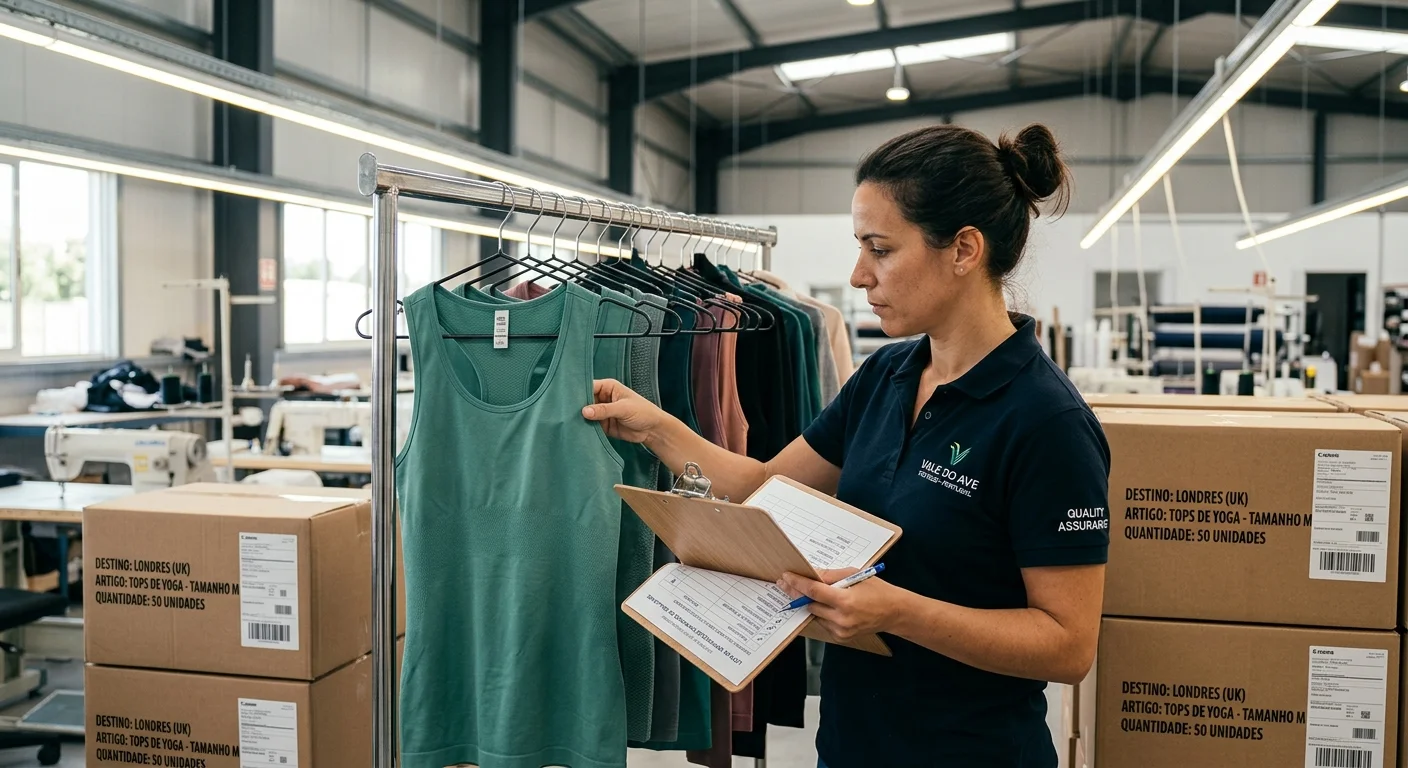
Portugal isn't just a sourcing alternative — it's a strategic decision that pays off over time.
The manufacturers in this guide aren't interchangeable. Valérius 360 solves a different problem than Petratex. But they share one thing: a manufacturing culture built on precision, sustainable fabric innovation, and a real willingness to grow with boutique brands. Most Asian factories can't offer that at low MOQ levels — it's not how their model works.
Your yoga studio is ready to build something that lasts beyond one season? European activewear production through Portugal gives you the quality foundation and brand story that justifies premium pricing of yoga top to your clients. That's the real takeaway here.
Don't shortlist six yoga apparel suppliers. Pick two that match your scale. Request samples this week. Then run the ROI numbers against your current apparel margins.
The studios winning on branded merchandise right now didn't stumble onto a perfect yoga tops manufacturer. They started the conversation earlier than everyone else. That's the only edge that matters.
That conversation starts today.