Your Turkish yoga apparel factory shortlist has been sitting in a spreadsheet for weeks — and you still haven't pulled the trigger. Maybe the 60-day China lead time broke your last product launch. Maybe a Brussels compliance officer flagged your current yoga apparel supplier's REACH documentation. Either way, you're here because nearshore sourcing for European activewear brands is no longer a strategic experiment — it's a survival move.
Turkey sits five to ten shipping days from your EU warehouse. It operates inside a customs union that cuts import duties to zero. It also hosts a cluster of Supplex-Lycra textile mills that supply some of Europe's most recognizable leggings labels.
But knowing Turkey exists as an option gets you nowhere without knowing how to act on it. You need costs to the cent. You need factories worth auditing. You need contracts that protect your MOQ flexibility. And you need a week-by-week roadmap that gets your first private label yoga leggings shipment moving in six to eight weeks. That's what this guide delivers.
Quantifiable Per-Unit Cost Model: Turkey vs. China vs. Portugal

Here's the uncomfortable truth most sourcing guides won't tell you: China's price advantage on yoga leggings is real. But by the time your goods clear Rotterdam customs, that gap is nearly gone.
The numbers below are built for performance leggings in Supplex/Lycra fabric (250–300 gsm) , scaled from audited t-shirt benchmarks. Leggings need 1.6–2.0x the fabric yardage and sewing complexity of a basic knit tee. The figures reflect that reality.
The Ex-Works Starting Point
Before a single pair leaves the yoga apparel factory, here's what you're paying per unit:
Cost Layer (per pair) | Turkey | China | Portugal |
|---|---|---|---|
Fabric (Supplex/Lycra) | $4.20–$5.60 | $3.00–$4.20 | $6.50–$8.20 |
CMT (cut, make, trim) | $3.20–$4.60 | $2.30–$3.60 | $5.00–$7.20 |
Trims & packaging | $0.55–$0.85 | $0.45–$0.65 | $0.75–$1.10 |
Ex-Works total | $7.95–$11.05 | $5.75–$8.45 | $12.25–$16.50 |
China looks cheaper. Of course it does. But ex-works is where the comparison starts , not where it ends.
The Landed Cost at Your EU Warehouse
This number is what drives your margin model:
Cost Layer (per pair) | Turkey | China | Portugal |
|---|---|---|---|
Freight to EU (per unit) | $0.80–$1.30 | $2.50–$4.00 | $0.30–$0.60 |
EU Import Duty | 0% (Customs Union) | 10.5–12% of customs value | 0% (intra-EU) |
QC/inspection (amortised) | $0.30–$0.50 | $0.60–$1.00 | $0.20–$0.35 |
Indicative Landed Cost | $9.05–$12.85 | $9.00–$14.20 | $12.75–$17.45 |
Typical MOQ (OEM sportswear) | 200–800 pcs/style | 500–1,500 pcs/style | 150–400 pcs/style |
At a 300-unit order — the real-world scale for most emerging European activewear brands — Turkey is the most cost-efficient mid-tier option. China's raw CMT discount starts at 30–50%. Add EU duties, sea freight, QC travel costs, and 12–16 weeks of tied-up working capital. That discount shrinks to 18–25% .
Portugal sits at the premium tier. The EU-made label is worth paying for — if your brand story needs it. At $12.75–$17.45 landed, that's exactly what you're buying.
The Hidden Cost China Defenders Always Skip
Lead time is a balance sheet issue, not just a planning inconvenience.
Turkey's production and transit window runs 5–8 weeks. China's runs 12–16 weeks. That's two fewer months your cash stays locked up per cycle. For a brand ordering €30,000 of stock, that's a real working capital difference. Use that money for your next collection sample run or your Meta ad budget instead.
Freight savings add up too. Turkey–EU road and short-sea shipping runs 40–60% cheaper than China sea freight on small top-up orders. For fast-moving SKUs you need to replenish quickly, it runs 65–75% cheaper than air freight .
The bottom line: Turkish private label yoga leggings and Chinese-made alternatives hit near-identical landed costs at the 300-unit scale . Turkey wins on speed, duty savings, and a more stable supply chain.
Strategic Hub Selection: Matching Production Centers to Your Volume & Fabric Needs
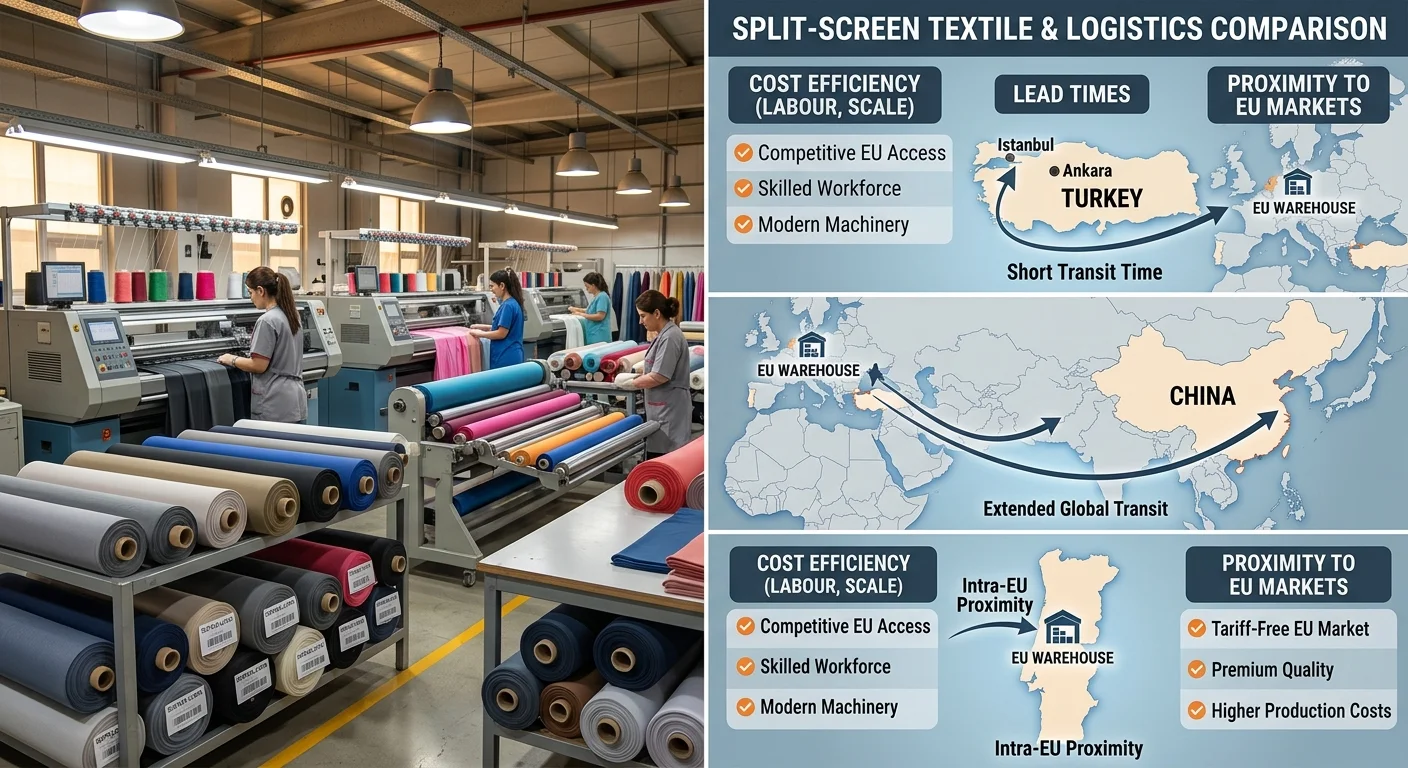
Turkey is not one sourcing market. It's three distinct production ecosystems — and picking the wrong one will cost you more than a bad MOQ negotiation.
Here's how they stack up:
Istanbul: Speed and Flexibility First
Start here when you're testing the market. The Merter, Güngören, and Beylikdüzü districts hold 350+ garment factories built for fast sampling, low minimums, and complex paneling — the core needs of emerging European activewear brands.
The numbers that matter:
- MOQ: 100–300 pcs/style/color
- First sample turnaround: 5–10 days (with fabric on hand)
- Bulk production: 4–7 weeks for programs under 10,000 units
Factories here run on EU buyer relationships. Most operate bilingual export desks in English, German, or French. Many have Gerber or Lectra CAD rooms on-site. Need 5–12-panel color blocking or digital sublimation prints? Istanbul's partner print house network handles it without adding weeks to your timeline.
Best for: Brand launches of 10–40 SKUs, influencer capsule drops, trend-reactive programs on 4–8 week calendars.
Denizli: Sustainability and Stable Repeats
Core SKUs validated? Denizli is where you lock in your fabric program. Turkey's yarn-to-finished-garment production runs out of single OIZ campuses here — that's standard practice, not a premium feature.
Around 60% of Denizli knitting yoga apparel manufacturers hold OEKO-TEX Standard 100 or STeP certifications on EU-bound production lines. Building toward GRS-certified rPET leggings? Need solid colorfastness documentation for REACH compliance? No other region in Turkey matches the infrastructure here.
The numbers that matter:
- MOQ: 300–800 pcs/style/color (1,000+ preferred for custom yarn-dyed programs)
- Lab dip approval: 5–10 days
- Bulk production: 6–9 weeks at 10,000–100,000 units once specs are locked
Best for: Sustainable activewear lines with stable seasonal repeats, brands that need shade continuity across multiple production runs, programs requiring in-house bulk testing for pilling and colorfastness.
Bursa: Technical Performance at Scale
Ready to move past basic cut-and-sew? Bursa is the answer. The Nilüfer OIZ cluster focuses on compression knits, 4-way stretch structures, and functional finishes — moisture-wicking, anti-odor, power-net panels. These are the specs that separate real performance leggings from the rest.
The numbers that matter:
- MOQ: 200–600 pcs/style/color
- Technical capabilities: Flatlock seams, bonded seams, compression knitting, documented stretch and recovery testing
Best for: Brands upgrading from basic yoga-pant suppliers, HIIT and running tights with measurable performance specs, mid-volume scaling between 1,000 and 20,000 units per style.
The Matching Framework: One Decision, Not Three
Your Priority | Right Hub |
|---|---|
High SKU count, low volume, complex prints | Istanbul |
Sustainability credentials, stable core program | Denizli |
Performance specs, technical knit, growing volume | Bursa |
One rule holds across all three: prioritize factories with a knitting or dye house within 50 km of the sewing plant. Close vertical proximity cuts sampling coordination by 4–6 days. It also removes the shade-mismatch risk that kills bulk approvals. In Denizli and Bursa, OIZ infrastructure makes this the default setup. In Istanbul, ask directly about preferred knitting partners in Tekirdağ or Çerkezköy.
Factory Verification Protocol: Audit Checklists, Certifications & Trading Company Red Flags
Three out of every ten Turkish "factories" on B2B directories are trading companies. That's not a cynical estimate — it's what buyers find again and again after doing real verification work. The good news: you can spot the signals before booking a flight or wiring a deposit.
Here's how to screen, verify, and audit your Turkish yoga leggings manufacturer — from the first email to pre-production approval.
The Certification Stack You Must Demand Upfront
Don't wait until price negotiations to ask for compliance documents. Request them on your first formal inquiry. A factory that hesitates? That hesitation is your data.
OEKO-TEX Standard 100 (Class II)
This one is non-negotiable for skin-contact activewear. Get the certificate PDF and check these points:
Confirm a recognized OEKO-TEX member institute issued it — Hohenstein and TESTEX are the benchmarks
Check that the Article/Material field lists "leggings," "sportswear," or "next-to-skin apparel" under Class II
Match the legal company name and address on the certificate to the factory's real registration — not a trading entity name
Look up the certificate number on the OEKO-TEX public database at oeko-tex.com. Certificates are valid for 12 months. An expired one tells you the factory stopped paying attention at some point — and that tells you something important
GRS (Global Recycled Standard) — for rPET and recycled nylon programs
Building an eco-story around recycled Supplex or recycled nylon blends? You need two documents — not one:
Scope Certificate (SC): confirms the factory site is certified. It lists which processes are covered (knitting, dyeing, sewing) and which product categories
Transaction Certificates (TCs): order-level proof that recycled inputs were used and traceable to a certified spinner or mill
One GRS threshold worth knowing: a product needs ≥20% recycled content to qualify as a GRS product, and ≥50% to carry the GRS label. Push your factory to provide the yoga fabric supplier's Scope Certificate too. No Scope Certificate from the supplier? The chain breaks right there.
BSCI (amfori) or SMETA 4-Pillar Audit Report
Ask for the full audit report plus the Corrective Action Plan (CAP) — not just the summary rating.
For amfori BSCI, target an A–C overall rating . A D or E rating means the factory has documented labor or safety violations. Key sections to go through: working hours, wage records, social insurance coverage, fire safety protocols, and chemical storage procedures.
For SMETA, check four things: audit date (must be under 18 months old), auditor identity (SGS, Intertek, or TÜV carry real weight), whether the audit was unannounced or semi-announced, and whether all four pillars — Labour, Health & Safety, Environment, and Business Ethics — are covered. A factory that shows you only the Labour section is hiding something.
REACH Declaration + Chemical Test Reports
Request a signed REACH declaration covering two things: compliance with Annex XVII restricted substances (azo dyes, nickel, certain phthalates), and an SVHC statement confirming no candidate list substances exceed 0.1% w/w per article .
A signed declaration alone isn't enough. Also ask for recent chemical test reports from an accredited third-party lab — SGS, Intertek, or Bureau Veritas. The test panel should cover azo dyes, disperse dyes, formaldehyde, heavy metals (Pb, Cd, Cr VI), PAHs, NP/NPEO, phthalates, and DMF. For factories using dope-dyed or recycled fabrics, add antimony and VOC contamination panels.
5 Signals a "Factory" Is a Trading Company
You don't need a flight to Istanbul to catch these. Every signal here is testable via email and video call.
Signal #1: Email and domain inconsistencies
A real yoga apparel manufacturer owns its domain and uses it for all business email. A primary contact using Gmail, Yahoo, or any free email service is a flag worth investigating. Go further — check when the website domain was registered (WHOIS tools work fine) and whether an individual in a different city or country registered it. Also ask for a factory landline. Trading companies run from offices. They rarely have a number that rings on a production floor.
Signal #2: Resistance to live video walkthroughs
This is your fastest filter. Ask for a live WhatsApp or WeChat video walkthrough at a set time during Turkish working hours (09:00–17:00 TRT). Tell the contact to start at the front gate so you can see the company name on the building. Then walk through the cutting room, sewing lines, and packing area.
A pre-recorded video with no visible date and no real-time interaction is a broker's stock footage library — nothing more. Real factories welcome this call. It's their chance to show you what they've built.
Signal #3: Slow sampling with vague explanations
A Turkish factory with in-house cutting and sewing capability delivers a first-fit sample for a basic leggings pattern in 3–7 days from in-stock fabric. Hearing timelines longer than 14 days? Phrases like "waiting for partner workshop" or "we must book factory slot"? You're being subcontracted to a jobbing workshop — possibly in another city entirely.
Signal #4: Inability to answer technical capacity questions
Put these questions to them directly. A real factory answers within 24–48 hours:
What sewing machine brands are on your floor? (Juki, Brother, Pegasus are standard references)
What needle gauge do you run for circular knitting? (Legitimate answers: 24G, 28G, 32G)
What's your daily output per sewing line for leggings? (Benchmark: 300–600 pcs/line/day depending on style)
Vague answers — "many machines," "big capacity," "we can handle any quantity" — are not answers. They're the absence of answers. The person on the other end has never stood on a production floor.
Signal #5: A suspiciously broad product catalog
No single factory credibly produces leggings, tailored wool coats, woven dress shirts, denim, and home textiles under one roof at competitive prices. See a catalog spanning unrelated categories? Ask for HS codes from recent shipping documents. HS codes jumping across very different classifications — with no clear explanation of separate production plants or disclosed subcontractors — means you're dealing with a trader who buys from wherever the order takes them.
The On-Site Audit Checklist: What to Verify Before PPO Approval
Visiting in person or running a remote audit through a third-party inspection service — either way, these checkpoints matter for custom yoga leggings manufacturing at mid-volume scale.
Factory Identity Verification
Match the factory's GPS coordinates (grab them via Google Maps pin) against the business registration address from the Turkish Trade Registry Gazette extract
Cross-reference the Vergi No (Tax ID) with the legal entity name on all certification documents
Photograph the front gate, company name board, and the nearest street sign — date-stamp every photo
Equipment and Production Capacity
Count what's running, not what's listed in a brochure:
Circular knitting machines: number of units, diameter (30″–34″ is standard for leggings), gauge (24G or 28G for standard performance fabric), and brand (Mayer & Cie and Terrot are industry references)
Seamless knitting: number of Santoni or Lonati machines — this determines your seamless leggings options
Sewing floor: total operators and machine types (overlock, flatlock, coverstitch, bartack, waistband elastic). Ask for a floor layout showing how many lines are dedicated to sportswear versus other product categories
Quality Control Infrastructure
Target a QC inspector ratio of at least 1 inspector per 15 sewing operators — that's the mid-market sportswear benchmark
Pull the last 3 months of inline and end-line inspection records. Check AQL levels (2.5 major / 4.0 minor is standard), rework rates (healthy benchmark: under 5% ), and final rejection rates ( under 1% for stable, repeating styles)
Confirm the final inspection area is separated from the packing station, with proper lighting (target ≥1,000 lux) and real inspection tables — not a cleared section of floor
Testing and Calibration
Ask for calibration logs covering fabric tension and GSM testers, seam strength and tensile machines, and the washing/tumble dryers used for shrinkage tests. Calibration should happen every 12 months through an ISO 17025-accredited service provider.
Also confirm the factory holds an active account with an independent chemical lab — SGS, Intertek, Bureau Veritas, UL, or TÜV. Request two to three recent test reports for similar sportswear products. Those reports show you whether the factory runs real compliance testing or just signs paperwork.
Material Traceability
Ask for a redacted Tier-1 fabric supplier invoice from a recent yoga-wear production run. It should show: supplier name, fabric article number, fiber composition (e.g., 78% recycled PA / 22% elastane), and purchase quantity. Use it to confirm the yoga apparel supplier is a credible Turkish, EU, or established Asian mill. Cross-check their GRS or OEKO-TEX certification numbers if recycled or eco-fiber claims are involved.
Also review material receiving records: batch numbers, shade lots, and incoming inspection entries for GSM, color consistency, and defect rates.
Social and Environmental Compliance
Cross-check the timekeeping system (card scanner or digital attendance) against payroll records for at least one to two months
For factories running in-house dyeing or printing, walk the chemical storage area. MSDS sheets should be posted, secondary containment should be visible, and ventilation systems should be running
Ask for waste management contracts covering dyehouse effluent and sludge disposal — this applies to wet-processing operations and faces growing scrutiny under EU due diligence frameworks
The Green Flag Profile: What a Trustworthy Turkish Factory Looks Like
After running the red-flag filters and the audit checklist, you'll know what to rule out. Here's what the right partner looks like.
Technical and Lab Capability
The factory runs an in-house dyeing lab with a digital spectrophotometer. Lab dips come back in 3–5 days with ΔE values included. They run their own colorfastness tests — washing, perspiration, rubbing, light — plus pilling and snagging tests in-house. Shade approval sign-offs from EU or US clients are on file.
Export and Compliance Maturity
There's a dedicated EU export or compliance officer. This person manages REACH documentation, renews OEKO-TEX and GRS certifications, and handles Movement Certificates (ATR/EUR.1) for EU customs clearance. They maintain full technical files — not just a folder of scanned PDFs — with test reports, risk assessments, and labeling specs by market.
The factory shows up under its own legal name in the amfori, Sedex, OEKO-TEX, or GRS public databases . Can't find them there on your own? The certifications on their letterhead carry less weight than they appear to.
Capacity Transparency
The right partner gives you clear numbers: "8 sewing lines, 120,000 pcs/month for leggings and yoga sets; typical MOQ 500–1,000 pcs per colorway." They confirm no single client takes up more than 20% of total sewing floor capacity — that structure keeps you from getting pushed aside when a larger buyer places a rush order.
They'll also share selected client references — brand names masked if under NDA — plus anonymized KPIs on on-time delivery and defect rates from those relationships.
Factories that pass this protocol do exist in Turkey. They're not what you'll find most of on Alibaba or industry directories. They're concentrated in specific hubs, and the sourcing community that works with them is smaller than it looks. This protocol is how you reach that group — and stay out of the expensive verification failures that set new buyers back by four to six months.
6–8 Week Nearshore Procurement Roadmap: From First Inquiry to EU Warehouse Delivery
Six weeks from today, your first Turkish-made yoga leggings could be sitting in your EU warehouse. Here's how to make that happen.
This roadmap breaks the process into four phases. Each phase has a hard deadline. Miss one by more than two to three days and the entire eight-week window stretches into ten or twelve. Stay on track and you'll move faster than most brands do on their first China sourcing cycle — with far less capital tied up.
Week 1–2: Lock Your Scope, Build Your RFQ Package, and Shortlist Factories
Before you send a single email to a Turkish factory, define three things:
What you're sourcing: Stick to 2–3 legging styles for your first run. Target volumes of 800–1,500 pcs per style. Set a firm EU warehouse in-date for Week 8 — not "end of the month," a specific date.
What you need from the product: GSM 220–280 in Supplex/nylon-Lycra blend (60–75% nylon, 25–40% elastane). Flatlock seams at 4–5 SPI in high-stretch zones. Brushed interior with moisture-wicking finish. Colorfastness Grade ≥4 for sweat and wash. These specs go straight into your RFQ — not as vague preferences, but as documented acceptance criteria.
Who signs off: Set your RACI before outreach begins. Procurement, Product/Design, QA, Finance, and Legal each need a named decision-maker. Approval bottlenecks inside your own business will kill a tight timeline faster than any factory delay.
Your RFQ package needs four components:
Graded tech pack — size XS–XL, tolerances ±0.5–1.0 cm on key measurement points, with construction sketches and stitching callouts
Fabric specification sheet — fiber content, GSM, knit structure (interlock or double-knit for opacity), finish requirements
Service level requirements — proto within 7–10 days of tech pack receipt, PPS within 7 days of proto comments, bulk cut-to-ship within 15–20 days of PPS sign-off
Compliance requirements — REACH-compliant dyes, OEKO-TEX Standard 100 Class II minimum for skin-contact garments
Send this package to 3–4 shortlisted Turkish OEM sportswear manufacturers — not 10, not 2. Too few and you have nothing to compare. Too many and follow-up management eats your timeline.
Before sharing graded patterns, sign a mutual NDA. It should cover patterns, grading rules, custom prints, and brand identity. Also add a clause that blocks unauthorized subcontracting. This takes one day to complete and protects you for the full length of the relationship.
Request physical fabric swatches at the same time. Turkish Supplex/Lycra mills can courier swatch kits to EU addresses in 3–5 days. Ask for 3–5 fabric options with full spec sheets — GSM, fiber content, shrinkage %, colorfastness data, and Martindale pilling grade. For any legging fabric going into production, target Grade 4–5 at 7,000–10,000 rubs (ISO 12945-2).
Also request stretch and recovery data. You want a minimum of 60–70% stretch and ≥92% recovery in both directions for compression performance. That's a measurable benchmark, not a judgment call.
Week 2–4: Prototyping Cycle — Two Rounds Maximum
By the start of Week 3, your shortlisted factory should be cutting your proto. The standard for Turkish OEM sportswear is 5–10 days from tech pack acceptance to first proto delivery . A factory quoting 14 days or more at this stage is a red flag — escalate or move to your next candidate.
Proto review protocol: Run a size M fit test on your target body block. Check four things — squat-proof opacity, waistband roll behavior, seam comfort on flatlock zones, and gusset coverage. Log every comment using digital annotation on PDF tech packs or CLO snapshots. Vague feedback like "fit feels off" adds revision rounds. Specific feedback like "inseam measures 1.5 cm short at crotch point on size M" gets fixed in one round.
Cap it at two proto revision rounds . A third round means your tech pack had gaps — go back, tighten the specs, then reissue.
Once the proto is approved, your Pre-Production Sample (PPS) follows within 5–7 days . The PPS must use bulk fabric and trims from your nominated Supplex/Lycra quality — no substitute materials. This sample sets your production approval baseline.
Pricing structure to confirm during this phase:
Turkish OEM leggings in Supplex-Lycra GSM 220–260, solid color, at 500–1,000 pcs per color tend to land at 7–12 EUR EXW . Get price validity confirmed for 3–6 months. Add a raw material fluctuation clause: a 10% tolerance band on nylon and elastane cost movements keeps pricing stable without renegotiation on small swings.
Payment terms to confirm at PO stage:
- 30% deposit at purchase order issuance (triggers fabric booking)
- 70% balance after final inspection pass, against copy BL or CMR supported by a third-party QC report
Week 4–6: Fabric Procurement, Cutting, and Inline QC
This phase runs on a tight dependency chain. Break one link and delivery slides out by a week.
Issue your color standards and greige quantities by the end of Week 2 — even before PPS approval. Turkish mills carry greige stock, but dyeing and finishing takes 7–12 days depending on your color count and their production queue. Running color commitment in parallel with prototyping is what keeps this roadmap inside eight weeks. Build in a cancellation clause for the greige allocation in case PPS is rejected — most mills in Denizli and Bursa accept this with a committed buyer.
Before cutting begins, confirm three things:
Shrinkage test (ISO 6330, 3 wash cycles) shows ≤3% dimensional change in both warp and weft
Colorfastness to washing and perspiration (ISO 105) at Grade ≥4
Fabric has rested on cutting tables for 12–24 hours to remove growth distortion
Cutting should start within 2–3 days of bulk fabric QC approval . Any delay here compresses your sewing window.
Inline QC checkpoints to build into your factory agreement:
At 50% sewing completion, your QC contact — factory-side or a third-party inspector — checks:
- Seam alignment on side seams, inseams, and gusset
- Waistband elasticity within ±5–8% of spec at 100% extension
- No needle damage, skipped stitches, or seam strength failures on flatlock zones
- Barcode and hangtag placement per tech pack
Ask for daily production dashboards during this phase — lines output, defects per 100 units, rework percentage. A shared WhatsApp or email report takes ten minutes to produce. You get full visibility without needing to take a flight.
Week 6–7: Final Inspection and Shipment Release
Final inspection runs at AQL 2.5, General Level II. For a lot of 3,200 pcs, that's a sample of around 200 units. The inspection covers workmanship, measurements, color shading across the production batch, logo positioning, seam quality, and packaging compliance.
On packaging: polybag thickness should be 30–40 microns for leggings, with suffocation warnings matching your destination country requirements. Making sustainability claims? Your FSC-certified hangtags and recycled polybag content need Certificates of Conformity on file before the shipment goes out.
Release shipment only after all three conditions are met:
1. AQL inspection passed
2. Shrinkage and colorfastness lab reports on file
3. Labels and barcodes scan-tested and confirmed
Don't release without all three. A passed AQL with missing compliance reports is still a compliance failure at EU customs.
Week 7–8: Transit and EU Warehouse Receipt
Turkey to central EU moves faster than most buyers expect.
Road freight (CMR) from Istanbul or Izmir to Germany, Austria, or Hungary takes 3–5 transit days via the Bulgaria–Romania–Hungary–Austria corridor. For shipments of 8–10 pallets or more, go full truckload. Smaller consignments via LTL add 1–2 days for consolidation.
Short-sea via Ro-Ro or Mediterranean feeder to Italian, Greek, or Spanish ports takes 3–6 days sea transit , with total door-to-door around 10–14 days. Use this route for Iberian or southern EU warehouses.
Customs clearance: Use your EUR.1 or ATR movement certificates to access Turkey-EU Customs Union preferential treatment. Yoga leggings qualify for 0% import duty — confirm this is applied on every shipment, not just assumed. Clear at Rotterdam, Antwerp, Hamburg, Trieste, or Italian ports based on your route.
Warehouse KPI: Book goods receipt and inventory within 24–48 hours of truck or container arrival . Check carton count against the packing list on arrival. Report any discrepancy to the factory within 48 hours — not two weeks later when accountability has gone cold.
The One-Page Timeline Summary
Phase | Key Actions | Deadline |
|---|---|---|
Weeks 1–2 | Internal scoping, RFQ package, factory shortlist, NDA, fabric swatch request | End of Week 2 |
Weeks 2–4 | Proto samples (≤2 rounds), PPS approval, pricing and payment terms confirmed | End of Week 4 |
Weeks 4–6 | Fabric dyeing (run parallel from Week 2), cutting, inline QC, sewing completion | End of Week 6 |
Week 6–7 | Final AQL inspection, shipment release authorization | End of Week 7 |
Weeks 7–8 | Road or short-sea transit, EU customs clearance, warehouse receipt | End of Week 8 |
Every brand that has compressed Turkey sourcing into this window made one key call: they ran fabric procurement in parallel with prototyping instead of waiting for PPS approval first. That single decision saves 10–12 days. The rest comes down to execution discipline.
Contract Structuring & Compliance Execution: EU-Turkey Customs Union & Low-MOQ Frameworks
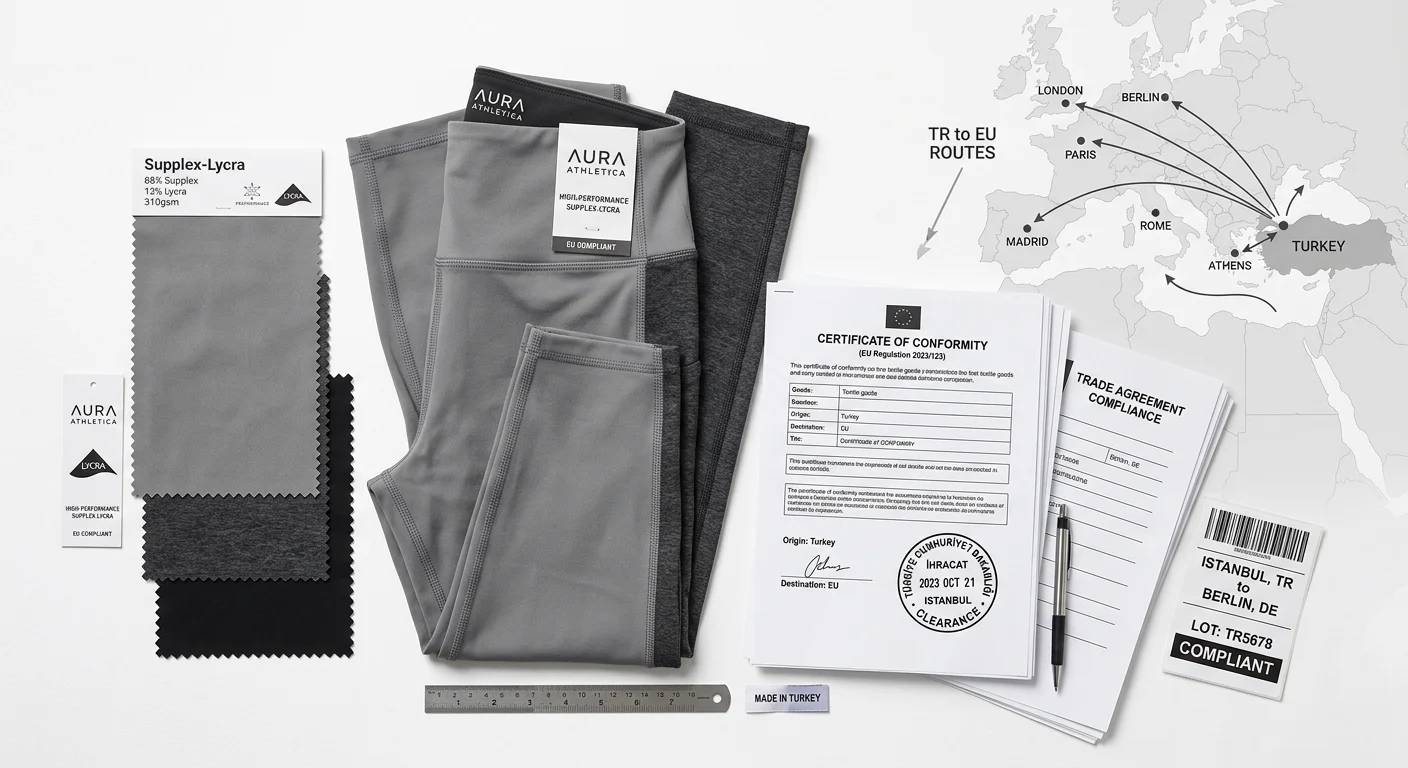
Most European brands lose money on Turkish sourcing not at the factory — but in the contract. The EU–Turkey Customs Union has been running since 1 July 1996 (Decision No 1/95). Zero import duty on activewear is already yours. But capturing it depends on one thing: the paperwork your yoga apparel supplier hands you at shipment.
Here's what that means in practice.
The A.TR Certificate: Your Zero-Duty Insurance Policy
Forget EUR.1. For industrial goods — including yoga leggings under HS 6114.30 — the right customs status proof is the A.TR Movement Certificate . Turkish customs or an authorized chamber of commerce issues it.
The A.TR doesn't prove origin. It proves the goods were in free circulation in Turkey at the time of export. That difference matters a great deal for your contract language.
Build these two clauses in:
"Seller shall provide an original A.TR Movement Certificate prior to each shipment. Any duties arising from an invalid or missing A.TR shall be debited to Seller."
"Goods shall ship from Turkey to [EU warehouse]. Third-country routing requires prior written approval. Seller bears all costs from any resulting loss of Customs Union preferences."
The standard EU MFN duty on HS 61/62 textiles runs around 12% ad valorem . On a €30,000 shipment, that's €3,600 hitting your P&L — all because a certificate was missing. Write the liability in. Goodwill doesn't cover it.
REACH Compliance: Push the Burden Upstream
EU importers carry primary legal responsibility for REACH. Turkish yoga apparel suppliers do not. That gap is why your contract must transfer the full compliance burden upstream through clear, documented obligations.
For skin-contact activewear, your RSL benchmarks are fixed:
Formaldehyde: ≤75 mg/kg (OEKO-TEX Standard 100 Class II)
Azo dye banned amines: <30 mg/kg per EN 14362
Nickel release in metallic trims: ≤0.5 µg/cm²/week
Reference the ECHA SVHC Candidate List tied to the publication date of each purchase order — not a fixed annual snapshot. The list updates twice a year. A static reference protects no one.
Require one third-party lab report per fabric quality per color, per trims family , mapped to a batch/lot number. Suppliers must keep all test records for a minimum of 10 years . EU market surveillance can flag a product at any time. You need documentation ready on demand — not a last-minute search.
Low-MOQ Frameworks That Deliver Results
At 150–500 units per style, Turkish factories can be profitable. The contract structure has to make it work.
Tiered pricing grid (attach as Annex 2 to your Framework Agreement):
Order Quantity | Indicative EXW Price |
|---|---|
150 pcs | ~$11.50/unit |
300 pcs | ~$10.20/unit |
500 pcs | ~$9.40/unit |
Lock in annual price reviews tied to validated yarn indices, with a ±3–5% adjustment cap . This cuts renegotiation friction on every order. Both sides stay protected from material cost swings.
Fabric pooling closes the MOQ gap further. Negotiate a clause that lets your supplier run core base fabrics — black, grey melange, white — in consolidated lots of 1,000–2,000 meters shared across brand orders. You commit to pre-approved base specs. The supplier pulls your dye allocation from pooled greige. The result: lower minimums, faster lead times, and a stable quality baseline.
Add a ±10% size-run variance clause — total PO quantity stays fixed, but the S/M/L/XL split can flex post-cutting without surcharge. For brands testing new markets, this one clause removes the inventory risk that kills new collection launches. It's a small contractual detail with a large practical impact.
Payment Structure and Incoterms Progression
Start with DAP (Delivered at Place) to your EU warehouse. Freight is built in, duty is zero with A.TR, and your landed cost calculation stays clean and auditable. After two to three successful shipments, move to FOB Izmir or Mersin . You gain freight control and can consolidate across multiple Turkish yoga wear suppliers.
On payment: open with an irrevocable LC at sight for the first two shipments. Required documents should include a clean on-board B/L, commercial invoice, packing list, A.TR certificate, and RSL test reports. Once performance is proven, shift to 30% deposit at PO / 70% balance against passed pre-shipment inspection . Add a 5–10% escrow holdback , released 14 days after warehouse receipt — subject to AQL inspection pass and clean customs clearance with no extra duties triggered.
The contract annex structure that keeps all of this running:
Annex 1: Technical specs and size grids
Annex 2: Price and MOQ matrix
Annex 3: RSL testing protocol — limits, frequency, approved labs
Annex 4: Logistics and Incoterms progression (DAP → FOB)
Annex 5: Quality standards — AQL levels, measurement tolerances, shade bands
Get the contract architecture right once. Every order after that runs on a repeatable, auditable system — not a string of one-off negotiations.
Execution Blueprint: Case Study of a Mid-Size European Brand's Turkey-to-EU Supply Chain Launch
A Berlin-based activewear brand had 12 SKUs, a €280,000 annual sourcing budget, and a Guangzhou factory that kept missing delivery windows. In Q1 2023, they made a decision: shift 40% of production to Turkey within one fiscal year.
Eighteen months later, inventory turns moved from 3.2x to 5.1x per year. Returns dropped from 8.5% to under 2%. Lead time from order placement to EU warehouse receipt went from 74 days down to 9.
Here's how they did it — and what you can replicate.
The Starting Point: Define Your EU Service Level First
Most brands start by searching for factories. This brand started from the other end.
They mapped the supply chain backwards — from the EU customer back to the Turkish factory floor. The first target they locked in: 9–10 days door-to-door from Istanbul to Rotterdam, with OTIF ≥94% . Every factory decision, logistics choice, and contract clause after that was built around hitting that one number.
Supply chain consultants call this approach value stream mapping — working backwards from customer service requirements rather than forwards from factory capability. Most sourcing guides skip this step. That's why so many brands end up with cheap factories that keep missing their real business targets.
The brand set three fixed service parameters before doing anything else:
Door-to-door transit: ≤10 days (road freight via Istanbul–Bulgaria–Romania–Hungary–Austria corridor)
OTIF target: 94% minimum across all SKUs
Reorder cycle: every 6–8 weeks, enabling faster inventory turns — compared to the 60–90 day pipeline locked up under the previous China model
Factory evaluation only began after those three requirements were set in stone.
The Factory Selection: Bursa First, Istanbul Second
The brand's core product — compression leggings with moisture-wicking finish — pointed straight toward Bursa's Nilüfer OIZ cluster for technical knit capability. They shortlisted three Bursa factories and two Istanbul factories, then ran the full verification protocol outlined in the previous section.
Two factories passed. One in Bursa handled their technical compression styles. One in Istanbul handled fast-turn capsule drops and seasonal colorways.
The split had a clear purpose. Bursa locked in performance quality and stable repeat production. Istanbul gave them SKU flexibility without pushing Bursa past its capacity.
Both factories also had knitting or dye operations within 50 km of their sewing plants. That proximity cut 4–6 days of inter-factory logistics coordination per development cycle. The brand's product team felt this gain right away during their first sample round.
The Numbers That Justified the Switch
The financial case wasn't clear until the brand built a full landed cost model — not just an ex-works comparison.
At their standard order volume of 300–500 pcs per colorway , the numbers looked like this:
Cost Element | China (Previous) | Turkey (New) |
|---|---|---|
Ex-Works per pair | $6.40 | $9.20 |
Freight to Rotterdam | $3.60 | $1.05 |
EU Import Duty | $0.77 (12.2% MFN) | $0 (Customs Union) |
QC/compliance (amortised) | $0.85 | $0.38 |
Landed cost | $11.62 | $10.63 |
Working capital tied up | 74 days | 11 days |
The $2.80 ex-works gap per unit looked alarming at first. It vanished once freight, duty, and QC costs were added in. Turkey came in at $0.99 cheaper per unit at their actual order scale.
The bigger win: cutting 63 days out of the pipeline freed up around €38,000 in working capital per order cycle . That cash went straight into paid social and influencer seeding for new collection launches. Before this, those activities kept getting pushed back because the money was tied up on a container ship between Shanghai and Rotterdam.
The Compliance Architecture That Made It Scalable
The brand's compliance officer had one goal: build a documentation system that could hold up through a retailer audit, an EU customs check, and a future CSDDD review — all from the same file structure.
Their Turkish factories delivered:
OEKO-TEX Standard 100 (Class II) certificates — checked against the public OEKO-TEX database each new production season
Signed REACH declarations tied to the ECHA SVHC Candidate List for each PO date — not a static annual snapshot
Third-party lab reports (SGS) per fabric quality per color, mapped to batch lot numbers, with 10-year retention written into the supply agreement
A.TR Movement Certificates on every shipment — with a contract clause holding the supplier liable for any duties triggered by a missing or invalid certificate
That last point carries more weight than most brands expect. On a €30,000 shipment, a missing A.TR means €3,660 in unexpected duty hitting your P&L. The brand added the liability clause to their Framework Agreement after their compliance consultant flagged the risk during contract review.
They also set up lot-level digital traceability — fabric roll numbers, dye lot codes, and incoming QC entries logged per batch before production release. The results were measurable: QC pass rates climbed above 97% within two production cycles. Any defect could be traced back to a specific fabric lot within hours, not weeks.
What Changed Inside the Brand
The shift wasn't just about factories. Internal restructuring was needed to capture the gains.
The brand picked a single primary logistics gateway: Rotterdam . All Turkish shipments went through there. One 3PL partner with standardized SOPs replaced the fragmented multi-carrier setup they'd run under China sourcing. Coordination overhead dropped sharply.
They also centralized EU inventory in one DC rather than holding country-level stock. Paired with 6–8 week reorder cycles, this brought total EU inventory days-on-hand down from 94 to 61 — with zero stockouts in the first year.
Before issuing the first Turkish PO, the brand set up a clear internal RACI — Procurement, QA, Finance, and Legal each had a named decision-maker. That structure cut the approval bottlenecks that had added 2–3 weeks to their previous China sourcing cycles at every launch.
The 12-Month Outcome
By Q1 2024 — twelve months after the nearshoring decision — the Turkey supply chain delivered:
Lead time: 74 days → 9 days (88% reduction)
Inventory turns: 3.2x → 5.1x per year
Defect/return rate: 8.5% → 1.9%
Landed cost per unit: $11.62 → $10.63 (net saving of $0.99/unit across ~18,000 units = ~$17,800 annual direct saving )
Working capital freed per cycle: ~€38,000
OTIF performance: 96.3% (vs a 94% target)
None of this happened because Turkey is easier than China. It happened because the brand ran the supply chain launch as a structured execution project. They set clear service targets, used a verified yoga apparel factory selection process, built a compliance system that could scale, and redesigned their internal operating model to capture the nearshoring advantage.
The framework exists. The factories exist. The customs union advantage exists. What turns those inputs into results like these is the discipline to work through each phase — without skipping steps.
Conclusion
The 60-day shipping clock from China isn't just a logistics inconvenience. It's a competitive liability your European competitors are already cutting out.
Turkey doesn't ask you to compromise. The EU-Turkey Customs Union gives you duty-free access. Istanbul, Denizli, and Bursa offer manufacturing infrastructure that matches anything in Guangdong. A 5–10 day lead time gives you something no Chinese yoga apparel supplier ever could — the ability to react to market demand before the trend fades.
You now have the cost model. You have the supplier verification checklist. You have the 6–8 week procurement roadmap built for brands that can't risk a failed first sourcing run.
The one question left is execution.
Start with one factory audit. Run one low-MOQ test order for your private label yoga leggings Turkey launch. Check the numbers against your current supply chain. Then scale what works.
Your nearshore sourcing strategy doesn't need perfect conditions to start. It starts this week.