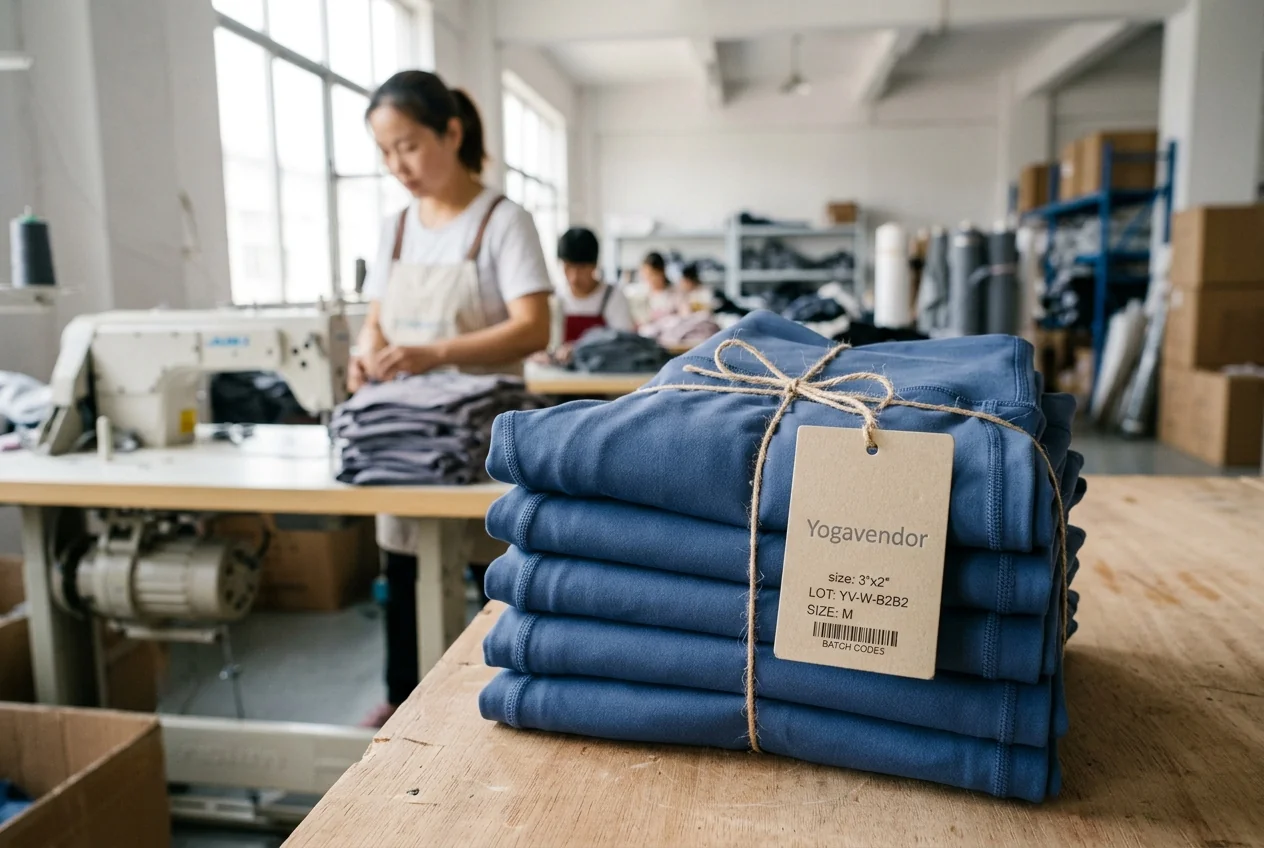
Wholesale yoga leggings that pass the squat test your customer runs in the fitting room.
No rolled-down waistbands. No pilling after 10 washes. No size drift between colorways. Built-in spec discipline — gusseted crotch, flatlock seams, 4-way stretch with 92% elastic recovery. This page reads like a test report on purpose: every squat-proof claim below carries its measurement method.
- Composition
- 82% nylon 18% spandex
- GSM
- 220 gsm (Sport Pro grade)
- Opacity
- Grade A (squat-proof at 150% stretch)
- Sizes
- XS–3XL / 3 inseam lengths
- Fabric test reports on request
- BSCI Audited
- ISO 9001:2015
- Send the leggings you're benchmarked against — we squat-test ours on camera
Fabric Grade Benchmark — GSM, Composition, Stretch, Opacity, Measured Side by Side
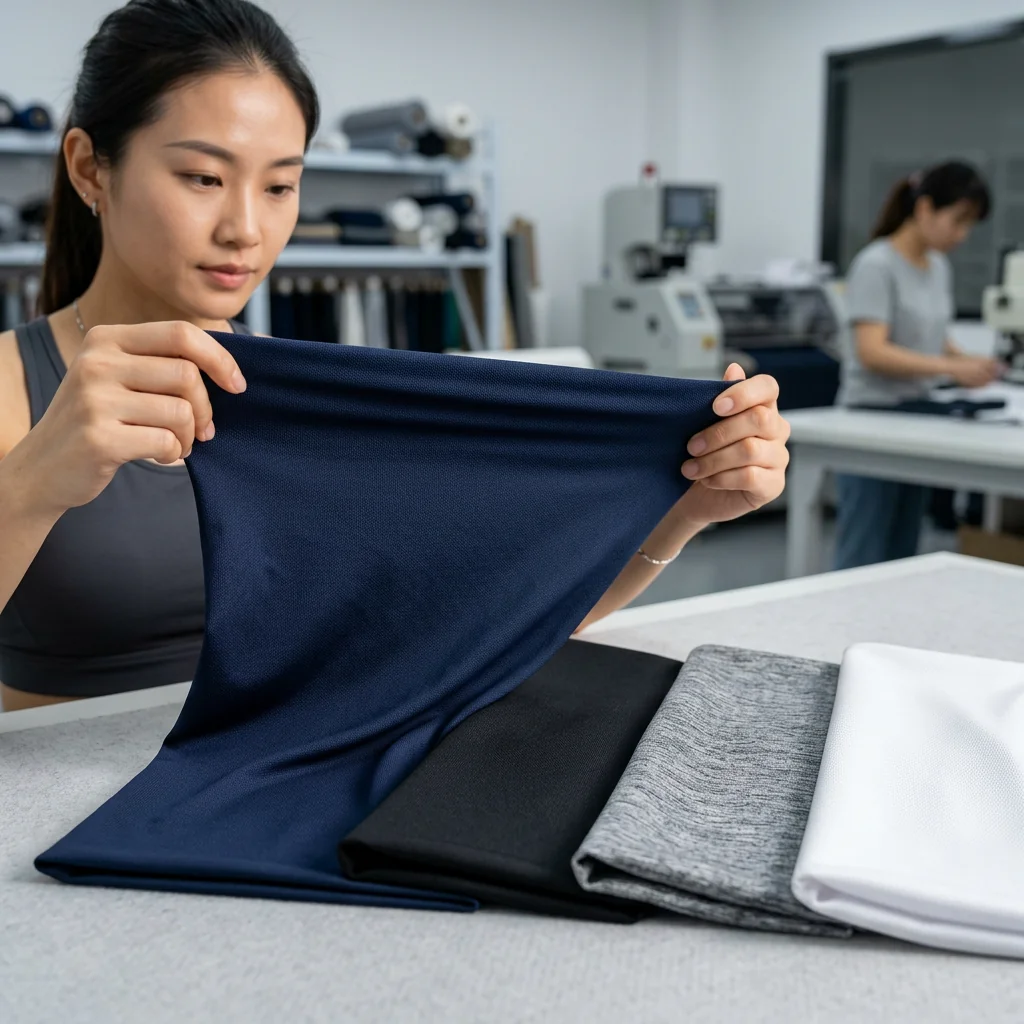
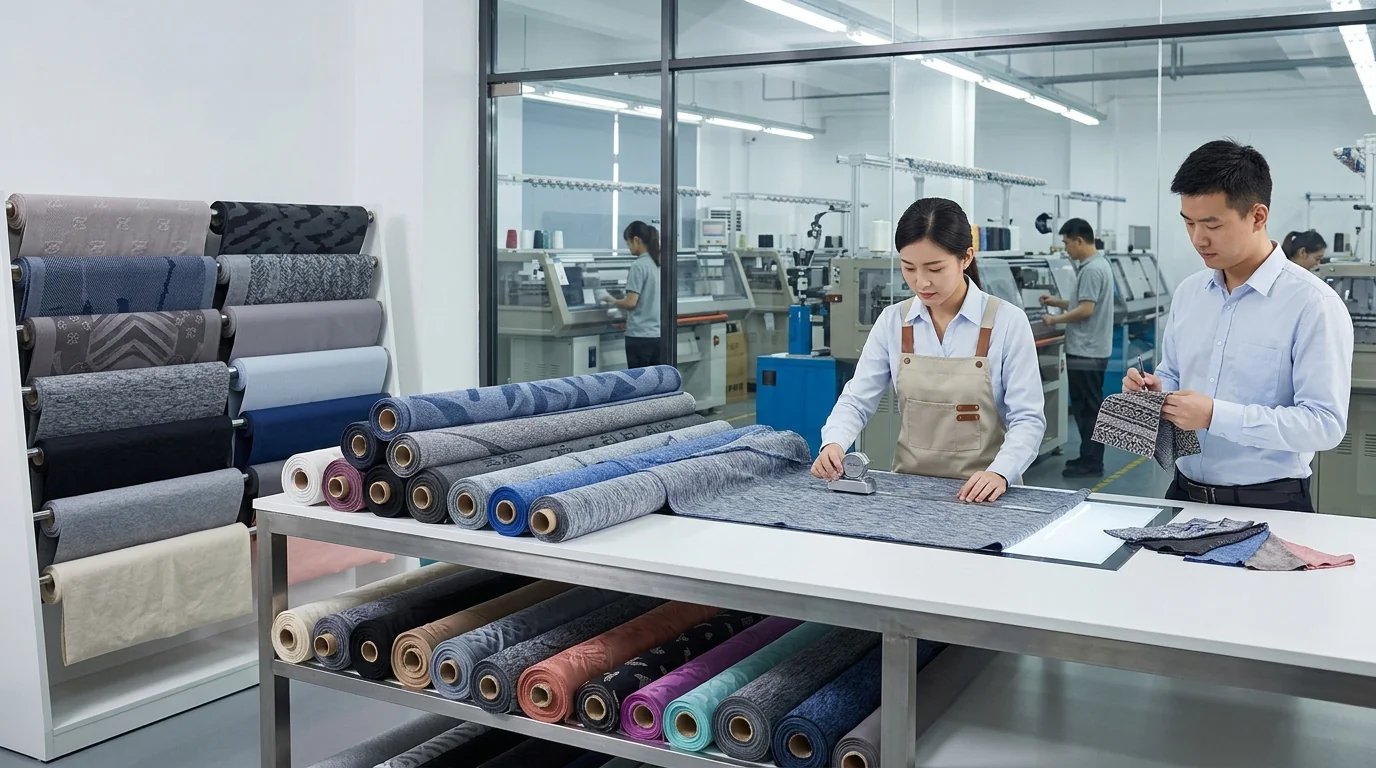
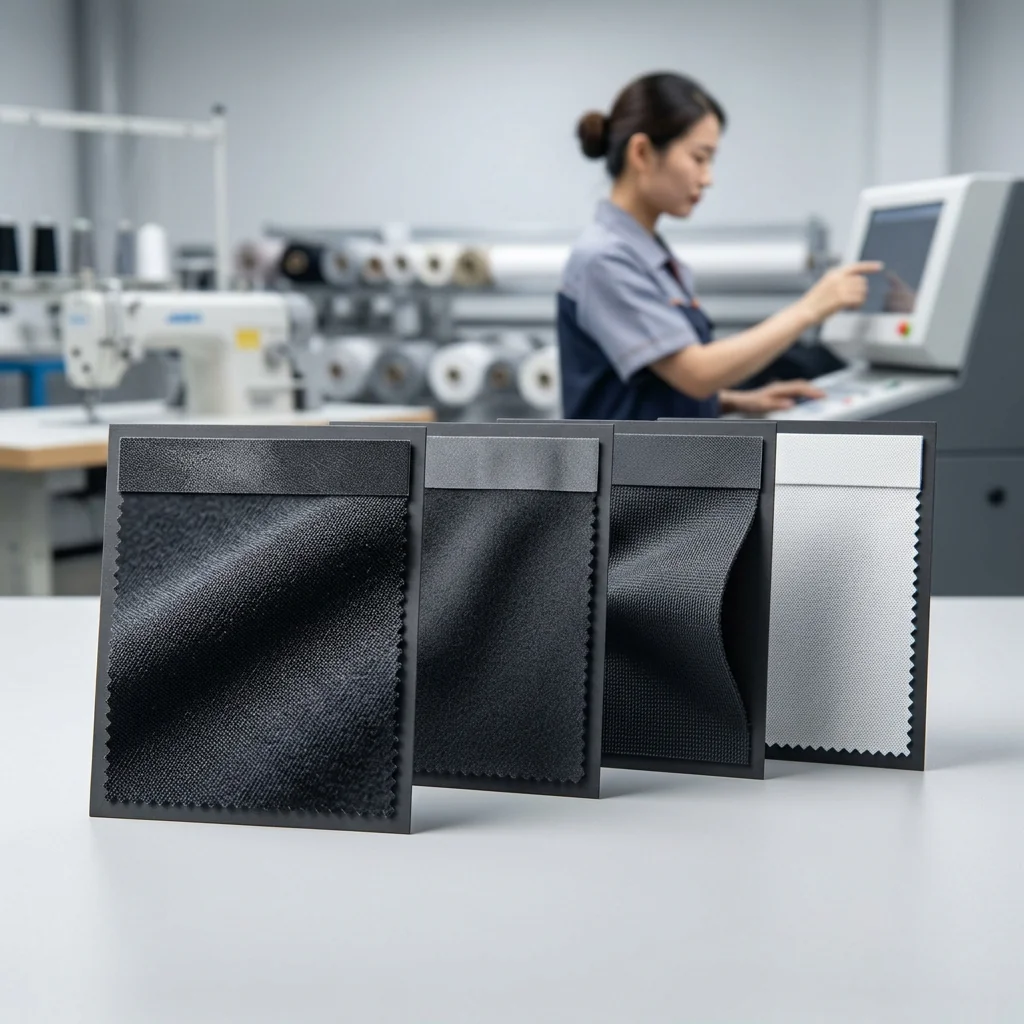
Not all yoga leggings fabric is equivalent — the difference between a pilling-in-week-2 failure and a 30-wash survivor comes down to GSM weight, composition ratio, and finishing treatment. We offer four fabric grades so you match the right spec to your price point and end-use. Buying bulk yoga leggings requires matching fabric grade to end-use — this table gives you the decision matrix.
| Grade | Swatch | Composition | GSM | 4-way Stretch | Opacity | Best For |
|---|---|---|---|---|---|---|
| Standard Flex |
|
75% nylon 25% spandex | 180 GSM | 200% | Grade B | Entry-price wholesale, gym basics |
| Sport Pro |
|
82% nylon 18% spandex | 220 GSM | 220% | Grade A | Studio boutique, mid-tier brand |
| Sculpt Compress |
|
78% nylon 22% spandex | 260 GSM | 190% | Grade A+ | Compression legging, body-shaping |
| Eco Recycled |
|
82% rPET nylon 18% spandex | 220 GSM | 215% | Grade A | Sustainability-positioned brand |
Construction Points Ranked by Return-Rate Impact: Waistband, Gusset, Seam
Waistband roll-down, gusset blowout, and chafing seams generate the majority of wholesale leggings returns. We engineer each construction point to spec — not as a selling point, but because rebuild costs for a failed bulk order are catastrophic.
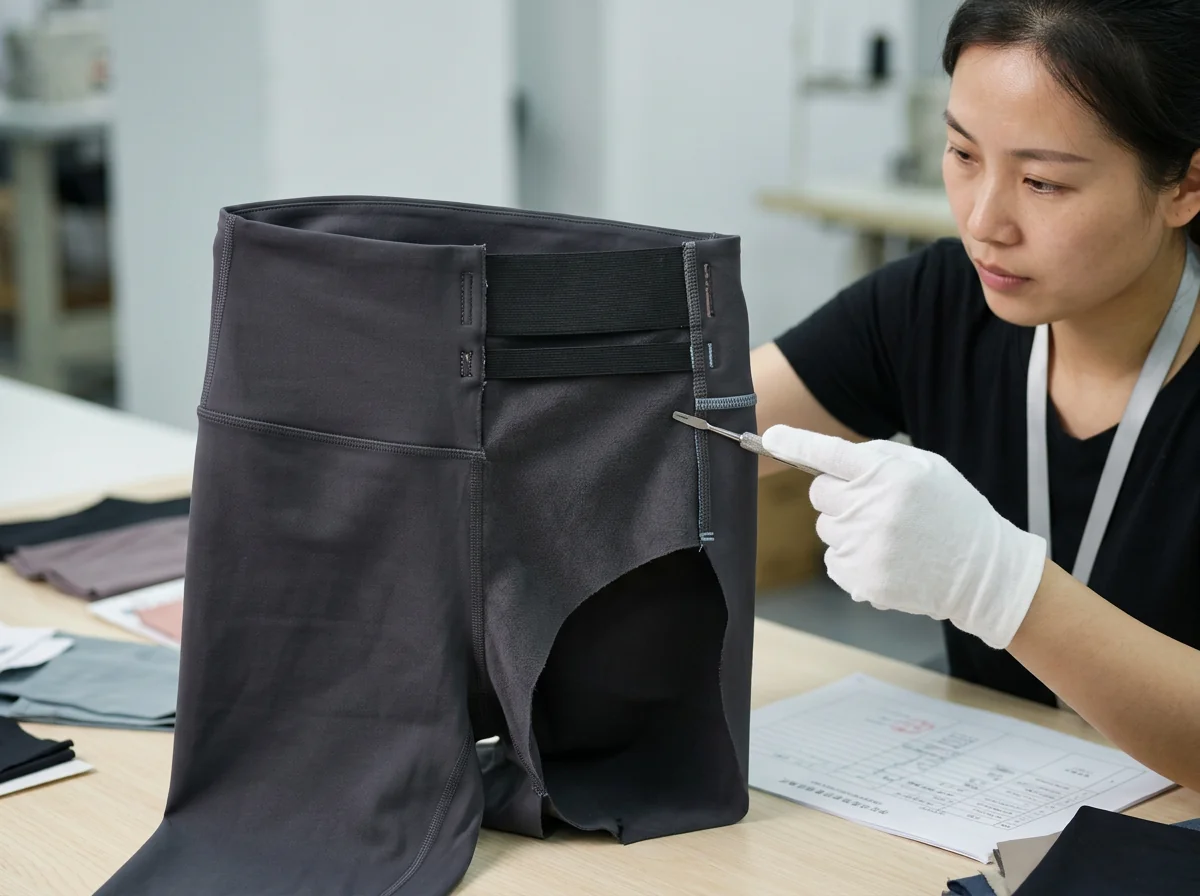 High-Waist Waistband
Anti-Roll High-Waist Waistband
- 8 cm / 10 cm width options
- Double-layer compression band: inner silicone grip strip + outer knit bonded seam
- No exposed elastic; encased construction prevents rolldown at 30+ wash cycles
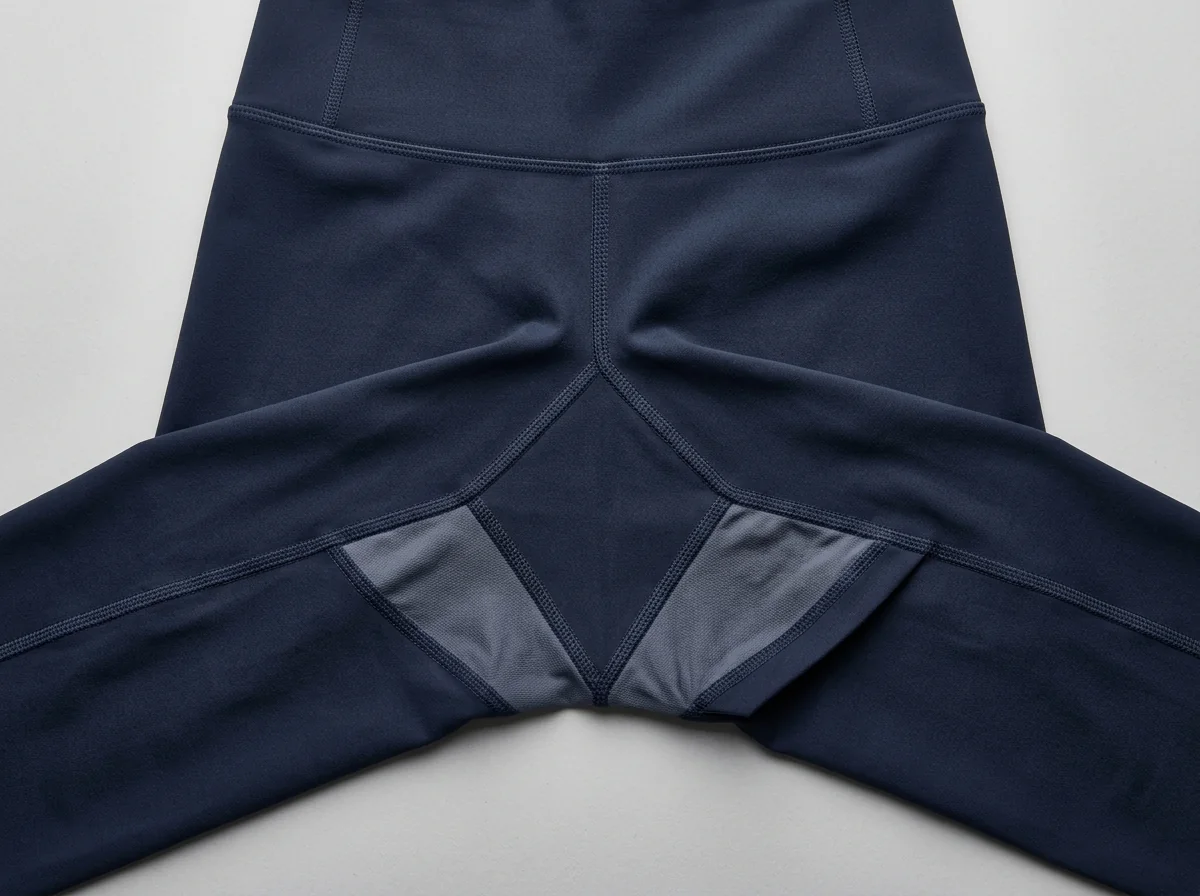 Diamond Gusset
Gusseted Diamond Crotch
- 4-panel diamond gusset (not 2-panel flat gusset)
- 100% gusset liner: moisture-wicking brushed nylon, separately sourced from main body fabric
- Gusset apex rated to 150% elongation; prevents seam stress under squat load
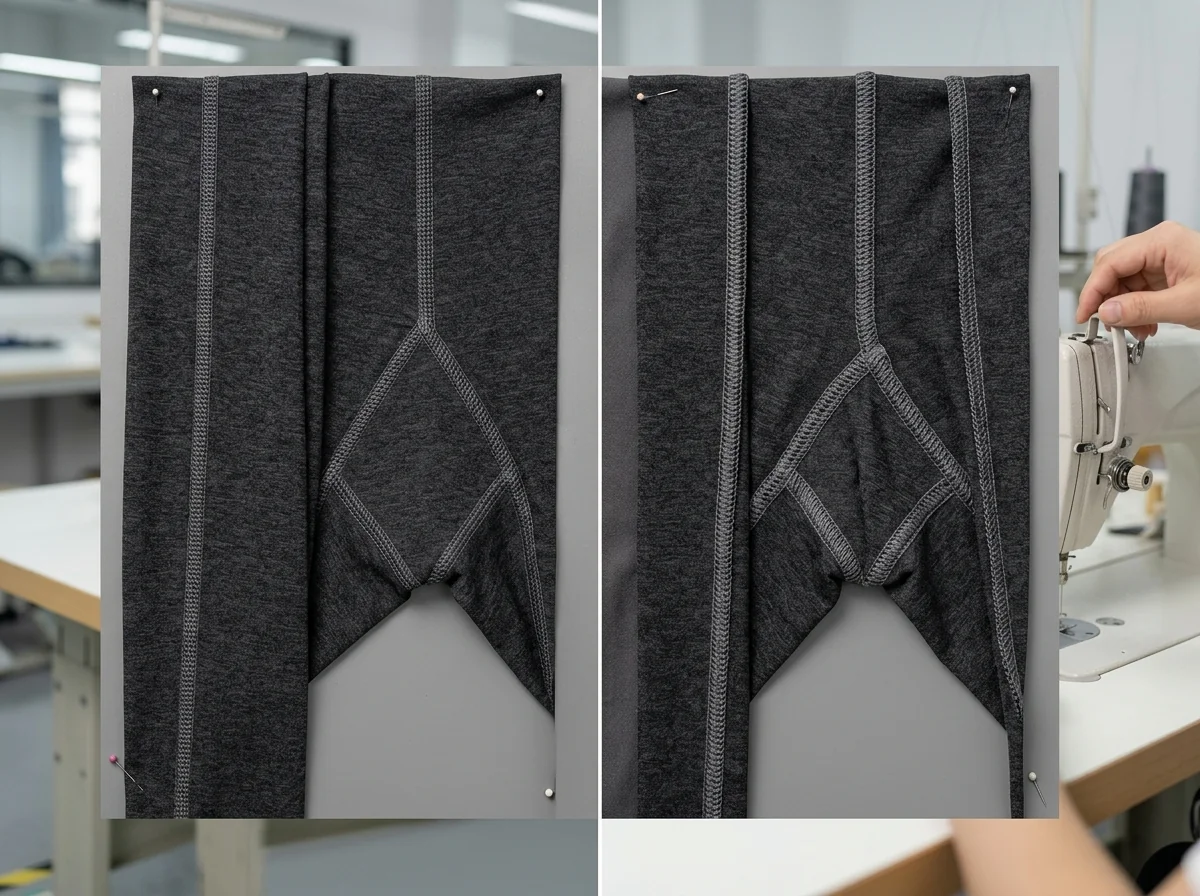 Flatlock Seam
Flatlock Seam System (no raw overlock)
- 3-needle flatlock on all leg seams; no raised seam ridge against skin
- Seam strength: 18 N/cm (test standard EN ISO 13935-2)
- Stitches per cm: 12 SPI minimum
Inside the Leggings Block: Rise Differential, Gusset Geometry, Stitch Selection
A legging is the hardest bottom in activewear to pattern because the wearer bends 90°+ at the hip while the fabric is already pre-tensioned on the body. Three engineering decisions inside our block determine whether your bulk run survives a season of squats — and they're worth understanding before you sign a tech pack.
1. Back rise is cut 4–6 cm longer than front rise — by design
- In deep hip flexion the back body needs roughly 12% more fabric length than standing posture; the front needs less, or it bunches at the navel.
- Our block carries a 4–6 cm back-over-front rise differential depending on GSM: heavier 260 gsm compression fabric stretches less lengthwise, so it gets the larger differential.
- A block copied from a casual-pant pattern (equal rises) is the root cause of two classic failures: waistband pulling down at the back during forward fold, and front waistband gaping when seated.
2. The diamond gusset is oriented to the fabric's dominant stretch axis
- Our 78–82% nylon / 18–22% spandex warp-knit stretches more in the course direction than the wale. The gusset diamond is cut with its long axis on the higher-stretch direction so the crotch seam never carries peak load.
- A 2-panel flat gusset forces a 4-seam junction at one point — the single most common burst location in bulk leggings. The 4-panel diamond moves each seam off the stress apex.
- Gusset liner is cut from a separate moisture-wicking nylon lot, never from body-fabric offcuts, so liner shrinkage can't pucker the crotch seam after the first wash.
3. Flatlock vs coverstitch — where each one goes and why
- Flatlock (3-needle, 12+ SPI) joins inner-leg and back-rise seams: both fabric edges butt flat, so there is no ridge to abrade the skin over a 75-minute class. Trade-off: lower seam elasticity, which is why it never goes on the waistband.
- Coverstitch attaches the waistband and finishes the hem: its looper thread network stretches up to 200% with the fabric, so the band recovers with the elastic instead of fighting it.
- If a supplier quotes you a legging sewn entirely on overlock, the price will look good and the inner-leg seam will ridge, twist, and chafe — that delta is fabric-handling labor, not margin.
Sampling runs as a 7-day in-house loop — pattern cut on day 1, sewn sample couriered day 7 — with 3–5 fit iterations and a squat-test sign-off before any size set is graded. Commercial terms are kept off this page on purpose: indicative FOB for basic-spec 230–250 gsm leggings runs $7.40–$8.20 per piece at pilot volume and steps down to $5.20–$6.30 above 1,000 pcs — the full tier logic lives on our pricing & MOQ page.
The Test Ledger: Opacity, Pilling, Recovery — Published Before You Ask
Spec sheets are cheap. Test results are expensive to fake. Before you commit to a bulk order of yoga leggings, request these three numbers from any yoga leggings supplier — here are ours.
Test method: fabric stretched to 150% on transparent backer under standardized lux lighting. Standard Flex: Grade B (disclosed — slight sheer at extreme stretch).
Industry average for similar GSM: 3.5–4.0. 30-cycle equivalent wash simulation (Grade 5 = no pilling, Grade 1 = severe pilling).
Before/after dimension comparison. Both waistband and body fabric exceed industry standard thresholds.
Need the full test certification documents before sampling?
Request test certification documentsGrading Data: XS–3XL on One Digital Block, Three Inseam Lengths
Size inconsistency between colorways is the #1 complaint in wholesale leggings returns — different dye lots relax fabric differently. We grade across the same block, lock measurements per colorway batch, and offer three inseam options so petite, regular, and tall buyers all have a solution.
| Size | Waist (cm) | Hip (cm) | Thigh (cm) | Weight Guide |
|---|---|---|---|---|
| XS | 60–64 | 86–90 | 52–55 | 45–55 kg |
| S | 65–69 | 91–95 | 56–59 | 56–65 kg |
| M | 70–74 | 96–100 | 60–63 | 66–75 kg |
| L | 75–80 | 101–106 | 64–68 | 76–88 kg |
| XL | 81–87 | 107–113 | 69–74 | 89–100 kg |
| 2XL | 88–95 | 114–121 | 75–81 | 101–115 kg |
| 3XL | 96–104 | 122–130 | 82–88 | 116–130 kg |
All colorways graded from the same digital pattern block. Shrinkage allowance baked into cut patterns per fabric dye-lot test. Cross-colorway measurement tolerance ±0.8 cm.
3 Inseam Options
Defect Interception Readout — Where Leggings Fail, Where Each Failure Gets Caught
Leggings have a defect profile unlike any other garment we sew: the failure points cluster at the gusset apex, the waistband join, and in fabric-lot variation you can't see until the garment is stretched. Our bottoms line runs leggings through five AQL 2.5 checkpoints staffed by inspectors who hold stop-shipment authority — the table maps each leggings-specific defect to the checkpoint built to intercept it.
| Checkpoint | Leggings-Specific Defect | How It's Intercepted |
|---|---|---|
| 1 · Fabric inbound | GSM drift between rolls; shade variance between dye lots | Every roll weighed against the locked GSM spec; dye lots benched against the approved lab dip before any roll reaches the spreader — body and waistband panels for one garment always cut from the same lot |
| 2 · Cutting | Panels cut off the stretch axis; gusset diamond mis-oriented | Marker audit confirms every panel's grain alignment; a mis-rotated gusset is scrapped at the table, not discovered in a returns report |
| 3 · In-line sewing | Seam burst at gusset apex; SPI below 12; waistband elastic twisted inside its casing | Roaming inspectors pull garments mid-seam for stretch-to-break checks at the apex; twisted elastic fails the hand-feel pass before the band is closed |
| 4 · Finished garment | Cross-size measurement drift; leg-length asymmetry between left and right | Full-measure audit per size against the graded spec sheet; both inseams measured on every audited piece |
| 5 · Pre-shipment | Mixed-size cartons; residual stitch holes from repairs; packaging spec misses | Lot-level statistical sampling on the sealed cartons; the report PDF goes to the buyer before the balance payment is requested |
Context for capacity planning: leggings sew on our dedicated bottoms line — 46 sewing stations, 58 operators, two embedded line inspectors — which turns a 500-piece colorway in 15–22 production days and a 2,000-piece program in 25–32. The factory-wide defect target and shipped-goods return rate both stay low. Line allocation detail sits on the manufacturing capacity page.
Colorway Inventory: 14 Validated Stock Shades, Custom Matching from 300 pcs
14 validated colorways are ready to cut and sew today — no minimum, no sampling delay. Custom color matching starts at 300 pcs per colorway, with lab-dip approval before bulk cutting. Logo application runs in-house on the same production floor.
Custom Color Matching
- Pantone / RAL reference accepted; physical swatch preferred for accuracy
- Lab-dip rounds: standard 2 rounds included; 3rd round at cost
- Minimum per custom colorway: 300 pcs (can be split across inseam variants)
- Lead time addition: +7 days for lab-dip approval cycle
Logo Application Benchmarks — All Methods Run In-House
Screen Print
From 200 pcsFlat logo on waistband exterior or calf panel
Heat Transfer / DTF
SKU-level volume band appliesFull-color artwork; ideal for complex multi-color logos
Embroidery
From 100 pcsWaistband logo badge; setup fee for new digitization
Woven Label
Standard on all ordersSewn-in neck / side-seam label; included with all orders
First Reorder Within 60 Days: A Sell-Through Case
The metric that matters for wholesale yoga leggings isn't the opening order — it's whether the product survives the floor and generates a reorder signal fast enough to justify the initial buy. Switching from a prior yoga leggings supplier, this brand needed proof before sampling.
Zero waistband complaints in first 90 days. 78% sell-through at Day 52.
Initial order: 480 pcs across 3 colorways (S / M / L, regular inseam, Sport Pro fabric)
Problem with previous supplier: waistband rolldown complaints from end-customers; 8% return rate in first 30 days.
Switch rationale: requested opacity-under-load certification and 30-wash pilling grade before sampling — we provided both in writing before a sample was cut.
Outcome: zero waistband complaints in first 90 days. Sell-through hit 78% in 52 days. First reorder placed at Day 54 for 720 pcs, adding 2XL and Tall inseam to the mix.
The datasets behind a Grade A rating — recorded per lot, not claimed per brochure
"Squat-proof" only means something if it is re-verified every time fabric enters the building. These are the three running records that sit behind the opacity grade printed on your spec sheet, and you can request the underlying documents for your own order at any point.
Dataset 1
Fit-iteration log — sign-off before any size set is graded
Each new leggings block records its own development history: pattern cut on day one of the in-house sampling loop, then 3–5 logged fit rounds, and a fit sign-off entered against the block before grading is released. If a buyer asks why a measurement sits where it does, the answer is in the log, not in someone's memory.
Sampling mechanics → sample-policyDataset 2
Lot-level opacity record — Grade A is a dye-lot property
An opacity grade certified on last quarter's fabric says nothing about the roll on the spreader today. Every incoming dye lot is re-benched under stretch before its first panel is cut, and the reading is filed against that lot number — so the seat panel of piece 1 and piece 4,000 trace back to the same documented result.
Fabric platform data → fabric-selectionDataset 3
Recovery score history — rebound measured, then approved
Waistband grip at month three is predicted by one number: how the knit rebounds after a hundred combined stretch-and-launder repetitions. Lots that score under threshold never reach the cutting table, which is the unglamorous reason the factory holds its shipped-goods returns under half a percent.
QC checkpoint detail → manufacturing-capacity