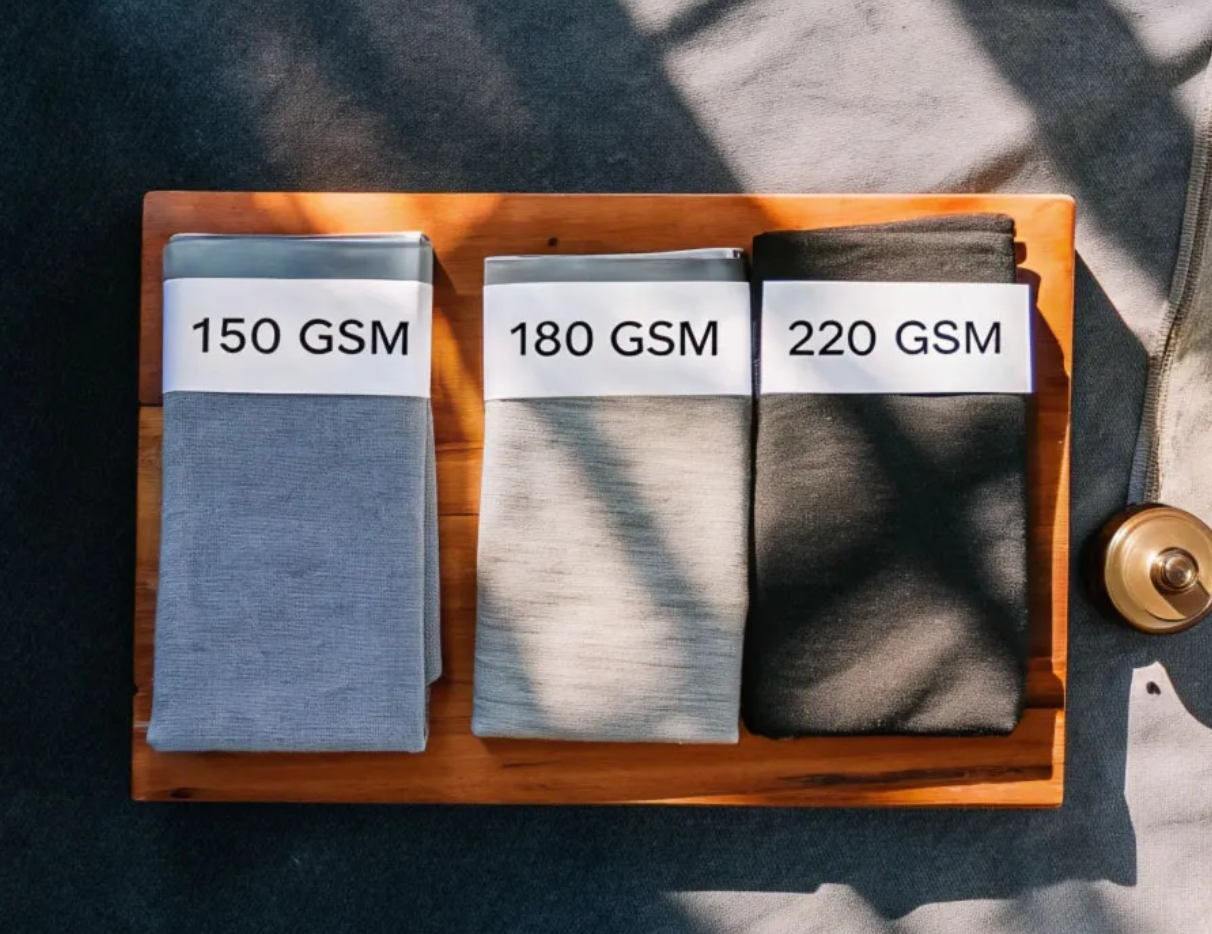
Every yoga brand has a fabric origin story — and most of them involve a expensive mistake. A yoga clothing manufacturer promises "premium 4-way stretch." The first bulk order arrives. The leggings pass the hanger test. Then a customer sends back a photo of a see-through squat.
The real difference between 4-way stretch and 2-way stretch fabric goes beyond a number on a mill data sheet. It's the difference between a legging that moves with the body through a Warrior II and one that breaks down during Downward Dog.
This guide is built for yoga brand founders, product developers, and sourcing managers making fabric decisions right now. Here's what you'll get:
A performance-scoring matrix across eight key yoga poses
A tiered fabric spec table mapped to your retail price point
A field-tested method for spotting stretch yoga fabric suppliers who are faking it
The Fabric Science Behind Stretch: Warp/Weft Knit Structures and Asymmetric Elasticity
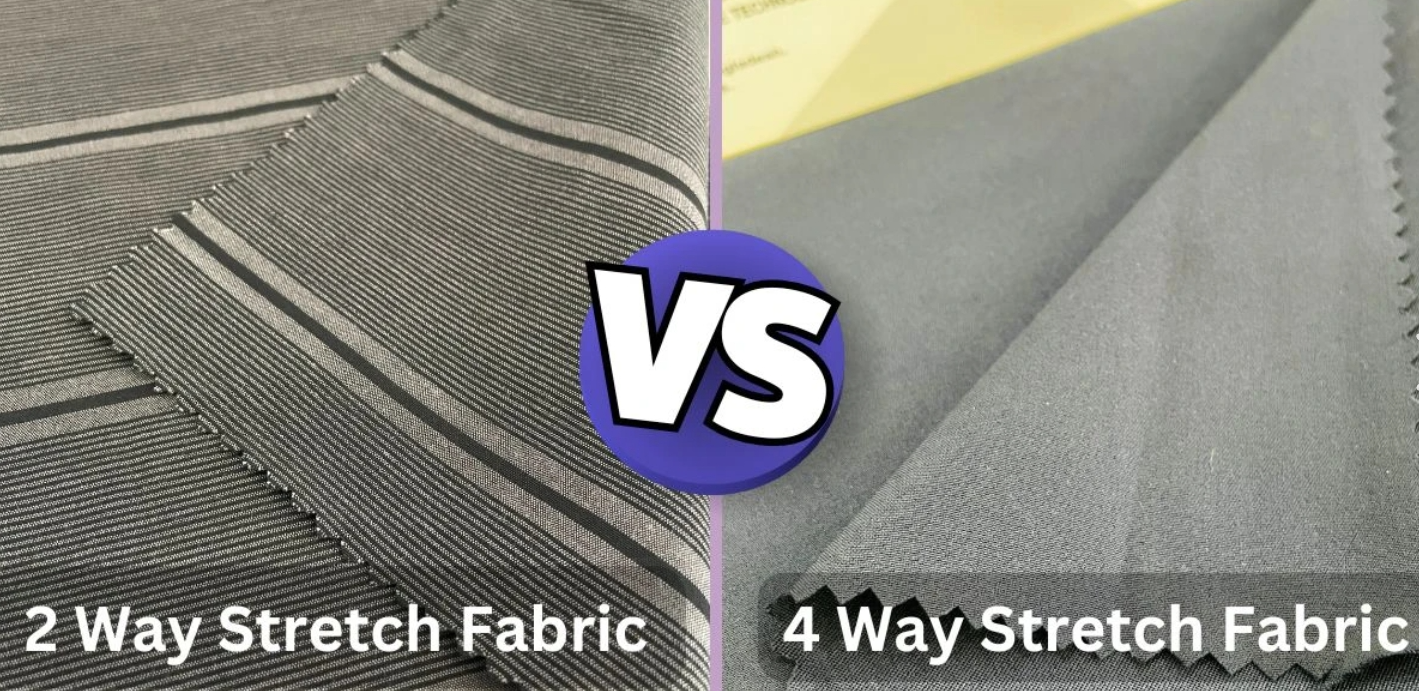
Stretch is not a single thing. It's a direction, a force, a recovery rate. Knowing which kind your fabric delivers is the difference between a legging that performs and one that lets you down.
Two knit structures control how yoga fabric moves: weft knit and warp knit . Each works at a different structural level. Those differences explain why two fabrics can both say "stretch" on the label — and give you opposite results on the mat.
Weft Knit: Why Stretch Is Lopsided by Default
In a weft knit structure (think single jersey, interlock, rib), one continuous yarn loops across the fabric width — course by course. Those loops open wide in the crosswise (weft) direction . So lateral stretch comes easy. The lengthwise (warp) direction works differently. Loop height and yarn crimp control it. There's far less room to move in that direction.
The real-world result: a standard weft knit fabric with 5–10% spandex gives you 40–70% usable stretch crosswise — but only 0–20% lengthwise , with weak recovery. That's your 2-way stretch. It fits the body in one plane. In Downward Dog or a deep forward fold, it's pulling stretch from a reserve it doesn't actually have.
Warp Knit: Engineering Stretch in Both Directions
Warp knit (tricot, raschel) flips the logic. Multiple yarns feed in parallel, each locked to its own needle position. The lapping movement — how each yarn crosses the needle bed — is programmable. So a skilled fabric engineer can set elasticity for both directions, each one tuned on its own terms.
Add spandex as a dedicated elastic channel in warp knit construction, and you get a true 4-way stretch fabric : 60–120% extension crosswise, 40–80% lengthwise, with recovery rates above 90–95% after five stretch cycles at 30% elongation. That's not a marketing claim. It's a structural outcome.
The Spandex Content Equation
Knit architecture sets the direction of stretch. Spandex content controls the quality of recovery.
Application | Spandex % | Warp Extension | Recovery Rate |
|---|---|---|---|
2-way basic legging | 5–10% | 0–20% | Low |
4-way mid-performance yoga | 15–18% | 40–60% | >90% |
4-way high-compression training | 20–25% | 60–80% | >95% |
Here's a nuance most brands miss: in 4-way fabric , stretch doesn't kick in at the spandex stage right away. From 0–20% strain, the fabric geometry shifts first — loops reorient, fibers redirect. The rubber-elastic spandex phase takes over from 20–60% strain, where diagonal shear stress builds up. That two-stage load distribution is exactly what makes 4-way fabric feel supportive — not just stretchy.
One design requirement brands often get wrong: true 4-way construction needs a continuous elastic yarn pathway running in both warp and weft directions at once . A weft knit fabric that relies on crimped, non-elastic filaments in the lengthwise direction — no matter how much spandex it packs in — will never give you real recovery in both directions. The structure has to earn it. No shortcut gets you there.
Performance Benchmarks: Stretch Percentage, Recovery, and Opacity Standards
Numbers don't lie — but they need context. A yoga fabric supplier's test report showing "80% stretch" tells you nothing. You need to know which direction was measured, under what load, and what happened to the fabric after the fifth stretch cycle.
Here's how to read performance data like a product developer, not a purchasing clerk.
The Stretch Metrics That Matter
Two industry-standard tests — ASTM D2594 and ISO 20932-1 — measure stretch percentage and recovery with a consistent formula:
Stretch % = (extended length − original length) / original length × 100
Recovery % = 1 − permanent set / extension × 100
For yoga leggings, the practical targets are:
Direction | General Yoga | Dynamic Flow / Hot Yoga |
|---|---|---|
Weft (crosswise) | 60–100% | 70–100% |
Warp (lengthwise) | 40–60% | 40–60% |
Recovery after 50% elongation | ≥90–95% | ≥90–95% |
Growth after 5 cycles | <5% | <5% |
These aren't goals to aim for. They're the minimum. Drop below them and you're shipping a product that bags at the knee by wash three.
Where 2-Way Fabric Falls Short
Wear testing shows the same pattern over and over. 2-way stretch fabric , under repeated squats and bends, builds up 3–8% plastic deformation in the knee and back-hip zones. The legging doesn't fall apart. It just stops looking like a legging — gradually, wash by wash.
4-way stretch spreads stress across both axes at the same time. Shape retention holds at ≥95% across repeated movement cycles. No single direction takes the full load, so nothing gives out first.
The gap between the two builds up over time. After one wear, you can't see it. After ten, it's showing up in your customer's Instagram complaint.
The Squat-Proof Opacity Problem Nobody Talks About
Stretch percentage and opacity are not separate issues. They pull against each other directly.
A 2-way fabric hits its limit in one direction, and the yarn network opens up unevenly. Inter-yarn gaps widen at the stress points — not across the whole panel. Compare that to a balanced 4-way construction at the same GSM, and skin-show risk runs 40%+ higher under the same stretch load.
Practical GSM thresholds for opacity:
Dark colorways : squat-proof at ≥220 gsm
Light colors and high-stretch styles : need ≥240–260 gsm , paired with a high-recovery 4-way structure
GSM alone doesn't guarantee opacity. A dense knit with matte yarn and strong cover factor can pass the backlight squat test at lower GSM. A looser weave at higher GSM can fail it. Opacity is a real brand requirement for most yoga legging lines — so spec the knit structure and yarn type before you lock in the weight.
Also worth flagging: heavy brushed or peach-finish treatments can reduce visual cover at high stretch. The raised fiber surface thins under tension. Running a brushed-interior legging? Confirm opacity in the finished state — not the greige state.
Your Pass/Fail Screening Criteria
Before any bulk order, run your fabric samples through this protocol:
Pre-condition at 21 ± 1°C, 65 ± 2% RH. Extend to 50% for recovery testing, 80–100% for high-stretch yoga simulation. Hold 10–30 seconds per cycle. Run 5–10 cycles minimum .
A fabric passes when it hits all four of these:
- Recovery ≥90% after 50% elongation
- Growth (residual deformation) ≤5% after 5 cycles
- No visible skin-through at 40–50% extension under backlight
- Knee and seat bagging ≤3% after wear simulation
One failure disqualifies the fabric from a yoga legging application — no matter what the yoga apparel supplier's data sheet says.
Yoga Pose Matching: 8-Pose Fabric Performance Scoring Matrix
Lab numbers don't do squats. Recovery rates and GSM thresholds matter — but a fabric that scores well on a test bench can still fall apart the moment a student drops into Pigeon Pose. What separates a well-built yoga legging from an expensive disappointment is how the fabric behaves across a real practice: the standing holds, the inversions, the sweaty final flow.
The matrix below scores 2-way vs. 4-way stretch fabric across eight key yoga poses, using three measurable dimensions:
Fit Retention — waistband/crotch/knee displacement during movement (mm)
Stretch & Recovery — warp/weft elongation rate + residual deformation after 5 cycles
Pressure Distribution — local contact pressure (kPa) at high-curvature zones
Scoring scale: 1–5. 5 = zero displacement, full biaxial extension, second-skin fit. 1 = visible shifting, skin-through risk, or pressure points that break the pose.
Yoga Pose | 2-Way Score | 4-Way Score | Critical Failure Point (2-Way) | Brand Application Guidance |
|---|---|---|---|---|
Warrior II | 3 | 5 | Warp direction tightens under a sustained lunge. Anterior thigh pressure builds after 60+ seconds. | 2-way works at entry level. Mid-to-high intensity standing sequences need 4-way. |
Deep Squat / Malasana | 2 | 5 | Waistband drops 10–20 mm. Gluteal coverage breaks. Opacity fails at 40%+ extension. | 4-way is non-negotiable. Pair with ≥240 gsm for squat-proof opacity. |
Downward Dog | 2 | 5 | Inversion gravity and warp tension pull the waistband toward the upper back. Ankle pooling starts. | Vinyasa flows need 4-way. 2-way works in beginner static classes only. |
Pigeon Pose | 3 | 5 | External hip rotation creates uneven crotch tension. Anterior thigh cutting sensation appears at moderate spandex content. | This is the top stress test for premium positioning. High-end yoga legging lines need 4-way. |
Cobra / Wheel (Backbends) | 2 | 5 | Lengthwise extension shifts the hem upward 15–25 mm. Shoulder seam pulls against the spinal curve. | Backbend-focused or Pilates-adjacent lines need 4-way with ≥130% warp elongation. |
Revolved Triangle | 3 | 5 | Compound twist pulls side seams outward. Seam misalignment becomes visible. Posterior knee compression increases. | Pattern-matched or printed panels need 4-way — 2-way distorts visual alignment under torsion. |
Inversions (Headstand / Handstand / Shoulderstand) | 1 | 5 | Full gravitational load reversal and multidirectional stress cause the waistband to slide 20–30 mm. Crotch air-gap becomes visible. | 4-way is a hard requirement. Keep 2-way fabric out of any inversion-inclusive curriculum. |
Hot Yoga | 2 | 5 | Wet modulus drops fast. Recovery slows. Posterior knee pooling gets worse. Wet-state opacity degrades further. | Specify moisture-wicking 4-way at 220–280 gsm. Wet recovery rate must stay ≥90%. |
What This Matrix Tells Brand Developers
Three patterns belong in your product development brief.
First: Deep Squat and Inversions are the two sorting poses. Include either in your product line, and you've made the 4-way decision. No cost optimization changes that. A 2-way fabric scoring 1–2 in these poses isn't a budget alternative. It's a liability.
Second: Pigeon Pose is the premium signal. Brands priced above $60 retail should treat Pigeon Pose performance as a brand identity requirement — not an afterthought. The hip-external-rotation load tests both warp elongation (≥120%) and diagonal shear recovery at the same time. A fabric that passes Pigeon Pose clean — no crotch tension, no anterior thigh cutting, gluteal line stable — communicates quality before your customer reads a word of your product copy.
Third: Hot Yoga creates a compound failure. It's not just heat. Moisture reduces fabric modulus and slows elastic recovery from the spandex phase. Wet fibers also lose opacity. A 2-way nylon spandex yoga fabric that holds up in a dry studio can fail on both stretch recovery and squat-proof coverage within the first fifteen minutes of a heated class. For hot yoga SKUs, moisture-wicking stretch fabric with 4-way construction at 22–28% spandex content isn't a premium spec — it's the minimum viable spec.
Matching Fabric Type to Practice Style
Practice Category | Recommended Structure | Spandex Content | Target GSM | Acceptable Pose Score Floor |
|---|---|---|---|---|
Yin / Restorative / Lifestyle | 2-way or light 4-way | 15–18% | 200–240 gsm | 3+ across standing poses; 2+ acceptable in inversions |
Vinyasa / Power / Ashtanga | Full 4-way, high recovery | 18–22% | 220–260 gsm | 4+ across all 8 poses |
Hot Yoga / Compression Training | High-modulus 4-way + wicking finish | 22–28% | 240–280 gsm | 5 on squat, inversion, and hot yoga; wet recovery ≥90% |
This matrix isn't a consumer feature list. It's a sourcing filter. Run your target fabric samples through all eight poses before approving bulk production — use wear testing with real practitioners or a structured fit protocol on a 3D dress form at key curvature zones. A fabric that scores below 3 in more than two poses for your target practice category is telling you something your supplier's data sheet never will.
Cost-Benefit Analysis: Spandex Content, GSM Weight, and MOQ Strategy
Fabric cost isn't one number. It's four numbers multiplied together — and most brands negotiate only one of them.
GSM, spandex content, base fiber, and knit structure each carry their own price weight. Stack them wrong and you're overpaying for performance your customer won't notice. Or you're underpaying your way into a return wave. Each variable moves your cost in a specific direction. Understanding that lets you build a product line you can defend on price.
The Four Price Drivers (And What Each One Costs You)
Spandex content is the sharpest lever. Moving from 5–8% to 15–20% spandex isn't a small tweak. It's a full category shift. Fabric FOB costs rise 20–40% at the same GSM. The progression looks like this:
Spandex % | Performance Tier | Typical Application |
|---|---|---|
5–8% | Basic stretch | Entry-level, lifestyle |
8–12% | Transitional 4-way | Mid-market everyday |
15–20% | Full high-recovery | Yoga, compression leggings |
20–25% | High-performance | Hot yoga, athletic compression |
GSM adds cost in direct proportion. The 220–260 gsm band covers most yoga legging applications. Step into 260–300 gsm and you're signaling a high-support, premium-construction product. Mill pricing reflects that jump.
Base fiber changes the whole equation. At identical GSM and spandex content, nylon spandex yoga fabric runs 10–30% more than polyester spandex blend activewear . That premium gives you better abrasion resistance, stronger elastic recovery, and the close-to-skin drape that justifies an $80+ retail price. For sub-$50 SKUs, polyester base is the rational call.
FOB Price Reference: What Asian Mills Quote at 500m+
Tier | GSM | Composition | Est. FOB |
|---|---|---|---|
Entry | 180–220 gsm | Poly/spandex 5–8% | US$2.5–4.0/m |
Transitional | 200–220 gsm | Poly/spandex 8–12% | US$3.5–5.0/m |
Core 4-way | 220–260 gsm | Poly/spandex 15–20% | US$4.5–7.0/m |
Premium | 260–300 gsm | Nylon/Lycra warp knit 20–25% + specialty finish | US$8–15/m |
These ranges assume standard colorways at volume. Custom fiber ratios yoga apparel, new knit structures, or proprietary finishes push you toward the higher end — sometimes past it.
MOQ: The Number Behind the Number
The MOQ on a yoga apparel supplier's line sheet is a starting point, not a final answer. A quoted "MOQ 300m/color" can silently double to 600m once you factor in:
Separate dyeing MOQ per colorway
Trim and label MOQ charged as its own line item
Sample yardage that doesn't count toward your bulk order
Before committing to any fabric development, ask your yoga clothing supplier to break out four separate minimums: fabric greige MOQ, dyeing MOQ, finishing treatment MOQ, and per-color minimums for custom yoga apparel shades. The gap between the headline number and the real commitment is often 50–100% larger.
Standard stock colors vs. custom yoga apparel development is the clearest MOQ decision most brands face:
Stock/standard colors : 300–500m/color, 15–30 day lead time — the right move for market testing and reorders
Custom development : 1,000–3,000m/color, 30–45 days plus 7–14 days for lab dips — use this path for a signature colorway or proprietary spec, not general production
The Consolidation Strategy Most Brands Skip
Build 70–80% of your SKUs around one or two base fabrics — consistent GSM, consistent base fiber, consistent spandex band. That volume concentration gives you real leverage to compress your per-meter cost. Each new fabric spec you add "just for this one style" fragments your order quantity and cuts your pricing position.
A practical default: lock in a 220–240 gsm / 12–18% spandex / poly or nylon base fabric as your workhorse. Build your colorway strategy around that single greige. Add a second fabric spec only when the performance requirement clearly demands it — hot yoga compression, for instance, where wet recovery and opacity standards require a distinct spec.
Comparing yoga apparel supplier quotes? Track six data points : GSM, spandex %, base fiber, knit structure (2-way vs. 4-way / warp knit), MOQ in meters or kg per color, and lead time across stock, dyed, and custom. Everything else on a quote sheet is noise until those six align.
Brand Selection Guide: Fabric Spec Procurement Table by Retail Price Band & Development Decision Tree
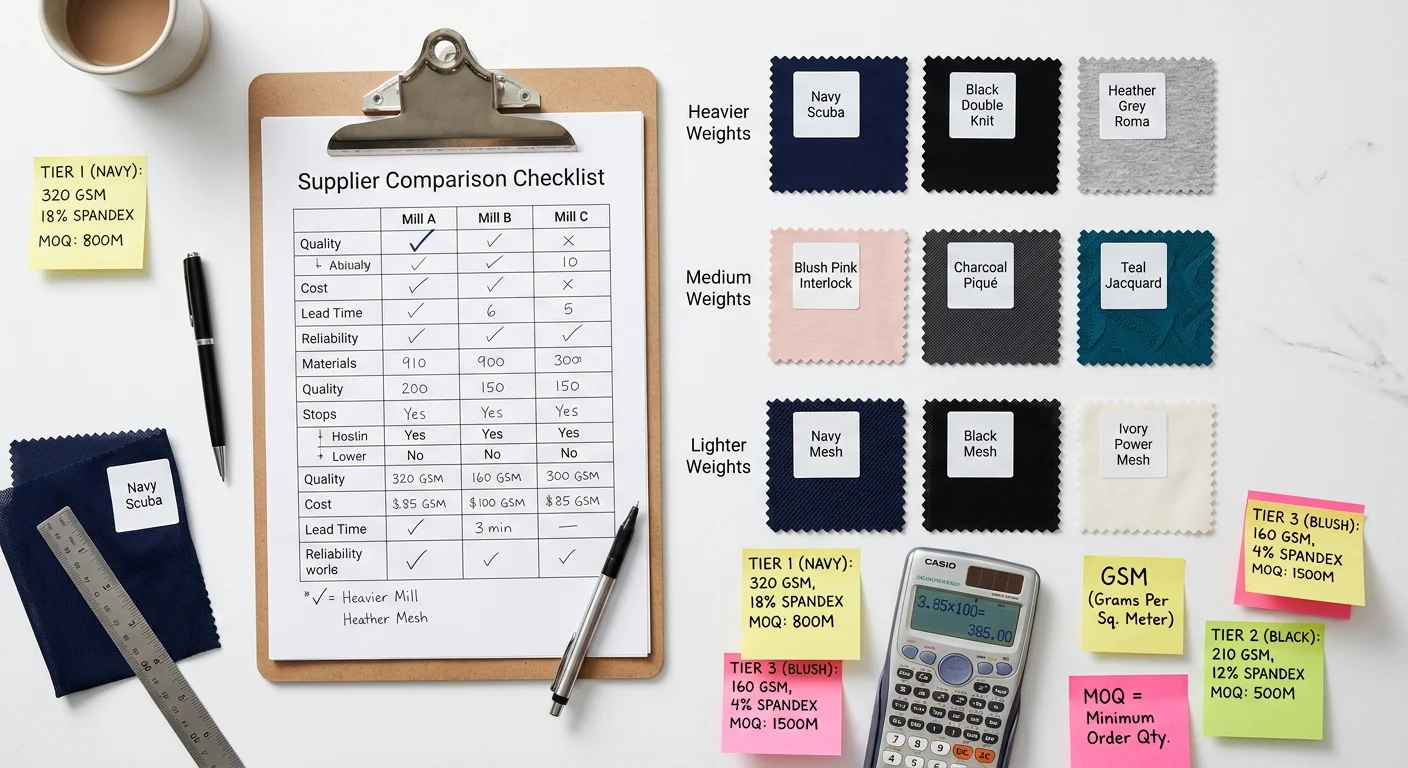
Retail price is not just a number you pick at a brand meeting. It's a hard constraint that works backward through every fabric decision — GSM, fiber blend, knit structure, functional finish. Get the sequence wrong and your margin disappears before the first order ships.
Here's how to work the math in reverse.
The Price-to-Fabric Cost Formula
Most DTC yoga brands run on a predictable cost structure:
Fabric cost = 25–40% of factory gate price
Factory gate price = 20–30% of retail
So a $60 retail legging should carry a factory price of $12–15. That leaves you a fabric budget of $3–6 per garment. At 1.2m per pair of leggings, your target fabric cost lands at $2.5–5.00/m — right at the line between mid-market and premium specs.
That math defines your playing field before you ever contact a mill.
Fabric Spec Table by Retail Price Band
Retail Price Band | Knit Structure | GSM Range | Recommended Composition | Target FOB Price | Performance Threshold | Brand Positioning |
|---|---|---|---|---|---|---|
$20–40 Entry | Single jersey or basic interlock, 4-way (weak warp) | 210–230 gsm | 85% Polyester / 15% Spandex | $2.8–4.0/m | Crosswise stretch ≥130%; recovery ≥90%; pilling ≥Grade 3 | Lifestyle, light yoga, print-led. Mild compression is fine. Cost drives every decision. |
$40–60 Mid-Entry | Interlock or double knit, 4-way | 220–240 gsm | 75–80% Polyester / 20–25% Spandex or 70–75% Nylon / 25–30% Spandex | Polyester: $3.5–5.0/m; Nylon: $4.5–6.0/m | Squat-proof in dark colors; stretch ≥140%; recovery ≥92%; moisture-wicking finish | Entry yoga and gym line. Basic opacity, good hand feel, moisture management. |
$60–80 Core Mid | High-gauge interlock, full 4-way | 230–260 gsm | 72–78% Nylon / 22–28% Spandex | $5.0–7.0/m | Biaxial stretch 90–100%; recovery ≥93%; pilling ≥Grade 4; light-color opacity ≥240 gsm | Brand hero product. Built for flow yoga and moderate-to-high-intensity training. |
$80–120 Premium | High-modulus warp knit or high-gauge circular + high-tenacity yarn | 250–280 gsm | 70–78% Nylon / 22–30% Lycra (branded fiber) | $7.0–10.0/m (with functional finish) | Recovery ≥95%; pilling ≥Grade 4.5; "buttery soft" or "slick cool" hand; no transparency | Sculpting and high-support lines. Waistband structure and targeted compression are standard here. |
$120+ Flagship | Warp knit Tricot / Power Net + brand-tier elastic fiber (Lycra Black, Xtra Life) | 260–300 gsm | 70–76% Nylon / 24–30% Lycra (brand-grade); or composite construction | $9.0–15.0/m (antimicrobial, UPF, cool-touch, etc.) | Squat-proof in light colors; directional compression (glute/thigh/core); chlorine/sweat resistance ≥Grade 4 | Professional training, cycling, recovery. Lead with tech: muscle support, UPF50+, Xtra Life durability. |
Industry benchmark : A standard mid-range yoga fabric — 75/25 Nylon/Spandex, 230–250 gsm — quotes $4–6/m from Chinese or Vietnamese mills at volume. Branded Lycra with functional finishes on warp knit construction runs $8–12/m.
The 5-Step Development Decision Tree
Step 1 → Lock your retail price band. Calculate your fabric budget ceiling.
Use the formula above. Don't start with the fabric. Start with the price your customer will pay. Let that number anchor everything downstream.
Step 2 → Match knit structure to your core use case.
Use Case | Structure Requirement | Minimum GSM |
|---|---|---|
Commute / lifestyle / limited movement | 2-way or weak 4-way | 180–210 gsm |
Flow yoga / gym training / inversions | Full 4-way, high recovery | ≥220 gsm |
High-intensity / sculpting / compression | 4-way warp knit, high modulus | 240–280 gsm |
Step 3 → Set your opacity threshold. Then reverse-engineer GSM and yarn.
Dark colorways need ≥220 gsm in interlock construction to pass the squat test. Light colors and white need ≥240–260 gsm. A denser knit structure combined with higher spandex content (20–25%) can also get you there. A 210–220 gsm light-color fabric requires both a tighter interlock construction and a controlled elongation spec. Without both, you'll get transparency under stretch.
Step 4 → Choose your fiber system and layer in functional finishes with a clear plan.
The composition choice is a brand positioning call, not just a cost call:
Print-forward, cost-sensitive lines → 80–88% Polyester / 12–20% Spandex. Strong color fidelity, lower cost. Trade-off: less premium hand feel.
"Naked feel" / buttery-soft positioning → 70–78% Nylon / 22–30% Spandex. This is Align-adjacent territory. Right for $40+ core yoga lines.
Sculpting / compression-forward → 70–76% Nylon / 24–30% Lycra, warp knit or high-density double-face. The structure does the work.
Functional finishes add real cost. Know what each one costs before you commit:
Finish | Approximate Adder |
|---|---|
Moisture-wicking | +$0.20–0.40/m |
Antimicrobial (silver ion) | +$0.40–0.80/m |
Cool-touch (contact cooling) | +$0.50–1.00/m |
UPF50+ | +$0.20–0.50/m |
Chlorine / sweat resistance | +$0.30–0.60/m |
Stack finishes by price band with purpose : Under $40, prioritize moisture-wicking and stop there. At $40–80, add one or two — wicking + antimicrobial, or wicking + UPF. At $80+, build a functional bundle as a technology story: cool-touch + antimicrobial + UPF, or chlorine-resistance + pilling-resistance for a longevity angle.
Step 5 → Define your supplier qualification checklist before sampling.
Any mill you're considering should hand over these documents without being chased:
Fiber content lab report (actual % by weight)
Measured GSM and fabric width
Biaxial stretch and recovery report: both directions tested to 50% elongation; recovery ≥90–95% depending on tier
Pilling resistance: ≥Grade 3.5 for mid-market; ≥Grade 4 for $60+
Colorfastness (sweat, crocking, laundering): ≥Grade 4 for $60+ retail
After that, run physical wear testing on samples. Do a squat-proof test across M–XL fit models, an opacity check under direct light at 40–50% extension, and a knee/seat bagging check after five movement cycles. Fabrics that clear every checkpoint go on your approved supplier list. Aim for two to three benchmarks per price band, with both a nylon and polyester option in each tier.
Translating the Table into a Product Line Architecture
Building a multi-tier line from scratch? A three-SKU fabric strategy covers most market positions without breaking up your order volume:
Entry line ($20–40) : 210–230 gsm / 85% Polyester + 15% Spandex / 4-way interlock → print-led, color-rich, cost-efficient
Core yoga line ($40–70) : 220–250 gsm / 72–78% Nylon + 22–28% Spandex / high-gauge interlock → the workhorse, your brand's reliable performer
Premium / hero line ($80+) : 250–280 gsm / 70–76% Nylon + Lycra branded / warp knit → margin maker, technology story, squat-proof in white
Run your core line fabric at enough volume to earn real pricing leverage. Build everything else from that center.
Inspection SOP: Identifying Fake "4-Way Stretch" and Avoiding Supply Chain Traps
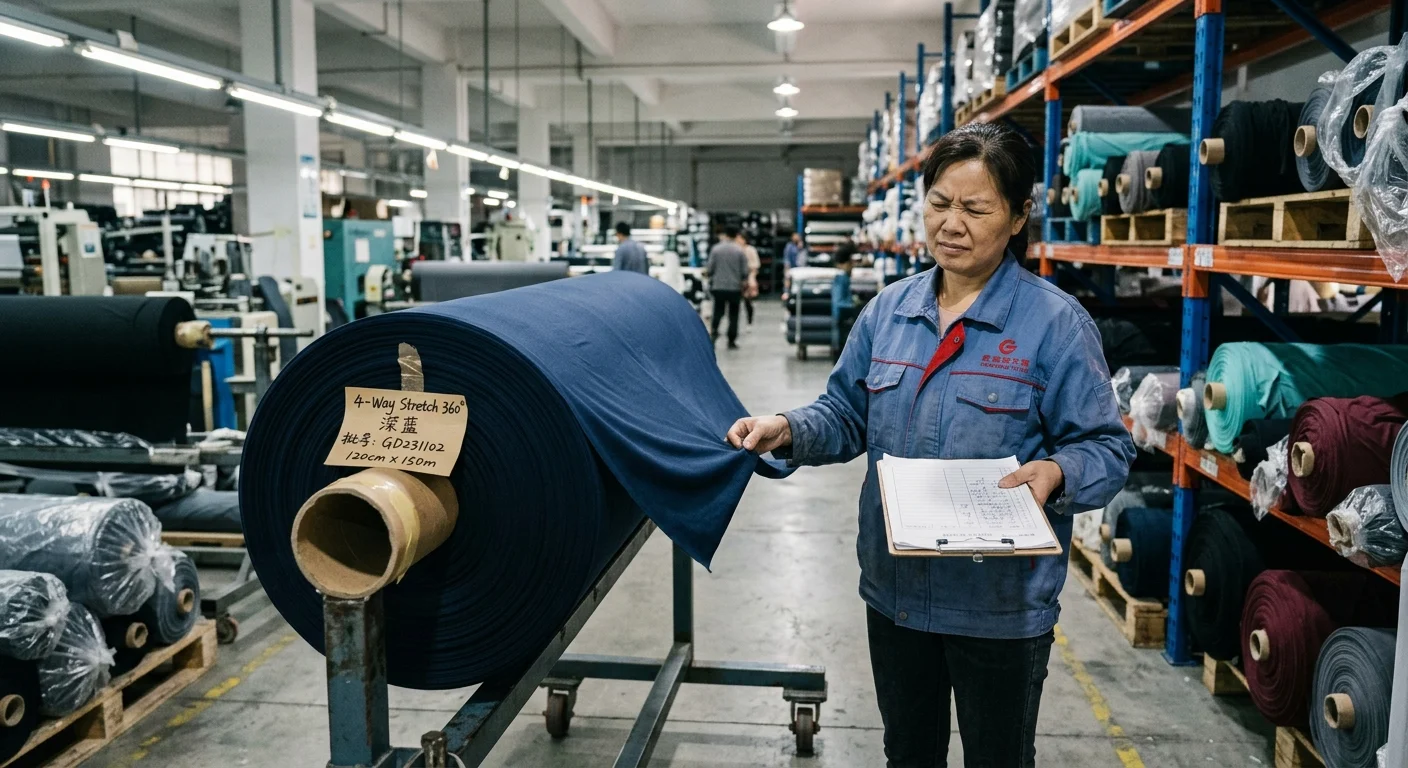
Somewhere in a Guangdong factory right now, a fabric roll is getting tagged "4-Way Stretch 360°." It will fail your customers before the second wash cycle.
This isn't a hypothetical. It's a pattern. The brands that get burned aren't careless — they're trusting yoga apparel supplier spec sheets that contain true statements, arranged to mislead. A single "Stretch: 60%" claim tells you nothing about direction, nothing about recovery, and nothing about what happens to that fabric after fifty squats in a heated room.
Here's how to stop trusting the label and start reading the fabric.
What "Fake 4-Way" Really Looks Like
The most common counterfeit isn't a blatant lie. It's a structural shortcut dressed in marketing language.
True 4-way stretch delivers real elongation in both the warp (lengthwise) and weft (crosswise) directions — with elastic recovery above 95% in both. Fake 4-way gives you strong weft extension (60–80%) and then leans on the knit geometry for warp "stretch" — a mechanical give of just 10–20%, with poor recovery. The fabric moves in one direction. It resists in the other. It still gets labeled "4-Way."
The usual offenders: standard single-face or double-face poly jersey, T/R jersey constructions where spandex runs in the weft only. The fabric feels stretchy on the hanger. It fails on the squat.
How suppliers make this work on paper:
Quote sheets list a single "Stretch 60%" figure — no warp/weft breakdown
Hangtags say "4-Way Stretch" or "360° Stretch" with no supporting test data
Sample yardage comes from a high-spandex batch; bulk production drops to 10–12% spandex instead of the quoted 18–22%
Recovery problems don't show up in early wear — they appear as knee bagging and seat sag by wash five
Spandex content is the diagnostic clue most brands miss:
Spandex % | Real-World Classification | Watch Out For |
|---|---|---|
8–12% | Mainly 2-way | Often mislabeled as 4-way |
15–20% | Marginal 4-way | Warp recovery often fails under load |
20–25% | True high-performance 4-way | Verify structure, not just content |
A legging spec showing 15% spandex in a standard jersey construction is not a 4-way fabric. The number sounds plausible. The construction disqualifies it.
The Grid Test: Your On-Table Verification Method
You don't need a lab to catch a fake. You need a ruler, a fabric marker, and five minutes at the cutting table.
Tools required: A transparent ruler (≥30 cm, graduated to 1 mm), a fine-tip textile marker, a flat cutting surface.
Procedure:
Find a defect-free, crease-free area of the fabric. Lay it flat — no tension, no pulling.
Draw a 5 cm × 5 cm grid square , edges aligned to warp and weft grain lines.
Grip the fabric at opposite sides of the square. Stretch in both directions at the same time to 50% extension — pulling each side from 5 cm to 7.5 cm. Mark your 7.5 cm reference point on the surface before you start.
Hold for 5 seconds (this simulates wear load). Release. Wait 5 seconds.
Measure both edges. Record warp and weft dimensions on their own.
Recovery tolerance formula:
Recovery Error = |Recovered dimension − Original dimension| ÷ Original dimension × 100%
Result | Classification |
|---|---|
Both warp & weft error < 5% (recovering to 4.75–5.25 cm) | ✅ True 4-way — Recovery ≥95% |
Weft error < 5%, warp error 8–12% (recovering to 5.4–5.6 cm or worse) | ⚠️ Fake 4-way — warp recovery ≤92% |
Photograph every test. Record original, extended, and recovered dimensions. The bulk order arrives — run the test again against the same numbers. A warp recovery difference of more than 3% between sample and bulk is a quality deviation. That's not a tolerance.
Lab Verification: What to Demand Before You Release Payment
The grid test tells you what's wrong. A third-party lab report proves it in language that holds up in a dispute.
Before any bulk order ships — and before you confirm sampling — require your supplier to provide a test report from SGS, Intertek, or Bureau Veritas , tested to:
ISO 20932-1:2018 (Determination of elasticity of fabrics — Strip method)
ASTM D3107 (Stretch and growth of woven and knit fabrics)
The report must itemize:
Warp stretch % at specified load
Weft stretch % at specified load
Recovery % after 5-cycle test at 50% elongation — warp and weft listed on their own
Growth (residual deformation) % after 5 cycles
Put these thresholds straight into your PO and tech pack:
"4-way stretch definition: Warp stretch ≥40%, Weft stretch ≥60%, Recovery ≥95% after 50% extension, 5-cycle test (ISO 20932-1 or ASTM D3107)."
What real performance data looks like:
Fabric Type | Recovery After 5 Cycles (50% extension) | Recovery After 50 Cycles |
|---|---|---|
True 4-way performance fabric | 96–98% | 92–95% |
Downgraded fake 4-way | 92–94% at first | Drops to 85–90% — visible as knee/seat bagging |
That 85–90% range is where customer complaints start. It's also the point where the fabric is too far into production to fix.
Dimensional Stability After Washing: AATCC 135
Stretch performance and wash stability fail together. A fabric with low spandex content and poor tension control during finishing will recover badly and shrink in unpredictable ways — often hiding each other's problems until the garment gets worn and washed several times.
Testing protocol — add this to your incoming inspection SOP:
Cut a 50 cm × 50 cm sample with warp and weft marked.
Machine wash at 40°C, standard cycle, with spin cycle (per AATCC 135 specification).
Air dry or tumble dry per brand standard.
Measure warp and weft dimensions after washing. Calculate shrinkage or elongation.
Acceptance standard for 4-way stretch knits:
Warp and weft dimensional change: ≤ ±3%
Either direction exceeds ±5% : expect side seam twisting, leg hem rotation, and pattern misalignment at retail
A low-spandex fabric with poor tension control can shrink sharply in the weft direction after the first wash. It creates the illusion of "good recovery" — the garment is just too small. Size complaints follow fast.
Incoming inspection requirement: Pull at least 3 rolls from different positions in each bulk dye lot (first roll, middle, end). Run AATCC 135 on each. Shrinkage above ±3% means the mill must adjust their heat-setting protocol before you release the rest of the order.
Batch Sampling AQL and Red-Flag Triggers
No fabric arrives the same across every roll. The goal of batch sampling isn't to find perfect fabric — it's to catch the rolls that will cause returns.
Minimum sampling protocol per color per batch:
Pull 3 rolls at random (first roll, mid-batch, final roll)
Cut at least 1.5 m per roll
Run 2 grid tests per roll at different positions — record warp and weft recovery error on their own
Escalation rules:
Trigger | Action |
|---|---|
Recovery rate variance > 3% between any two rolls in the same batch | Expand inspection to all rolls in the batch |
Any single roll with warp recovery error > 8–10% | Flag as suspected fake 4-way; request mill batch records and machine ID; hold goods pending investigation |
Weft stretch > 60% but warp stretch < 25% across multiple samples | Reject the 4-way classification; renegotiate fabric category or reject the shipment |
Lock It Into the Contract
A conversation about quality holds nothing. A PO clause holds everything.
Model language for your tech pack and purchase order:
Stretch and Recovery:
"4-way stretch: Warp stretch ≥40%, Weft stretch ≥60%, Recovery ≥95% after 50% extension, 5-cycle test per ISO 20932-1 or ASTM D3107. Growth ≤5% after 5 cycles."
Dimensional Stability:
"Warp and weft dimensional change after AATCC 135 wash: ≤±3%. Shrinkage exceeding ±5% in either direction is non-conformance."
Fiber Content Tolerance:
"Fiber content: [e.g., Polyester 80–82% / Spandex 18–20%] — tolerance ±1% per ISO 1833 fiber content testing. Any deviation beyond tolerance is material non-conformance."
Consequences:
"If bulk fabric fails to meet stretch, recovery, or dimensional stability criteria, Buyer reserves the right to reject goods, request replacement, or apply a price deduction of X% per non-conforming meter. Third-party lab report (SGS / Intertek / BV) is required as a condition of final payment release."
The Price Signal You're Ignoring
One last filter: a yoga apparel supplier quote for claimed high-performance 4-way fabric that lands well below market rate means the performance spec isn't real.
Reference FOB pricing from South China and Yangtze River Delta mills (at volume):
Spec | Market FOB Range |
|---|---|
150–200 gsm standard poly jersey, 8–10% spandex | USD $2.5–3.5/kg |
200–260 gsm true 4-way performance fabric (Poly/Spandex 78–80/20–22) | USD $4.0–6.0/kg |
A quote for "4-way stretch yoga fabric" at $2.8/kg isn't a deal. It's a 2-way fabric with a better label. The grid test will confirm it. Your customer's Instagram photo will confirm it too — but by then, the order is shipped and the return window is open.
Conclusion
This fabric decision isn't about stretch direction. It's about how your customer feels during her third Warrior II of the morning — and whether your leggings hold up with her.
4-way stretch fabric earns its premium price point through a genuine physical partnership with the body. It moves where the body moves, recovers where the body bends. 2-way stretch, chosen with clear intent and spec'd to a defined standard, still builds an honest, profitable product. The real mistake isn't choosing the "wrong" one. It's choosing either one without a specification sheet, a verified recovery-rate test, and a yoga wear supplier who can back up what's on the label.
Here's your next step: bring the fabric-by-price-tier recommendation table and the pose performance matrix from this guide into your next product development meeting. Let the data lead the conversation. Before your next fabric order ships, run the four-point recovery SOP.
Why does this matter? A mislabeled "4-way stretch" that fails at the seams isn't just a return. It's a one-star review that follows your product listing for years. That kind of damage is hard to recover from.
Build the spec. Verify the claim. Own the quality.