You've found the factory. You've checked their Alibaba profile. Maybe you've even sent a few WhatsApp messages back and forth. Now you're staring at a blank email draft, asking yourself: how do I ask for fabric samples without looking like I have no idea what I'm doing?
Most activewear founders get this wrong. Not because they're unprepared — but because nobody told them that a fabric swatch request to a Chinese manufacturer isn't like placing an online order. It's closer to a mini-negotiation, and it has its own unwritten rules. Get it right, and Chinese fitness activewear suppliers put your inquiry at the top of the pile. They send accurate samples. They take your brand seriously. Get it wrong, and you'll wait three weeks for swatches that look nothing like what you specified.
This is a field-tested, step-by-step playbook for requesting activewear material samples from Chinese suppliers. It covers what to say, what to specify, what it'll cost you, and how to evaluate what lands on your desk.
Pre-Request Supply Chain Screening & Fabric Wishlist Preparation
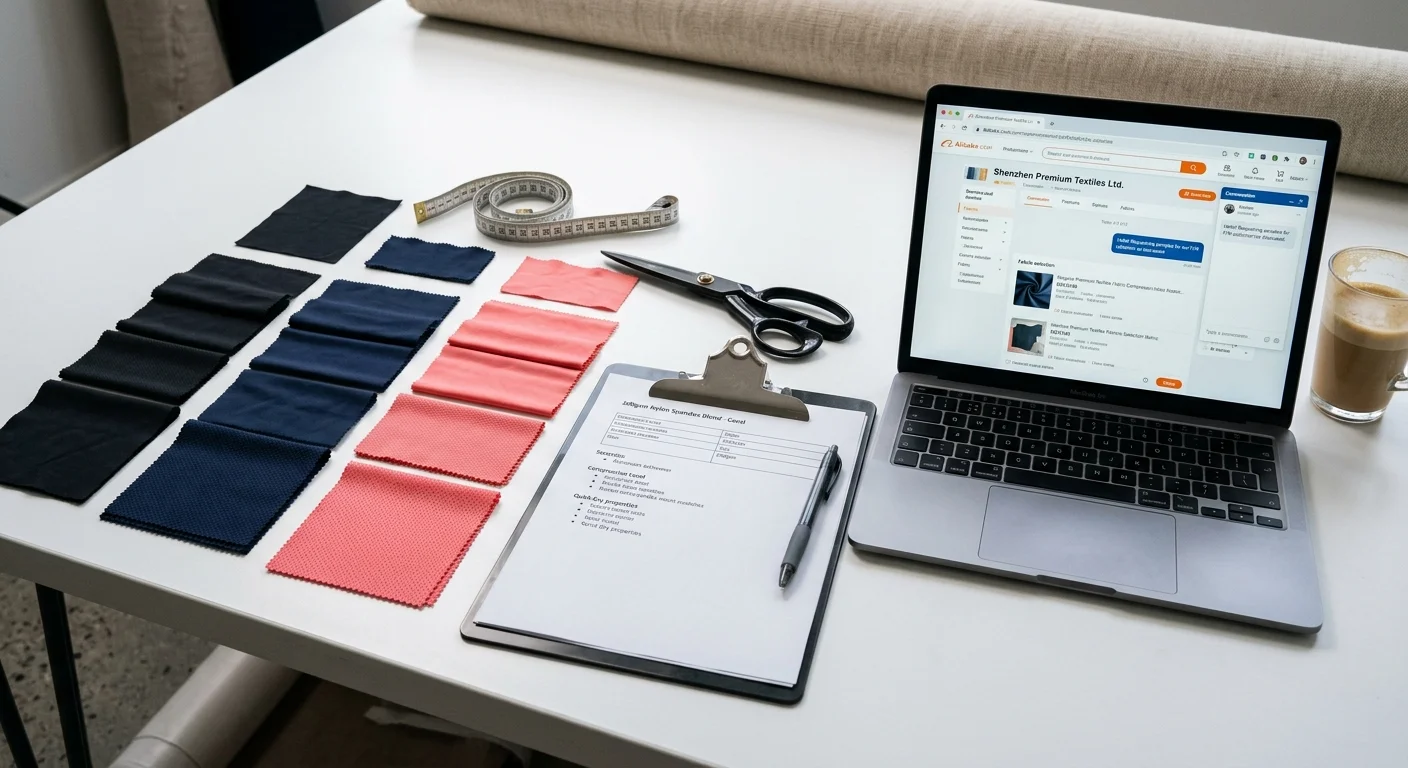
Before you write a single sample request email, there's groundwork that decides whether you get the right fabric — or an expensive pile of wrong ones. That work starts here.
Seasoned activewear sourcing consultants say the same thing: most sample mismatches aren't communication failures. They're screening failures. The buyer contacted the wrong type of activewear supplier, never clarified fabric requirements on their end first, and ended up in a loop of wrong GSMs and off-hand-feel swatches. This section cuts that problem off before it starts.
Step 1: Find the Right Suppliers in the Right Places
China's activewear fabric production is not spread out — it clusters by region. Knowing where to look saves you weeks of dead-end conversations.
Three provinces dominate nylon spandex activewear textile sourcing in China:
Fujian (Quanzhou, Xiamen) — strong in knitted sports fabric, yoga wear fabric, nylon spandex interlock
Guangdong (Guangzhou, Dongguan) — activewear and sportswear factories, nylon spandex knitting mills
Zhejiang (Shaoxing, Ningbo, Suzhou) — warp knit sports fabric, nylon spandex for leggings and bras
Search these regions on Alibaba , 1688 , Global Sources , or SwatchOn (Korea-based but carries Chinese mill stock). Use focused keywords: "activewear fabric," "yoga wear fabric," "legging fabric," "nylon spandex interlock."
Apply these filters right away to cut through noise:
Certifications: BSCI / ISO 9001 / OEKO-TEX / GRS
Main markets: North America / Western Europe
Export percentage: ≥ 60%
On SwatchOn, filter by fiber type (Nylon/Polyamide, Spandex 20–30%) and GSM band — 220–320 gsm for leggings, 160–220 gsm for lightweight tops and bras.
Step 2: Pre-Qualify Before You Ask for Anything
Not every activewear supplier listing "sportswear fabric" on their Alibaba profile specializes in performance activewear. Many are trading companies or generic knit mills that handle everything from dress fabric to school uniforms.
Run every candidate through this shortlist filter before spending time on a sample request:
Product Specialization — Ask straight out:
- "What percentage of your production is activewear or sportswear in the last 12 months?"
- "Can you share 3–5 EU/US customer categories in activewear?"
Certifications — Require visible proof, not just logo badges:
- BSCI or SEDEX (social compliance audit)
- ISO 9001 (quality management)
- OEKO-TEX Standard 100 — Class II for sportswear
- GRS — required if you plan recycled nylon or polyester ranges
Export Experience — Target suppliers with:
- ≥ 5 years of documented export history
- EU, US, UK, Canada, Australia listed as primary markets
- Familiarity with REACH and California Prop 65 — ask them face to face. Their answer tells you everything.
Production Infrastructure — Mills with in-house knitting, dyeing, and finishing under one roof carry far lower lead time risk. Suppliers that outsource dyeing to third-party dye houses add delays and quality variables you don't need.
Step 3: Build Your Fabric Wishlist Matrix Before You Contact Anyone
Most buyers skip this step. They reach out to suppliers with vague references — "something like Lululemon's Align" — then wonder why samples come back wrong.
Build a simple matrix. Fill it out before making any contact. Structure it around these seven columns:
Column | What to Define |
|---|---|
Product Category | Leggings (high-impact / yoga), sports bra (high / light support), crop top, long sleeve training top |
Target Use | HIIT / running, studio yoga / Pilates, all-day athleisure |
Fiber Range | Core: 70–80% nylon, 20–30% spandex (e.g., 75/25, 78/22); optional: recycled nylon (75% recycled PA, 25% spandex) |
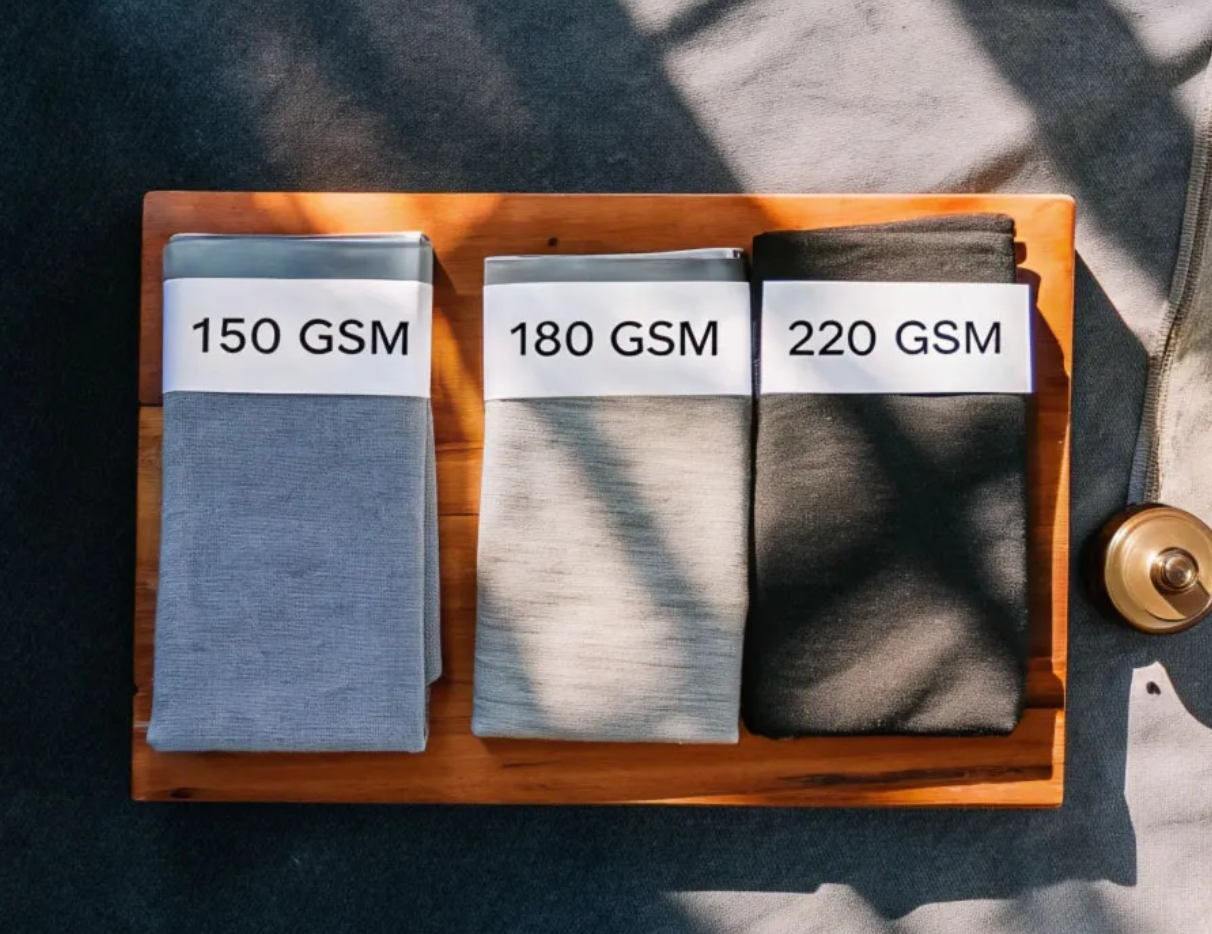
GSM Band | High-impact leggings: 260–320 gsm; yoga leggings: 220–260 gsm; light bra/top: 160–220 gsm |
Construction & Hand-Feel | Single jersey (general leggings), interlock (squat-proof opacity), warp knit tricot (compression/recovery), power mesh (bra panels) |
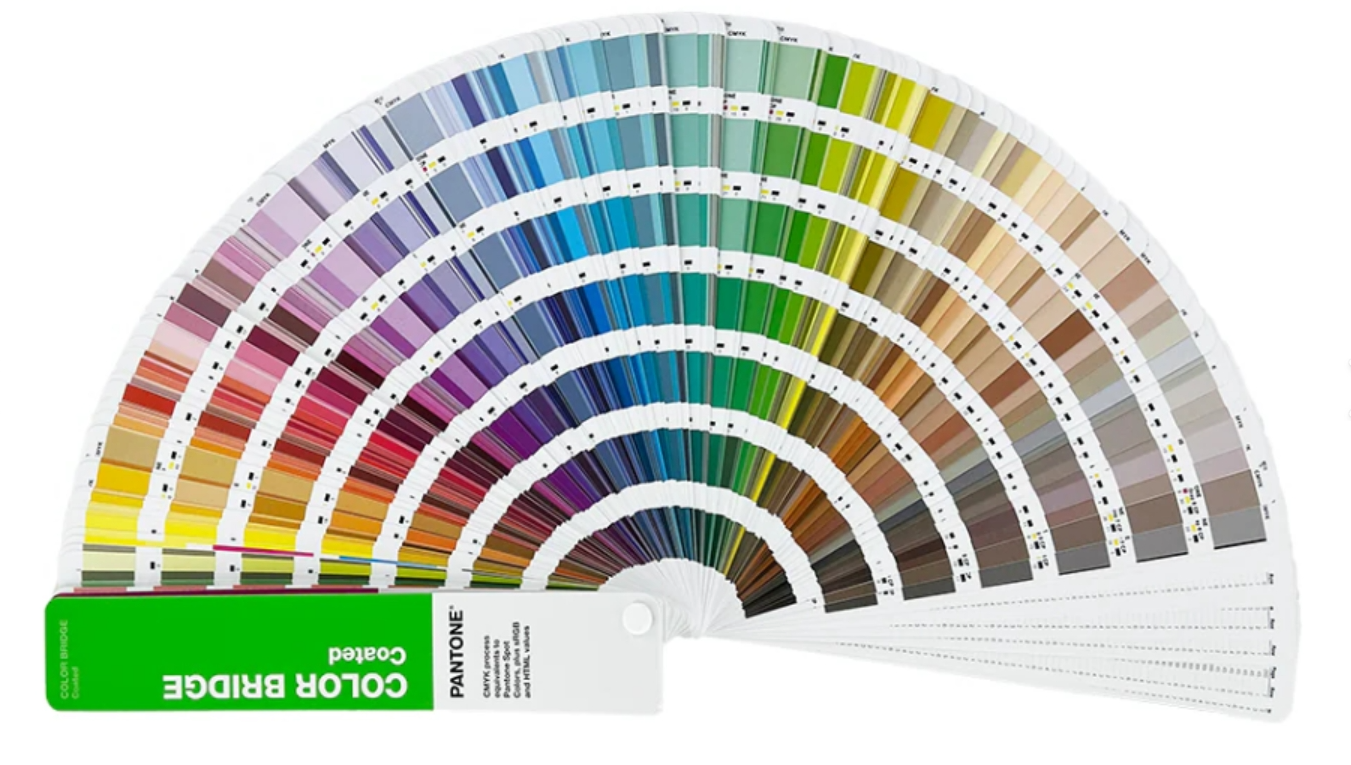
Color Plan | Core darks (black, navy, charcoal), neutrals, 1–2 seasonal pops; define stock colors vs. custom Pantone of activewear |
Compliance Tier | Tier 1: OEKO-TEX only; Tier 2: + BSCI/WRAP; Tier 3: + GRS/recycled fiber traceability |
Hand-feel descriptors matter more than most buyers expect. Use precise language in your matrix:
- "Buttery, cool touch, high drape" = naked-feel yoga fabric
- "Brushed, peach skin, matte" = loungewear warmth
- "Compressive, slick, medium sheen" = high-impact performance
The more exact your language here, the less guesswork activewear suppliers face. Vague descriptions produce vague samples.
Step 4: Understand MOQ Realities Before You Ask for Samples
Get clear on MOQ baselines before you receive swatches. Once a fabric wins you over, it's harder to walk away from an MOQ that doesn't work for your business.
For nylon-spandex activewear mills in China:
Scenario | Sampling MOQ | Bulk MOQ |
|---|---|---|
Stock/ready goods (piece-dye or solution-dyed) | 1–10 m/color (free or USD 5–10/m) | 50–300 m/color |
Custom Pantone on existing greige | Varies | 200–500 m/color |
New fabric development (new knit + new color) | Lab dip only | 500–1,000 m/color |
Ask these three MOQ screening questions before requesting any physical samples:
1. "What is your MOQ for stock colors of existing nylon/spandex activewear qualities?"
2. "What is your MOQ for custom Pantone colors on existing greige of Chinese yoga apparel?"
3. "What is the minimum total order quantity per shipment you prefer?"
Export-focused mills will sometimes accept 200–300 m/color minimums when all colors share the same greige base. But you have to ask. And they'll only flex on this with buyers who come across as serious. That credibility starts with how you request your first sample.
First Contact Email Template & B2B Inquiry Script
Here's the uncomfortable truth: Chinese fabric mills get dozens of sample requests every day. Most get ignored — not because suppliers are rude, but because vague emails signal low-value buyers.
Your first email does two jobs at once. It requests samples and it shows your brand as a serious buyer. A strong subject line gets your email opened by the right person. A weak one gets buried under 40 other cold inquiries.
The Subject Line Formula That Gets Opened
Drop the formal corporate headers. The best-performing subject lines from experienced activewear buyers look like internal threads — short, specific, to the point:
Primary template: Fabric Sample Request for Performance Knits – 220–280 GSM Nylon/Spandex (Buyer: US / [Brand Name])
Shorter variants that work just as well:
- ss25 fabric sampling – [brand]
- new nylon knits – [brand]
- samples for [brand] aw25
Keep it under five words where possible. All lowercase. Include the product type, the season, and your brand name. That combination tells the supplier you're a real buyer with a real timeline.
The First-Contact Email Template (English)
Copy this. Modify the bracketed fields. Send it.
Subject: Fabric Sample Request for Performance Knits – 220–260 GSM Nylon/Spandex (Buyer: [Country] / [Brand])
Dear [Contact Name],
I am [Your Name], purchasing manager at [Brand, Country]. We are sourcing performance fabrics for our SS25 activewear line. We'd like to request fabric swatches for testing — for leggings, sports bras, and training tops. Our projected annual volume is [X,000] pcs/style.
Please share your current ready-stock performance knits or recommended fabrics for high-impact activewear (OEKO-TEX / GRS preferred). We cover express courier costs.
Attached:
– 1–2 reference garment photos (flat lay + stretched state)
– Basic spec table (GSM, fiber %, stretch direction, color requirements)Please confirm:
1. Available sample formats (A4 color cards, 30×30 cm cuts, 50 cm bulk simulation)
2. MOQ per color and lead time for bulk production
3. Price tiers at 500 / 1,000 / 3,000 m per color
4. Your WhatsApp/WeChat and Alibaba Trade Assurance link for faster sample setupLooking forward to your swatch book and pricing tiers.
Best regards,
[Your Name] | [Title] – [Brand]
[Country] | [WhatsApp] | [Email] | [Website]
What to Attach — Keep It Tight
Two files. Nothing more.
File 1 — Reference photos (JPG/PNG, under 2MB):
One flat-lay shot showing front and back. One close-up with the fabric stretched out. This lets the sportswear manufacturer read opacity and recovery behavior at a glance.
File 2 — Spec table (one-page PDF or Excel):
Parameter | Your Target |
|---|---|
Product type | Women's 7/8 leggings / sports bra |
Target use | High-impact training / studio yoga |
Fabric construction | Circular knit / warp knit |
Target GSM | 220–260 gsm (leggings); 180–220 gsm (tops) |
Fiber content | 75–80% nylon / 20–25% spandex |
Stretch direction | 4-way (min. 60% weft, 40% warp) |
Hand-feel | Cool-touch / slick / brushed |
Function | Moisture-wicking, quick-dry, squat-proof, UPF 40+ |
Colors | Black, off-white, neon coral (Pantone reference) |
Certifications required | OEKO-TEX 100, GRS |
Projected volume | [X,000] pcs/style ≈ [Y,000] m/fabric |
The 3-Day Follow-Up (When There's No Reply)
Don't send a second full pitch. Send this instead — 35 words, maximum:
Subject: re: fabric sample request – [brand]
Hi [Name],
Just checking you received our SS25 fabric sample request below. Got ready performance knits with OEKO-TEX/GRS? Please send color cards + MOQ/price tiers. We can confirm DHL shipping right away.Best, [Your Name]
The line "we can confirm DHL shipping right away" is there for a reason. It tells suppliers you're not just browsing — you're ready to move. That one detail shifts how they rank your reply in their queue.
Technical Parameter Specification & Cross-Cultural Communication Pitfalls
Here's a hard truth that cost many sourcing consultants multiple expensive sample cycles: the factory isn't guessing wrong. You're specifying wrong.
The gap between the fabric you imagined and the swatch that lands on your desk rarely comes from supplier incompetence. It comes from incomplete technical briefs. Too much room for interpretation — plus a set of communication dynamics unique to cross-border B2B — catches most Western buyers off guard.
Fix both problems before you send your next request.
The Non-Negotiable Technical Spec Fields
Every fabric sample request for activewear material sourcing in China needs these parameters stated in full — not implied, not approximated, not described with adjectives. Numbers only.
Fiber Composition
State the exact percentage and include a tolerance band in the same sentence. Don't write "mostly nylon with some spandex." Write:
- "78% nylon / 22% spandex, ±3% each fiber."
- For recycled materials: "≥70% GRS-certified recycled nylon, minimum recycled content ≥70%."
Fabric Weight (GSM)
Always pair a numeric GSM range with a tolerance. "Medium weight" means nothing across 40 different mills in Fujian.
- Leggings: "260 gsm ±10 gsm (measured on cutting width basis)."
- Bras and tops: "200 gsm ±10 gsm."
Usable Width
This one gets skipped all the time. State finished usable width — not machine width — after relaxation:
- "Usable width 160 cm ±3 cm, minimum acceptable 150 cm after relax, measured selvedge to selvedge under no tension."
Knit Construction
Name the structure by its proper term. "Stretchy knit" tells a Chinese textile and activewear factory almost nothing:
- Use precise terms: warp knit power mesh, weft-knit single jersey, interlock, double-knit scuba.
- Add gauge where opacity matters: "32–40 gauge warp knit for squat-proof opacity."
Stretch Performance
For any activewear fabric claiming 4-way stretch, specify direction and percentage — with the test method attached:
- "Stretch ≥70% in both warp and weft directions (ASTM D2594, load 4.5 N, 5-minute hold). Please report warp and weft numbers as separate figures in your lab sheet."
Recovery / Permanent Set
This is the spec that separates performance fabric from regular knit fabric:
- "Permanent set after 50% extension <5% (ASTM D2594 / BS EN 14704-1)."
- "Fabric growth after 2 hours on hanger ≤3% length, ≤2% width."
Moisture-Wicking and Quick Dry
Use time-based numbers only. Vague claims like "moisture-wicking performance" can't be tested or verified:
- "Wicking height ≥10 cm in 10 minutes (AATCC 197)."
- "Drying time ≤45 minutes on hanger after standard home wash at 20–25°C, 65% RH (AATCC 201)."
Opacity (Squat-Proof)
State the exact stretch condition and the pass threshold:
- "No visible skin or underwear at 130% extension on body form for any color with L >70. Minimum opacity 98% at 130% extension via instrumental light transmission test."*
- Require fit photos or a short video from the supplier at that stretch percentage. Don't accept verbal confirmation here.
Shrinkage
This is the most skipped spec — and one of the most expensive to miss:
- "Max residual shrinkage ≤3% length and ≤3% width after 3 home washes at 40°C (AATCC 135 / ISO 6330). Any result exceeding this tolerance is grounds for rejection."
Pilling and Abrasion
- "Pilling resistance ≥ Grade 4 after 5,000 rubs (Martindale, ISO 12945-2)."
- For leggings: "Abrasion resistance ≥10,000 rubs Martindale, Grade 4 appearance, no breakdown."
Color Fastness
Three separate requirements — don't lump them together:
- Washing: "≥ Grade 4 (ISO 105-C06 / AATCC 61)."
- Dry and wet rubbing: "Dry ≥ Grade 4; wet ≥ Grade 3–4 (ISO 105-X12 / AATCC 8)."
- Perspiration: "Acid and alkali perspiration ≥ Grade 4 (ISO 105-E04 / AATCC 15)."
Compliance and Chemical Restrictions
State these upfront — not after samples are approved:
- OEKO-TEX Standard 100, Product Class II (direct skin contact)
- GRS certificate holder and scope number if recycled fibers are involved
- "Conform to ZDHC MRSL v3.1 Level 1 minimum. No azo dyes releasing banned amines, no formaldehyde >75 ppm, no PFAS in any DWR treatment."
Ready-to-Copy Tech Spec Block
Drop this straight into your spec sheet or RFQ. Replace the bracketed values with your own targets:
Composition: 78% nylon / 22% spandex, ±3% each fiber
Weight: 240 gsm ±10 gsm
Width: Usable 160 cm ±3 cm, min 150 cm after relax
Structure: Warp knit 4-way stretch, gauge 32–40
Stretch: ≥70% warp / ≥70% weft (ASTM D2594, 4.5 N, 5 min)
Recovery: Permanent set after 50% stretch <5%
Quick dry: ≤45 min on hanger post-wash (AATCC 201)
Opacity: ≥98% at 130% extension (light transmission)
Shrinkage: ≤3% length and width after 3x wash at 40°C (ISO 6330)
Pilling: ≥ Grade 4 / 5,000 rubs (ISO 12945-2)
Color fastness: Wash ≥4, dry rub ≥4, wet rub ≥3–4, perspiration ≥4
Compliance: OEKO-TEX Std 100 Class II; ZDHC MRSL v3.1 Level 1
Cross-Cultural Communication Pitfalls — And How to Fix Each One
Technical specs solve half the problem. The other half is communication behavior — and this is where most Western buyers silently damage supplier relationships without seeing it happen.
Pitfall 1: Vague Hand-Feel Descriptors
"Buttery soft," "Lululemon-like," "not too shiny" — experienced Chinese fabric sales managers filter these phrases out because they can't be tested. They also mean different things in different factories.
Fix: Replace feel language with measurable references. Send an actual reference garment where possible. Write: "Match weight, stretch, and surface sheen of attached reference sample. GSM 240±10, stretch ≥70% both ways, matte finish." Visuals of texture and drape on a mannequin do more work than any adjective.
Pitfall 2: Missing Tolerance Ranges
Most mills treat ±5–10% variance as standard unless you say otherwise. That assumption produces GSM mismatches, width problems, and off-shade swatches.
Fix: Add tolerances line by line throughout your spec:
"GSM 240 ±10 gsm; usable width 160 cm ±3 cm; composition ±3% each fiber; shade ΔE ≤1.0 vs approved lab dip (CIELAB, D65, 10°)."
Pitfall 3: The "We Will Try" Response
This is the most culture-specific pitfall on the list. In high-context communication cultures, a direct "no" from a supplier is rare. Phrases like "we will try," "should be okay," or "no problem" don't always mean what they sound like to a Western buyer. They often mean: "I'm not sure, but I don't want to disappoint you."
Fix: Convert every capability question into a closed, measurable format:
- Don't ask: "Can you do good pilling resistance?"
- Ask instead: "Can you meet pilling Grade 4 after 5,000 rubs per ISO 12945-2? Please answer YES or NO, and attach your most recent third-party test report."
Asking for a test report moves confirmation from verbal to documented. It also tells the supplier you're the kind of buyer who follows up.
Pitfall 4: Lab Dip vs. Bulk Color Mismatch
Different mills have different internal definitions of "acceptable" color variation. Without a number written into your brief, bulk fabric can ship 2–3 ΔE off your approved lab dip — and no one technically broke the terms.
Fix: Specify color tolerance in writing before lab dips are submitted:
"Bulk must match approved PANTONE [XXX C] and signed lab dip. Bulk tolerance: ΔE ≤1.0 average, ≤1.5 max vs lab dip, measured under D65 and TL84 illuminants. No visible bariness or streaks at 130% stretch."
Pitfall 5: Hidden MOQ Assumptions
A mill quotes 300 m/color MOQ. You plan to order 300 m/color. Then the invoice arrives with a 20% small-order surcharge no one mentioned. This happens because cultural norms around small orders create reluctance to bring bad news to the buyer unprompted.
Fix: Ask these questions before samples are approved:
- "Is the stated MOQ of 300 m/color valid for the first order AND repeat orders?"
- "Is there a surcharge for orders below your standard MOQ? Please quote the percentage or cost per meter."
- "What is the minimum sample yardage available before bulk commitment — 50 m? 100 m?"
Pitfall 6: Different Definitions of "4-Way Stretch"
Some Chinese mills label any elastane-containing knit as "4-way stretch" — even if the warp direction delivers little real elongation. For activewear, this is a serious problem. A legging with weak warp stretch will bag at the knee after two wears.
Fix: Specify direction and percentage as separate figures, with the test method attached:
"We require stretch ≥70% in both length and width directions, measured per ASTM D2594, load 4.5 N, 5-minute hold. Please report warp stretch and weft stretch as separate numbers in your test sheet."
Pitfall 7: Ambiguous Test Standards
"Good color fastness" and "good pilling" without a standard number mean nothing in a cross-border context. China, the EU, and the US default to different test methods for the same performance attribute.
Fix: Always pair the requirement with the standard number and grade:
- Not: "Good pilling"
- But: "Pilling ≥ Grade 4, ISO 12945-2, Martindale method, 5,000 rubs"
Follow up with: "Please confirm which test method you use and send a recent third-party report from SGS, Bureau Veritas, or Intertek."
Pitfall 8: Hiding Test Failures Until It's Too Late
Some factories hold back lab failures or production problems until the order is already mid-production — partly due to face-saving norms, partly because they expect to fix the issue before you notice. By the time it surfaces, your timeline is already squeezed.
Fix: Address this in your purchase terms, not just your brief:
"Supplier must disclose all lab results, including failures. No shipment proceeds if any key parameter from the agreed spec table fails, without written buyer waiver. Disclosing issues early will not result in automatic order cancellation — it opens the door for adjustments."
That last sentence matters. It tells the supplier that transparency is safe — and that's the shift that actually changes how they communicate with you.
Getting your technical parameters right and your communication approach dialed in are two different skills. Both are learnable. And both pay off in the same place: you get an accurate pre-production sample approval on the first or second round instead of the fifth — saving weeks of back-and-forth and keeping your launch timeline on track.
Real-World Sample Cost & Logistics Timeline Reference
Budget uncertainty kills momentum fast. Nothing stalls early-stage sourcing quite like not knowing what things cost. So here are real numbers — not textbook ranges, but figures that activewear buyers run into again and again when requesting fabric samples from Chinese mills.
What You'll Pay
Sample Type | Fee Range | Courier Cost (EU/US) | Prep Time | Transit |
|---|---|---|---|---|
A4 Color Card / Swatch Book | Free–$20 | $25–60 | 2–5 days | 3–7 days |
Hand-Loom / 30–50 cm Cut | $10–30/flat | $30–55 | 3–7 days | 3–7 days |
Custom Lab Dip / Special Finish | $50–150 | $35–65 | 5–10 days | 3–5 days |
New Composition Knit Development | $80–200+ | $40–70 | 10–25 days | 3–7 days |
All-in landing cost — your real budget numbers:
- Swatch card: $25–80 total
- Cut length: $40–110 total
- Lab dip / special finish: $85–215 total
- New development sample: $120–270+ total
Most sample fees get credited back against your first bulk invoice once a PO is confirmed. Small development fees are typically waived at a $3,000–5,000+ order value . Larger programs get negotiated one by one.
The Timeline That Matters
Three paths. Three very different timeframes:
Stock swatch + courier → door-to-door in 4–7 days
Lab dip / cut + one revision round → 10–20 days
New composition development + approval + resample → 3–6 weeks
Build in at least one revision round. Color, hand-feel, and finish don't usually come back right on the first dispatch. Expect a second pass.
Logistics, Payments & Customs — The Practical Checklist
Use your own DHL/UPS/FedEx account. You get full routing control and cleaner chargeback tracking that way. For sample deposits, standard payment options are PayPal, Wise, bank transfer, or Alibaba Trade Assurance.
On the customs activewear side, declare an accurate commercial value — one that lines up with your local duty thresholds. Make sure every shipment includes:
- Commercial invoice + packing list
- HS code ( 5903 for coated fabrics; 5408 for woven artificial filament)
- Fabric code, color code, gross weight, dimensions
- Courier tracking number
Also ask the supplier to label each sample with fabric construction, finish, colorway, lot reference, and your sample request ID. It feels like extra admin. But three mills' swatches arriving in the same week is a real scenario — and proper labeling is what keeps things straight.
Tech Confirmation & Follow-Up Communication Protocols
Samples get lost right here — between "yes, we'll send it" and what shows up in the box.
The fix isn't chasing suppliers harder. Send one structured confirmation email before anything ships. That single document locks in every parameter. It cuts ambiguity. And it gives you a paper trail to reference if something arrives off-spec.
The Pre-Shipment Tech Confirmation Email
Send this after the supplier quotes but before they pack anything.
English version:
Subject: Tech Confirmation Before Sample Shipment – [Fabric Code]
Thank you for the quote. Before shipping, please confirm the attached datasheet matches the samples you will send:
– Fiber content [%]
– GSM
– Usable width
– Stretch direction and stretch %
– Color fastness targets (washing / rubbing / perspiration)Please attach the latest lab reports if you have them — pilling, color fastness, shrinkage.
Print the fabric code and composition on a label. Fix it to each swatch or roll.Ship to: [Company], [Full Address], [Contact], [Phone], [Email].
Declare on invoice and airway bill: "Fabric swatches – Sample only – Not for resale."
Declared customs value: US$[X].Send the tracking number on dispatch day.
Please reply to confirm you understand all points above.
The Status Follow-Up (When Dispatch Goes Quiet)
Subject: Follow-Up – Fabric Sample Request Sent [Date]
Quick update needed on the sample we sent [Date]. Can you confirm dispatch status and estimated ship date? We have a design review on [Date] — timing matters.
Three things to confirm:
– Are all requested colors/qualities ready to ship?
– Are any items delayed or substituted?
– What courier and tracking number will you use?If the original date won't work, propose a new one. We'll adjust on our end.
What to Do the Moment Samples Arrive
Receipt is not the finish line — it's the starting gun. Run this sequence within 72 hours:
Cross-check labels vs. datasheet — fabric code, composition, colorway. Any gap here points to bigger production problems down the line.
Spot-measure GSM and width on 1–2 samples on your own. Don't rely on the sportswear supplier's numbers alone.
Pull stretch in both directions and compare against your ≥70% spec.
Email a receipt confirmation listing every discrepancy — even small ones — in writing.
That documentation habit is what separates buyers who get fast resolution from those who spend weeks arguing over whose memory is correct.
15-Metric Fabric Evaluation Checklist & Performance Standards
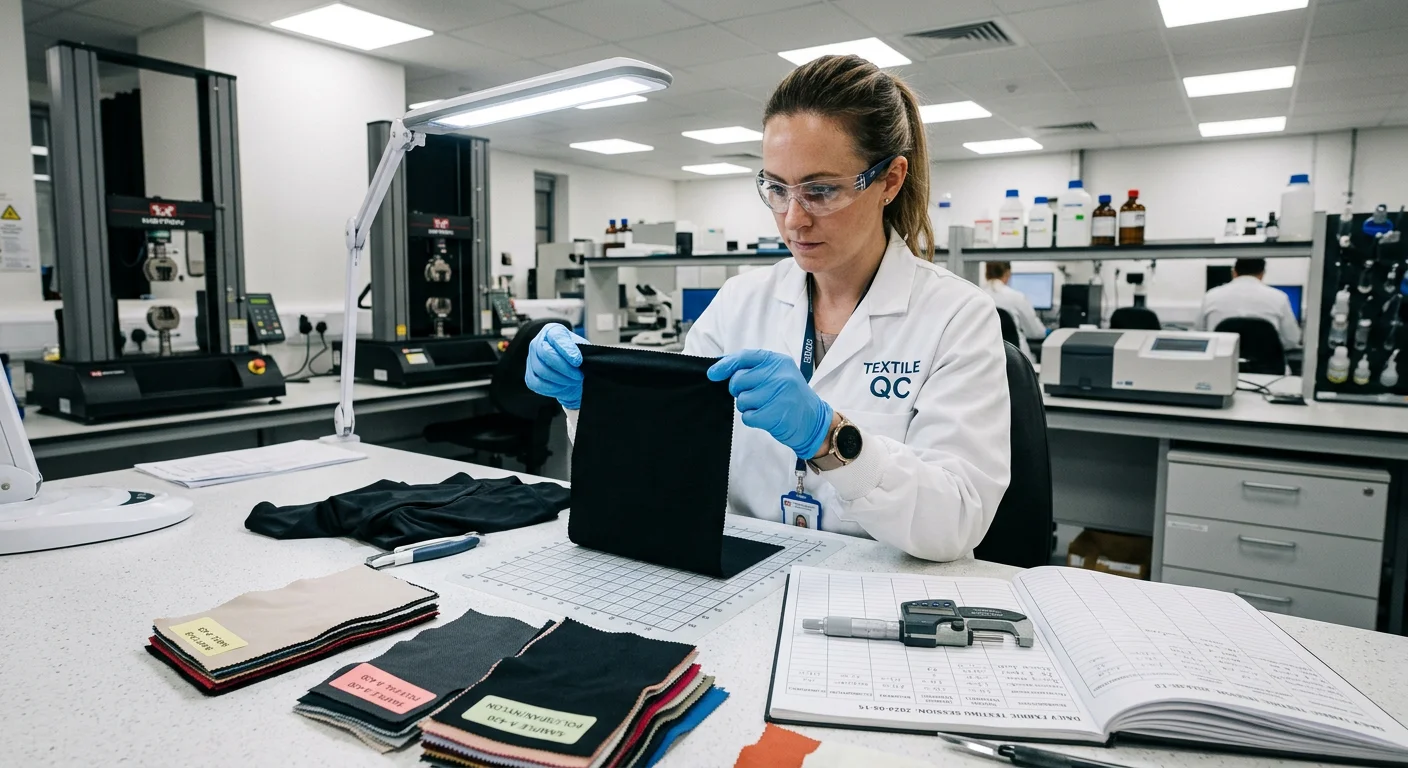
The swatch arrives. You hold it up, squeeze it, stretch it once in each direction, and decide it feels good. That gut-check approach costs brands thousands of dollars every year in pre-production rejects and post-launch returns.
Feeling fabric isn't evaluating fabric. Here's the system that works.
The checklist below covers 15 measurable metrics. Each one has a specific pass threshold pulled from AATCC, ASTM, and ISO testing standards used by activewear QA teams worldwide. Work through every metric in sequence. Document everything. Don't skip the ones that feel obvious.
The 15 Metrics — Standards, Targets, and What Failure Looks Like
1. Color Uniformity & Shade vs. Standard
Measure against your approved lab dip using CIELAB delta E. Acceptable range: ΔE ≤1.0–1.5 for bulk lots. Visual grey scale for color change after washing: ≥Grade 4 (AATCC 61 / ISO 105-C06). Roll-to-roll shade variation should fall within ½ grey scale grade . Under a D65 lightbox at 1 meter, there should be zero visible streaks, barring, or broken floats.
2. Major Surface Defect Rate
Using the 4-point inspection system: ≤1 major defect per 10 linear meters , minor defects ≤5 per 10 m . Document defect type and location. A high defect rate on samples means bulk will be worse.
3. GSM vs. Spec
Measure per ASTM D3776 / ISO 3801. Acceptable tolerance: ±5% — or tighter at ±5 gsm for performance knits. A spec of 250 gsm means your acceptable window runs 245–255 gsm. Go outside that band and stretch, recovery, and opacity all shift. Those shifts compound as you move through production.
4. Usable Width
Lay the fabric flat for 24 hours with zero tension, then measure between selvages. Minimum: ≥150 cm net usable , with roll-to-roll variation ≤2 cm . Edge curl on single jerseys should stay ≤10 mm ; interlocks ≤5 mm . Usable seam allowance must clear at least 1.2 cm each side .
5. Knit Structure & Loop Density vs. Spec
Confirm construction type — warp knit (tricot/raschel) vs. weft knit (single jersey, interlock). Record wales per cm (WPC) and courses per cm (CPC). Tolerance: ±5% vs. spec . A notation like "Nylon/Spandex weft knit, 28 gg, 18 WPC × 22 CPC" gives you a reference point for every bulk roll that follows.
6. Stretch Percentage (Width Direction)
Test per ASTM D2594 / ISO 14704-1 at 4.5–7 N load. Target for activewear bottom weights: 60–80% width stretch , 30–60% length stretch . True 4-way stretch products should deliver a combined warp + weft stretch ≥140% . Get warp and weft numbers reported as two separate figures — not averaged together.
7. Recovery / Permanent Set
Extend fabric to 80% of maximum safe stretch for 5 cycles. Relax flat for 10 minutes. Residual growth (permanent set): ≤5% for premium performance; ≤8% as the outer acceptance limit. Anything above 8% in either direction points to elastane breakdown or poor yarn integration. This metric is what separates a legging that holds its shape through 50 washes from one that bags at the knee after five.
8. Opacity at 120–130% Stretch
No instruments required — but run the test correctly. Stretch the swatch to 120–130% of its relaxed width under 1,000–1,500 lux light over a skin-tone or black card. Pass: no visible skin or underwear outline. Conditional: slight shadowing is acceptable in dark colors only. Light and pastel colorways must be opaque — no exceptions. Supplier claims of "squat-proof" mean nothing without this test.
9. Moisture Spread Time
Per AATCC 79 / AATCC 195. A water droplet on a hydrophilic finish fabric should spread in ≤2 seconds . After 60 seconds, the wetting ring should cover ≥3× the original drop area . For hanger dry time: put 0.1 ml water on a 10×10 cm swatch at 20–24°C, 50–60% RH. Dry-to-touch target: ≤30–60 minutes .
10. Pilling Grade at 5,000 Rubs
Martindale method, ISO 12945-2 or AATCC 129. Minimum acceptable: Grade 4 after 5,000 rubs on the 1–5 scale. Premium specs push to 10,000 rubs at Grade 3–4 . For legging abrasion resistance, the target is ≥20,000 rubs before yarn breakdown .
11. Shrinkage After Wash
Three home launderings at 40°C, line dry (AATCC 135 / ISO 5077). Maximum acceptable: ≤3% in both length and width . Skew/torque: ≤3% . A shrinkage result above 5% in either direction is an automatic reject — not a negotiation.
12. Seam Performance
Seam slippage at 180 N load: ≤4 mm (ASTM D1683 / ISO 13936). Seam breaking strength: ≥150 N for knits in key structural seams. Run tests on both cross-grain and on-grain orientations.
13. Color Fastness to Wash and Crocking
Washing (AATCC 61 / ISO 105-C06): color change ≥Grade 4 ; staining on multifiber ≤Grade 4 . Dry rubbing (AATCC 8): ≥Grade 4 . Wet rubbing: ≥Grade 3–4 . Perspiration — acid and alkaline (AATCC 15 / ISO 105-E04): color change and staining both ≥Grade 4 . For outdoor or high-UV applications, light fastness (AATCC 16 / ISO 105-B02): ≥Grade 4 after 20 hours Xenon arc .
14. Compliance Verification
Pull the actual OEKO-TEX Standard 100 certificate — don't accept a logo on a PDF. Check that the specific fabric article number is listed in scope. Verify the validity date. Confirm the issuing institute on the OEKO-TEX database. For recycled fiber claims, GRS or RCS certification must show an unbroken chain of custody from fiber → yarn → fabric, with valid Transaction Certificates at each stage. Missing or unverifiable documents are an automatic fail.
15. Traceability & Composition Match
Each roll must carry:Chinese activewear supplier name, batch code, color code, fabric code, and production date. Batch codes must match across the roll selvage, packing list, and COA. Fiber composition tolerance per ISO 1833: ±3 percentage points vs. invoice (e.g., a 75/25 nylon/spandex spec accepts 72–78% nylon). Low elastane content is the most common miss here. It's also what causes stretch and recovery failures earlier in the process.
How to Use This Checklist: Pass, Conditional, or Reject
Run all 15 metrics. Then use these three decision rules:
PASS — Move to Tech Pack
All 15 metrics are within spec. Marginal values (e.g., wash fastness at Grade 3–4 rather than 4) are documented and signed off as acceptable for the end-use application.
CONDITIONAL — Proceed with Adjustments
One to three metrics fall outside spec but can be fixed through pattern grading changes, color standard resets, or documented tolerance relaxation. Write any conditional approval into the tech pack and bulk PO. A pre-production roll retest is required before production starts.
REJECT — Request New Lot or Alternative Fabric
Each of these triggers automatic rejection — no exceptions, no negotiation:
- Opacity fail on light or pastel colors at 120% stretch
- GSM deviation >±8–10% or usable width <145 cm when 150 cm is required
- Pilling after 5,000 rubs, or shrinkage >5% in either direction
- Wash fastness or wet crocking
- Missing, expired, or unverifiable OEKO-TEX certificate; unsupported recycled fiber claim
Send a written failure report with photos, test data, and the specific corrective action needed before you accept any new sample submission.
Conclusion
You now have what a seasoned sourcing consultant brings into their first factory meeting. Most buyers never reach this point before placing an order.
Here's the hard truth about activewear material sourcing from China : suppliers don't prioritize buyers who look like they're guessing. They prioritize buyers who know the language — not Mandarin, but GSM weights, recovery rates, and pre-production approval cycles. That's what this guide gave you.
You have three tools in hand:
Your email templates
Your 15-metric fabric evaluation checklist
Your cost-and-timeline reference table
These aren't just resources. They're your credibility on paper.
Send a structured fabric swatch request with clear technical parameters. That one move tells every serious sportswear textile supplier in China that you're worth their best samples — not their leftover stock.
Now stop reading. Open your inbox, pull up Template One, and send your first request today.
The factory clock doesn't start until you do.