Most brands never see what happens after they approve a sample and place a bulk order. The garments come back — sometimes perfect, sometimes not — and there's rarely a clear explanation for why. That uncertainty is where quality problems hide.
So here's a behind-the-scenes look at how we run final garment inspection on every yoga and activewear order before it leaves our sportswear factory floor:
The AQL sampling inspection level we follow
How we classify every defect we find
What our QC team checks, stitch by stitch
Why none of it is as complicated as it sounds — once you can see it for yourself
Pre-Shipment Verification & AQL Sampling Execution

Inspection doesn't start when the QC team walks onto the floor. It starts before a single garment gets touched.
The 80% Rule: When Inspection Can Begin
We hold a hard threshold: at least 80% of the total order quantity must be produced and packed before we kick off pre-shipment inspection (PSI). That's not arbitrary. QIMA and most serious inspection firms worldwide use the same standard. On top of that, 80% of export cartons must be sealed, labeled, and palletized . Carton counts get cross-verified against the packing list and PO quantities — per size, color, and SKU.
A finished quantity below 95% of the PO gets flagged as a short shipment. The decision goes back to the buyer. Any style/color/size ratio that deviates more than ±3% from the packing list gets recorded as a packing non-conformity — before AQL sampling starts.
Document Cross-Match Before Anyone Pulls a Single Garment
Every required document must be present and verified before sampling begins:
The latest PO and any approved amendments
Certified tech pack with tolerance tables, stitch specs, and seam allowances
Sealed PP sample — this is the gold standard everything gets compared against
Approved fabric BOM (fiber content, GSM range, functional finishes)
Labeling and packaging instructions down to hangtag position and polybag warnings
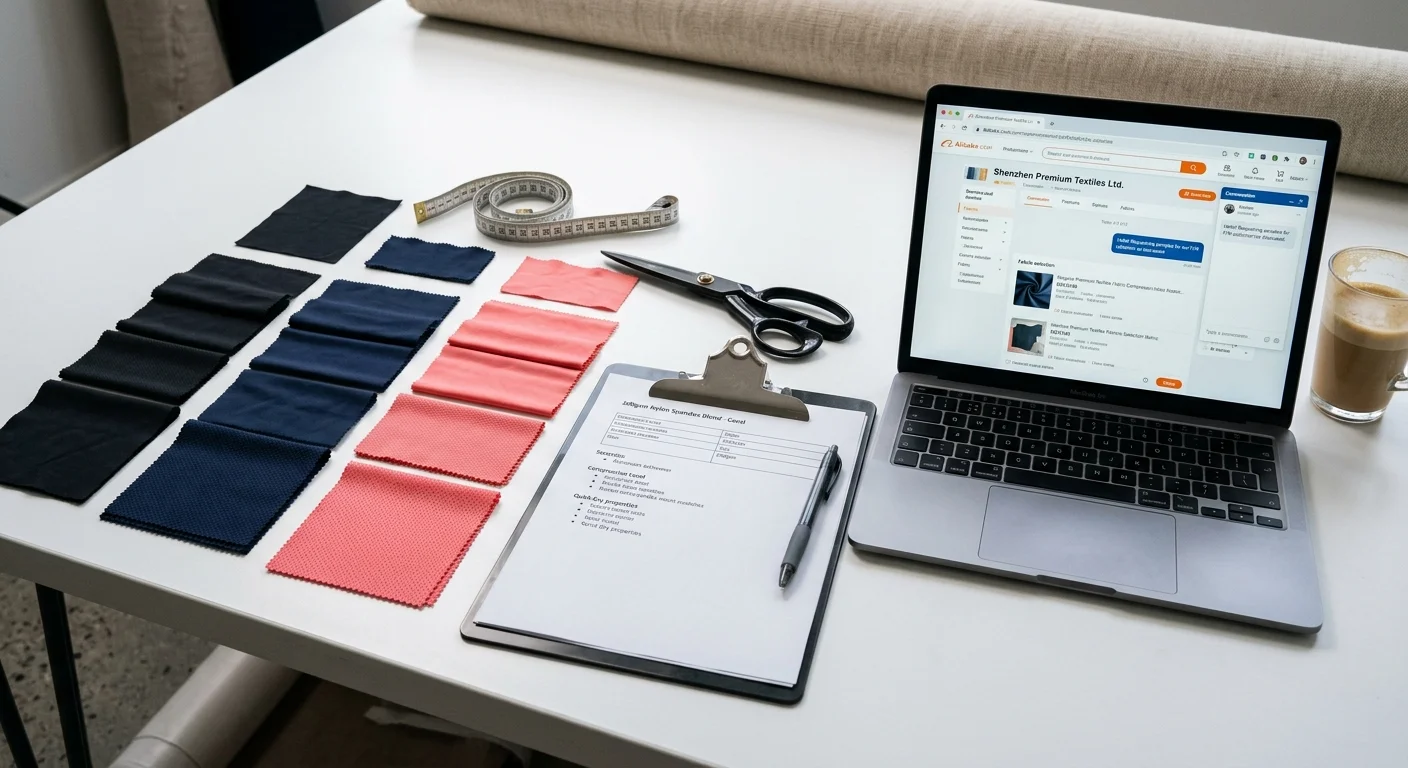
Our inspector cross-checks cutting markers, bundle tags, and fabric lot IDs against the BOM. We also pull inspection tickets from at least three fabric rolls. This confirms GSM and fiber composition fall within tolerance — ±5% GSM and ±3% fiber ratio. Any unauthorized substitution — wrong fabric, unapproved trim change — puts the entire PSI on hold.
How AQL Sampling Works
We follow ANSI/ASQ Z1.4, Normal Inspection, General Level II — the same standard referenced as ISO 2859-1. Each inspection lot is defined by a unique combination of style + color + PO. Lots cannot be merged.
Defects fall into three tiers:
Defect Type | Examples | AQL Level |
|---|---|---|
Critical | Incorrect fiber label, sharp objects, contamination | 0.0 — zero tolerance |
Major | Failed seams, measurement out-of-tolerance, wrong branding | 2.5 |
Minor | Loose threads, minor print misalignment | 4.0 |
For a lot of 501–1,200 units , the sample size is 80 pieces (Code Letter J). At AQL 2.5 for major defects: accept at 5 or fewer, reject at 6. One critical defect anywhere in the sample — the lot fails on the spot.
The Randomization Protocol That Prevents "Hide-and-Seek" Defects
Carton selection runs through a digital random number generator — screenshot saved in the report. We pull from top, middle, and bottom of the warehouse across different pallets. Yoga apparel Factory staff sometimes suggest which cartons to open. The inspector rejects that input and reselects on their own.
Inside each carton, a second randomizer determines which positions and sizes get pulled. No defective piece gets swapped out once it enters the sample. It stays in. It gets counted.
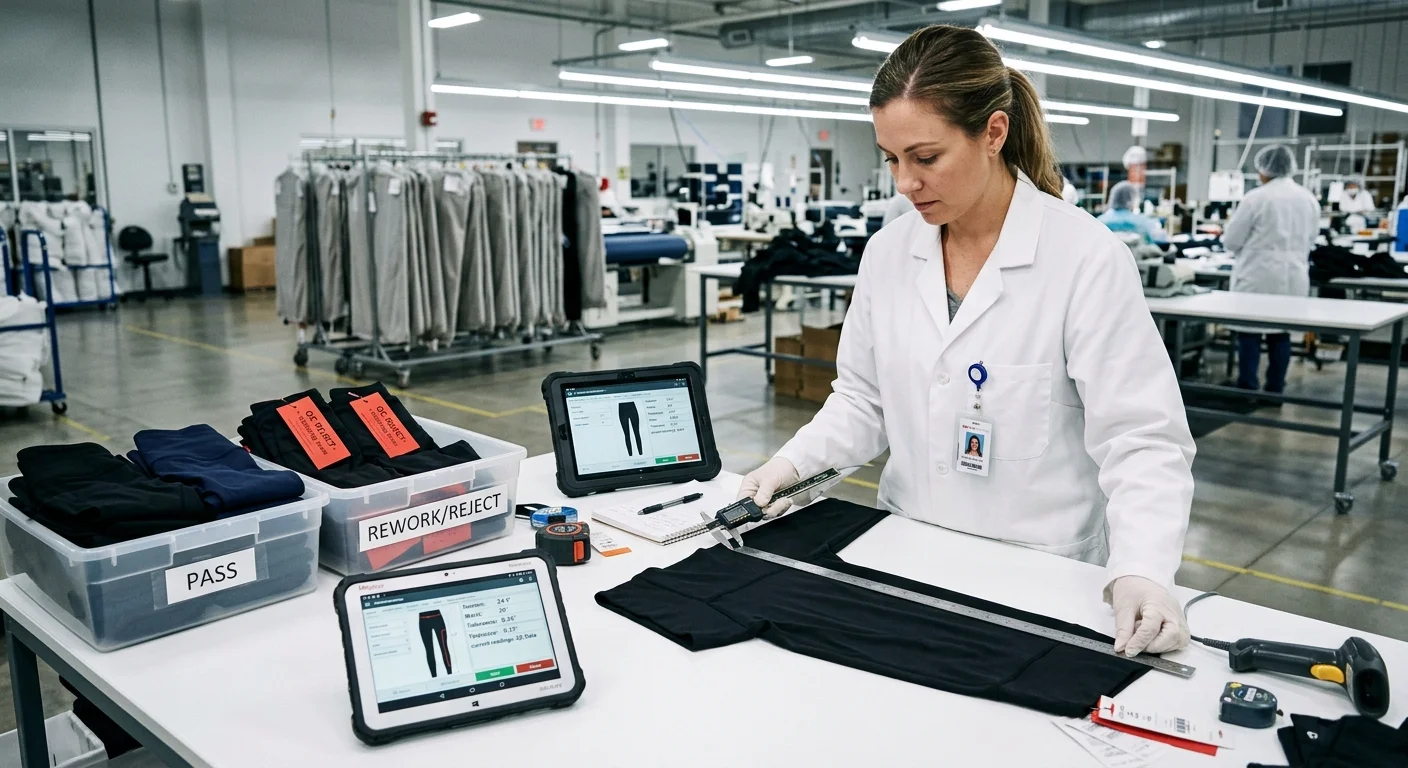
Two lead QC technicians split the work — one owns visual workmanship and packaging, the other handles fabric and trim conformance against the BOM and PP sample. A third specialist handles measurements using digital calipers and a tablet-based measurement app . Every data point gets time-stamped and locked to a piece ID.
Any lot that fails AQL goes back for 100% re-screening before re-inspection is on the table.
Visual Workmanship & Yoga Leggings Stitching Inspection
Pull a finished yoga legging off a bulk production rack. Hold it under a D65 light source. What you see — before a single measurement gets taken — tells you most of what you need to know about whether a yoga wear factory cares.
This is where the inspection gets detailed. Every seam, every stitch, every heat-transfer edge. Our visual workmanship check covers seven structural zones: waistband, side seams, inseams, crotch gusset, ankle hems, pocket entries, and logo placements. Each zone has its own pass/fail criteria. None of it is subjective.
Stitch Type, Stitch Density, and Why They're Not the Same Thing
Yoga leggings use three primary stitch constructions. Each one gets inspected against its own specification — not a generic "looks fine" judgment.
Flatlock seams (crotch, inseam, panel joins) are the structural backbone of the garment. In high-tension zones — seat, inner thigh, crotch gusset — we require 10–12 SPI (stitches per inch) . Drop below that and the seam doesn't just look wrong. It fails under load. Seam width needle-to-needle runs 4–6mm , with a tolerance of ±0.5mm along the entire seam length . Thread tension gets tested by stretching the seam to 150–200% of its natural length. No tunneling. No thread pop. No visible loops breaking the surface.
4-thread overlock on inside construction seams runs 8–10 SPI on medium-weight fabric (200–260 g/m²). On lighter high-stretch constructions where seam grinning risk increases, that steps up to 10–12 SPI . Chain-off ends are secured at 3–5cm with backtack or bar-tack — no raw chain hanging free. Any exposed fabric edge greater than 1mm running longer than 10mm is a major defect . It gets logged right away.
Coverstitch on hems and waistband topstitch runs 8–10 SPI with twin-needle spacing of 3.2–4.0mm . The two thread lines must stay parallel to within ±0.5mm . Laddering — where the underside chain unravels under stretch — gets caught by pulling the hem to 150% and checking in real time. Not after it relaxes back.
Bartacks are required at pocket openings, drawcord exits, and gusset endpoints. Each should run 6–10mm in length at 28–32 stitches . Fabric showing through the bartack under normal light means it's understitched. A missing bartack where the spec calls for one is a major defect — one count per location .
Crotch Gusset: The Zone That Fails Most Often
The crotch gusset is the highest-stress point in any yoga legging. It's also where factories cut the most corners.
We check gusset attachment with double-needle flatlock requiring overlap of ≥6mm . Left and right seam allowances must match within ±0.5mm . Asymmetry here causes the gusset to torque under wear. Tip alignment gets checked against the front and back rise centerline. Misalignment beyond 5mm in either direction is a major defect .
Beyond the visual check, every gusset gets a manual stretch test. Hold the waistband in one hand, the lower leg in the other, and pull to 150–200% of natural length — three to five reps. No audible thread break. No seam opening greater than 1mm after the stretch releases. Needle holes enlarged beyond 0.7–1mm around the crotch point signal needle damage or over-punching. That's also classified as major .
Fabric Surface Screening: What the Camera Sees That the Hand Misses
Perfect stitching doesn't guarantee a pass. A garment can still fail visual inspection at the fabric level. On naked poly-spandex and nylon-spandex — the main constructions in yoga activewear — the surface tells its own story.
Critical defects with zero tolerance:
Oil, grease, or silicone spots of any size on visible zones (front rise, thighs, waistband)
Needle punctures or holes visible without stretching
Shading bands or barré lines visible at 60cm under D65 light — particularly on solid dark colorways
Dye migration or color halo around logo prints or contrast panels exceeding 1mm
Brushed fabric surfaces get checked for bald spots and brushing strip marks longer than 10mm . Visible pilling on new goods is a major defect . Pre-production lab results need to confirm Grade 3–4+ on Martindale after 5,000+ rubs before bulk cutting starts.
The squat-proof check runs on one size-M garment per color per lot under bright direct light. Visible skin tone or underwear pattern at the seat or upper thigh = major defect . The entire fabric lot goes on hold for review. Not just the individual piece.
Labels, Logos, and the Defects That Trigger Automatic Batch Failure
Heat-transfer placement tolerance is ±0.5cm in both axes. Misalignment greater than 1.5cm from the spec position is a major defect . Adhesion gets tested by hand — 10 to 20 rubs across the transfer surface — checking for edge lifting, cracking, bubbling, or ghost outlines.
Care labels and fiber content are where critical defects live. Wrong fiber percentage, missing country of origin, absent care instructions — any one of these triggers an automatic batch failure . No negotiation. No rework path. The labeling gets corrected and the lot gets re-inspected from scratch.
Drawcord ends, eyelets, and any hardware follow the same hard line. Broken, deformed, or sharp edges on any metal or plastic component = critical defect .
How Defects Get Classified and Routed
Every non-conforming piece found during visual inspection gets a red QC tag. It moves straight to a dedicated repair station — separate operators, separate machines, separate workflow from the main production floor. The rework log captures style, size, defect type, operator ID, and date.
Defect thresholds per 80-piece sample lot:
Classification | Threshold | Consequence |
|---|---|---|
Critical | 0 allowed | Batch FAIL on first finding |
Major | ≤5 accepted | Fail at 6+ |
Minor | ≤7 accepted | Fail at 8+ |
Pull a defect rate above threshold on the AQL sample and the scope expands right away to 200–315 pieces — or a 100% check for that lot. Reworked garments don't re-enter export cartons on the inspector's word alone. They go through a full visual and stitching re-inspection first. No second-grade goods ship in export packaging unless it's pre-agreed, labeled separately, and documented in the order file.
Measurement Tolerance in Garment Inspection & Spec Calibration
A yoga legging that fits in size S but runs loose in size M — from the same bulk production run — isn't bad luck. It's a spec calibration failure. And it happens more than most brands expect.
Every pass or fail in our measurement inspection ties back to one control document: the tech pack spec sheet . That document must define every Point of Measure (POM) before a tape measure touches a single garment. Three things need to be locked in:
The target measurement for each size
The tolerance band (±) around that target
The garment state during measurement — relaxed, flat, or stretched
Miss any one of those three, and the inspector is guessing. We don't accept that.
The Tolerance Numbers That Matter for Activewear
General knitwear benchmarks give you a starting point: ±1 cm on body width, ±1.5 cm on body length. Yoga leggings aren't general knitwear, though. Compression zones — waistband, hip, upper thigh — need tighter control. We hold ±1.0 cm on every fit-critical compression point. Lower-tension areas like the full inseam or ankle extension use the standard ±1.5 cm allowance.
Here's the full breakdown across key POMs for yoga bottoms:
Point of Measure | Tolerance | Measurement State |
|---|---|---|
Waistband height (relaxed) | ±1.0 cm | Flat, relaxed |
Hip cross width | ±1.0 cm | Flat, relaxed |
Front rise / Back rise | ±1.0 cm | Flat, relaxed |
Thigh width | ±1.0 cm | Flat, relaxed |
Full inseam | ±1.5 cm | Flat, relaxed |
Leg opening circumference | ±1.0 cm | Flat, relaxed |
Crotch depth | ±1.0 cm | Flat, relaxed |
Waist and shoulder dimensions on similar constructions run ±0.75–1.0 cm — tighter than body length. Fit failures at those points show up the moment someone puts the garment on. A 2 cm deviation at the hip is not a minor defect. It becomes a one-star review.
The Measurement Protocol: Flat, Relaxed, Consistent
How you measure matters just as much as what you measure. Our protocol holds firm on three points.
First: measure flat. Every garment lays on a calibrated flat board — no bunching, no pulling, no variation between operators. Before reading side opening width, shift seam allowances slightly inward. That way you're reading the actual opening, not the folded seam edge.
Second: don't stretch the garment unless the POM calls for a stretched measurement. Stretch specs apply to waistband recovery and compression recovery tests. Those get their own dedicated entries in the spec sheet. Everything else measures in its natural relaxed state.
Third: give garments time to rest. Garments packed in polybags or stacked in cartons hold compression. They need time to recover before you measure them. Our standard is a 24-hour rest period for knit and stretch fabrics before final dimensional inspection. Fabric memory under compression throws off readings. One hour off the shelf is not enough.
Size Coverage and Escalation Logic
We don't spot-check one size and clear the lot. Every inspection pulls three sizes — S, M, and L — and checks each one against the master spec sheet on its own. Results feed into our QC measurement table in real time. Automated pass/fail flags tie straight to the tolerance thresholds in the spec sheet.
One POM out of tolerance on a pulled piece triggers expanded batch measurement — not a flag-and-move-on. The inspector checks a broader size range across additional cartons before the lot can move forward.
Some buyers don't submit tolerance specs with their tech pack. It happens more than it should. In those cases, our inspectors fall back on the half-grade rule : half the size grade increment becomes the working tolerance. That's an industry fallback, not a preferred approach. The right answer is a complete, spec'd tech pack before production starts — not a judgment call on the inspection floor.
Activewear Functional Performance & Seam Strength Testing
Dimensions don't lie. But they don't tell you whether a legging survives a hot yoga session, holds its shape after twenty washes, or stays opaque when your customer drops into a deep squat under studio lighting. That takes a different kind of testing — one that goes beyond measurements.
Functional performance inspection is what separates a serious activewear factory from one that just ships boxes.
Seam Strength: The 150 N Minimum That Matters
The crotch gusset, inner leg seams, and waistband anchors on a yoga legging take a beating. Repeated high-load stretching, lateral torque, and sweat saturation across hundreds of wear cycles — most people never consider these forces. We check every one of these zones against hard minimum numbers. No "feels strong enough" guesswork.
Our seam strength protocol references ASTM D5034 for knit construction checks. It also aligns with performance benchmarks used by third-party labs including Bureau Veritas and Intertek:
Minimum seam strength before rupture or stitch pop: ≥ 150–200 N (≈ 15–20 kgf)
Seam slippage at 180 N load: ≤ 4 mm
On the factory floor, this means a manual pull test on every lot. We apply 15 kg to the crotch gusset, shoulder straps, and waistband anchor points. Any stitch pop or fabric tear at that load is an immediate failure. Not a "monitor and see." The garment goes straight to the repair station.
Bonded and taped seams — the kind used in premium chafe-free constructions — get their own peel-strength check. The standard: ≥ 2–4 N/cm peel resistance on bonded hems and logo tape edges. We verify this after five to ten wash-dry cycles. Any edge lift, adhesive bleed, or delamination voids the lot. Full stop.
Stretch, Recovery, and the 92% Rule
A yoga legging that bags at the knee after the first wear hasn't failed at the seam. It's failed at the fabric. Our stretch and recovery checks run against ASTM D2594 and ASTM D3107 , targeting:
Stretch (crosswise): > 80–120% at specified load for 4-way poly/elastane constructions
Permanent set after recovery: < 5–8%
Our working spec is tighter than the general industry floor: 40% crosswise extension held for 30 seconds, requiring ≥ 92% recovery . That's the standard a premium-tier waistband or compression panel needs to pass. Anything that doesn't spring back gets flagged — noted in the data log and marked on the physical sample.
Waistband durability runs a 20-cycle full-stretch protocol . The pass criteria are clear: zero permanent deformation, zero edge rolling on 3–5 cm wide bands, zero elastic slippage within the casing. That's stricter than many commercial minimums. It's also what your customer notices the moment she puts the legging on for the third time.
Moisture Management: Numbers Behind the "High-Wicking" Claim
"Wicking fabric" is one of the most overused phrases in activewear marketing. Every second brand uses it. Very few can back it up with test data.
We can. Our functional fabric checks run AATCC 195 (Liquid Moisture Management Test) on knit constructions used for leggings, bras, and training tops. Here are the benchmarks we hold for performance claims:
Performance Metric | Minimum Threshold | Applies To |
|---|---|---|
Overall Moisture Management Capacity (OMMC) | ≥ 0.40–0.60 | High-wicking polyester/elastane jerseys |
Spreading speed (bottom surface) | ≥ 10–15 mm/s | High-intensity training pieces |
One-way transport index | > 200% | "Dry touch" outer-face claims |
Simpler constructions go through the AATCC 79 absorbency drop test. Target: the water drop disappears within ≤ 1–2 seconds. That's the baseline. Anything slower and "quick-wick" comes off the spec sheet — and off the hangtag.
Breathability, Opacity, and the Squat Test Protocol
Opacity and breathability pull in opposite directions. Brushed "squat-proof" leggings with tight construction often drop air permeability to 30–80 L/m²/s to gain coverage. That's acceptable, as long as moisture management makes up for it. Lightweight poly/elastane jerseys need to hit 100–300 L/m²/s at 125 Pa (per ASTM D737 ) to support real breathability claims.
Water vapour resistance follows ISO 11092 . We target Ret 6–13 for standard yoga and gym garments. Above Ret 20, the fabric is not suitable for high-sweat use — no matter how good it looks on a hanger.
The squat test isn't standardized across the industry. Every brand runs its own protocol. Ours: one size-M garment per color per lot, placed on a fitting form under 500–1000 lux white lighting. We assess it at 30–50 cm and 2–3 m distances after 10–20 squat cycles . Pass criteria: zero visible skin outline, zero underwear pattern, zero point-thinning at the glutes, crotch, or waistband seam intersections. Any see-through at the glute or waist panels under frontal and backlighting means rejection of the full fabric lot — not just the single garment tested.
Colorfastness: What Grade 4 Requires
Dark nylon and polyester leggings are where colorfastness failures hit hardest. Color transfer onto light-colored furniture, dye rubbing onto skin after a sweaty class, fading after five machine washes — these complaints generate returns and kill repeat purchase rates.
Our minimum standards for bulk activewear:
Colorfastness to laundering (AATCC 61 / ISO 105-C06): ≥ Grade 4 color change and staining
Colorfastness to perspiration (AATCC 15 / ISO 105-E04): ≥ Grade 4 stain on nylon, polyester, acetate
Dry crocking (AATCC 8): ≥ Grade 4–5 after 10 rub cycles on white cotton
Wet crocking: ≥ Grade 3–4 after 10 cycles
For dark colorways — black, navy, deep olive — wet crocking is the harder spec and the most common failure point. A Grade 3 on wet crocking from a dark nylon blend isn't a close call. It's a fail. The lot doesn't move until we trace the root cause back to the dyeing stage and get it corrected.
Packing and Labeling Inspection & Export Carton Audit
A garment can pass every stitch test and hit every measurement spec — then still create a warehouse nightmare the moment it lands at a retailer's distribution center. A barcode scans wrong. A carton label lists the wrong size. A suffocation warning is missing from a polybag. These aren't small details. They trigger chargebacks, customs holds, and returns that no one ever traces back to the real source.
This is where the inspection shifts from the garment itself to everything around it.
Label Compliance: What Gets Checked and Why It Can't Be Eyeballed
Every label on a finished yoga legging — fiber content, care instructions, country of origin, size — gets checked against the approved artwork file and tech pack . Not from memory. Not from a previous shipment's label.
For US market shipments , the compliance checklist under FTCA / 16 CFR 303 & 423 is non-negotiable:
Fiber generic names listed in descending order by percentage (e.g., "87% Nylon, 13% Elastane" — not brand names, not abbreviations)
Registered Number (RN) or company name present
Country of origin on permanent label
Care instructions that cover at least one safe cleaning method with no contradictory instructions
Fiber percentage tolerance is ±3 percentage points per component against the approved spec. A label reading 97% Polyester / 3% Spandex when the spec calls for 95/5 falls inside tolerance. A label reading 90/10 does not.
EU shipments follow Regulation (EU) 1007/2011. The label must use approved fiber names from Annex I only — "elastane" is correct, "spandex" is not. Abbreviations fail. Shell and lining with different fiber compositions each need their own label. Care symbols must follow ISO 3758, with local language text for the destination country.
Care labels also go through a wash durability spot check — one to three pieces, one domestic wash cycle. Pass criteria: label stays readable, no more than 10% print loss, no bleeding.
A wrong fiber percentage is a major defect . A missing country of origin, a missing suffocation warning on a polybag, or a mismatched barcode that could cause a mis-shipment — those are critical . The lot stops.
Heat-Transfer and Woven Label Placement
Neck labels and waistband labels must sit within ±0.5 cm of the position in the spec. That goes for both heat-transfer and woven constructions.
Heat-transfer labels go through a manual rub test — 10 to 20 passes across the surface. We check for edge lifting, cracking, ghosting, and incomplete transfer. A tape pull test (standard cellophane tape, three repetitions) confirms no logo or text flakes off. Adhesive residue on the outer fabric near the label position is an automatic fail — no discussion needed.
Woven labels get checked for loose threads, frayed edges, and puckering against the knit base fabric. Stitching must hold at 3–4 stitches per centimeter at minimum. A label that pulls away under light tension isn't just a cosmetic issue. It's a wearability failure waiting to generate a return form.
Polybag Verification: Thickness, Warnings, and Construction
Each polybag gets measured at three points — center plus two edges — using a micrometer. The standard spec is 40 ±3 microns (acceptable range: 37–43 μm). Outside that range is a major defect.
For US and Canadian shipments, a polybag opening of 5 inches or more in any direction requires a choking/suffocation warning by law. The wording must match the buyer's approved template or CPSC language. Font size minimum: 10–12 pt , visible with the bag sealed. A missing warning on an eligible bag is a critical defect — full stop, no exceptions.
We check seal integrity across all seal types — side seal, bottom seal, and self-adhesive flap. Seal width must meet spec ( ≥5 mm ) with no open areas or pinholes. Air-escape holes are counted and measured against spec (2–4 holes at 5 mm diameter). The self-adhesive flap glue must hold under repeated pressure with zero glue overflow onto the garment .
For sea shipments, silica gel desiccant sachets — 2 × 10 g per export carton — are checked for presence, count, and placement. Each sachet must carry "Do Not Eat" text in the destination language, plus yoga apparel supplier ID and manufacturing date where required. No sachet goes into direct contact with children's garments where the buyer spec prohibits it.
Barcode Scanning and SKU Matrix Verification
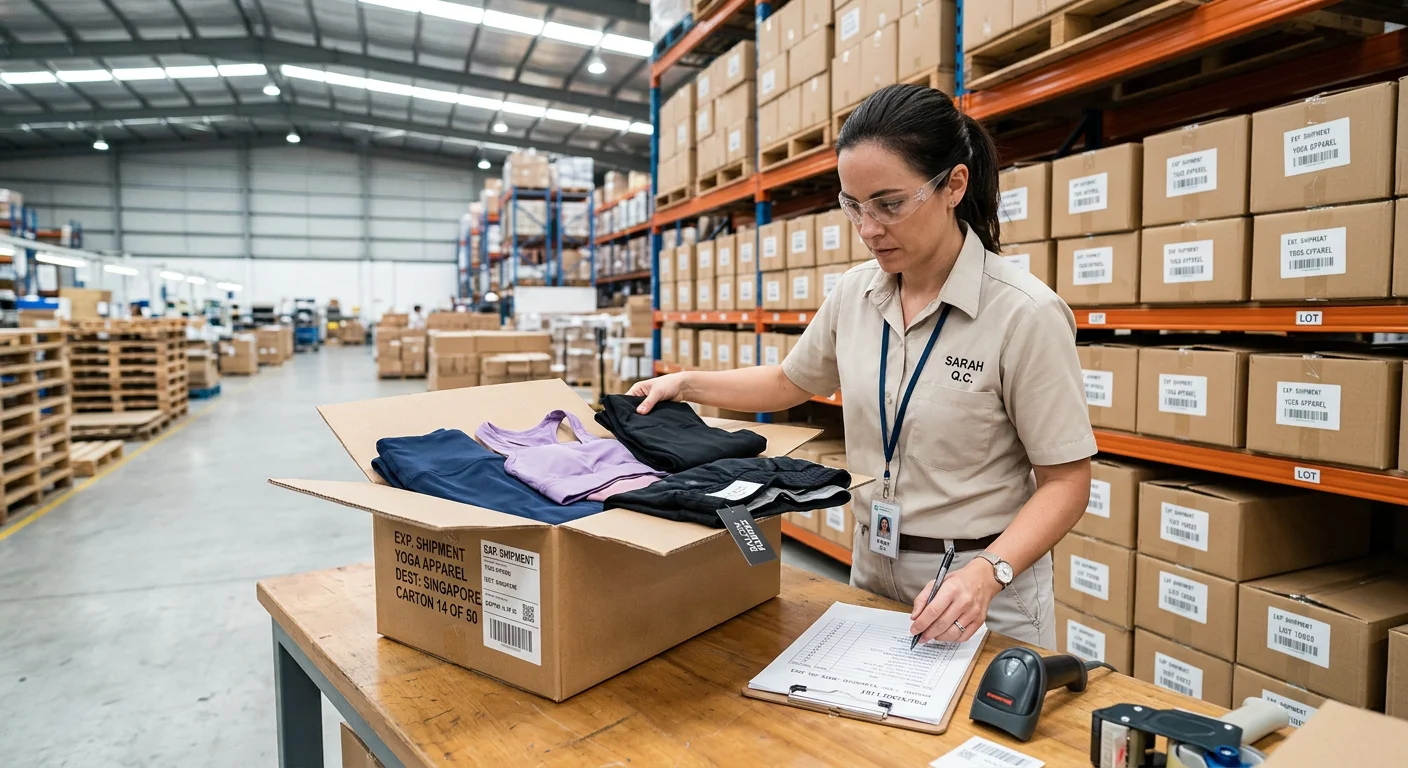
The scanning standard is clear: 100% scan pass rate across all unit barcodes (hangtag and polybag), inner pack labels, and export carton labels within the inspection sample. A handheld scanner linked to the digital packing list checks UPC/EAN code, style code, color code, and size code against the PO in real time.
The human-readable text printed under each barcode must match the encoded data exactly . No exceptions. No "close enough."
Placement matters too. Hangtag barcodes need 5 mm minimum clear space from all edges and cannot sit on folds or seams. Export carton barcodes go on two adjacent sides , lower right corner, 5–10 cm from the bottom edge . A barcode that scans fine but sits on a crease that a warehouse scanner can't read is still a failure at the receiving dock.
Any size, color, or price-region mismatch against the master SKU matrix — or duplicate barcodes across different SKUs in the same shipment — gets classified as critical .
Export Carton Audit: Board Grade, Dimensions, and Drop Testing
The carton is the last line of defense across 10,000 kilometers of ocean freight.
Standard export cartons must be 5-ply corrugated double wall unless the buyer has approved something else. The spec benchmarks:
BC flute double wall
Edge Crush Test (ECT): ≥ 44 ECT (275# burst equivalent)
Side-wall compression strength: >150 lb/in²
Flute orientation must run vertically for stacking strength. We check the yoga apparel manufacturer's certificate stamp — burst strength, ECT rating, maximum gross weight — on each carton where available.
Carton dimensions are measured (L × W × H outside) against the spec sheet. Tolerance: ±0.5 cm . Full carton weight is compared against the master packing list. Tolerance: ±0.5–1.0 kg depending on carton size.
Sealing tape runs 48–72 mm wide , H-taped top and bottom with no unsealed gaps greater than 5 cm . Where PP strapping is used, a minimum of two straps go on at firm tension — tight enough not to slip, not so tight as to crush the edges.
For the drop test , we follow ISTA 1A protocol on selected packed cartons:
Cartons under 10 kg: 0.76 m (30 inch) drop height
Sequence: 1 corner drop → 3 edge drops → 6 face drops
Pass criteria: no structural carton failure, zero polybag rupture , no moisture ingress, no crush zones that compromise stacking. Garments inside get checked for seam strain and permanent creasing against buyer tolerance. Every test gets documented — carton ID, weight, drop sequence, damage notes, and photographs — and recorded in the Carton Audit Report .
Carton Marks: The Compliance Checklist That Closes the Inspection
Every export carton label gets compared line by line against the buyer's packaging manual and PO. Required fields:
Shipping mark, PO#, style#, color, size range, quantity
Carton number / total cartons (sequential and unique)
Country of origin — font height ≥ 1 cm, no handwriting
Gross/net weight and carton dimensions
Handling pictograms per ISO 780 ("This Side Up," "Keep Dry," etc.) on required surfaces
Carton serial numbers get cross-checked against the packing list for sequential accuracy. Then we open selected cartons. The actual contents — size, color, quantity — must match the label exactly . Any mismatch is a critical defect . Not a note to monitor. A stop.
Final Audit Before Shipment Report & 18-Point Master Checklist
Every step in this article — the AQL sampling, the stitch counts, the squat tests, the carton audits — feeds into one final deliverable: a single inspection report. That report either releases your order or stops it cold.
Here's what the report contains, and the 18-point checklist that drives it.
What the Report Documents
We generate our pre-shipment inspection report digitally. It gets timestamped, inspector-tagged, and locked to your PO the moment the final check closes. This isn't a summary. It's a complete evidence file.
Every defect photo carries a tag: PO number, style/SKU, defect code, carton ID, size, and inspector ID. A cracked heat transfer on a size-M black legging from Carton 14 doesn't get described in a paragraph. It gets a code (e.g., 301 — label defect), a photograph, and a location reference. The measurement matrix shows actual vs. spec for every POM across S, M, and L. Out-of-spec points get auto-flagged in red. Functional test logs record each test step — stretch cycles, rub count, pull force — as a timestamped pass/fail entry.
The final output: one consolidated PDF. It includes checklist results, a measurement table, defect statistics, photos, and a clear verdict at the top.
PASS. CONDITIONAL PASS. FAIL.
No ambiguity. No room for interpretation.
The Three Verdicts — and What Triggers Each One
PASS requires all three conditions:
- Critical defects: 0
- Major defects: within AQL 2.5 allowance
- Minor defects: within AQL 4.0 allowance
A PASS triggers warehouse release and logistics booking confirmation to the forwarder. The order moves.
CONDITIONAL PASS applies when minor defects run above the AQL ceiling — within 10% of the minor limit — but the flaw is localized and repairable. The required path has two steps. First, 100% sorting of the affected SKU or color. Second, 50% random re-inspection under tightened criteria. Shipment releases after the re-inspection report clears. Not before.
FAIL stops everything. One critical defect anywhere in the sample — a needle fragment, a missing suffocation warning, a wrong fiber content — locks the batch. Majors or minors that exceed AQL after re-sampling get the same result. The lot goes on hold. A CAPA (Corrective and Preventive Action) response is due within 24–48 hours : root cause, containment plan, corrective action, and prevention plan. Both production and QA management must sign off.
Some buyers add a clause at this point: the next two lots require inline inspection plus final 100% inspection, at the yoga apparel factory's cost.
Carton QR Traceability
Each master export carton carries a unique QR code tied to its PO, carton number, and production batch. Scan it — from our warehouse, your freight forwarder's dock, or your own receiving team — and you land on a B2B portal page. That page holds the full report PDF, carton packing list, lab test reports, defect photos, and current inspection status.
That's the transparency layer. It closes the information gap between the factory floor and your warehouse door.
The 18-Point Master Checklist
Use this against any Activewear Supplier . These are the specific checks — with pass/fail thresholds — that a serious yoga garment QC process must cover.
A. Appearance (6 Points)
# | Check Point | Standard | Defect Class |
|---|---|---|---|
1 | Flatlock stitch density | 10–12 SPI on all structural seams; <9 SPI = fail | Major |
2 | Crotch gusset alignment | Bar-tack symmetry ±3 mm; twisted or off-center gusset | Major |
3 | Fabric surface — stains, holes, snags | Full visual under ≥1,000 lux; zero oil marks, holes, ladder runs | Major / Critical |
4 | Seam allowance consistency | ±0.5 mm vs. spec (e.g., 6 mm); >1 mm on structural seams | Major |
5 | Heat-transfer / logo placement | ±1.5 cm in both axes from fixed reference point | Major (misplace) / Critical (wrong logo) |
6 | Loose threads and debris | No loose thread >3 cm; zero metal debris or broken needle fragment | Minor / Critical |
B. Dimension Tolerance (4 Points)
# | Check Point | Standard | Defect Class |
|---|---|---|---|
7 | Waistband — relaxed and stretched | ±1.0 cm relaxed; stretched at defined tension to spec | Major |
8 | Front and back rise | ±1.0–1.5 cm; differential within spec for correct fit | Major |
9 | Full inseam and outseam | ±1.5 cm; leg-length skew left vs. right ≤1.0 cm | Major |
10 | Size S/M/L cross-verification | All key POMs vs. master size chart; deviation >±1.5 cm at any point | Major / Critical |
C. Functionality (4 Points)
# | Check Point | Standard | Defect Class |
|---|---|---|---|
11 | 40% stretch / ≥92% recovery | Hold at 40% extension for 10 seconds; ≥9.2 cm recovery on 10 cm mark | Major |
12 | Opacity and squat validation | ≥500 lux; zero visible underwear or skin outline at seat, thigh, waistband | Major / Systemic Fail |
13 | 15 kg seam strength pull test | 15 kgf for 10 seconds on crotch and inseam; no opening >3 mm, no thread break | Major / Critical |
14 | Dry and wet colorfastness rub | ≥Grade 4.0 Grey Scale dry and wet; <3.0 on dark colors | Major / Critical |
D. Packing & Labeling (4 Points)
# | Check Point | Standard | Defect Class |
|---|---|---|---|
15 | Fiber content and care label compliance | Correct % in descending order; RN/CA, country of origin, ISO care symbols per destination market | Critical |
16 | Polybag thickness and suffocation warning | 40 ±3 microns; warning text ≥10 pt on bags ≥5 inches opening | Critical |
17 | Barcode scan rate and SKU match | 100% scan pass; human-readable text matches encoded data; no duplicates across SKUs | Critical |
18 | Export carton integrity and marking | ECT ≥44, 5-ply double wall; sequential carton numbers; contents match label | Major / Critical |
A sportswear supplier who can walk you through every row of this checklist — with data, not descriptions — runs a real QC process. Take this list into your next factory conversation. The answers you get back will tell you everything.
Conclusion
Every yoga legging that leaves this facility gets pulled apart — in testing and in practice — before it reaches your customer.
That's not a marketing line. AQL 2.5 sampling inspection looks like this when you run it for real: stitching counts verified, seam stress tested, measurements cross-checked against your tech pack, labels confirmed, cartons sealed and audited. The whole chain, documented.
Here's what that means for your brand: the quality risk in activewear manufacturing doesn't live on the production line. It lives in the gap between what a factory claims their QC process is and what they can show you.
We just showed you ours.
Vetting yoga apparel suppliers right now? Use the 18-point checklist from this article as your baseline. Ask every yoga apparel factory to walk you through their final garment inspection process, step by step. The ones worth working with won't hesitate.
The ones who go quiet? You already have your answer.