Choosing the wrong sales channel for your yoga wear brand doesn't just hurt your margins. It can drain your runway, split your brand identity, and trap you in a growth ceiling you won't see until it's too late.
You might be a founder planning your first production run. Or maybe you run an established label and you're rethinking how you distribute. Either way, the DTC vs. wholesale yoga apparel decision is one of the most high-stakes strategic calls you'll face. And the hard truth? There's no single right answer.
The winning model depends on four things:
Your current stage
Your available capital
Your manufacturing relationships
How much brand control you're willing to trade for volume
What follows breaks down both models with real numbers, honest trade-offs, and a clear framework. Use it to stop guessing and start building a channel strategy that fits where your yoga apparel brand is going.
Side-by-Side Comparison: Key Differences at a Glance
The numbers say it all.
Here's what separates DTC from wholesale across seven dimensions that matter for a yoga wear brand:
Dimension | Wholesale | DTC |
|---|---|---|
Gross Margin per Unit | Retailer buys at 40–60% off MSRP. Brand margin sits at 30–40% | Brand keeps full retail revenue. Margins reach 60–80% per unit |
Customer Data | Retailer owns all end-consumer data. You see bulk order numbers — nothing else | You own every email, purchase history, and behavioral signal |
Pricing Control | Retailers push markdowns (30–50% seasonal discounts). This chips away at brand positioning | You control pricing windows, member discounts, and bundling |
Market Reach | Fast offline coverage through existing retail foot traffic. Fewer, larger orders | Online reach through content and paid media. Many small orders |
Cash Flow | Net 30/60/90 payment terms create gaps. Cash arrives late | Most orders settle at T+0/1. Capital turns over fast |
Operational Complexity | B2B demands: MOQ negotiations, EDI, account management, long-term contracts | Front-end marketing plus fulfillment: ads, returns, customer service |
Startup Capital | Large first-run quantities needed to hit retailer MOQ. Big upfront commitment | Launch with 100–300 units per style. Pre-sell first, then scale |
The trade-off is clear: wholesale buys you reach, DTC buys you control. So the real question is — which one does your brand need more right now?
The Real Advantages of Going DTC for Yoga Wear
Here's a number worth thinking about: an $80 pair of yoga leggings that costs $20 to produce gives you a 75% gross margin through your own DTC channel. Sell that same pair wholesale at $40? Your margin drops to 50%. That's 25 percentage points — gone — before you spend a dollar on ads, returns, or customer service.
That margin gap is the foundation of the DTC advantage. But it's just the start.
The Margin Math Works in Your Favor
DTC brands across the activewear industry hit 60–75% gross margins . Wholesale yoga wear brands land at 40–55%. The gap is real and consistent.
Yes, there's the messy side of DTC — a 30% online return rate, reverse logistics, inspection costs. Even after all that, your effective DTC margin still sits around 60–65% . That's money staying in your business instead of going to a retailer.
That extra margin has work to do. It covers your customer acquisition cost (CAC), which runs $30–$70 per new customer for DTC apparel brands. The rule to follow: your LTV:CAC ratio needs to stay at 3:1 or better , measured in gross margin dollars, not revenue.
Here's how the math plays out. A yoga wear brand with 60% margins and a 12-month LTV of $240 has a gross margin LTV of $144. So your CAC ceiling is $48 before profitability starts shrinking. Push CAC above $70 and your net margin can fall from a solid 8–12% down to 3% or lower.
Most DTC founders miss this. They overestimate their margins by 5–8 percentage points . The reason? They forget to include returns and logistics in their unit economics.
First-Party Data Is Your Moat
Wholesale gives you purchase orders. DTC gives you something far more valuable: customer behavior at scale .
Every return, every size selection, every repurchase signal feeds back into your product development loop. That data lets you build a body type–height–yoga style size recommendation matrix . This kind of tool can cut size-related returns from 30% down to 20–25%. In real terms, that's a 5–10 point margin recovery you can't get on a retailer's shelf.
Yoga wear is a category driven by seasonal color rotations, fabric preferences, and practice-specific fit. For this category, that data compounds over time. Get 40–60% of your list purchasing in the last 90 days , and repeat revenue can make up more than 50% of total revenue . That's not a marketing win. That's a structural business asset.
You Control the Story
A retail shelf gives your leggings a hang tag and six inches of space. Your DTC product page gives you room to share fabric weight (g/m²), compression level, four-way stretch percentages, recycled fiber content (30–70%), and certifications like GRS or OEKO-TEX. You control every detail of how the product is presented.
That transparency isn't just brand storytelling. It's margin protection . Brands that communicate sustainability credentials and technical performance specs clearly can command a 5–10 point gross margin premium over generic activewear.
That premium is almost impossible to hold through wholesale. The retailer controls the presentation. The retailer sets the markdown calendar. You lose that edge the moment your product hits their shelf.
Test Fast, Fail Small
DTC gives you something wholesale never can: the ability to test at low risk .
Launch a limited colorway capsule — 300 to 500 units — and show it to just 5–10% of your active customer base. Conversion hits 8–12%? You've got a winner. Scale production 3–5x. It doesn't move? Your community absorbs the inventory.
Compare that to wholesale yoga wear. Unsold seasonal stock hits 20–30% of the order — a loss with no mid-season fix.
The same thinking applies to size expansion:
Test XXS and 3XL in runs of 50–100 units
Sells out in under six weeks? Add it to your permanent line
Under 40% sell-through in three months? Keep it as a limited drop
DTC gives you the feedback loop. Wholesale just gives you the invoice.
Where DTC Gets Painful: Hidden Costs Yoga Brands Often Underestimate
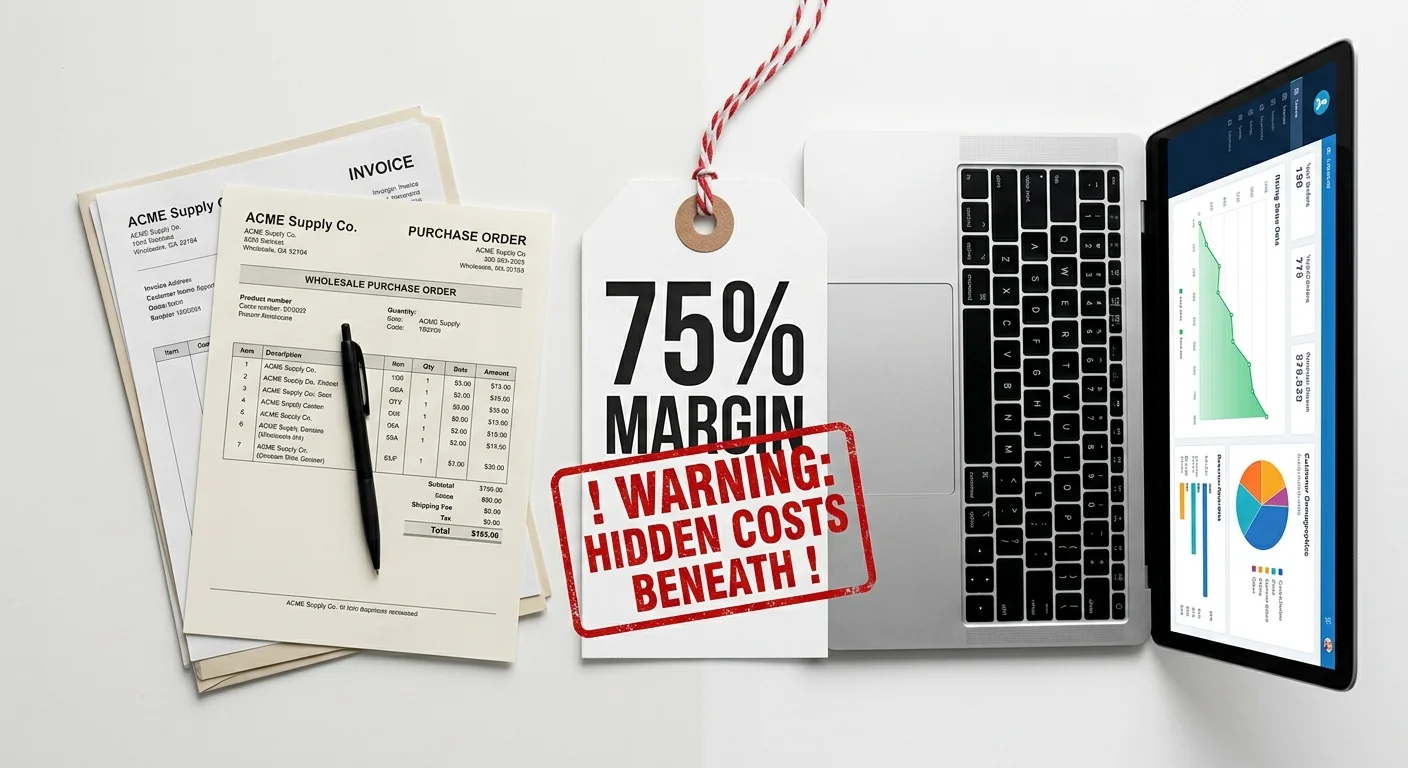
The 75% gross margin number looks incredible on paper. The reality that follows it? Much less pretty.
DTC's structural advantages are real — but they come with a cost stack that most yoga wear founders never price in until cash starts bleeding out. Here's what the optimistic projections leave out.
Customer Acquisition Has Gotten Brutally Expensive
Five years ago, scaling a DTC brand on Meta ads was a real, working strategy. That window has closed.
The median CAC for a DTC apparel brand now sits at $130–$156 per customer — up 60% from five years ago. The average DTC brand loses $29 on the first purchase before any operational costs hit. That's not a rounding error. That's a structural problem.
The math works only if your LTV:CAC ratio holds at 3:1 or better . Drop below that threshold and no amount of ad spend optimization saves you. Paid-first brands run LTV:CAC ratios 2.4x lower than brands built on organic, community, and ambassador channels. Brands with strong ambassador and referral programs cut CAC by 30–50% and pull in customers with 16% higher LTV . That's the lever most yoga brands ignore.
The Operational Cost Stack Nobody Talks About
Beyond ads, the infrastructure cost of running a real DTC operation adds up fast:
Fulfillment : 3PL pick-and-pack runs $1.50–$3.50 per order . Storage adds $0.50–$0.90/cubic foot/month . Standard domestic shipping lands at $6–$12 per package .
Returns : Apparel return rates hit 15–30% . Each return costs $8–$15 to process — before any inventory damage gets counted.
Tech stack : SaaS tools for attribution, email/SMS, and analytics run $2,000–$10,000/month for a mid-sized brand.
Payment processing : Stripe and similar gateways take 2–4% of GMV off the top, on every transaction.
Add it all up and your real net margin — after ads, returns, fulfillment, and SaaS — can drop from a projected 12% down to 3–5% . No operational mistakes needed. It just happens.
The fix isn't spending less. It's building a retention layer that earns back what acquisition costs. For brands doing $5M–$30M in revenue , pulling 25–40% of revenue from email and SMS is a solid benchmark. Below 20%? Your paid acquisition spend is carrying too much weight on its own.
The Wholesale Advantage: Reach, Stability, and Surprising Margin Math
Most yoga wear founders look at wholesale and see a margin haircut. What they miss is everything that happens below the gross margin line.
Here's the reality most people don't expect: a wholesale account doesn't just move units. It puts your leggings in front of the same high-intent customers 6–12 times per month . A boutique fitness studio member shows up that often. She sees your product on the rack every single visit. That's 10+ repeated brand impressions per month — from a placement that costs you zero CAC.
Run the math on that "expensive" shelf space. A display fee of $2,000/month in a studio with 2,000 visitors generates 2,000–6,000 visual exposures per month. That's a CPM of $333–$1,000 — on par with elevator ad inventory in a tier-1 city. But these are high-spending, fitness-obsessed women — the ones you're after. Plus, unlike a digital impression, this one sits right next to a fitting room.
Wholesale EBIT Often Beats DTC (Even With Lower Gross Margins)
This is where the math surprises people.
Yes, wholesale gross margins run 40–55% versus DTC's 55–65% . That 10–20 point gap looks bad. But the gross margin comparison leaves out a lot:
DTC's hidden cost stack:
- Customer acquisition: 20–30% of revenue on paid channels
- Fulfillment and reverse logistics: 5–10% of revenue
- Returns (online apparel returns hit 20–40% ): erodes another 3–8 EBIT points
Strip all that away and many DTC operations land at 5–10% EBIT — or worse.
Wholesale? The cost structure is a different picture. No ongoing CAC. No per-unit reverse logistics. Shipments go out in bulk. Returns are rare — and governed by contract when they do happen. A well-run wholesale channel delivers 15–25% EBIT margins , even with the lower gross margin up top.
Lower gross margin. Higher operating profit. That's the wholesale math most brands never sit down to do.
Predictable Cash Flow Is a Competitive Advantage
Retail buyers place orders 3–6 months in advance . That's not a bureaucratic inconvenience — it's a gift to your supply chain.
With confirmed wholesale orders in hand, you can plan production runs at 1.05–1.2x order volume for safety stock. You can negotiate better unit economics with your yoga clothing manufacturer . You also break out of the "guess and overstock" cycle that kills so many DTC apparel brands. Payment terms settle at Net 30–60 days after shipment — predictable, plannable, bankable.
Compare that to DTC. Every revenue dollar hangs on today's ad performance. One algorithm shift next month and your numbers change.
For early-to-mid-stage private label yoga wear brands still building supply chain discipline, wholesale's order-first model turns "I hope this sells" into "I know this sells — before the factory runs a single stitch."
The Organic Brand Search Lift Nobody Budgets For
A new yoga apparel brand enters a regional retail chain. Brand-name search volume — on Google, on Instagram, on Xiaohongshu — jumps 30–100% . That lift doesn't show up on your wholesale invoice. It shows up in your DTC conversion rate climbing without any extra ad spend.
Every yoga wear wholesale transaction creates downstream UGC. Customers buy in-store, wear it to class, post it, and tag the brand. The retailer absorbs the acquisition cost. Your DTC channel collects the warm traffic.
Most activewear brand strategy frameworks don't account for this at all — but it's real, and it builds over time.
Wholesale Trade-Offs Yoga Wear Brands Can't Ignore
The margin math on wholesale looks manageable — until you run the actual numbers.
Take that same $80 pair of yoga leggings. Your COGS sits at $24. Sell DTC and you pocket $56 gross margin per unit — 70%. Sell wholesale at the standard 50% discount and your margin collapses to $16 per unit — 40%. That's not a rounding error. That's 71% of your profit per unit, gone .
The volume math makes it worse. To hit the same $11,200 gross margin that 200 DTC units generate, you need to push 700 wholesale units . Your sales pressure just multiplied 3.5x. And that's before you've spent a cent on trade marketing or account management.
That's still the middle scenario.
Some major retail chains demand 40% of MSRP — more founders run into this than you'd expect. Your wholesale price drops to $32. Gross margin: $8 per unit, 25%. One bad quarter of raw material costs — textiles have swung 10–15% in recent years — and you're staring at 12–18% margins . You're moving volume. You're not building a business.
You Lose the Price Floor — and the Brand Story That Goes With It
Wholesale doesn't just compress margins. It hands your pricing narrative to someone else.
Your DTC channel holds $80. Your wholesale partner runs a buy-one-get-one promotion. Now every price comparison platform anchors your product at $40. Every reseller does the same. Every social media screenshot reinforces it. That psychological price floor is hard to rebuild — close to impossible, really. Your own website conversion rate drops. Shoppers learn to wait for the channel discount.
For private label yoga wear brands investing in premium positioning, this is existential. Lululemon built its "athletic luxury" identity on controlled scarcity and disciplined pricing. The moment a product shows up in a discount outlet, that positioning starts leaking.
Enforcing MAP (Minimum Advertised Price) policies sounds like a fix. In practice, smaller activewear brands don't have the negotiating leverage to make it stick. This gets worse across international distributors or cross-border ecommerce sellers. There, MAP enforcement is close to unenforceable.
The Data You Never Get Back
Every wholesale order ships out. No customer profiles come back.
You get reorder frequency. SKU movement. That's it. The retailer owns the membership system, the purchase history, the size feedback. That partner rotates in a competing brand next season, and your repeat customers follow their loyalty program — not yours.
Brands that route 70–80% of revenue through wholesale keep just 20–30% in owned channels. The result: no functioning CRM, no size optimization, no precise inventory planning. Compare that to Lululemon and MAIA ACTIVE — both built on direct consumer relationships. That's not a coincidence. Brands with owned data hold 50–60%+ long-term gross margins . Wholesale-heavy brands fall behind on both margin and valuation multiples.
Wholesale gives you distribution. It doesn't give you a business that compounds.
Yoga Wear-Specific Factors That Should Tilt Your Decision
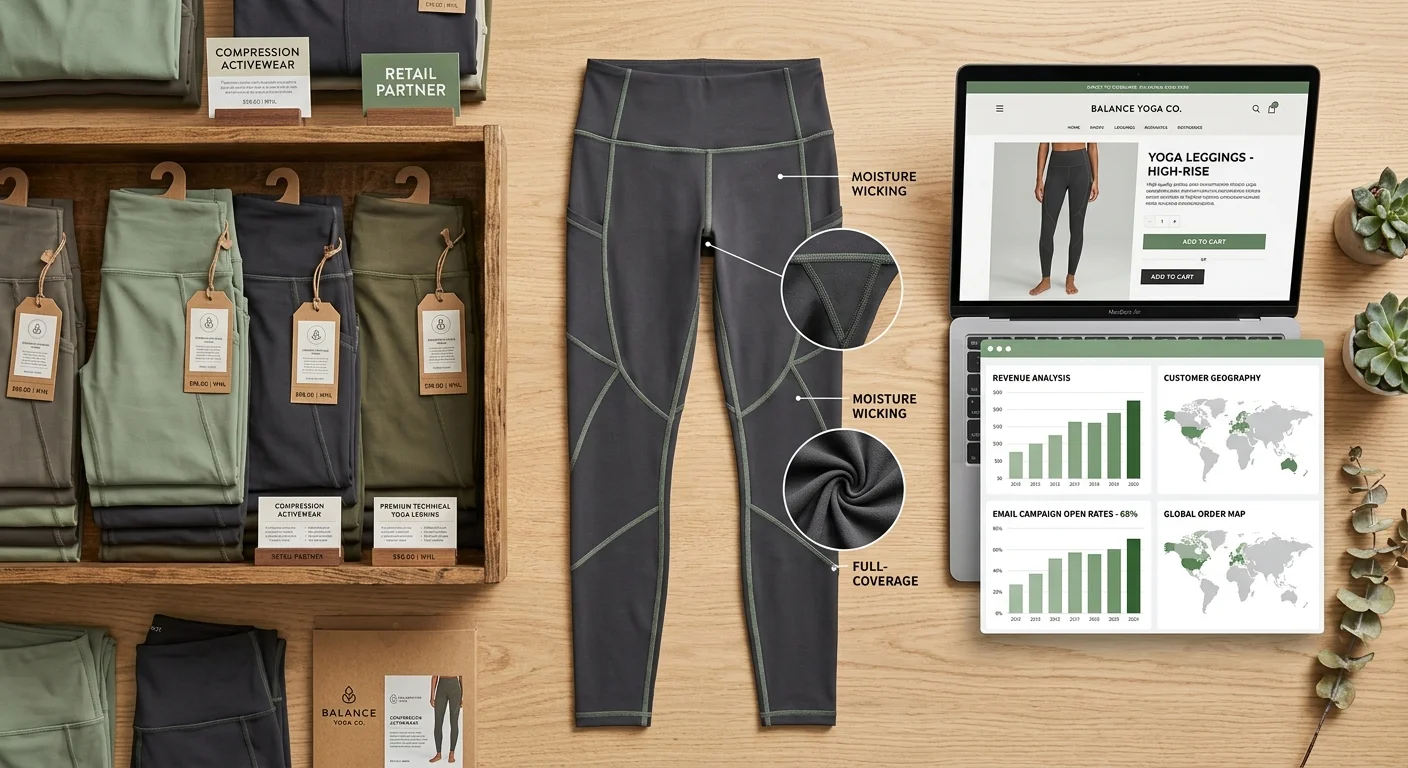
Yoga wear isn't just apparel. It's a performance product. That single fact changes how the DTC vs. wholesale decision plays out — in ways most general brand strategy advice misses entirely.
Three variables are specific to this category. Get them right and your channel choice becomes clear.
Fit Sensitivity Changes Your Return Risk Profile
Yoga leggings live or die by fit. A customer can't know whether a high-waist compressive pant works for her body until she moves in it — squats, folds forward, holds a plank. Online, she can't do that.
45% of global yoga wear revenue already flows through online channels (2023 data). Yet fit-related returns remain the single biggest margin leak for DTC yoga brands. New silhouettes and technical fabrics — like high-stretch TPU composite knits (elasticity modulus: 30–50 MPa) — carry a much higher first-purchase return rate in unfamiliar markets.
The takeaway is direct: unvalidated fits belong in wholesale first. Let studio foot traffic and fitting rooms do the proof-of-concept work. A silhouette with solid sell-through data behind it is ready to shift to DTC. The fit risk disappears. The margin upside stays.
Your Sustainability Story Determines Which Channel Amplifies It
A brand built on recycled polyester, GOTS-certified organic cotton, or GRS-verified materials fits naturally in DTC. That story needs room to breathe. Carbon-neutral logistics, supply chain transparency, fabric certifications — none of that fits on a hang tag.
DTC gives you the product page, the email sequence, the community post. You can publish moisture-wicking rates (0.2 g/cm²/min for TPU composite vs. 0.1 g/cm²/min for cotton), cite AATCC 195 test results, and show customers why the fabric cuts muscle fatigue by ~15% during high-intensity sessions. That level of technical detail earns a 5–10 point gross margin premium — but you need to control the presentation to capture it.
Mass-market, price-competitive yoga lines tell a different story. Positioning in the ¥100–300 per unit range? Wholesale wins on efficiency. Studio chains and sporting goods retailers get you to volume faster than any paid social campaign.
SKU Type Should Drive Channel Assignment
Not every product in your line deserves the same distribution strategy. This is where most yoga wear brands leave money on the table.
A practical framework:
SKU Type | Best Channel | Why |
|---|---|---|
Classic evergreen (black high-waist legging, basic bra) | Wholesale | Stable demand, no storytelling required, scales with bulk orders |
Limited capsule / collab / print | DTC-first | High narrative value, premium pricing, community-driven launch |
New technical fabric / unvalidated fit | Wholesale first, then DTC | Let in-store try-ons validate before committing to online returns |
The logic is simple. Wholesale handles your volume workhorses. DTC launches your high-margin storytelling pieces. A flexible yoga clothing manufacturer — one that produces small-batch capsule runs alongside full-scale evergreen production — makes this dual-track approach work in practice. Without that supply chain flexibility, you're stuck in one channel whether it fits your product or not.
Profit Anatomy: Unit Economics Comparison with Real Numbers
Two yoga brands. Same $80 legging. Same factory. Two very different financial realities.
That's not a hypothetical. Run the unit economics side by side — DTC versus wholesale — with real numbers, and the gap becomes clear.
The DTC Unit: Where the $80 Goes
Start with an $80 retail price and a production cost of $18 (mid-range for a quality activewear piece). On paper, that's a 77% gross margin. In practice, the cost stack eats most of it.
Here's what leaves your pocket before a single dollar hits net profit:
COGS (fabric, cut-and-sew, QC, factory margin): ~$18
Fulfillment + 3PL logistics: ~$7
Packaging (hangtags, polybags, mailers): ~$1.50
Payment processing (Stripe/Shopify at ~3.5%): ~$2.80
Returns & shrinkage (15% return rate, resold at 70%): ~$4.00
Total variable cost: ~$33.30
That leaves a contribution margin of $46.70 per unit — about 58%. Healthy, but far from the 75% number that shows up in pitch decks.
Then comes CAC. This is where the model either works or quietly falls apart.
Scenario | CAC | Net Profit per Unit | Net Margin |
|---|---|---|---|
Best case (strong word-of-mouth, low paid dependency) | ~$30 | $16.70 | ~21% |
Mid case (standard paid social mix) | ~$55 | −$8.30 | −10% (first-order loss) |
Worst case (ad-heavy, low retention) | ~$90 | −$43.30 | −54% |
A first-order loss of $8.30 isn't a crisis on its own. It becomes one if customers don't return. At a 12-month LTV of 3 orders, each customer generates ~$140 in contribution margin. Subtract a $55 CAC and you're left with $85 per customer to cover fixed costs. That math works.
Drop LTV to 2 orders with a $90 CAC? You're left with $3.40 per customer. You'd need over 100,000 new customers just to break even on overhead.
Four levers that move the DTC number:
- Cut production cost from $18 → $15 through volume and better sourcing: +$3/unit
- Negotiate 3PL rates to reduce fulfillment from $7 → $5: +$2/unit
- Reduce return rate from 15% → 8–10% via better sizing tools: saves ~$1.50–$2/unit
- Shift payment mix away from high-fee processors: saves ~$0.50–$0.80/unit
The Wholesale Unit: Less Glamorous, More Profitable Than You'd Think
Same legging. Wholesale price to the retailer: $36 (mid-range at ~45% of MSRP).
The cost structure shifts in your favor. Bulk shipments replace per-order fulfillment. Retail packaging drops off. Payment processing falls to under 1% on B2B wire transfers.
COGS: ~$18
Bulk freight + logistics: ~$1.50
Simplified packaging: ~$0.70
B2B payment fees: ~$0.40
Total variable cost: ~$20.60
Brand-side gross margin: $15.40 per unit — 43%.
That's a 15-point gap versus DTC's contribution margin. But look at what changes below that line. Wholesale CAC, spread across account volume, runs under $3–$5 per unit . No ad spend per unit. No reverse logistics. No per-order customer service tickets.
Net profit per wholesale unit: $12.40 — a 34% net margin.
Compare that to DTC's mid-case of −$8.30 on the first order. Wholesale wins on unit economics at launch. It's not close.
The retailer takes on the gross margin upside ($44 per unit, ~55%). In return, they carry all the operating costs: rent, staff, markdowns, loyalty programs. That's the deal. You give up $30 in per-unit gross margin. You get predictable cash, no ad spend, and a supply chain you can plan around with confidence.
Break-Even Reality Check
For a small yoga wear brand with ~$350K in annual fixed costs, the break-even picture looks like this:
DTC (best case, CAC ~$30): ~21,000 units/year, or ~$1.68M in revenue
DTC (mid case, CAC ~$55): First-order profitability is out of reach — you need ~4,100 loyal repeat customers to cover overhead through LTV
DTC (worst case, CAC ~$90, LTV = 2 orders): Needs ~103,000 new customers per year — not a viable path
Wholesale: At $12.40 net per unit, break-even sits at ~ 28,200 units/year — and without CAC pressure, that volume is reachable through a small group of stable retail accounts
The numbers lay out the tradeoff clearly. DTC has a higher ceiling. Wholesale has a lower floor risk. Which one fits your brand comes down to where you are in the build — not which model sounds better on paper.
Which Model Fits Your Brand Stage: A Practical Decision Framework
The data doesn't care about your vision. It cares about where you are right now.
Match your channel strategy to your stage. That's the difference between a brand that grows steadily and one that burns through cash chasing the wrong model. Here's how the math breaks down across three phases.
Early-Stage Brands (0–2 Years, Under $500K Revenue)
Run 80–90% DTC, with 10–20% boutique wholesale as a test bed.
Your most valuable asset right now isn't revenue — it's data. DTC gives you first-party signals wholesale never will: browsing paths, cart abandonment patterns, return reasons, repurchase intervals. Brands running DTC-first can compress new product cycles from 12–18 months down to 5–6 months . That's 2–3x faster validation.
For wholesale, keep it tight. Pick 2–3 studios with 300–800 visitors per month. Drop 30–80 units per store across 2–4 styles. Use consignment or low-deposit terms. Run a 45–60 day rotation cycle. Track try-on rate, size conversion, and color preference. That offline data feeds straight back into your DTC product pages.
Three metrics that tell you if early-stage economics are working:
- CAC ÷ first-order gross margin ≤ 1.0
- First-to-second purchase conversion ≥ 20–30%
- Return rate ≤ 10–15%
Growth-Stage Brands ($500K–$5M Revenue)
Shift to a 50–70% DTC / 30–50% wholesale split — but keep the channels doing different jobs.
DTC carries your brand equity, membership system, and high-margin storytelling launches. Wholesale brings predictable cash flow. It also opens geographic markets your paid media hasn't reached yet.
The key is clear product separation:
Channel | What Goes There |
|---|---|
DTC | Limited colorways, collabs, new technical fabrics — first 4–8 weeks exclusive |
Wholesale | Core steady SKUs (black, navy, grey) with consistent reorder availability |
Keep channel price gaps within 5–15% . Go beyond that, and customers start playing your channels against each other. Build DTC loyalty through non-price benefits — points, birthday gifts, size personalization — not deeper discounts.
Target benchmarks to hit:
- Combined gross margin of 50–60%
- Wholesale receivables cycling at 30–60 days
- DTC at an LTV:CAC ratio of 3:1 or better
Scale-Stage Brands (Over $5M Revenue)
DTC becomes your data hub and pricing anchor — not just another sales channel.
At this stage, channel diversity matters at a structural level. Top-performing activewear brands at scale land here: DTC at 25–40% , platform ecommerce at 30–40%, and wholesale/distribution filling the remaining 20–40%. No single channel goes above 50%.
DTC's role shifts at this point. New technical styles launch there first. It sets your price ceiling. Every other channel prices relative to it. Wholesale expands into lower-tier cities and large gym chains through annual framework agreements. These lock in volume commitments of $300K–$700K per account with defined display standards.
Five Yes/No Questions to Find Your Channel Answer
The stage framework above still feels abstract for some brands. Run through these questions instead:
Do you have 12+ months of operating capital? Yes → lean DTC. No → raise wholesale to 40–60% and lock in receivables first.
Can your team run DTC analytics on their own — attribution, A/B testing, CRM automation? No → start with simpler wholesale KPIs until you build that capability.
Are your products high-variant (sizes, colors, custom fits) and iterated often? Yes → DTC first. Use wholesale for your top 20–30% proven SKUs.
Do you need positive cash flow within 3–6 months? Yes → wholesale partners with upfront deposits are your fastest path.
Is your brand story technical or sustainability-led? Yes → DTC is the one channel that gives you the page space to tell it right.
The right model isn't DTC or wholesale. It's the right blend for the stage you're in right now — not the stage you're planning to reach.
Real-World Scenarios: How Different Yoga Wear Brands Choose
Three very different yoga wear brands. Three very different channel mixes. Each one faces the same decision — DTC or wholesale — but lands on a different answer.
Here's what those choices look like in practice.
Scenario A: The Boutique Eco Brand (DTC-Heavy, Selective Wholesale)
CRZ YOGA built its positioning on one idea: Lululemon quality at one-third the price. The channel mix behind that idea runs 60–80% DTC and 20–40% wholesale. Wholesale stays limited to 5–10 premium studios in high-income urban neighborhoods.
Wholesale terms stay tight. That means 20–50 units per SKU, 40–50% off retail, and a 10–20% exchange window at 60–90 days. That's enough physical presence to anchor the brand's premium positioning without flooding the market.
The DTC side carries the brand story. Product pages list recycled polyester content, sustainability certifications, and detailed sizing guides. The result: ~224,000 website visits per month, with 95% of traffic concentrated in the U.S. — a focused, single-market strategy by design. Over 5–10 years, that model scaled to ¥1.5 billion in annual revenue.
The lesson: Eco and technical storytelling belongs in DTC. Wholesale earns you the shelf presence that makes the brand feel real.
Scenario B: The Mass-Market Value Brand (Wholesale-First, DTC as Brand Shelf)
A price-driven activewear line doesn't need a community. It needs velocity.
For this brand type, wholesale takes 70–90% of revenue. The DTC website isn't a sales engine — it's a brand credibility page. It explains why the leggings cost one-third of Lululemon's price. It hosts limited drops and collabs to hold some brand equity. But the real volume runs through Amazon FBA, eBay, Lazada, and Cdiscount.
The playbook looks like this:
- Lock in 20–50 core SKUs
- Price at 30–50% below category leaders
- Hold a 4.5-star rating or higher
- Use TikTok content to push traffic to the platform storefront
One brand ran this exact model — TikTok driving awareness, Tmall closing the sale — and hit ¥150 million in revenue.
The lesson: Price is your value proposition. Wholesale channels scale that faster than any DTC ad campaign.
Scenario C: The Hybrid Model (DTC + Wholesale, Different Jobs)
Vuori and Lululemon didn't pick between DTC and wholesale. They gave each channel a separate role — and kept a strict line between them.
At full scale, the revenue split runs 40–60% DTC, 40–60% wholesale . It shifts as the brand grows. Early on, DTC leads — it controls brand narrative and produces test data. As volume targets rise, wholesale moves into gym chains and department stores to cover geographic gaps that paid media can't fill without burning budget.
Here's how each channel is used:
Channel | Job |
|---|---|
DTC | New fabric launches, high-margin capsule drops, community and membership programs |
Wholesale | Core basics (black, navy, grey), gym chains, geographic expansion |
New styles go to DTC first for a 4–8 week test window . The thresholds: conversion ≥ 2–3%, return rate ≤ 15%, rating ≥ 4.5 stars. Clear those numbers, and the style moves into wholesale production at scale. Miss them, and the exposure stays contained.
Pricing stays unified across both channels. DTC discounts cap at 5–15% during member events. Wholesale contracts include MAP clauses. Neither channel can undercut the other in a way that erodes the brand floor.
The lesson: The hybrid model doesn't split the difference between DTC and wholesale. It gives each channel a clear job — and holds both to it.
Your Next Move: How to Audit and Choose Your Channel Strategy
Stop theorizing. Pull out a spreadsheet and run the numbers on your actual products.
Pick your top 5 SKUs. For each one, calculate true net profit under both models using this formula:
Net profit per unit = Retail price − COGS − channel costs − CAC − fulfillment − fixed cost allocation
For DTC, plug in real figures: payment processing (3–4% of GMV), CAC ($15–30 per customer on Meta/TikTok), and fulfillment ($5–10 per unit including returns). Your DTC net margin sits below 8–10% and CAC keeps climbing? That's your signal to shift.
For wholesale, use 50–60% of MSRP as your baseline price. That same SKU holds 25–30%+ gross margin at wholesale — with return rates under 5% versus DTC's 10–25%? The channel math is telling you something.
Now take a hard look at your team across two areas:
Digital capability : Can you sustain $5,000–10,000/month in ad spend? Can you produce 10–20 fresh creatives each month and hit a 30–40% repurchase rate within 12 months? No on any of these? DTC will drain you fast.
Supply chain readiness : Can your yoga apparel factory deliver 95%+ first-pass quality? Can they turn around 500-unit reorders in 15–25 days and support MOQs as low as 50–100 units per colorway? Yes across the board? You can run both channels with real flexibility.
Lock in your 12–24 month priority — brand equity or revenue scale — and stick to it. Chasing both with no clear direction is how brands end up underfunded and stuck in the middle.
Conclusion
Here's the uncomfortable truth most brand advice skips: there is no single correct answer — just the right answer for your stage, your capital, and your tolerance for complexity.
Starting out? Lean toward DTC. It protects your margins, keeps your customer data in your hands, and helps you build something that feels like a real brand. Scaling fast and need volume? Wholesale opens doors that no Instagram ad budget can match. Build it right, and you'll end up with a hybrid model that puts each channel to work where it performs best.
The yoga wear market rewards founders who make deliberate channel decisions. Not those who default to Shopify because everyone else did. Not those who chase wholesale accounts because a big retailer sent one email.
You now have the framework. The unit economics. The scenarios.
One question remains: what does your brand need right now?
Start there. Need a manufacturing partner who understands both models inside and out? yogavendor.com is built for that conversation.