Picking the wrong business model early on can wreck your yoga wear brand before it even launches. It drains your budget, delays your timeline, and locks you into a supply chain that won't grow with you.
Most founders rush into custom yoga apparel manufacturing without asking one key question: Should I build a private label brand, or does white label get me to market faster with less risk?
The answer depends on where you stand right now — your capital, your timeline, your brand vision, and how far you want to take it.
This guide gives you a clear side-by-side breakdown, real-world scenarios, and a practical cost framework. Use it to make the right call before you place your first order.
What's the Real Difference Between Private Label and White Label Yoga Wear?
White label means picking a product that already exists and putting your name on it. Private label means building a product around your brand from scratch.
Both get your logo onto a pair of leggings. But what happens underneath that logo is a different story.
White Label: Fast, Flexible, and Ready to Go
With white label activewear, the factory has already done the hard work. They've developed the patterns, sourced the fabric, and refined the fit. You browse a catalog, pick your styles, swap out the hang tags and woven labels, and you're selling.
That speed is the whole point. Multiple brands can — and often do — sell the exact same base garment. Your competitive edge comes from your marketing, your pricing, and your positioning. Not the product itself.
Private Label: Built for Brand Differentiation
Custom yoga apparel manufacturing under a private label model is a different process. You specify the actual product details — high-waist vs. mid-rise, compression level, inseam length, fabric weight, gusset construction, scrunch seam placement. The factory builds to your brief, not their catalog.
This is where OEM yoga clothing and ODM sportswear terms come in. You're not picking from existing stock. You're driving the development process — every spec, every detail, every decision.
The tradeoff is real: higher upfront costs, longer lead times, and sample rounds. But the result is a legging no competitor can copy-paste onto their own store.
The One-Line Decision Filter
White Label | Private Label | |
|---|---|---|
Customization | Logo, tags, packaging | Fit, fabric, construction, colorway |
Exclusivity | Shared across multiple brands | Brand-exclusive by contract |
Speed to market | Faster | Slower |
Upfront cost | Lower | Higher |
Differentiation potential | Limited | High |
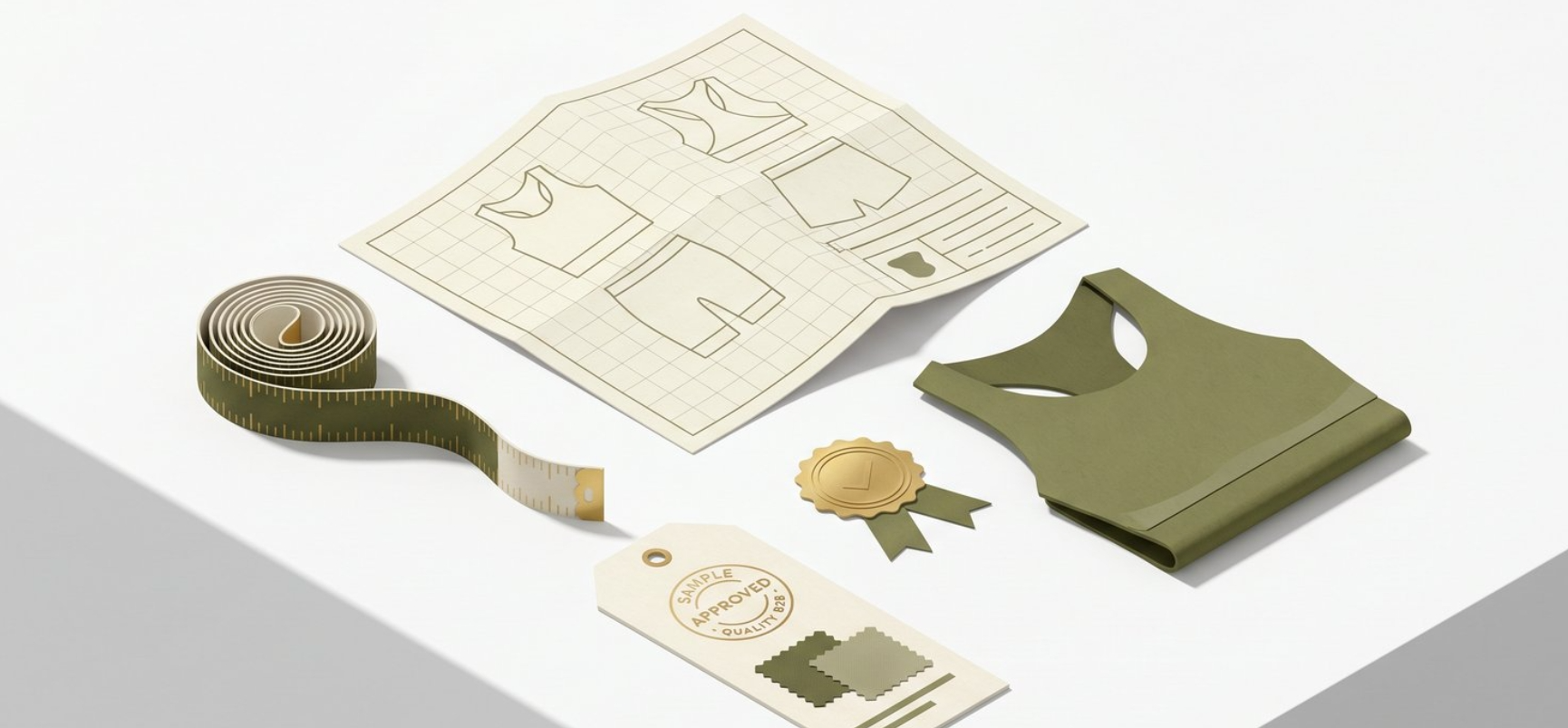
See "choose from catalog, change the label" — that's white label. See "submit a tech pack, approve samples, select your own fabric" — that's private label.
Head-to-Head Comparison: Private Label vs White Label for Yoga Apparel
The difference between these two models goes beyond words. It shows up in your cash flow, your launch timeline, and whether your leggings look identical to the ones your competitor sells on the next page of Amazon search results.
Here's where each model stands across the dimensions that matter most for a yoga wear brand.
The Full Breakdown (9 Dimensions That Matter)
Dimension | Private Label | White Label |
|---|---|---|
Customization Depth | Fabric weight, waistband construction, gusset, seam placement, colorway — all yours to specify | Logo, hangtags, packaging — fabric and cut are fixed |
Brand Exclusivity | The factory holds your specs under contract and keeps them from other buyers (1–3 year terms are standard) | The same base legging can be sold by dozens of brands at the same time |
MOQ & Starting Cost | 200–500 pcs per colorway; sampling fees of $100–$500 per style; custom fabric minimums can run 500–1,000 meters | As low as 1–50 pcs with POD; 50–100 pcs for standard bulk white label; zero sampling fees |
Time to Market | 60–120 days standard; up to 180 days if custom fabric development is involved | 7–21 days for logo/print-on-existing; POD platforms (e.g., Printful) can go live in hours |
Brand Control | Full control over fit spec, stitch density, pilling grade (Grade 4+), colorfastness standards | Control stops at visual elements — you pick from the factory's menu, you don't write your own |
Long-Term Competitive Moat | Proprietary fit, potential design patent, higher margin ceiling, "technology story" (e.g., UPF 50+ fabric spec) | The moat lives in marketing and pricing — not the product itself |
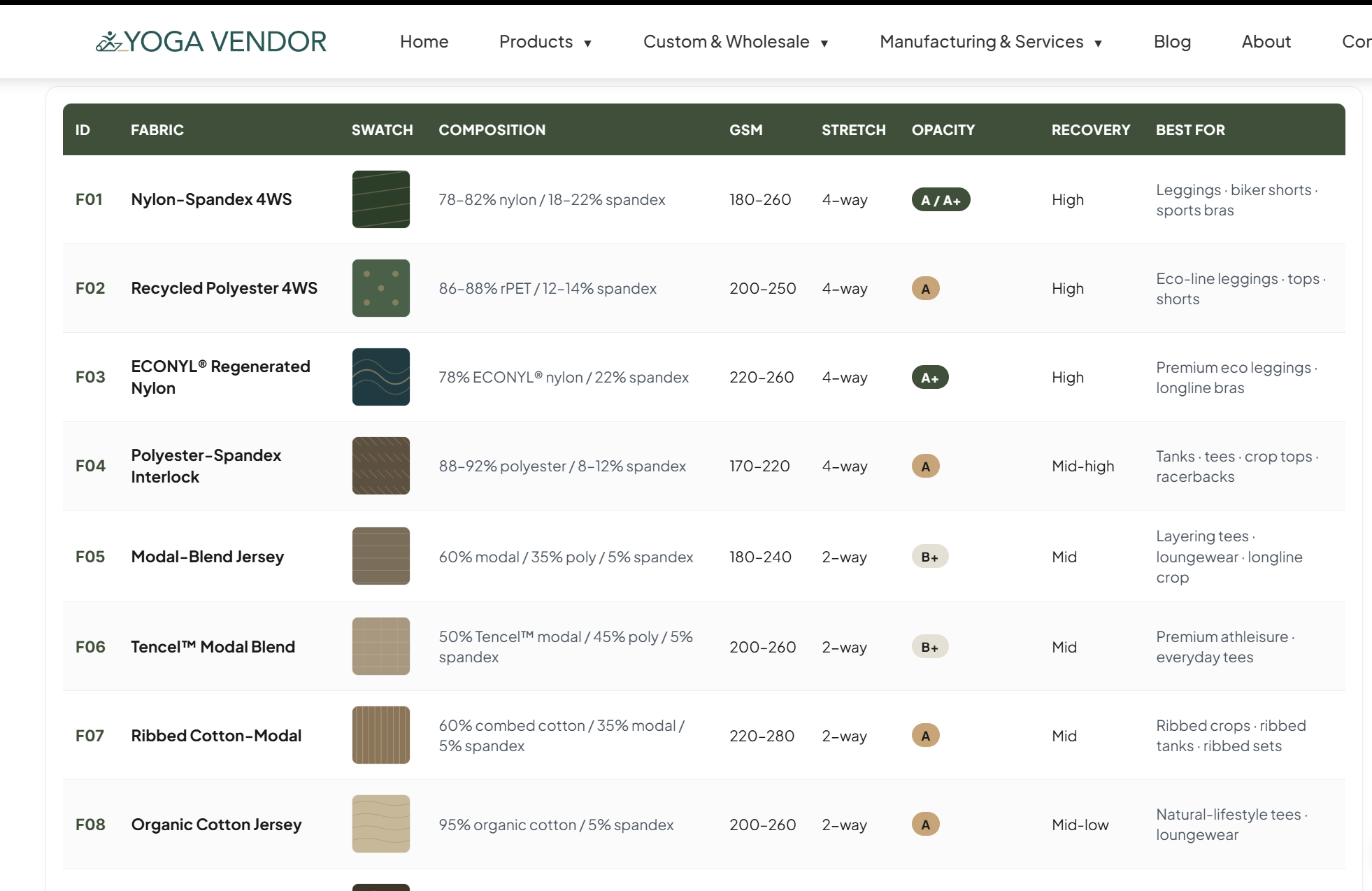
Fabric Performance Customization | Set your own nylon/spandex ratio (e.g., 75–80% nylon / 20–25% spandex at 220–260 gsm), add UPF 50+, moisture-wicking finish, mesh panels | Pick from 2–5 existing fabric options; performance claims are often marketing language, not exclusive formulations |
Size Inclusivity | Build a full XXS–4XL grading system; adjust hip volume, crotch depth, and inseam for your target market (East Asian vs. Western body proportions) | Standard range runs S–XL in a "universal fit" pattern; a wider size range needs higher MOQ with few grading adjustments |
Sustainable Material Options | Specify Econyl, rPET, organic cotton blends; require GRS, OEKO-TEX, or GOTS certifications as your brand USP (expect a 10–30% cost premium) | Eco options exist only if the factory stocks them — offered as an add-on at higher MOQ, with price driving the decision |
What This Means in Practice
For a brand just starting out , white label's low MOQ and zero development cost are more than conveniences — they're survival tools. You can test three price points ($29 / $39 / $49) across two fabric weights (190–210 gsm lightweight vs. 220–240 gsm mid-weight) with a real audience. The cost is a fraction of what a private label sampling round would run.
For a brand gaining traction , the white label ceiling hits fast. A single style moving 300–500 units per month with a return rate below 10% is proof. That's the signal to lock in your own pattern, negotiate exclusive fabric rights, and stop sharing your best-selling silhouette with every other reseller on the platform.
The brands that scale are not the ones who went private label first. They're the ones who used white label data to earn the right to go private label — and made the switch at the right moment.
Which Model Fits Your Yoga Brand Stage Right Now?
Your business stage determines everything — not your ambition, not your aesthetic, not how many Lululemon dupes you've bookmarked.
Pick the model that matches the resources you have today . Not the brand you imagine having in three years. Here's how to match your situation to the right decision.
Stage 1: You Have ≤$5,000 and You're Starting From Zero → White Label First
At this budget, white label isn't just the smart choice — it's the responsible one.
Here's what $5,000 buys you in white label yoga apparel:
Inventory: Focus on 2–3 core styles (high-waist leggings + sports bra + crop top). Factory price runs $8–$12 per piece with an MOQ of 50 units per style. Your first order lands around $1,200–$1,800.
Lightweight branding: Custom hang tags of yoga wear, woven labels, and a printed poly bag — budget $0.30–$0.70 per unit. Your logo is on the product without a $500 sampling round.
Marketing: Put $1,000–$1,500 toward influencer seeding and early ads. This is where white label pays off — you're spending on traction, not development.
Total usable inventory: 400–600 finished units .
Your one job at this stage is validation. You need data, not differentiation. Run white label styles in the $25–$35 price range. Test two fabric weights — 180–220 gsm lightweight vs. 220–260 gsm mid-weight. Track these three numbers closely:
Sell-through rate within 30 days: ≥70%
Return rate: ≤10–15%
Review rating: ≥4.4/5 with no pattern of quality complaints
Those numbers hold? You haven't just made sales. You've earned the right to go private label.
Stage 2: You're Doing ≥$10,000/Month GMV → Private Label Your Best Sellers
At this scale — about 200+ orders per month at a $50 average order value — white label starts working against you. The same legging you're selling sits on a dozen other storefronts. Your margin ceiling is fixed by the factory's catalog, not your brand equity.
The move here isn't to go all-in on private label overnight. It's surgical.
Pull your top 20% of SKUs. In most stores, those 1–3 styles drive 60–80% of revenue. Those are your private label candidates.
Check each candidate for three signals before you commit $3,000–$8,000 to a full private label development run:
60–90 day repurchase rate ≥30% — that's a strong SKU by activewear DTC standards. The industry benchmark sits at 25–40% annual repurchase for mature brands.
Three consecutive months of stable unit sales — volume fluctuation under 20% month-over-month.
Ad ACOS at least 30% below your store average — your store runs 25% ACOS and this style pulls 15–18%? Organic demand is already there.
All three boxes checked? Move that style into private label development. That means custom yoga clothing colorway, branded waistband, and adjusted fit spec — waist height, inseam length, gusset construction. Keep your remaining SKUs in white label. That maintains cash flow while private label samples are in production.
The financial case is clear. Say your white label cost is $8 landed ($10 with shipping) and you sell at $25. That's a 40% net margin after platform fees and ads. A private label contract at 300–500 units can drop that unit cost to $7 or below. Same retail price — but now you pick up 5–10 extra percentage points of net margin.
Stage 3: You Already Have Brand Assets → Build the Pyramid
You're coming in with an existing audience, email list, or cross-category brand. The white label vs. private label question becomes a portfolio decision — not a binary one.
The structure that works: 20–30% private label, 70–80% white label.
Private label series ($60–$90 price point): High-margin, story-driven styles sold through your own DTC site. This is where your brand identity lives — proprietary colorways, performance fabric specs (UPF 50+, Econyl, rPET), size-inclusive grading from XXS to 4XL. Mature activewear brands running this model hit gross margins of 55–70%. That's the ceiling you're building toward.
White label catalog ($25–$50 price point): Your volume engine. Run it on Amazon, Shopee, or Etsy — wherever platform traffic is strong. It funds private label development and keeps inventory moving.
Push white label toward platform channels. Pull private label into DTC. The two tracks don't compete — they feed each other.
The One-Page Decision Framework
Your Situation | Recommended Model | First Action |
|---|---|---|
Budget ≤$5,000, no existing audience | 100% White Label | Test 2–3 styles, validate sell-through in 60–90 days |
Monthly GMV ≥$10,000, 1–3 strong SKUs | White Label + Private Label Core | Identify top SKU, initiate private label sampling |
Existing brand assets, cross-category expansion | Pyramid (20–30% private / 70–80% white) | Launch private label DTC series; route white label to platform channels |
The brands that get this right don't always have the biggest budgets. They're the ones who used white label data to make a smarter private label bet — at the right moment.
Real-World Scenarios: How Yoga Wear Brands Use Each Model
Theory is clean. Reality is messier — and more instructive.
The brands that figure out private label vs. white label fastest aren't the ones who read the most guides. They're the ones who watched other founders make expensive mistakes and learned from them. Here are three scenarios worth studying.
Scenario 1: The Shopify Seller Who Used White Label to Buy Real Data
A DTC founder launching a custom logo yoga wear brand doesn't need differentiation on day one. They need proof that someone will pay for what they're selling.
The standard white label test looks like this: one silhouette (high-waist 7/8 legging + medium-support bra), three color families, $2,500–$4,000 in first inventory. Factory cost for a nylon-spandex set (200–230gsm) runs $13–17 FOB per set . Shopify pricing lands at $45–69 per set — gross margin sitting at 60–70% before ad spend.
The three-color split isn't random:
- Muted neutrals (oat, sage, dusty blue) → targets 25–34
- High-saturation brights (neon green, hot pink) → targets 18–24
- Dark basics (black, charcoal, navy) → universal 25–44
Run $50–100/day on Meta or TikTok across the three collections. After 14 days, the pattern is almost always the same. Dark basics convert best across all age groups — even with lower CTR. Brights pull strong clicks from 18–24 but carry a higher return rate. Neutrals hold the best margin headroom. Buyers in the 25–34 range will pay $3–5 more per set with no real drop in conversion.
That data shows you which colorway to take private label first. White label didn't just generate revenue — it funded a smarter product decision.
Scenario 2: The Yoga Studio That Turned Its Best-Selling Legging Into a Brand Asset
Studios with 300–1,200 members hold an edge most e-commerce sellers don't. They have a built-in audience with strong opinions and high purchase frequency.
The upgrade path that works starts with feedback collection, not sketching . Before touching a tech pack, poll 100–300 students on three things: where the waistband rolls, which colors show sweat the fastest, and whether the fabric feels suffocating mid-class. That input builds a real product brief.
The spec changes that come out of this process are consistent across studios:
- Waist height bumped from 9–9.5" to 10–11" front rise , with an extra 0.5–1" added at the back to keep coverage in deep forward folds
- Double-layer waistband with a 6–8cm internal elastic band , plus curved side panels to remove the "dig-in" line
- Diamond gusset, 8–10cm , cutting the stress point that causes seam blowout
Fabric spec: 75–80% nylon / 20–25% spandex at 230–240gsm , four-way stretch, with moisture-wicking performance verified at 70%+ moisture reduction within 30 minutes.
First production run: 80–150 units per colorway , 3 colors (black + studio signature color + one limited-edition). Pre-sell 50–100 units inside the studio's community group before the full run ships. The presale funds production and confirms demand at the same time.
The result: unit cost lands at $18–22 all-in (including pattern development, custom branding, and packaging). Studio retail price moves to $65–79 . Gross margin: 65–75% . The white label version before it sold at $45–59 on a $12–15 cost — solid numbers, but no story, no loyalty, no reason for a student to tell a friend.
Studios that do this well build one signature detail into every seasonal drop — a V-cut waistband, a back-waist pocket, a tonal logo stitch — while keeping the core pattern stable. After three seasons, members start calling it "our legging." That's a moat no competitor can replicate with a catalog reorder.
Scenario 3: The Amazon Seller Managing Both Models at Once
For yoga leggings wholesale sellers running an Amazon catalog, the question is almost never which model — it's which model for which SKU.
White label handles the fast-moving, high-volume basics. Factory lead time is 7–15 days production , MOQ at 100–200 units per style per colorway , often with direct FBA labeling available. A new search trend spikes — say, "ribbed yoga set" or "scrunch bum legging" — and white label lets you test that keyword category in under three weeks without a $500 sample round.
Private label protects your top performers. An ASIN shows three straight months of stable velocity and an ACOS well below your account average? That's the SKU worth locking down with an exclusive spec. Custom colorway, branded waistband jacquard, adjusted inseam — these are the changes that make a customer search for your listing by name, rather than clicking the next result.
The split that works in practice: white label runs the platform volume engine , private label builds the brand search term . You need both. Neither model alone gets you there.
Cost Breakdown: What to Budget for Each Model
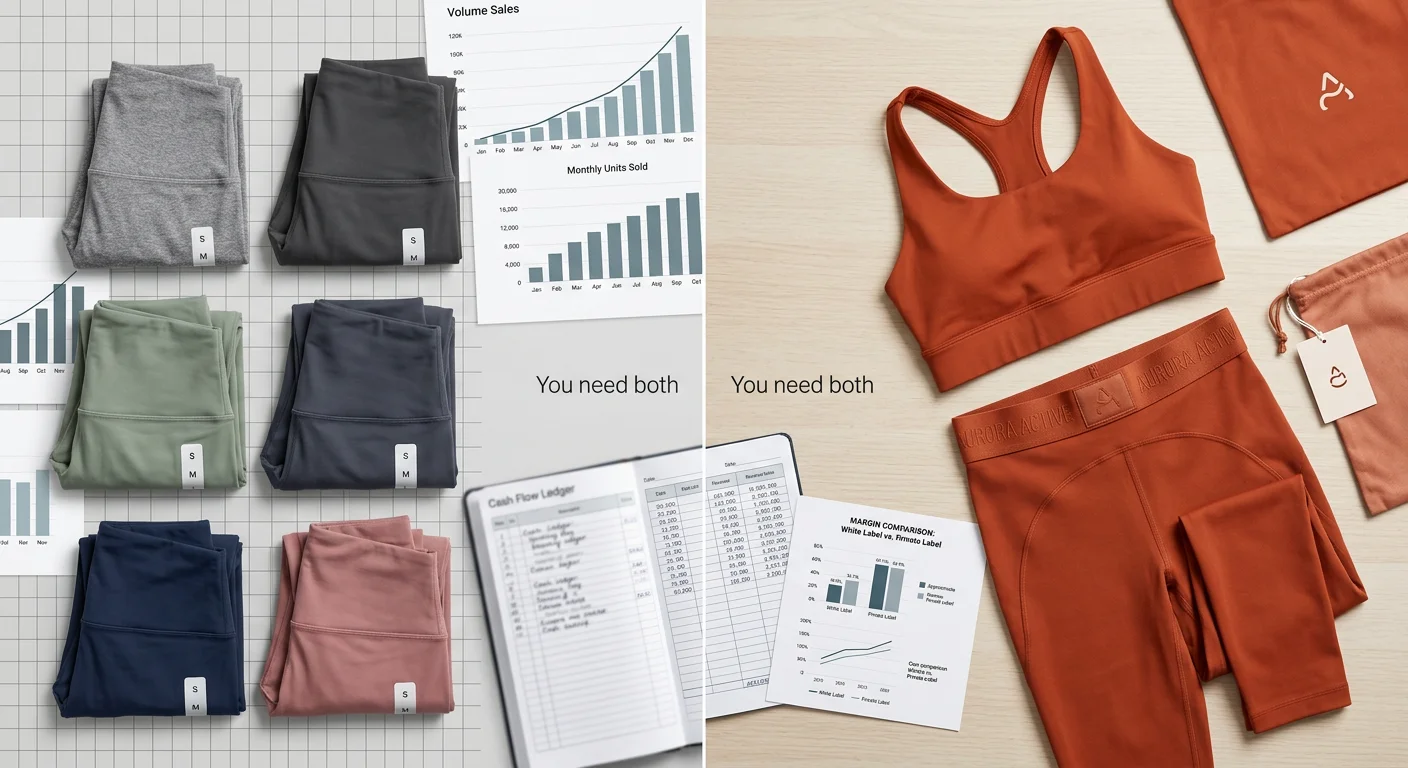
Numbers don't lie. The gap between white label and private label isn't just a strategic difference — it hits your cash flow before you ship a single unit.
Here's what each model costs to launch.
White Label: What Your First Dollar Buys
White label's biggest advantage isn't speed. It's capital efficiency at the moment you need it most.
For yoga wear, the startup cost structure looks like this:
Sampling: Most factories charge $0 on existing styles. You're choosing from their catalog, not asking them to build something new. Some charge a nominal fee of $15–$70 per sample for shipping and handling — that's it.
MOQ: Standard bulk white label runs 50–200 units per style per colorway. Factory cost for a nylon-spandex legging (200–230 gsm) runs $8–$12 per piece . Your first order of 100 units per style costs $800–$1,200 per SKU .
Branding add-ons: Custom yoga clothing woven labels, hang tags, and a printed poly bag cost around $0.30–$0.70 per unit . Minimum label orders start at 1,000 pieces. Budget $150–$300 for your first label run.
Packaging setup fee: Want a custom hang tag design? Expect a one-time setup or plate fee of $30–$80 . After that, you pay per-unit cost only.
Realistic white label launch budget for 2–3 yoga wear styles:
Cost Item | Estimated Range |
|---|---|
Inventory (2 styles × 100 units × $10 avg.) | $2,000 |
Woven labels + hang tags (setup + units) | $300–$500 |
Poly bags / basic packaging | $100–$150 |
Samples / shipping | $50–$150 |
Total to launch | $2,450–$2,800 |
That leaves real budget for marketing — which is where white label brands should be spending.
Private Label: The Real Cost of Ownership
Private label costs more upfront. The question isn't whether that's true — it's whether you understand where the money goes so you can plan for it.
Development costs come first, before production:
Pattern development + sample round: $100–$300 per style for the first sample. Complex constructions — articulated gussets, multi-panel waistbands, integrated mesh — push this to $300–$500 per round. Plan for 2–3 sample rounds before you reach a production-ready spec.
Custom fabric minimums: Specifying your own nylon/spandex ratio or weight (say, 75% nylon / 25% spandex at 240 gsm with a moisture-wicking finish) means most fabric mills require a minimum order of 500–1,000 meters per colorway . At $3–$6 per meter, that's $1,500–$6,000 in fabric before a single garment is cut.
MOQ: Private label production starts at 200–500 units per colorway . The fully-loaded unit cost runs $14–$22 (fabric + cut/sew + branding + packaging). Your first production run per style lands at $2,800–$11,000 .
Certification costs: Brands built around OEKO-TEX or GRS certification need to factor in $500–$2,000+ per certification . Most early-stage brands skip this by sourcing pre-certified fabrics from the mill. You get the credential without paying for direct testing.
Realistic private label development budget for 1 hero style:
Cost Item | Estimated Range |
|---|---|
Pattern development + 2–3 sample rounds | $300–$900 |
Custom fabric (500m minimum) | $1,500–$3,000 |
First production run (300 units × $18 avg.) | $5,400 |
Custom branding (jacquard waistband, labels) | $400–$700 |
Packaging (custom bag + hang tag) | $200–$400 |
Total to launch 1 private label style | $7,800–$10,400 |
The Margin Math That Makes It Worth It
Private label founders absorb that upfront cost for one reason: the margin ceiling is a different game entirely.
A white label legging at $10 landed sells for $35 — that's a 71% gross margin on paper. Platform fees (15–20%), return logistics, and pricing pressure from identical competitor listings compress that to 30–40% net in real life. Your product has no price-defense mechanism.
A private label legging at $18 landed — with your own fit spec, branded waistband, and a construction story — holds a $65–$85 retail price with far less price erosion. Gross margin runs 65–78% . Plus, no one else is selling the same product one search result away.
Metric | White Label | Private Label |
|---|---|---|
Typical unit cost | $8–$12 | $14–$22 |
Realistic retail price | $25–$45 | $55–$90 |
Gross margin (pre-marketing) | 55–70% | 65–78% |
Real-world net margin (post-platform/ads) | 30–40% | 50–65% |
Break-even units (est.) | 150–300 units | 400–600 units |
The break-even point is higher for private label — that's the honest answer. Brands that cross it build something competitors can't copy with a catalog reorder. That's the trade you're making.
Budget under $5,000 today? White label is not a compromise. It's the smart starting point. Already moving $10,000+ per month with three months of stable sales data on your top SKU? The private label math starts working in your favor.
The Smartest Path: A Phased Strategy for Building Your Yoga Wear Brand
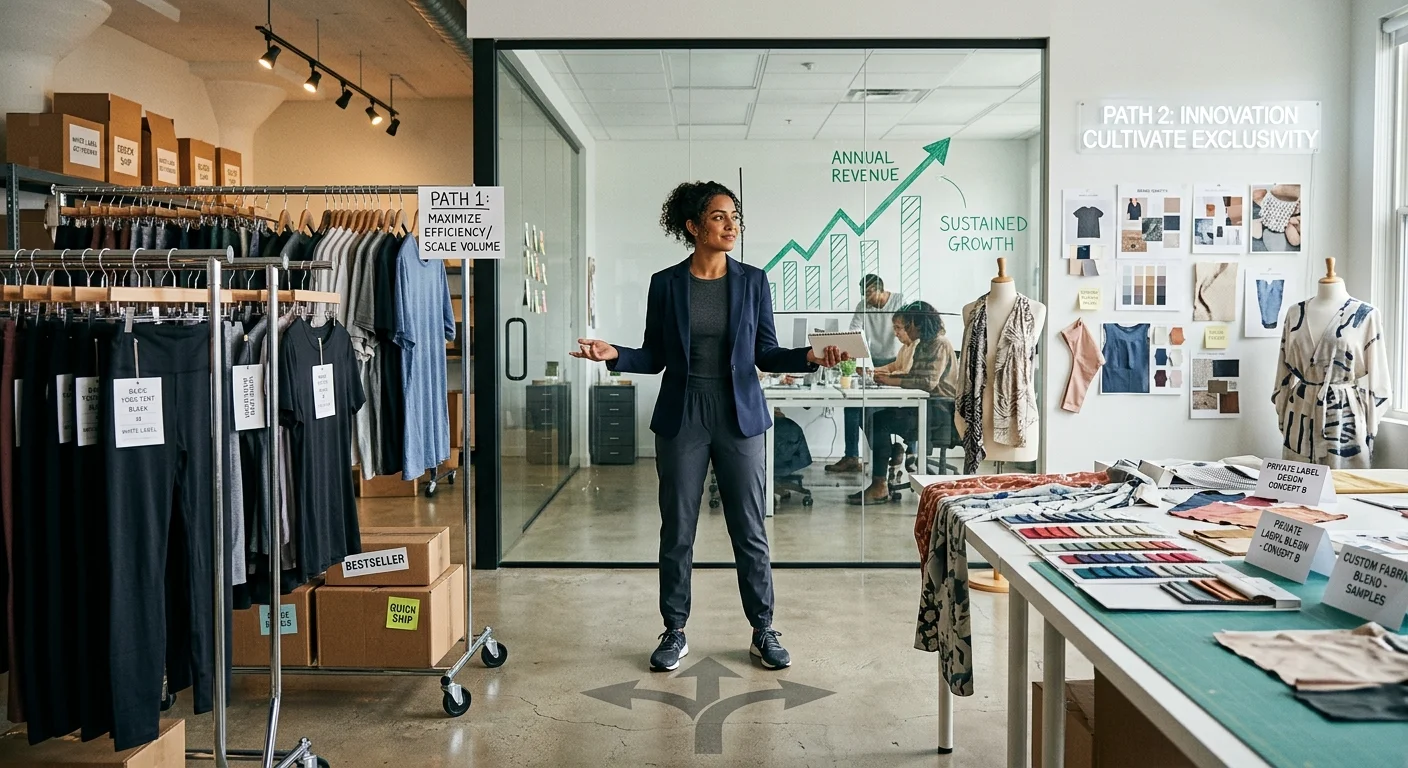
The brands that win in yoga apparel don't pick a model and hope for the best. They build in stages — using white label data to de-risk every private label dollar they spend.
Think of it as a three-phase ladder. Each rung has a clear entry point, a clear exit condition, and hard numbers to hit before you move up.
Phase 1: Validate With White Label (Weeks 1–8)
Start with 1–3 styles, 1–2 colorways each — blacks and navies first. Keep your total test run between 100–300 units. Your one job here is to collect real conversion data. Not build a brand story.
Hit these four numbers before spending a single dollar on private label development:
Cold traffic conversion rate ≥2.0–3.0%
Return rate <8–10% (industry average runs 10–25%)
60–90 day repurchase rate ≥20–25%
Gross margin per unit ≥40% after landed cost and shipping
A style that clears all four thresholds is no longer just a product. It's a private label candidate with a data-backed business case behind it.
Phase 2: Amplify Your Winners — Cut Everything Else
Look for 1–3 SKUs hitting 100–300 units per month with ≥4.4-star ratings . Cut the bottom 30–40% of your catalog. Put your resources behind the top performers — nothing else.
Run A/B tests on hero imagery, title positioning, and size-chart presentation. A ≥15–20% lift in conversion is a clear signal. The market wants more from that style — not from your broader catalog. That's your green light for Phase 3.
Phase 3: Build Your Private Label Moat
Don't enter private label development until a single style holds ≥300–500 units per month for 3–6 straight months , with a return rate staying below 8%.
The product changes at this stage are precise — not full redesigns. Adjust waist height by half an inch. Upgrade fabric GSM from 220 to 240. Add a diamond gusset where reviews flagged seam stress. Each change targets one specific complaint cluster, pulled straight from your review keyword data.
As you scale, watch one ratio closely: private label SKUs should make up <40% of your total catalog but drive ≥60% of revenue . That's the mark of a brand with real pricing power — not just a store with good-looking products.
Conclusion
Private label vs. white label yoga wear — it's not about which model is "better." It's about which one fits where you are right now .
New to the activewear market? White label gets you moving fast. Low risk, quick setup, immediate cash flow. Ready to build something competitors can't copy? A private label route is how real brands get built. Custom yoga apparel manufacturing gives you that edge.
Most successful yoga wear brands don't stick with one path forever. They start smart. Then they grow with purpose.
The brands winning today didn't wait for the perfect plan. They found the right activewear private label supplier . They asked better questions. Then they took the first step.
Your next step? Connect with yogavendor.com — tell them where you are and where you want to go. Let the supply chain work for your brand, not against it.