Every hot yoga class is a real stress test for your product. The conditions are brutal: 40°C heat, 45 minutes of hard exertion, and sweat output that can top a full liter per session. No lab comes close to replicating that.
For activewear brands, the damage rarely shows up right away. It surfaces three months later — returned leggings with permanent odor, stretched-out waistbands, and one-star reviews saying "falls apart after a few washes."
The hard truth? Most of that damage is preventable. Better fabric selection helps, but it's not the whole story. You also need smarter antimicrobial treatment specs, tighter yoga apparel supplier QA standards, and care instructions that actually work — even on a label no bigger than a business card.
This guide gives you the technical framework and practical tools to get all three right.
Hot Yoga Environment Stressors & Textile Degradation Mechanisms

Fabric doesn't fail all at once. It fails by degrees — a little elasticity gone after each wash, a faint odor that slowly becomes permanent, a waistband that stops snapping back around month four. To stop that from happening, you need to understand what a hot yoga class actually does to a garment at the fiber level.
The Environment Is More Extreme Than It Looks on Paper
A standard Bikram-style studio runs at 105°F (40.5°C) with high humidity. Instructors often describe it as "sauna-like." Classes last 60 to 90 minutes . In that single session, one practitioner can lose 1 to 2 liters of sweat — not across a full day, but in one class.
That sweat isn't just water. It carries a chemically aggressive mix:
Sodium chloride (Na⁺: 20–65 mmol/L) — forms hard crystals at evaporation points, especially along seam lines and waistbands
Urea (10–40 mmol/L) and lactate (15–35 mmol/L) — organic films that coat yarn surfaces and feed microbial growth
Ammonia and short-chain fatty acids — the actual molecules your customer smells
Skip the rinse after class, and those compounds don't just dry up. They crystallize inside the tiny gaps between yarn fibers. Those crystals then act like microscopic sandpaper during the next wear and wash cycle.
Three Degradation Pathways Running at the Same Time
1. Odor trapped inside synthetic fibers
Polyester has low surface energy. That gives it a strong chemical attraction to fats and odor-causing compounds — the sebum and fatty acids your body produces during hard exercise. Those molecules push deep into microfiber bundles and settle into the loose molecular regions of the polymer , where water-based detergents can't reach well. Multiple studies confirm polyester holds far more odor-causing compounds than cotton after the same wash process. The smell isn't a washing failure. It's a fiber structure problem.
2. Biofilm buildup inside yarn gaps
Bacteria like Corynebacterium , Staphylococcus , and Moraxella break down sweat compounds into strong-smelling molecules: isovaleric acid, isobutyric acid, and 3-methyl-2-hexenoic acid . On synthetic fabrics, these bacteria form biofilm-like patches , held in place by sebum residue and detergent film. Standard home wash cycles at ≤40°C don't destroy these biofilms. They just spread them around.
3. Elastane breakdown from heat, chemistry, and salt abrasion
Spandex (segmented polyurethane) breaks down through hydrolysis and heat-driven oxidation . Each 10°C rise in wash temperature speeds up that breakdown — this is basic Arrhenius chemistry applied to yoga pants. Repeated wash cycles above 40°C, tumble drying at 60–80°C, or any contact with chlorine bleach attacks the urethane bonds in the fiber. That's what causes the bagging and sagging behind your one-star reviews. Salt crystals make it worse. They concentrate physical stress at high-movement zones — inner thighs, seat, waistband folds — right where elastane is already under the most strain.
Why "Wash More Carefully" Isn't the Whole Answer
The wear–wash cycle builds damage over time in a loop:
Wear → sweat and sebum soak into the fiber structure
Dry without rinsing → salts crystallize at stress points
Wash → agitation pushes crystals into fibers; leftover rinse residue adds more buildup
Repeat → surface roughness grows, spandex cracks at strain zones, odor gets locked deeper
By the time a customer sees visible graying, thinning at contact points, or permanent odor, the garment has already gone through dozens of these cycles. The damage built up long before anyone wrote a complaint.
Your fabric specs, antimicrobial treatments, and care label instructions all need to account for this environment. Not a regular gym session — but 90 minutes in a 40°C room, two to four times a week, for years.
50/100-Wash Performance Matrix: Anti-Odor & Elasticity Data by Fabric
Numbers don't lie — but yoga apparel's fabric suppliers sometimes do. A treatment can look great at launch. Six months of hot yoga classes, three washes a week — that's where your brand's reputation gets tested. The gap between what's claimed and what's delivered is where things fall apart.
The matrix below gives you a working reference for five fabric profiles used in performance activewear. Each column is a metric your QA team and sourcing managers should request from suppliers before signing a single purchase order. Anti-bacterial rates follow AATCC 100 methodology — the standard most directly tied to real-world odor control. Elastic recovery figures reflect post-wash, post-dry conditions at controlled tension.
Use this as your baseline. Push back hard on any yoga apparel supplier data that looks better.
Fabric Composition | Moisture-Wicking | Antimicrobial Tech | Anti-Bacterial Rate @ 50 Washes | Anti-Bacterial Rate @ 100 Washes | Elastic Recovery @ 50 Washes | Elastic Recovery @ 100 Washes | Key Durability Notes |
|---|---|---|---|---|---|---|---|
Standard Polyester (Interlock) | Moderate | None | 65–70% | 30–35% | 92% | 78% | Shape holds for 50–100 washes with proper care; elastic loss and seam fray are the typical failure points |
Silver-Ion Treated Polyester | High | Ionic Silver (permanent bond) | 96–99% | 88–92% | 91% | 80% | Best wash-durability among common odor-control options; performance depends on how the silver is bonded to the fiber |
Nylon 6.6 + Lycra® (20%) | High | None (inherent) | 55–60% | 20–25% | 94% | 82% | Excellent hand feel and stretch retention; inherent antimicrobial performance drops fast without an added finish |
Bamboo Viscose Blend (65/30/5 Spandex) | High | Natural phenol-based | 85–88% | 60–65% | 86% | 68% | Higher shrinkage risk; performance declines faster under frequent hot-wash cycles; weakest elasticity retention in this group |
Micro-Channel Polyester + Zinc Pyrithione | Very High | Chemical finish (non-leaching) | 93–95% | 85–89% | 93% | 85% | Best overall balance of odor control and stretch retention across the full 100-wash range |
What the Numbers Are Really Telling You
Standard polyester is a trap for hot yoga SKUs. A 65% anti-bacterial rate at 50 washes sounds acceptable. Then you realize your core customer washes her leggings three times a week. She hits 50 washes in about four months. By month eight, you're looking at 30–35% bacterial reduction. That's not a care-label problem. That's a product design decision that got made in your sourcing meeting.
Silver-ion treatment is the durability benchmark — but the application method matters as much as the chemistry. Treatments bonded at the fiber level (not applied to the surface) hold 88–92% anti-bacterial efficacy at 100 washes. Surface applications shed much faster. Some degrade to near-untreated performance within 30 washes. So ask your supplier one direct question: Is this treatment fiber-incorporated or surface-applied? That single question separates performance fabric from performance marketing.
Micro-channel polyester + zinc pyrithione stands out for brands that care about both odor control and long-term elasticity. It delivers the most consistent results across both — 85–89% anti-bacterial rate and 85% elastic recovery at 100 washes. For high-frequency hot yoga practitioners, that profile is hard to beat at a competitive price point.
Bamboo viscose blends need an honest conversation with your product team. The natural antimicrobial story connects well with wellness consumers, and 85–88% at 50 washes is a solid number. But the 100-wash data tells a different story — a 60–65% anti-bacterial rate and just 68% elastic recovery. Your brand markets bamboo apparel as premium, durable activewear. Your customers practice hot yoga several times a week. That gap between what you're selling and what the fabric delivers creates real return risk.
The Sourcing Implication No One Talks About
Most brands check fabric performance at purchase . The smarter move is to check it at wash cycle 50 and wash cycle 100 — because that's where the real customer experience happens. A garment that looks great in a showroom sample and turns into a stretched, odor-soaked disappointment by month five isn't a fabric problem anymore. It's a brand credibility problem.
Pull these specific data points from every activewear fabric supplier before you lock in specs:
AATCC 100 anti-bacterial efficacy (both 50-wash and 100-wash results)
Elastic recovery rate (post-wash, standardized tension testing)
Antimicrobial treatment method : fiber-incorporated vs. surface-applied
Dimensional stability (shrinkage %) after 50 hot-water wash cycles
Color fastness after repeated wash at 40°C (ISO 105-C06 or equivalent)
Brands that ask these questions at the sourcing stage don't end up spending their customer service budget on complaints about smelly yoga pants at month six.
Standardized Bilingual Care Label Template & Consumer Pitfall Guide
A care label is the last conversation your brand has with the customer before the product goes through the wash. Make it count — or pay for it in returns.
Most activewear brands treat the care label as a legal formality. A row of ISO symbols, a fiber content line, done. Hot yoga apparel is different. It gets washed three times a week, inside a machine that can hit temperatures your fabric hates. That tiny strip of satin carries real weight. It's where your material science either gets communicated — or gets lost.
Here's how to build a label system that protects your product. Plus, the five consumer behaviors most likely to destroy it.
The Bilingual Label Architecture: What Goes Where
Your care communication works as a two-layer system. The woven label handles technical compliance. The hangtag handles the human connection.
Woven Label — Front (ISO Symbol Side)
Standard dimensions: 30–35 mm wide × 60–80 mm tall . That's not much space. Use it with precision.
Top row: ISO 3758 wash tub symbol at 30°C with a single bar (mild/delicate program). Below that, a horizontal symbol row — minimum 5 mm symbol height for legibility on woven fabric:
Triangle with cross — do not bleach
Square with circle, single dot, underline — tumble dry low, gentle
Iron with cross — do not iron (mandatory for elastane-heavy constructions)
Circle with "P" + bar — mild professional cleaning , or crossed if dry-clean is prohibited
Bottom of front: fiber content and origin, bilingual. 83% Polyester / 17% Elastane Made in Vietnam
Woven Label — Back (Five-Line Bilingual Copy)
This is where the real work happens. Same dimensions, reversed side, five instruction lines. Sans-serif font, minimum 6 pt on satin.
CARE INSTRUCTIONS
Machine wash cold on delicate cycle. Do not exceed 30°C (86°F).Wash inside out. Use half dose of enzyme-based activewear detergent. Do not overdose.Never use fabric softeners or dryer sheets. Residue destroys moisture-wicking channels.Tumble dry low or line dry in shade. High heat causes permanent damage to elastane.Rinse well after class if you can't wash within 2 hours.
Hangtag — Front and Back
Front: brand logo, a matching ISO symbol row with short bilingual captions ("Cold delicate "), standard card size 54 × 86 mm .
Back: a QR code (minimum 20 × 20 mm printable area) linked to a unified care tutorial landing page — one URL, all SKUs. Under it: Scan for 60‑second wash tutorial. Footer: Care symbols based on ISO 3758 .
That QR code isn't optional. It's where you explain why — and prevention always converts better than apology.
The Five Pitfalls That Are Costing You Returns Right Now
These aren't edge cases. They're predictable patterns. The right upfront communication stops most of them cold.
1. Fabric softener — the silent wicking killer
Softener leaves a chemical film across synthetic fiber surfaces. After just five home-laundering cycles with softener , lab testing on performance polyester knits shows wicking speed loss of 40–60% . The customer doesn't feel the chemistry. She just notices her top "never dries" and "holds the sweat smell." Your label copy needs to say it straight: Never use fabric softeners or dryer sheets. Residue destroys moisture-wicking channels.
2. High-heat drying and elastane fatigue
Most home dryers on "high" reach 60–80°C exhaust air temperature . That's well above the 50°C threshold where elastane starts to crack at the molecular level — damage that builds up and can't be reversed. After 10–20 high-heat drying cycles, expect permanent bagging at the knees and seat. The waistband stops snapping back. The fix is already written into your label copy. Your job as a brand is making sure customers read it.
3. Detergent overload and "locked-in odor"
Too much detergent leaves surfactant residue that doesn't rinse out clean. Mix that with hard water minerals and you get a waxy, water-repelling buildup on synthetic fibers. That buildup traps sweat proteins, skin oils, and odor-forming bacteria like Micrococcus species. The garment smells fine out of the wash — then turns sour twenty minutes into wear. The fix: an oxygen bleach soak (percarbonate-based) at 30–40°C for 30–60 minutes , followed by a no-detergent rinse cycle. Put this on your QR landing page. That's the kind of rescue information that turns a frustrated customer into a repeat buyer.
4. Sealed gym bag storage after class
A warm, damp, sealed sports bag is a bacterial incubator. Odor-forming bacteria can reach rapid, compounding growth within roughly two hours — colony counts shoot up by orders of magnitude compared to garments that were rinsed and aired right away. The damage isn't just next-wash odor. It becomes a persistent smell that standard washing can't fix. Add to that progressive fiber breakdown from bacterial enzymes, concentrated lactic acid, and urea. The rule for your customers is simple: Can't wash within two hours? Cold-rinse it and hang it open. Never seal a soaked garment in a bag overnight.
5. Chlorine bleach on nylon-elastane blends
Chlorine bleach breaks down the molecular chains in both nylon and elastane. Textile durability data shows repeated chlorine bleach exposure causes tensile strength loss exceeding 15% in nylon fabrics — plus yellowing and surface pitting on elastane. That damage is permanent. The "Do Not Bleach / 不可漂白" symbol on your label needs plain-language backup on your QR page: Never use chlorine bleach on this garment. It cuts fabric strength by over 15% and causes yellowing and permanent loss of stretch.
The Internal Spec That Holds It All Together
Label design is a brand decision. Label consistency is an operations decision — and it's where most brands quietly drop the ball.
Build a single master care template ID in your PLM or ERP system, locked to all "performance knit with elastane" style classifications. No SKU-level rephrasing. No regional copy variations that contradict each other. Add a QC checklist at first bulk: verify the symbol set, confirm all five bilingual bullets are present, check EN/CN alignment, and scan the QR code yourself to confirm it resolves correctly.
Brands that treat care communication as a product specification — not an afterthought — are the ones whose customers come back for a second pair. The alternative is a one-star review about yoga pants that "fell apart."
Supplier QA Checklist: Mandatory Lab Tests & Acceptance Thresholds
Fabric claims are easy. Test data is honest.
A yoga apparel supplier can tell you their silver-ion treatment lasts "through dozens of washes." They can promise dimensional stability and call their antimicrobial finish "permanent." None of that means anything without a lab report number attached — from an accredited, independent facility, run on your production lot, not a reference sample pulled from a trade show booth.
This checklist turns the performance specs from earlier sections into procurement language with real teeth. You get specific test methods, numerical thresholds, sampling requirements, and contractual clauses your sourcing team can paste straight into a purchase order.
Anti-Odor Performance: AATCC 100 & ISO 20743
These two standards are your non-negotiables for antimicrobial verification.
AATCC 100 tests against Staphylococcus aureus and Klebsiella pneumoniae — the organisms most closely tied to sweat-related odor in activewear. Set your acceptance thresholds at two checkpoints:
Initial (pre-wash): ≥99% bacterial reduction at 24 hours
After 50 home laundering cycles (AATCC 135 wash protocol): ≥90% reduction — classified as a durable finish
A treatment that holds ≥99% reduction after 50 washes qualifies as a permanent finish — put that distinction on your PO and your care label
ISO 20743 runs parallel for EU and Japan markets. Require results that match your AATCC 100 spec from the same production lot and finish batch. A supplier hitting ≥2.0 log reduction before washing and ≥1.0–1.5 log after 50 washes is in the right range.
Sampling rule: Minimum one sample per color per fabric lot, tested at 0, 10, 25, and 50 wash cycles. Report pre-wash and post-wash results as two separate entries.
Procurement clause to add verbatim:
"Supplier guarantees anti-odor efficacy ≥85% retention at 50 home launderings, tested by an independent ISO/IEC 17025-accredited lab using AATCC 100 or ISO 20743 on the production lot. Results falling below this threshold entitle buyer to reject goods or receive 100% credit on affected lots."
Dimensional Stability, Pilling & Burst Strength
Three tests. Three numbers. No negotiation.
AATCC 135 — Dimensional Change
Hot yoga customers notice fit problems fast. A waistband that shifts 4% after one wash is a return waiting to happen.
≤2% dimensional change (length and width) after 1 laundering cycle
≤3% after 10 cycles
Test at least two garment sizes per style and one fabric width strip per lot
ASTM D4970 — Pilling Resistance (Martindale)
For synthetic blends in yoga leggings, set the bar at grade ≥4 out of 5 after a 1-hour Martindale rub at 12 kPa. Any lot that comes in at grade 3.5 or below goes on hold — no exceptions — until the yoga clothing supplier addresses yarn twist or fabric construction.
Burst Strength — ISO 13938-2 or ASTM D3786
Deep poses put serious lateral stress on fabric. Minimum thresholds:
Standard line: ≥650 kPa
High-impact line: ≥800 kPa
Test warp, weft, and bias specimens from the waist, thigh, and knee zones — not just center-panel samples.
Color, pH & Chemical Compliance
AATCC 61 — Colorfastness to Laundering
For bright, neon, and dark yoga colorways, require Grade ≥4 for both color change and staining after 10 cycles. Grade 3–3.5 is mass-market standard. A premium activewear line needs grade 4 — that's where dye transfer complaints stop.
ISO 3071 — Fabric pH
Acceptable range: 5.5–7.0 . Reject any lot outside that window. A pH below 4.0 speeds up finish hydrolysis and raises skin irritation risk — both problems that show up in customer reviews, not lab reports.
OEKO-TEX Standard 100 (Class II minimum)
Every fabric and trim supplier needs a current, active certificate. It must cover formaldehyde (≤75 mg/kg for Class II), azo dyes (not detectable at 30 mg/kg), heavy metals, and pH. The certificate must name the exact article — not a broad material category. It must also be valid for your production period. An expired certificate carries the same weight as no certificate.
Shipment Documentation & Sampling Protocol
Every shipment needs a Certificate of Analysis covering all of the above, plus fabric lot number, production date, finishing line, and batch traceability. Run all tests through ISO/IEC 17025-accredited labs, and require the test method revision year on every report.
Sampling by color:
- 3 fabric swatches: antimicrobial, pilling, burst strength
- 3 garments (sizes S, M, L): dimensional change, colorfastness, pH
Acceptance thresholds:
- Critical properties (antimicrobial, shrinkage, colorfastness): AQL 0 — one failure fails the lot
- Major properties (pilling, burst strength): AQL 1.0–1.5 , scaled to volume
Brands that build this checklist into standard yoga apparel supplier onboarding don't spend month six managing odor complaints. They spend it planning the next seasonal launch.
Brand Implementation: Optimizing Finishes & User Education Workflows

Getting the fabric right is half the job. The other half is making sure your finish holds up in real life — and that your customer knows how to keep it that way.
Match Your Finish Tier to Your Product Promise
Not every SKU needs silver-ion treatment. Every SKU does need a finish spec that matches how your customer uses it. That's the honest starting point.
Three tiers worth building into your internal sourcing standards:
Entry tier (hydrophilic wicking finish, no antimicrobial): Durable for 20–30 home launderings at 30°C with proper care. This works for casual or low-frequency yoga lines — but your care label has to carry its weight. A customer running this through a hot wash twice a week? That 20–30 wash window shrinks fast.
Mid tier (zinc pyrithione or silver-ion surface treatment): Holds >90% antimicrobial efficacy through 20–30 launderings with non-chlorine detergents. No high heat, no bleach, no softeners. It's practical and cost-effective — but frame the claim with care. On the hangtag: "odor-causing bacteria inhibition" — not "antimicrobial protection." That one distinction keeps you compliant under EPA treated article exemption in the US and BPR requirements in the EU.
Premium tier (fiber-incorporated silver, non-leaching polymer-bound biocide): Built for the hot yoga devotee who trains four times a week. Non-leaching covalent systems can last the garment's full lifecycle. But they need strict care — no strong oxidizers, no high-pH detergents, no chlorine. Their lifespan depends on how well you communicate that to your customer.
Build the User Education Layer
Here's a number worth knowing: 40–50% of activewear owners either overdose detergent or wash on hot. That's not a quirky customer habit. It's a product failure in progress — and it shows up in your return data.
Better communication changes this. Research on label design shows:
Icon-led care labels improve comprehension by 20–30% and self-reported compliance by 15–20% compared to dense text
Highlighted "Do Not" symbols in contrasting color boost recall of restrictions by ~25%
QR codes on care labels drive 30–40% more visits to digital care instructions versus printing a URL alone
The format that beats everything else: 3–4 large icons + a bolded five-to-seven-word directive + a QR code . That's it. Not a paragraph. Not a wall of warnings.
Your QR destination should include short vertical video — each clip under 60 seconds. Completion rates for short vertical video run 2–3× higher than long-form text on mobile. Three clips worth producing: cold-water wash technique, fold-to-hang drying method, and enzyme booster protocol for sweat odor.
The Post-Purchase Sequence That Protects Your Product
One email at purchase isn't enough. A three-touch lifecycle sequence gives you real leverage:
Day 3: "How to get the best performance" — cold wash basics, no softener, wash inside out
Day 30: "Deep care: keeping odor away" — enzyme pre-soak, no chlorine, no high heat
Day 90: Longevity check-in survey — pilling, odor retention, stretch loss
Brands sending care content at Day 21–30 see 15–25% higher open rates than promotional emails alone. Adding "make it last longer" guidance cuts quality-related returns by 5–10% in DTC case studies. That's not a soft win. That's margin recovered.
At Day 90, survey data goes straight back to your product team. Your heavy-use cohort overwashing at high heat? That's your signal. Revisit finish specs — or add an explicit icon pair for "no high heat / no chlorine" with plain-language backup: "Heat and bleach damage stretch and odor control."
The brands that close the loop between what their finish can handle and what their customers do — those are the brands that stop losing good customers to bad laundry habits.
Conclusion
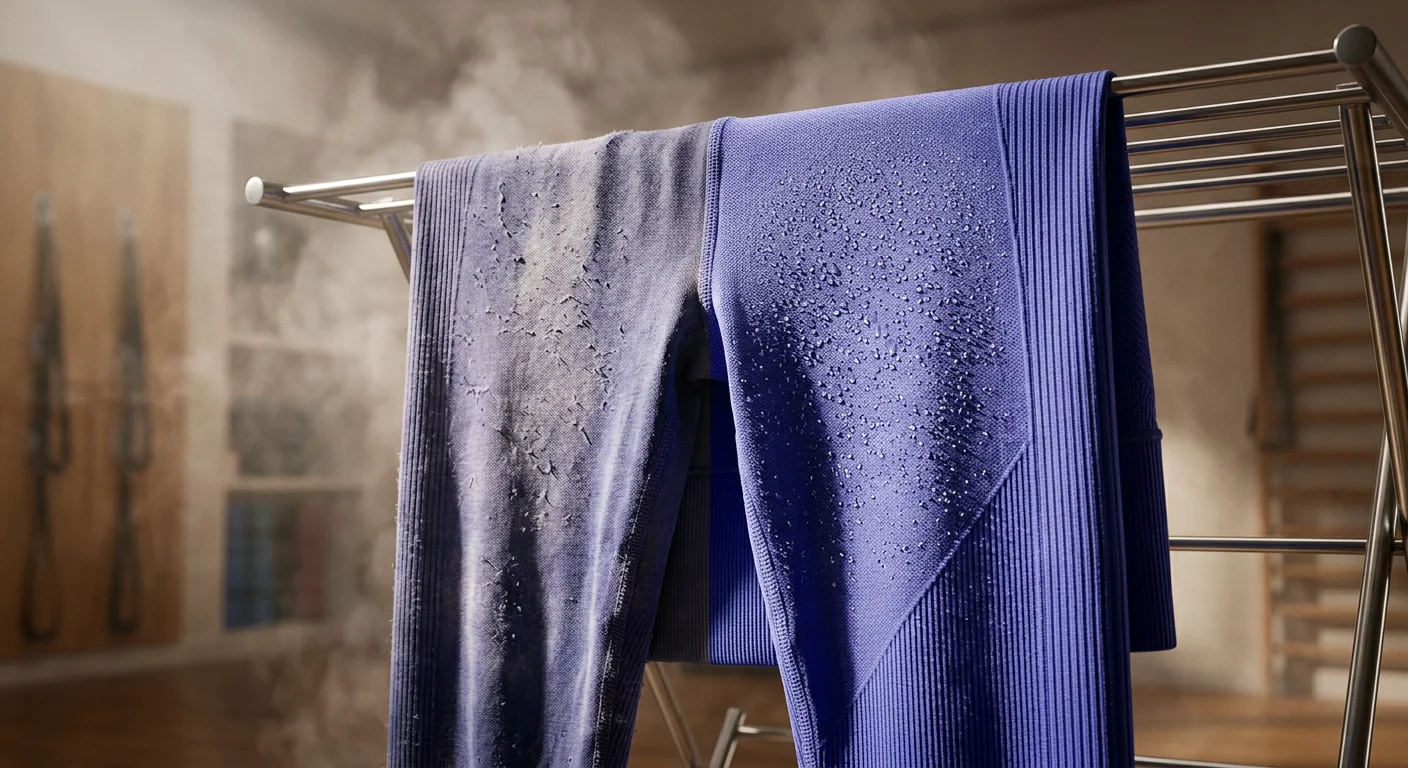
Hot yoga studios are brutal on garments. The heat hits 40°C. The sweat cycles never stop. Your fabric choices — made months before that first class — will either hold up or break down fast.
Here's the core takeaway: antimicrobial performance is engineered in, not washed in. It breaks down on a clear timeline. Your brand should own that timeline, not dodge it.
The tools in this guide exist for one reason — to move your brand from damage control to product confidence:
50/100-wash performance data
Bilingual care label templates
Supplier QA checklist
Your next move is simple. Take these three steps:
Audit your current moisture-wicking fabric care standards against the AATCC 100 thresholds in this guide.
Brief your yoga apparel suppliers on the findings.
Rewrite your hang tags to reflect accurate care and performance claims.
Brands that educate their customers build real trust. That trust holds — even through the sweatiest 90-minute Bikram session. And that's what keeps customers coming back, not filing returns.