Finding a domestic manufacturer who can deliver a matched activewear set is harder than it sounds. You need both pieces — the legging and the sports bra — cut from the same fabric, the same dye lot, the same construction standard, and shipped together. That's a specific requirement. Most manufacturers don't do it well.
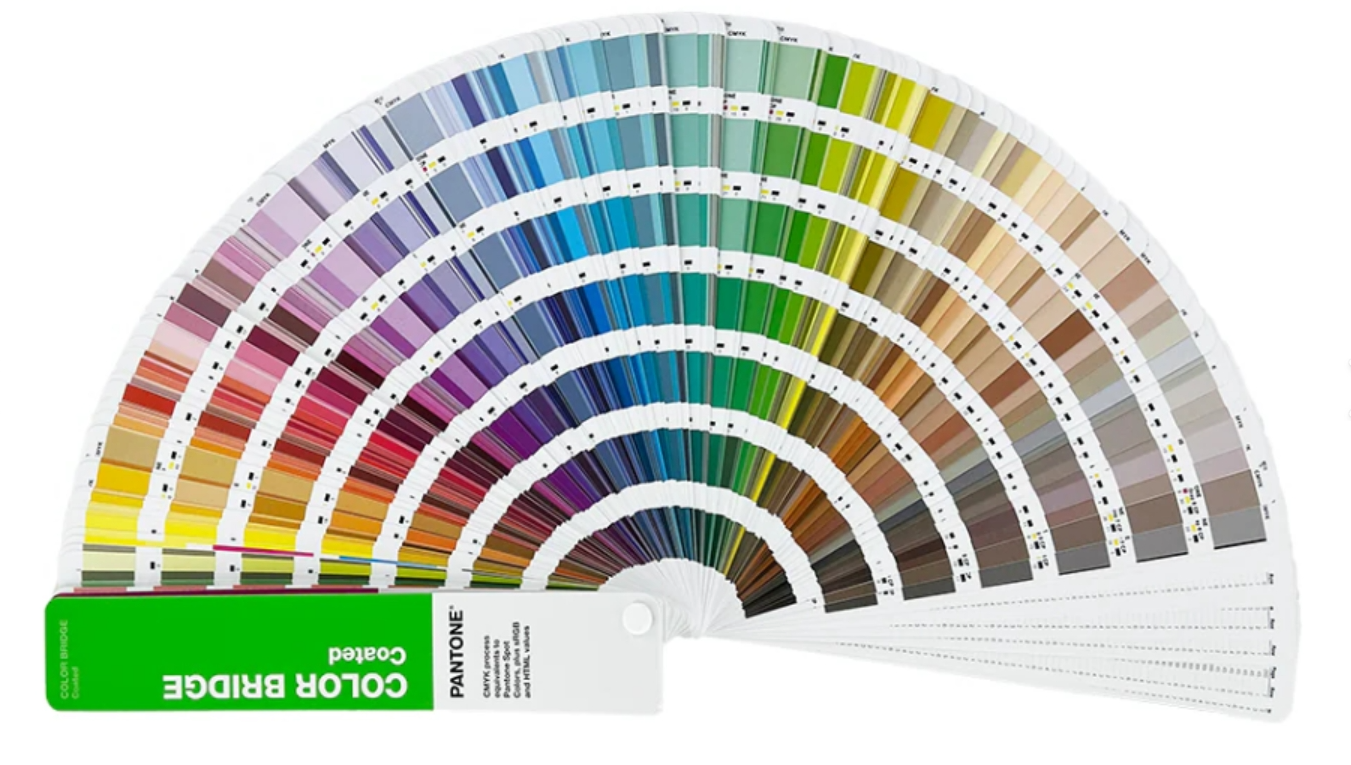
Many brands learn this the hard way. They place an overseas order, the set arrives as two pieces that matched on a Pantone card — but side by side, they look like they came from different brands entirely.
Sourcing made in USA custom activewear sets takes more planning. You're building a brand story that needs to hold up to real scrutiny — and justify a $90 price tag. The domestic manufacturing path delivers that. You just need to know what to ask, where to look, and what the real numbers are.
This guide covers all of it:
Real cost ranges
Honest MOQ realities
A supplier vetting matrix you can use right away
The questions most buyers forget to ask until it's too late
Domestic Activewear Manufacturing Clusters & Regional Capacity Traits
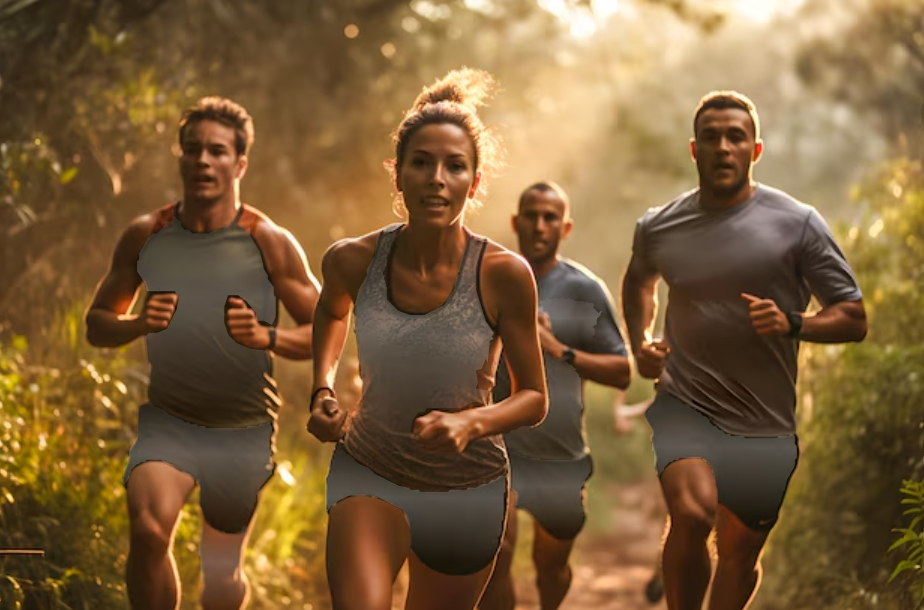
The United States doesn't have one activewear manufacturing hub. It has three — and each one runs like a different world.
Picking the right cluster for your brand is not a small logistics detail. This choice shapes your MOQ, your lead time, and your cost structure. It also decides whether your made in USA custom sports wear sets can exist as a real product line.
Los Angeles: Where Small Brands Come to Life
LA is the starting point for most DTC activewear founders, and for good reason. The city's garment district is built on a tight network of micro-factories — most running 5 to 50 machines. Patternmakers, sample rooms, and performance fabric suppliers all sit within miles of each other.
The result: you can walk into a fit session on Monday and have a revised sample by Thursday.
For cut and sew activewear — matching leggings and sports bra sets in particular — LA boutique shops work with MOQs of 50–150 pieces per style per color . Some studios go as low as 20–30 pieces for influencer capsules or test drops. Expect a higher per-unit cost and a simplified size run (XS–XL only) at that level.
Reorder capacity for most small LA shops sits at 300–800 pieces per style . Production lead times run 4–8 weeks once your patterns and markers are locked.
This region suits story-driven brands — the ones with a strong aesthetic, a founder face, and customers who care that the waistband sits just right.
Best fit for: Brands needing 50–150 pcs/style, rapid fit iteration, frequent colorway drops, yoga set and athleisure-forward silhouettes.
New York Metro: Technical Precision, Scalable Volume
New York runs on a different track. The Garment District in Midtown is a high-knowledge environment. You'll find patternmakers, graders, and sample rooms that focus on complex knit construction and technical design accuracy. This is the place to go for garments that are structurally demanding — where getting the pattern right across a full size run matters for wholesale performance.
NYC's real strength shows up in the broader metro area. Long Island (Hauppauge), New Jersey, and Pennsylvania host larger regional contract manufacturers . These facilities support production runs from 1,000 to 10,000 pieces per style — numbers that work for private label activewear programs and department store wholesale.
The standard model here is hybrid. Brands use NYC for design development, tech packs, and salesman samples. Then they move bulk production to regional partners for matching leggings sports bra set wholesale programs at steady volume.
Regional knit facilities in this area set MOQs at 300–500 pieces per color/style for cost-efficient production.
Best fit for: Brands scaling into wholesale, running seasonal private-label programs, needing technical precision across a full size curve.
The Southeast Corridor: Performance Fabric, Bulk Output
The Carolinas don't make fashion. They make performance.
This region is the domestic center for moisture wicking fabric mills, circular knit and warp knit facilities, compression fabric finishing, and sublimation printing. Your brand's core promise is technical — anti-microbial treatment, UV protection, compression zones, sweat management? The Southeast is where your performance fabric sourcing domestic conversation starts.
The economics here run on volume. Performance knit mills require 1,000–3,000 yards per color as a minimum — around 800–2,500 leggings-equivalent units, depending on fabric consumption. Cut-and-sew plants serving corporate and team programs handle 5,000–50,000 pieces per season with no issue.
Sublimation printing activewear operations in this region set minimums at 50–100 pieces per design. Total order expectations run higher though — 500–2,000 pieces across sizes.
Miami acts as a design and logistics front-end within this corridor. It's a strong fit for brands with Latin American market connections or swim-active crossover product lines.
Best fit for: Performance-driven brands, team and gym uniform programs, bulk yardage procurement, women activewear set OEM at scale with consistent QC standards.
The Regional Decision, Simplified
Region | MOQ Range | Core Strength | Best Brand Stage |
|---|---|---|---|
Los Angeles | 50–150 pcs/style | Fit iteration, capsule drops, yoga/athleisure | Early-stage, DTC, influencer-led |
New York Metro | 300–5,000+ pcs/style | Technical design, private label scaling | Growth stage, wholesale programs |
Southeast (Carolinas/Miami) | 500–50,000 pcs/style | Performance fabric, sublimation, bulk CMT | Established brands, uniform/team programs |
Think of it as a sourcing progression. LA handles concept and small-series yoga sets . New York covers technical design and scalable athleisure private label programs . The Carolinas take on bulk performance fabric and sublimated activewear runs . Many brands end up using more than one — building in LA, scaling in New York, and pulling performance fabrication from the Southeast as volume grows.
Domestic OEM vs Overseas Sourcing: Lead Time, Cost & MOQ Comparison
Let's be direct: overseas manufacturing costs less per unit. Full stop. But unit price alone doesn't determine whether your activewear set launch succeeds or fails.
The number that actually matters is total landed cost . That figure shifts fast once you add freight, import duties, customs clearance, and the carrying cost of inventory you had to order at 1,000 pieces minimum — before you even knew the fit was right.
MOQ: The Number That Changes Everything at Launch
Overseas factories require 500–1,000+ pieces per style per color to start a production run. For a matched leggings-and-sports-bra set, that means committing to 500 sets before a single customer has tried them on.
Domestic cut and sew activewear manufacturers work on a different logic. MOQs sit between 24 and 300 pieces per style per color . That's small enough to:
Test a colorway
Validate your size curve
Confirm sell-through before scaling
That flexibility isn't just convenient. For a new brand holding a $90 price point, it protects your cash position in a real, measurable way.
Lead Time & Sampling Speed
Overseas sampling means shipping in both directions, customs processing, and a communication gap that grows every time you request a revision. One fit correction can eat two to three weeks.
Domestic women activewear set OEM runs on a different timeline:
Same time zone
Same language
Revised sample back in days, not months
For yoga set custom manufacturing — where waistband placement or bra strap angle needs three rounds of refinement — that speed translates directly to saved money.
Domestic production lead times run 4–8 weeks from locked patterns to finished goods. Overseas timelines, counting ocean transit alone, run 14–20 weeks .
The Hybrid Model Most Brands Land On
Start domestic. Validate the style. Prove the demand. Then move volume offshore once your order size justifies the MOQ and your brand can absorb the inventory exposure.
Use domestic moisture wicking fabric supplier relationships and cut and sew activewear USA production for your first drops, capsule launches, and seasonal tests. The higher unit cost is real — but so is the dead stock risk you sidestep by not over-ordering on an unproven style.
End-to-End Production Timeline: From Initial Inquiry to Bulk Shipment
Here's what most factories won't tell you upfront: the quoted production time and the actual door-to-door time are two very different numbers.
A factory says "4–6 weeks." That means 4–6 weeks of sewing — after your tech pack is locked, after your fabric arrives, after your samples are approved. The full timeline, from first email to bulk shipment in your warehouse, runs 10–14 weeks for sea freight. Often longer.
Knowing where those weeks go is what separates a smooth launch from a missed season.
Phase 1: Tech Pack & Material Lock (Weeks 1–2)
Get your tech pack done within 10 working days. That includes style, grading rules, GSM specs, logo placement, and BOM. At the same time, lock your Pantone colorways and trim selections. Lab dip approval takes 3–7 days per round on its own. Delay this step and you push your entire fabric window back.
Phase 2: Fabric & Trim Sourcing (Weeks 1–6, running parallel)
This is where most timelines fall apart — quietly, without warning.
In-stock performance fabrics — standard nylon/spandex in black, navy, heather grey — arrive in 1–2 weeks
Custom colors or special finishes? Plan for 4–8 weeks
Specialty trims like molded cups or jacquard elastic add another 3–6 weeks
Pick your priorities early. Every custom choice adds time.
Phase 3: Sampling & Fit Iteration (Weeks 2–6)
First proto takes 7–14 days once materials are confirmed. Most brands go through 2–4 fit rounds for a matched activewear set — checking waistband flip, strap recovery, and squat-proof opacity. Build this into your budget. Don't plan around skipping it.
Phase 4: Pre-Production & Bulk (Weeks 5–10)
Bulk cut-and-sew for 1–3 styles across 3–5 sizes takes 15–30 sewing days . Before full bulk starts, a pilot batch of around 500 pieces runs first. This catches seam slippage and color consistency problems before they spread through the full order.
Phase 5: Finishing, QC & Dispatch (Weeks 10–14)
Final inspection at AQL 2.5 takes 1–2 days. Then add steaming, polybagging, and carton packing. Factory to port runs 1–3 days . Customs clearance adds another 3–7 days .
The shortcut playbook:
Use the factory's base blocks
Choose in-stock fabrics
Limit prints to two colors
With tight project management, you can compress the full timeline to 8–10 weeks ex-factory . That's a real number — not an optimistic guess.
True Cost Breakdown for Custom Activewear Sets Across Pricing Tiers
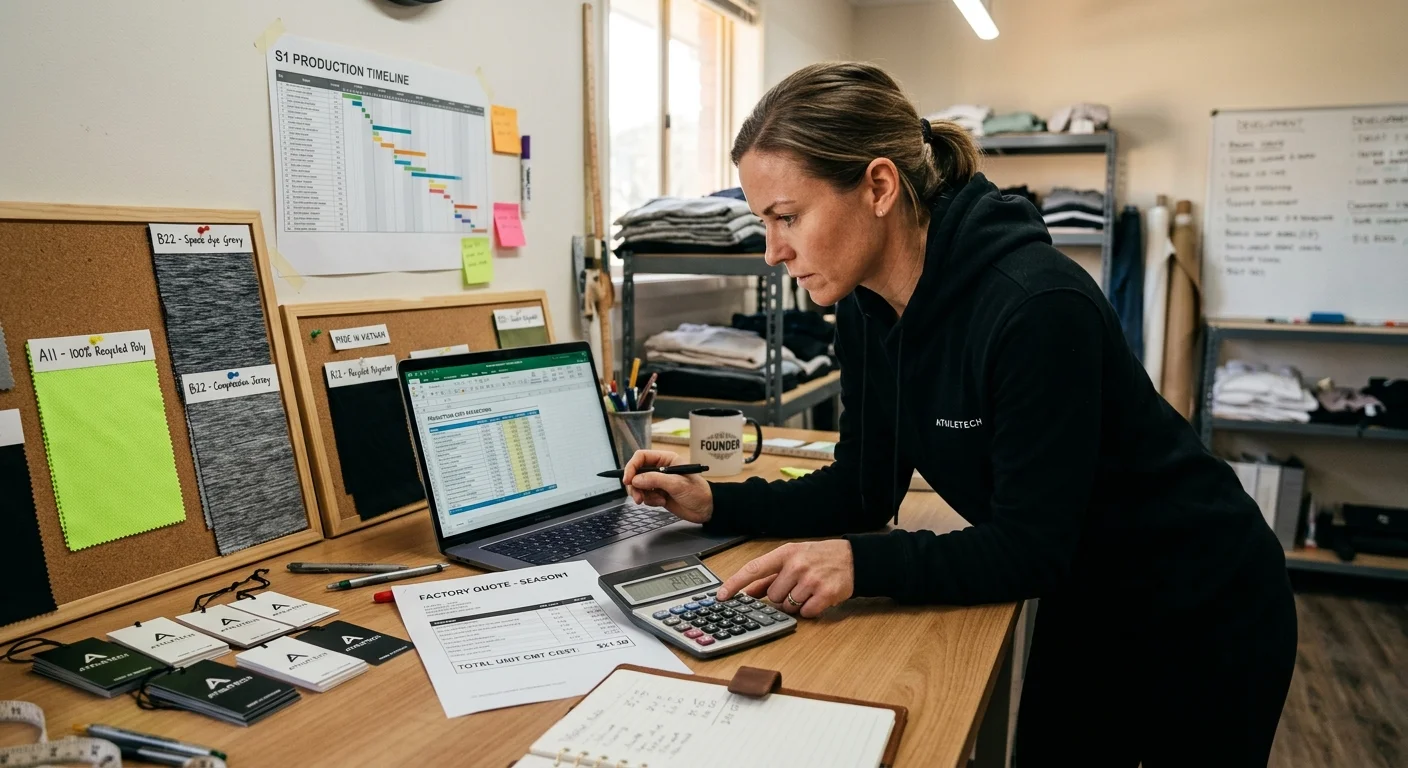
The number most factories give you is not the number that matters. The quote covers CMT. It does not cover the fabric surcharge on your 200-yard custom dye lot, the grading fee spread across your first 300-unit run, or the branded hangtag package your retail buyer just made non-negotiable. By the time those details surface, your margin model looks very different.
Here is what a custom activewear set — sports bra plus legging, made in the USA — costs to manufacture across three real pricing tiers.
Budget Tier: ~$18–$22 per set
This is entry-level domestic production done right. The fabric is a 180–220 GSM polyester/spandex blend — functional, moisture-wicking, nothing exotic. Construction runs on 4-thread overlock plus coverstitch at the hems. No flatlock. A single-color heat transfer logo on the front and bra band handles branding.
Where the money goes at a $20 set cost:
Cost Component | % of Total | Dollar Amount |
|---|---|---|
Fabric & basic trims | 35% | $7.00 |
Cutting & spreading | 15% | $3.00 |
Sewing (CMT labor) | 40% | $8.00 |
Finishing & packaging | 10% | $2.00 |
Fabric cost at this tier runs $3–$5 per set . That is based on mill pricing of $3.00–$4.50/kg and a set consumption of 0.9–1.1 kg, including cutting wastage. CMT labor — overlock and coverstitch, nothing more — lands at $4–$7 per set .
A $20 manufacturing cost supports $60–$75 retail using standard cost-to-wholesale-to-retail multipliers. That is a real, workable margin — as long as your brand story does not need a performance-fabric callout.
Mid Tier: ~$28–$32 per set
Most emerging women activewear set OEM programs sit right here. This is also where the product starts to earn its price tag in ways customers can feel. The fabric upgrades to a 240–280 GSM nylon/Lycra blend. Flatlock seaming appears in high-stretch zones. The gusset is lined. Dye-sublimation panels become possible at this tier, and woven neck labels replace printed ones.
Where the money goes at a $30 set cost:
Cost Component | % of Total | Dollar Amount |
|---|---|---|
Fabric & technical trims | 40% | $12.00 |
Cutting | 15% | $4.50 |
Sewing (CMT labor) | 35% | $10.50 |
Branding & embellishment | 10% | $3.00 |
Nylon/spandex performance knits run 20–60% more expensive than basic polyester. Realistic fabric cost at this tier is $8–$12 per set . The branding package adds real cost on top of that: woven labels ($0.15–$0.35), silicone logo patches ($0.40–$0.90 for two pieces), and sublimation printing activewear panels ($1.00–$2.50 per garment, depending on coverage).
A $30 cost supports $60–$75 wholesale and $120–$150 retail . This is the sweet spot for athleisure private label programs targeting the mid-premium customer.
Premium Tier: ~$38–$45 per set
At this level, the product handles technical demands that cheaper sets cannot match. Fabric moves into 280–320+ GSM brushed nylon/spandex with a peached handfeel, or into seamless and bonded construction using high-gauge circular or warp knit. Eco-certified recycled yarns — GRS-certified recycled nylon or polyester — carry a 10–20% yarn upcharge over standard options. Premium retail buyers are making those yarns a hard requirement more and more.
You also get laser-cut edges, bonded hems, hidden waistband pockets, and double-layer panels. The branding package includes 3D silicone or TPU logos, branded elastic waistbands, and a multi-component hangtag setup.
Where the money goes at a $40 set cost:
Cost Component | % of Total | Dollar Amount |
|---|---|---|
Fabric & premium trims | 45% | $18.00 |
Cutting & laser/bonding prep | 20% | $8.00 |
Sewing & bonding | 25% | $10.00 |
Premium branding package | 10% | $4.00 |
High-GSM recycled nylon/spandex runs $8–$14 per meter . Set consumption at this construction weight hits 1.2–1.4 meters . That puts fabric cost alone at $10–$20 per set . A $40 cost supports $80–$100 wholesale and $160–$220+ retail , provided your brand holds that positioning.
The Hidden Costs Most Quotes Don't Include
Before you take any factory's per-unit number at face value, add these back in:
Pattern development & grading : A new bra-plus-legging block costs $250–$500 to develop. Grading across a full XS–XXL size run adds $150–$350 per style . On a 500-piece opening order, that grading fee alone adds $0.70 per set — real money at launch volume.
Sampling fees : Most domestic cut and sew activewear USA factories include one or two proto samples. Revisions after that often bill at $60–$120 per sample or $80–$150 per development hour .
Low-MOQ fabric surcharges : Custom dye lots below 500–1,000 meters carry a 5–20% fabric upcharge or a flat $150–$300 dye-lot fee . Factory CMT for orders under 300 sets per style can add $1–$3 per unit in uplift.
Retail-readiness packaging : Branded polybag with insert ( $0.25–$0.80/set ), hangtags ( $0.20–$0.50/set ), barcode labels and folding service ( $0.15–$0.40/set ). Each line item looks small. They add up fast.
How to Pull Cost Down Without Gutting the Product
Three levers that work:
1. Consolidate around a shared base block. Use one legging pattern across multiple colorways. This cuts grading and changeover cost. Line efficiency improves by 5–10% — the sewing line stops resetting for a new fit on every run.
2. Negotiate tiered reorder brackets. A solid price ladder looks like this: 300–499 sets at base CMT, 2–4% reduction at 500–999 sets , 5–8%+ reduction at 1,000+ . Lock pricing across two to three repeat runs if you can commit to a forecast. Factories value predictability more than most buyers expect.
3. Book off-peak production. Domestic performance fabric sourcing and CMT capacity gets tight before spring/summer and back-to-school. Shoulder-season slots can yield 5–8% CM discounts . You also tend to get a faster line position — there is less competition for spots outside the peak rush.
Supplier Evaluation Checklist: 10-Dimension Vetting Matrix
Most buyers walk into their first domestic sourcing conversation with three questions: Can you make leggings? Can you make a matching bra? What's your MOQ? That's not vetting. That's hoping.
A real evaluation has structure. The matrix below gives you ten dimensions to score every potential made in USA custom activewear sets manufacturer before you spend a dollar on sampling. Use it as your interview script, your RFQ framework, and your final comparison tool — all in one.
How to Use This Matrix
Score each supplier 1–5 on every dimension. Weight the dimensions based on your priorities (suggested weights below). Multiply score × weight for each row, then total the column. Cut any supplier below 65% of the maximum possible score before you waste sampling budget on them.
Dimension 1: Physical US Presence & Legal Standing (Weight: 15%)
This is your first filter — and it cuts more vendors than you'd expect.
Request a state business registration printout showing a manufacturing or cut-and-sew NAICS code at a physical street address. Ask for a signed W-9 and certificate of good standing. Then ask for a live video walk-through of the production floor. Not photos. Video, unedited.
Score 5: Full street address, production floor footage, open to live walk-through.
Score 3: Address confirmed, photos provided, some reluctance on video.
Score 1: Address resolves to a UPS Store, virtual office, or co-working space.
One quick check most buyers skip: reverse-image-search their factory photos. Factory photos that show up on unrelated overseas manufacturer websites are an automatic disqualification. For cut and sew activewear USA claims, California requires a Garment Registration for cut-and-sew operations. Your shortlisted LA vendor can't produce one? That's a hard flag.
Dimension 2: Set-Specific MOQ Structure (Weight: 15%)
The term "activewear manufacturer" does a lot of heavy lifting in this industry. Many shops that claim to make activewear sets produce single pieces and loosely coordinate them. Find the ones who treat a matching leggings sports bra set as a single SKU — cut from the same dye lot, sewn on the same line, QC'd together.
Ask directly: What is your MOQ for a two-piece set — sports bra plus legging — in one style and one color?
Score 5: ≤50 sets per style/color; mixed sizes (XS–XL) within that 50; micro-run option of 10–20 sets using stock fabric remnants.
Score 4: 51–100 sets per style/color; test run of 30–50 available with upcharge.
Score 3: 101–200 sets per style/color.
Score 2: 201–300 sets.
Score 1: >300 sets per style/color, or full dye-lot orders only (800–1,000+ meters of fabric).
Also ask for their written policy on leftover fabric. The best activewear set MOQ USA manufacturer partners store client roll remnants and allow ≤30-unit reorders from that inventory. It's a small detail. But it signals a lot about how they approach long-term client relationships.
Dimension 3: Production Capacity & In-House vs. Subcontracted Work (Weight: 12%)
Send every shortlisted vendor a capacity disclosure table as part of your initial RFQ. Ask them to fill in:
% of cutting done in-house (laser or straight knife)
% of sewing done in-house vs. subcontracted
% of printing/heat transfer in-house vs. external
Average output of leggings and sports bras per month
Score 5: ≥70% in-house cutting and sewing; subcontracting limited to embroidery, printing, or overflow only.
Score 4: 50–69% in-house sewing, with cutting fully in-house.
Score 3: 30–49% in-house sewing; stable, named long-term subcontractor list provided.
Score 1–2: <30% in-house, or flat refusal to disclose subcontractor use.
Then check their capacity claims against reality. A single operator on performance knit can sew 15–25 leggings per hour . Ask for their machine list — number of 4-needle 6-thread flatlock machines, overlocks, coverstitches — and run the math yourself. A shop claiming 5,000 leggings per month with four sewing machines and one shift? The numbers don't hold.
Dimension 4: Fabric Library & Performance Fabric Sourcing (Weight: 12%)
Domestic performance fabric sourcing is one of the harder parts of this process. A strong supplier doesn't just "source anything you want." They maintain an active library — swatch books with GSM, fiber composition, recommended end use, and available color cards.
Score 5: 10+ active nylon/spandex stock SKUs; 5+ polyester/spandex options; swatch book with GSM and composition documented; color restock lead times listed.
Score 3: Limited but documented fabric offering; can source custom with lead time.
Score 1–2: "We can source anything" with no real catalog, no lab data, no swatches.
Push further. Ask for mill origin or mill code, country of origin, and basic performance test data — stretch and recovery (% recovery on 30–50% extension), pilling resistance (Martindale grade 4+), and colorfastness to washing and sweat. A supplier who hands you a PDF with mill-level test reports is operating at a completely different level than one who can't.
Dimension 5: Sampling Process, Fees & Credit Policy (Weight: 10%)
A fair benchmark for cut and sew activewear sampling: $150–$300 per style , including pattern development and one sewn sample. Quote comes in far lower? Ask what's missing. Quote comes in far higher? Ask why — and whether they're working from existing blocks.
The credit policy tells you even more about how a factory sees the relationship. Your target terms:
Score 5: ≥50% of sampling fee credited against first bulk PO of ≥300 pieces per style, credit valid for at least 12 months.
Score 4: 30–49% credit at ≥300 pieces, or 50% credit at ≥500 pieces.
Score 2–3: Partial credit only at ≥1,000 pieces, or case-by-case.
Score 1: No credit policy of any kind.
Also confirm: how many fit revision rounds are included in the sampling fee? What's the realistic sample lead time from a finalized tech pack? For yoga set custom manufacturing , strap angle and waistband placement often need three revision rounds. Get that number upfront. It saves a lot of frustration later.
Dimension 6: Quality Control Infrastructure (Weight: 10%)
Ask for their AQL level and the inspection standard they reference. AQL 2.5 for major defects, 4.0 for minor, against ANSI/ASQ Z1.4 is a solid baseline for women activewear set OEM production.
Score 5: Inline inspection + pre-production sample approval + final AQL inspection, all with documented sampling plans and checklists.
Score 3: Final inspection only, with some documentation.
Score 1–2: "We check everything before it ships" with no structured process behind it.
Go deeper. Do they use the 4-point system for incoming fabric inspection? Do they run stretch tests on high-stress seams — squat tests on leggings, burst tests on bra construction? Wash tests across at least five cycles on development samples? Tests that are documented and photographed during pre-production earn a higher score.
Dimension 7: Certifications & Compliance (Weight: 8%)
Three things to check here:
Made in USA / FTC compliance. Ask for their formal policy on how they ensure "all or near-all" domestic content — the FTC's standard for an unqualified Made in USA claim. Request sample labels and any prior retail or legal audits. A supplier who can't explain this clearly is a liability.
Material certifications. Can they source OEKO-TEX STANDARD 100 certified fabrics? GRS-certified recycled yarns for domestic performance fabric sourcing programs targeting sustainability-focused retail? Score higher for at least one current, verifiable certificate from a fabric supplier covering performance knits.
Workplace compliance. Ask for the last OSHA inspection date and any social accountability audit (SMETA, SA8000, WRAP). Not a requirement for a small domestic shop — but a supplier who shares even an internal safety audit takes operations seriously.
Dimension 8: Communication Standards & Project Management (Weight: 8%)
This dimension looks soft. It isn't. Communication breakdowns cause more domestic production delays than fabric sourcing problems.
Score 5: Named project manager with direct email and phone/WhatsApp; backup contact designated; written commitment to <24-hour first response and <72-hour formal quote after tech pack receipt; weekly production updates with photo or video.
Score 3: Responsive but no structured update cadence; single point of contact only.
Score 1–2: "Email us anytime" as the only SLA.
Ask directly: can they provide a written critical path at the start of each production run? That means PP sample approval date, fabric-in date, cut start, sew start, and packing. Suppliers who build this into their process hit deadlines at a much higher rate than those who don't.
Dimension 9: Commercial Terms — Pricing Stability & Capacity Reservation (Weight: 6%)
Score 5: Firm pricing for ≥90 days from quote, with a clear escalation formula tied to specific yarn index movements; willing to reserve production capacity (e.g., 1,000 sets/month) against a rolling forecast with defined booking and deposit terms.
Score 4: 60-day firm pricing; capacity reservation available but informal.
Score 1–2: Price valid "until materials change" with no defined window; no capacity reservation offered.
For athleisure private label programs running multiple drops per year, capacity reservation isn't optional. It's what turns a vendor into a real supply chain partner.
Dimension 10: Activewear Set Portfolio & Client References (Weight: 4%)
This last dimension is about proof of work. Ask for:
Portfolio photos of matching bra and legging sets they've produced — not generic activewear, not swimwear, not yoga pants on their own
A brief description of fabrics used and the intended activity for each style
Three references from brands at a similar volume and price tier
Call those references. Ask three questions directly: Did the bra and legging match in final production? Were there any dye-lot or GSM inconsistencies between the two pieces? How did they handle the first quality issue that came up?
Those three answers will tell you more than any factory tour.
The Supplier Comparison Summary Table
Evaluation Dimension | Weight | Supplier A | Supplier B | Supplier C |
|---|---|---|---|---|
1. Physical US Presence & Legal Standing | 15% | /5 | /5 | /5 |
2. Set-Specific MOQ Structure | 15% | /5 | /5 | /5 |
3. Production Capacity & In-House % | 12% | /5 | /5 | /5 |
4. Fabric Library & Performance Sourcing | 12% | /5 | /5 | /5 |
5. Sampling Fees & Credit Policy | 10% | /5 | /5 | /5 |
6. QC Infrastructure | 10% | /5 | /5 | /5 |
7. Certifications & Compliance | 8% | /5 | /5 | /5 |
8. Communication & Project Management | 8% | /5 | /5 | /5 |
9. Pricing Stability & Capacity Reservation | 6% | /5 | /5 | /5 |
10. Activewear Set Portfolio & References | 4% | /5 | /5 | /5 |
Weighted Total Score | 100% |
Any supplier scoring below a 3.2 weighted average (64% of maximum) doesn't belong on your final shortlist — no matter how good their price looks. A low-cost vendor with no set-specific production experience or in-house capacity control will cost you far more in corrections, delays, and re-sampling than the unit price gap ever saves.
Pre-Contract Verification: Critical Questions & Common Sourcing Traps
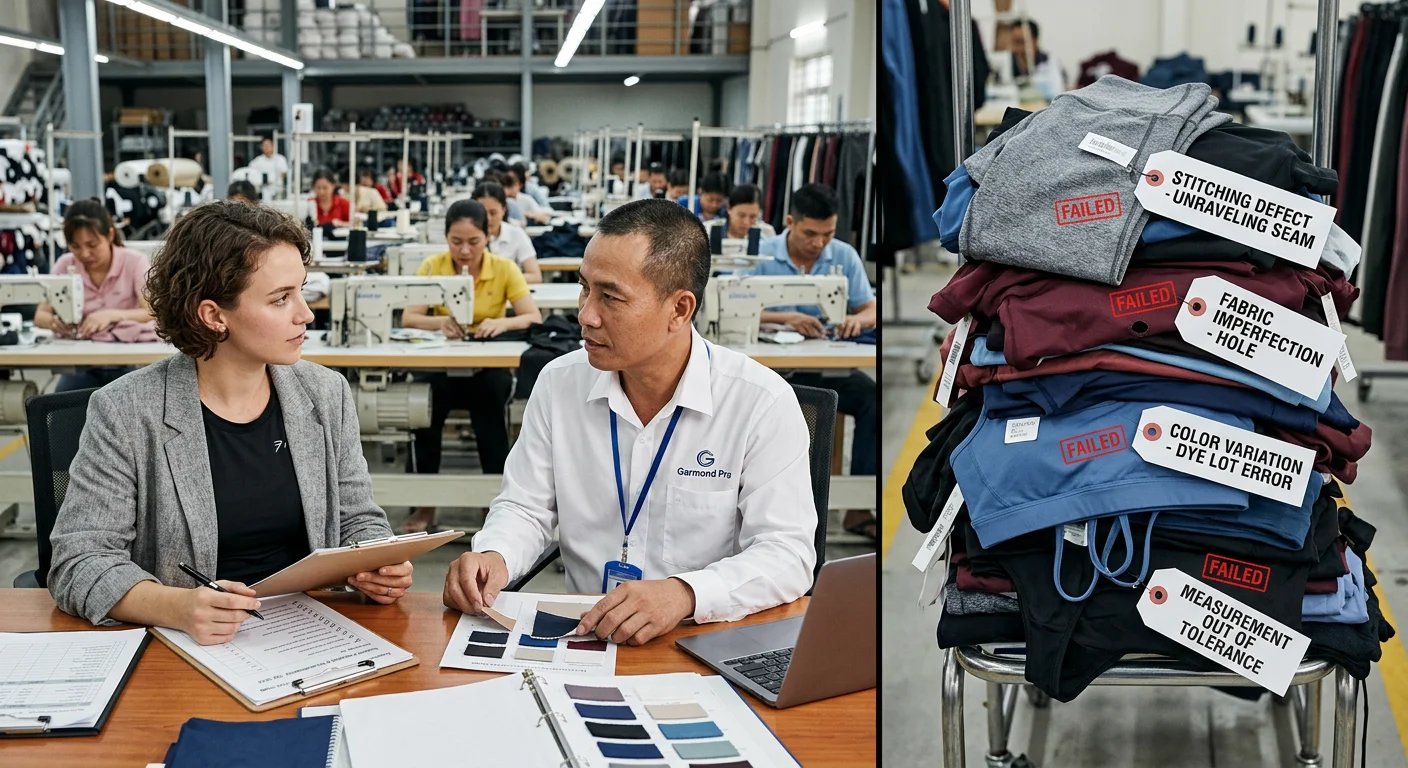
Contracts signed in good faith still fail. Not because people are dishonest — though that happens too — but because both sides assumed they meant the same thing, and they didn't.
Before you commit to any domestic cut and sew activewear USA manufacturer, know this: five traps eat sourcing budgets fast, well before a single legging ships.
Trap 1: The "Made in USA" Label That Isn't
This one costs brands more than money. It costs them the story.
Many factories cut and sew on U.S. soil — but the fabric was knitted in Taiwan, dyed in China, and shipped to LA for final assembly. That does not qualify as a made in USA custom activewear sets claim. The FTC's standard is "all or virtually all" domestic content. Legal advisors treat 95%+ U.S. cost content as the practical working threshold.
Before you sign, require:
- A full materials breakdown sheet listing fiber origin, yarn spinning country, knit/weave country, dye and finish country, and cut/sew country — each as a percentage of ex-factory cost
- Mill invoices showing U.S. seller and country of spinning
- A supplier-signed annual FTC compliance certificate from an officer, with backup cost calculations
Write this into the contract: U.S. content drops below the agreed threshold, and labels must change right away. You also get the right to cancel open POs without penalty. Add supplier indemnity too — covering regulatory fines, recalls, and retail chargebacks from any inaccurate origin claim.
Trap 2: Performance Specs That Live Only in Your Head
You want Grade 4 colorfastness. Seams that don't slip at 180N. Shrinkage under 3% after three washes. Fine — but those numbers don't exist unless they're in the contract.
Put these questions in writing before signing:
- Which test methods apply — ASTM D1683 for seam strength, AATCC 61 for colorfastness, AATCC 135 for shrinkage?
- What pass/fail thresholds is the factory committing to?
- What is the defect credit formula for confirmed failures — full replacement plus freight if defects exceed 2% of shipment quantity?
Tie the balance payment (the final 70%) to passing third-party lab reports from SGS, Intertek, or Bureau Veritas. Run those tests on random bulk rolls — not development yardage. Samples pass. Bulk sometimes doesn't.
Trap 3: IP You Paid For, That Isn't Yours
Tech packs, graded pattern files, digital markers, print screens — brands fund all the development work, then find out the factory claims those files as house IP.
One clear clause fixes this. Insert a work-for-hire and full assignment provision. All patterns, graded nests, DXF files, markers, and artwork created from your direction belong to you upon full payment. The supplier waives any reuse rights — for their own line or any third party. Push that obligation down the chain too. Require your manufacturer to get back-to-back NDAs and IP assignments signed by every subcontractor they use, including print shops and pattern houses.
Trap 4: Reorder Pricing That "Changes With Materials"
Every factory reserves the right to adjust pricing as input costs move. Fair enough. The real problem is a clause with no defined formula, no reference index, and no adjustment band — just "we'll let you know."
Negotiate these terms into the contract:
- Base price tied to a published index (Cotlook A or ICE Cotton #2 for cotton-blend programs; polyester chip index for nylon/spandex)
- A non-adjustment band of ±5% within which FOB holds firm
- A defined look-back period — 30-day moving average before each new PO
Price adjustments need to be mechanical and auditable. You should not have to re-negotiate the price from scratch on every reorder.
Trap 5: Low MOQ Claims That Don't Hold Under Load
A factory quoting 24 pieces per style sounds great for test drops. But no dedicated small-batch line, no scheduling system, and three large wholesale clients ahead of you? Your 24-piece reorder gets pushed back every single time.
Ask these before signing:
- How many dedicated lines handle micro-batch runs (≤50 pcs/style)?
- What production floor scheduling software do they use?
Also write a Reorder SLA into the contract. For orders under 100 sets in fabrics you've already approved, cutting starts within 10 working days of PO receipt and ships within 25–30 calendar days. Add a late-delivery penalty — 1–2% of FOB per delayed week, capped. Add a clause stating your reorders cannot be bumped by larger clients without your written approval.
A factory that won't put this in writing is already telling you something important.
Conclusion
Sourcing made in USA custom fitness wear sets isn't a shortcut — it's a strategic commitment. The brands winning in the mid-to-premium activewear space aren't just slapping a domestic label on their hangtags. They've put in the real work. They called the factories. They asked the tough MOQ questions. They requested fabric swatches. And they walked away from suppliers who couldn't back up their claims.
You now have the framework to do the same.
Use the supplier evaluation matrix before your first inquiry call. Check the cost tier breakdown before setting your wholesale pricing. And if a factory tells you they can deliver a full cut and sew activewear set in six weeks at $14 a unit — trust your instincts. That number doesn't add up.
The right domestic manufacturing partner isn't easy to find. But once you land one, it becomes one of the strongest decisions your brand will make. It's hard for competitors to copy. It builds real credibility with buyers. And it holds up over time.
Start with one supplier. Ask the hard questions. See what comes back.