Choosing between seamless knitting technology and cut-and-sew sportswear production is more than a manufacturing decision. It's a strategic call that shapes your cost structure, your MOQ commitments, your product quality, and how fast you can get to market.
Get it wrong at the sourcing stage, and the consequences are real. You could end up locked into a $15,000 minimum you didn't budget for. Or you're sitting on inventory that pills after 20 washes.
This guide gives you real numbers, factory-level insights, and a clear decision framework. Launching your first yoga leggings brand line? Scaling an existing brand? Either way, you'll walk away knowing which production method deserves your next purchase order.
Seamless vs Cut-and-Sew: What Matters for B2B Buyers (Brief Overview)
Two production methods. Dozens of variables. One decision that shapes your brand for years.
Here's the clearest way to frame it:
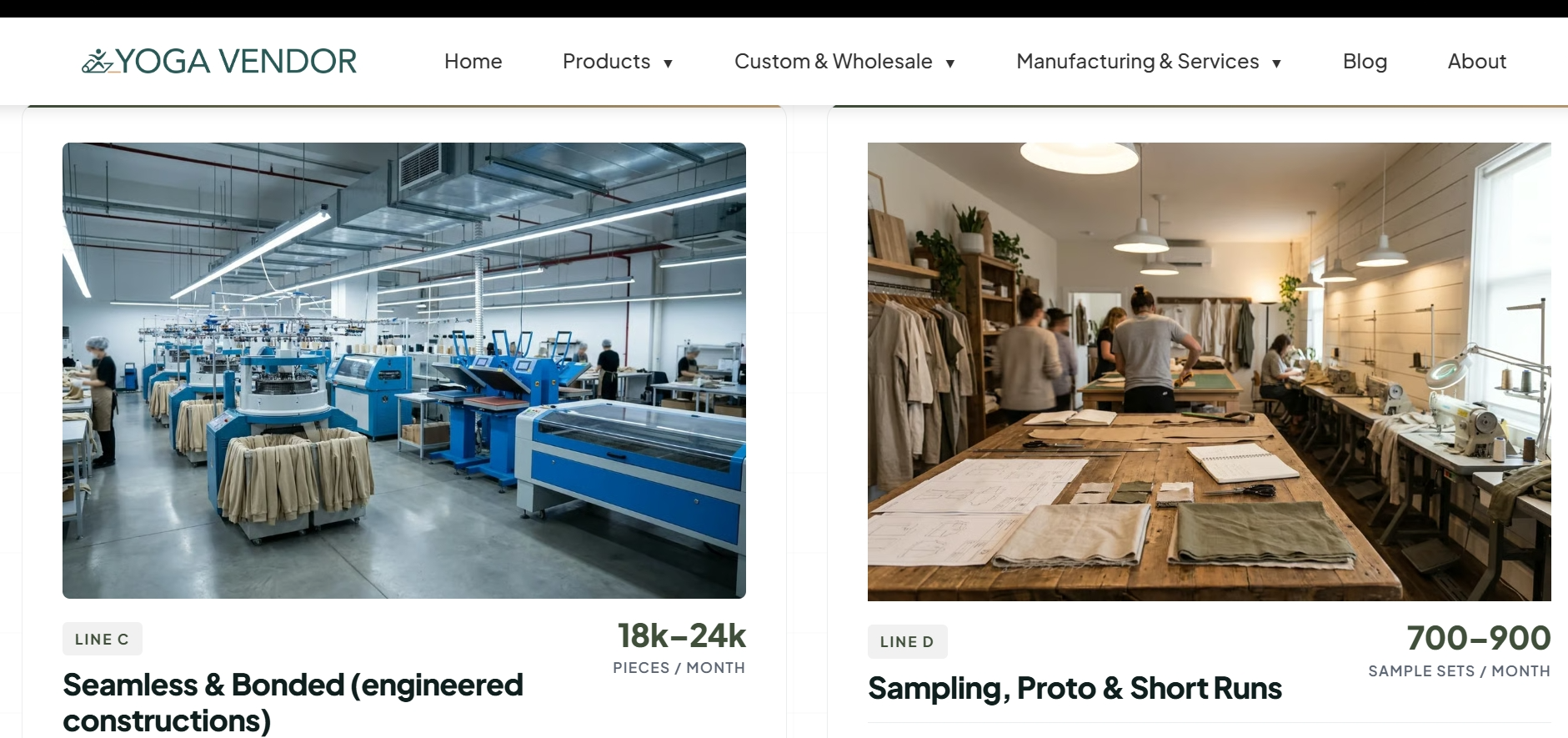
Seamless knitting technology builds a garment straight from yarn on circular knitting machines — think 300–600 needle systems that produce a finished tube in one pass. You get minimal seam lines, consistent stretch, and fabric waste as low as 3–8%. The tradeoff? High entry barriers, fewer yoga wear supplier options, and MOQs that start at 300–800 pieces per colorway — and go up from there.
Cut-and-sew sportswear production is the traditional path: roll goods fabric, pattern pieces, cut, sew. Every activewear garment factory in the world can do it. MOQs drop to 100–300 pieces per color. Design options are wide open — color blocking, mesh paneling, asymmetrical cuts, pockets. Your imagination sets the limit.
This decision isn't about which method is better . It's about which one fits where your brand stands right now.
Dimension | Seamless | Cut-and-Sew |
|---|---|---|
Best for | Functional basics, compression, long-run styles | Trend pieces, multi-panel designs, new brand testing |
Fabric waste | 3–8% | 10–20%+ |
Design freedom | Limited by machine capability | High |
Global supplier pool | Narrow | Wide |
The sections below break down each of these dimensions with real yoga apparel factory data. Use them to match the right method to your budget, timeline, and product positioning.
Cost Comparison: Seamless vs Cut-and-Sew Yoga Wear Manufacturing
Most sourcing guides skip the real numbers. Here's what they don't tell you. At small volumes, seamless yoga wear costs 30–40% more per piece than cut-and-sew. At 3,000+ units, that gap drops to 10–20%. Your choice of method doesn't just change your unit cost — it reshapes your entire cost model.
Here's the full breakdown.
Unit Cost at a Glance (FOB, Mid-Range Yoga Leggings)
Cost Item | Cut-and-Sew | Seamless |
|---|---|---|
Sampling fee | USD 80–150/style | USD 150–250/style + size range |
Tooling / programming | USD 30–80/color (print screens only) | ~USD 200–500/style (amortized over 1,000+ pcs) |
Unit cost @ MOQ | USD 6–8/pc (300–500 pcs) | USD 7–10/pc (600–1,000 pcs) |
Unit cost @ scale | USD 5–6/pc (2,000+ pcs) | USD 6–7/pc (3,000+ pcs) |
Standard MOQ | 300 pcs/style | 600–1,000 pcs/style/color |
Figures reflect China/Vietnam yoga wear factory benchmarks for mid-positioned activewear brands. Expect ±20–30% variance by region and spec.
Where the Real Cost Difference Lives
The sticker price gap is just one part of the picture. The hidden cost structure is where these two methods pull apart.
Seamless front-loads your spend. Programming a new knit structure takes a skilled technician hours — sometimes a full day. Change the design, change the size, adjust the compression zone layout — you're back to reprogramming. Each change ties up a machine. Drop below 600 pieces per colorway, and that setup cost spreads across too few units. The math falls apart fast.
Cut-and-sew spreads cost across the process. Pattern adjustments take 1–2 hours. Tooling costs stay low — USD 30–80 per print screen if needed. But a complex multi-panel design with 20+ sewing steps adds labor cost at every seam. Plus, fabric waste runs 10–20%. Your real material cost ends up higher than your fabric price shows.
Seamless has one clear hidden advantage: near-zero cutting waste. Use premium nylon or high-stretch technical yarn, and the 3–8% waste rate stands out sharply against the 15–20% waste on cut-and-sew. At volume, that difference can offset a big chunk of the programming cost.
The Volume Decision Point
This is where the decision gets clear:
Under 800 pcs/style/color → Cut-and-sew wins on total landed cost. Lower MOQ, lower sampling fees, and zero programming overhead.
800–1,500 pcs/style → The gap narrows. Base your choice on design complexity and reorder potential.
1,500–2,000+ pcs on a long-run basic → Seamless becomes a real competitor. Fewer sewing steps mean lower defect rates, lower rework costs, and more consistent QC results on large runs.
One sizing note worth knowing: seamless machines run on a single tube diameter — one machine, one size. Add more sizes, and you add machine changeovers. That means more hidden time cost. Cut-and-sew handles this better. It nests multiple sizes on a single fabric lay, so scaling from XS to XL adds little to your unit cost.
The Total Cost Reality
Neither method is cheaper by default. Seamless costs less at scale on repeatable styles . Cut-and-sew costs less for small runs, complex designs, and brands still testing the market.
Launching your first yoga leggings line with a USD 15,000 budget? Cut-and-sew gives you more styles, more flexibility, and less financial risk. Running a core basic that moves 3,000 units a season? Seamless starts making strong economic sense — and delivers a quality feel your customers will notice.
MOQ Reality Check: Minimum Order Quantities for Each Method
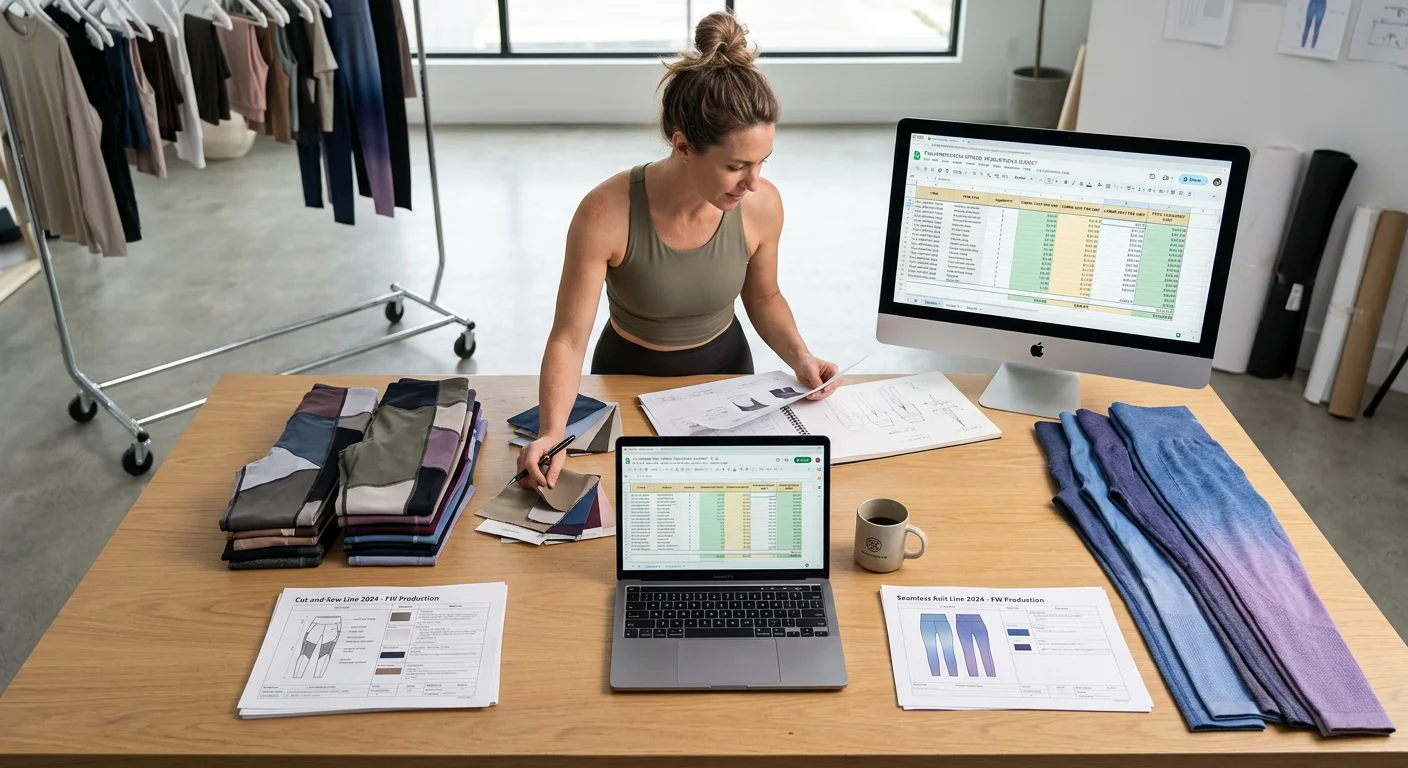
The number that kills more yoga wear launches than any other isn't the unit price. It's the minimum order quantity you didn't price out before you committed.
Here's the baseline reality for each method.
Cut-and-sew yoga wear factories — the small-to-mid-size OEM yoga apparel operations across China and Vietnam that specialize in sportswear — start at 200–300 pieces per style per color . Complex designs with multi-panel construction, bonded seams, or laser perforation push that floor to 300–500 pieces . Large-scale OEM yoga clothing factories running full production lines often won't look at you below 800–1,000 pieces . Know which type of factory you're dealing with before you negotiate.
Seamless knitting carries a higher floor by default. The industry benchmark sits at 600–1,000 pieces per style for new accounts. Two forces push that number up:
Machine setup time — 4–10 technical hours per style change on a Santoni circular knitting system
Yarn economics — custom-dyed yarn requires a minimum dye order of 80–150 kg per color
At 0.3 kg of yarn per legging, that single-color minimum alone equals 300–500 pieces — before machine waste. Add a second colorway, and your real minimum hits 600–1,000 pieces per style .
One workaround: use a factory's stock yarn colors . Some yoga apparel suppliers will drop the MOQ to 400–600 pieces . The tradeoff is a 10–20% higher unit processing fee.
MOQ by Brand Stage: Matching the Method to Where You Are
This is where the numbers get actionable.
Brand Stage | Recommended Method | Practical MOQ Target |
|---|---|---|
Startup (< 5,000 units/year) | Cut-and-sew primary | 200–300 pcs/style, 1–2 colors |
Growing DTC (150–300+ units/month per style) | Seamless for proven bestsellers | 600–1,000 pcs/style; cut-and-sew for test items |
Established brand (> 5,000 units/style/year) | Seamless-dominant | 3,000–10,000 pcs per replenishment cycle |
The math behind the startup warning is worth spelling out. A seamless MOQ of 800 pieces at USD 9 FOB — factored up 40% for freight, duty, and warehousing — puts USD 10,080 in committed capital per style on the table. A cut-and-sew order at 300 pieces and USD 7 FOB puts USD 2,940 on the table. That's a 3.4× difference in cash exposure on your first order, before you've sold a single unit.
For a brand still testing whether its legging design sells at scale, that gap is everything.
Here's a simple formula worth keeping:
Divide your available first-order budget by your estimated landed cost per piece. The result is your real MOQ ceiling.
Your real MOQ ceiling falls below what the factory requires? You have two options — shift to cut-and-sew, or negotiate phased delivery. Both work. Placing an order you can't finance does not.
Quality & Performance Differences That Affect Your Product
The fabric on your customer's skin tells the truth. Your branding can be strong. Your website can look clean. Your price point can be competitive. But a yoga legging that pills at 20 washes, gaps at the waistband, or chafes on a 10km run ends the relationship. The production method you picked six months ago either pays off — or costs you.
Fit, Compression, and How the Garment Moves
Seamless knitting builds compression right into the fabric structure. A single seamless legging can deliver gradient compression variance of 10–30% across zones — quads, waist, calves. It does this by adjusting loop length and lateral elongation at the machine level. Cut-and-sew achieves gradient compression through fabric panel splicing. The range there sits in the 5–15% band. Push that gradient too high in cut-and-sew, and the seam becomes the pressure point. That's not a figure of speech — it's what your customer feels.
Stretch range matters too. Seamless circular knit structures reach 120–160% lateral elongation and 60–100% lengthwise . Standard cut-and-sew woven activewear fabric runs 80–130% lateral and 40–80% lengthwise . For dynamic yoga movement — deep squats, hip openers, inversions — your customer will feel that gap.
Cut-and-sew has one structural advantage seamless can't match: true 3D pattern shaping . Darts, curved side seams, and multi-panel construction let cut-and-sew leggings control waist-to-hip differential up to 15–25 cm on a standard women's S. Seamless is limited by circular needle bed diameter. It manages 10–18 cm before the waistband starts rolling or the seat fabric thins out.
Consumer testing makes the trade-off clear:
- "No-seam / friction comfort" — seamless scores 0.3–0.8 points higher on a 1–5 scale
- "Shape definition / body contouring" — cut-and-sew scores 0.5–1.0 points higher
Neither method wins across the board. The real question is which dimension your customer values most.
Durability: Where Each Method Breaks Down
Chafing and blistering start at seam lines. In endurance testing beyond 20km, cut-and-sew garments with exposed overlock stitching show blister incidence of 15–25% among wearers. Seamless construction limits seaming to the waistband and toe closures. That drops the rate to 3–8% . For sensitive skin users, contact pressure at seam zones runs 20–50% higher than surrounding fabric. Seamless keeps that gap below 15%.
Cut-and-sew durability comes down to stitch execution:
Optimal stitch density : 3–4 stitches/cm for standard seams; 4–5 stitches/cm in high-stretch zones
Below 2.5 stitches/cm : seam tear risk rises fast under ISO 13935-2 tensile testing
Seam strength benchmark : well-executed activewear seams hold ≥ 150–200 N ; moving stitch density from 2.5 to 4 stitches/cm adds 15–30% seam strength
Open-seam failure rate : poor thread tension control leads to seam failure within 3 months in 3–5% of units ; a proper back-stitch length of 2–3 cm brings that below 1–2%
Seamless durability is a machine calibration problem — not a sewing problem. Yarn tension variance of just ±5–10% causes uneven loop formation. You'll see it as streaks, thin zones, or micro-holes. On an uncalibrated line, first-batch reject rates run 5–8% . A well-calibrated seamless operation brings that down to 1–3% .
Under heavy use — 4–5 workout sessions per week, 30–50 machine washes — real-world garment lifespan looks like this:
Method | Typical Lifespan | Primary Failure Mode |
|---|---|---|
Seamless | 12–18 months | Localized wear-thinning, elastic fatigue |
Cut-and-Sew | 9–18 months | Seam separation, edge distortion, chafing |
The overlap is real. A badly calibrated seamless yoga wear factory produces failures in the first wash cycle. A cut-and-sew activewear factory with weak stitch discipline cuts wearable life 20–30% short of what the fabric could actually support. Factory execution closes the gap — or blows it wide open.
Design Freedom and Its Limits
Seamless knitting locks you into what a circular needle bed can do. Large-scale prints, complex color-blocking, zippered structures, 3D pockets — these are either impossible or far too costly to execute in seamless. Your design options narrow to compression zones, texture variation, and tonal yarn shifts.
Cut-and-sew opens up every structural option: mesh paneling, asymmetrical seams, bonded construction, laser perforation, crossback strapping. For trend-driven collections or standout hero products, that flexibility has real commercial value.
Building a core performance line around comfort and compression uniformity? Seamless is the right call. Building a visual identity through design? Cut-and-sew is the tool you need.
Production Lead Times: Sampling & Bulk Delivery Timelines
Lead time is what most brands underestimate — and it's the one thing that kills seasonal launches the fastest.
Here's what the calendar looks like for each method.
Sampling: How Long Before You Hold a Real Garment
Cut-and-sew moves faster at the sampling stage. Start with a finalized tech pack and fabric in-house, and a proto sample lands in 1.5–2.5 weeks . Sales samples follow in another 1–1.5 weeks . Style changes — fit tweaks, seam repositioning, pattern adjustments — get handled in CAD or on a cutting table. Machine changeover between styles takes hours, not days.
Seamless sampling runs longer. Plan for 2–3 weeks for a proto, plus another 1–2 weeks for sales or size set samples. The reason comes down to machine programming. Every new seamless style needs a coded knitting program built for the Santoni or Lonati circular system. Writing that program takes time. So does running test knits, fixing fit issues, and adjusting compression zones. Each revision round adds 2–3 days . Every size may need its own parameter set. Cut-and-sew skips all of that.
Bulk Production: Full-Order Timelines
Stage | Cut-and-Sew | Seamless |
|---|---|---|
Manufacturing only (fabric in-house) | 4–7 weeks | 5–8 weeks |
Total lead time (materials → delivery) | 7–12 weeks | 10–16 weeks |
Repeat order predictability | Medium | High (once program is locked) |
Cut-and-sew has a shorter total timeline. But it's more exposed to labor variables — operator skill, line balancing, and style complexity can all shift your delivery date.
Seamless takes longer upfront. Here's the trade-off worth knowing: once the knitting program is validated, reorders run as a machine cycle . Output per day stays consistent. Human-skill variance drops out of the equation. For core carry-over styles, seamless reorders can compress to 7–10 weeks total — close to cut-and-sew — with much tighter delivery predictability.
The Planning Rule Most Brands Learn Too Late
For new seasonal styles on cut-and-sew, brief your factory 5–6 months out. For new seamless styles with custom compression or graphics of yoga wear , push that window to 6–7 months. Miss it, and your choice is a delayed launch or an air-freight bill.
For rapid style testing — 200–500 units to validate a new design — cut-and-sew wins. Proto-to-warehouse in 7–9 weeks is realistic. Seamless programming costs make small test runs slow and expensive. The exception: you're working inside an existing base program and swapping colors.
Which Method Fits Your Brand Stage? (Decision Matrix)
Four brand types walk into a sourcing decision. One of them picks the right method on the first try.
The other three make one of two mistakes. They over-invest in tooling they don't need yet. Or they under-spec their production and watch retention numbers drop after the first wash cycle. This matrix is built to prevent both.
Here's how to use it: find your brand stage in the left column. Match it to the recommended production approach. Then use the criteria on the right to pressure-test your choice before briefing a factory.
The Four Brand Stages
① New brand, testing the market — You're pre-PMF. Annual volume sits below $500K. You need MOQs of 50–150 pieces per color — not 600–1,000. Your margin target is 60%+ gross. Three months of dead inventory is not an option. Cut-and-sew with simple customization is the structure that fits here. Lock your per-style investment to 30–50% of your ad budget for that quarter. Stop there.
② Scaling DTC brand — You have 2–3 seasons of sales history. Your ROAS holds above 1.5. Stockouts are starting to cap growth. At 300–1,000 pieces per color with 90–120 day cash cycles, you can absorb standard OEM terms. Take your proven bestsellers and start moving them to seamless production. Anything still in market validation? Keep it on cut-and-sew.
③ Premium technical line — Retail price of $80–150. Customers pay for compression performance, fabric recovery above 90%, and pilling resistance beyond 20,000 Martindale cycles. Development cost at 5–10% of unit retail is acceptable. A 90–150 day lead time is also workable — as long as the factory has tensile testing equipment, documented high-end brand references, and fabric MOQs under 1,500 meters per color. All three matter.
④ Fashion-driven athleisure line — You're pushing 5–20 new SKUs per month. TikTok and Instagram eat novelty fast. A single print's commercial window runs 3–6 months. You need single-print MOQs at 100–200 pieces. Sampling turnaround must stay under 10 days. Look for a factory that runs grey-fabric-first workflows — so replenishment orders don't sit waiting on new yarn runs.
Decision Matrix at a Glance
Brand Stage | Best-Fit Method | Key Threshold |
|---|---|---|
New brand / market test | Cut-and-sew, low MOQ | ≤ 150 pcs/color; 15–30 day proto |
Scaling DTC | OEM cut-and-sew + seamless for core SKUs | 300–1,000 pcs; factory capacity > 10K units/month |
Premium technical line | Seamless + technical fabric co-development | 60–90 day bulk; fabric lab + brand references required |
Fashion athleisure | Cut-and-sew, print/splice specialist | ≤ 200 pcs/print; sampling return rate < 10% |
One rule cuts across all four stages: your MOQ ceiling is your available first-order budget divided by your estimated landed cost per unit. That number falls below what the factory requires? No brand vision fills that gap. Change the method — or change the factory.
How to Vet a Yoga Wear Manufacturer for Each Method
The wrong factory doesn't announce itself. It quotes low, ships samples fast, and disappears three weeks into bulk production. Vetting isn't a formality — it's the one thing standing between your launch budget and a container of unusable goods.
Here's what to check, split by production method.
Vetting a Seamless Knitting Factory
Machine inventory first. Ask for a full machine list — brand, model, count. Santoni SM8-TOP2 systems are the industry benchmark for yoga leggings. A factory running fewer than 20 machines carries real risk on complex patterns and bulk delivery timelines. So does one running outdated pre-2000 models. A standard 13–18 inch circular knitting machine produces 180–300 leggings per 10–12 hour shift. That number tells you whether their quoted lead time holds up.
Break down MOQ by size and color — not by style. "300 pieces per style" means nothing until it's split into per-color, per-size commitments. A legitimate seamless factory gives you this structure:
- Basic knit construction: 150–300 pcs/color , full size run
- Complex jacquard or engineered mesh: 300–500 pcs/color
Ask whether they'll accept a 3:3:2:2 size ratio. A factory that won't give you a straight answer on that — that's your answer.
Demand elastic recovery numbers, not descriptions. Ask for the test methodology — AATCC, ASTM, or GB/T standard. A factory worth working with shows you three things: stretch ratio (e.g., 150% of original length), hold time (30 seconds), and residual elongation at 1 minute and 30 minutes post-release. Your minimum threshold: ≥90% lateral recovery after a single cycle, ≥85% after five cycles. Ask for test report screenshots from existing export clients — brand names redacted is fine.
Vetting a Cut-and-Sew Sportswear Factory
Pattern and grading capability drives fit consistency. Ask how many pattern makers are on staff, their average experience level, and whether they use digital grading systems — Gerber, Lectra, or CLO. Then ask for an actual grading table from a previous women's activewear project. For women's yoga leggings targeting Western markets, waist increments should run 3–4 cm per size , with hip increments similar. A factory that can't hand you a clear grading chart on request is a factory guessing at your fit.
Check stitch construction at the pressure points. On any sample, look at the crotch, side seam, and waistband. These should show four-needle six-thread or three-needle five-thread construction. Target 8–10 stitches per inch on main seams. Ask for seam break force data — high-performance yoga leggings need seam tensile strength of ≥70–90 N . Factories with solid QC protocols have this number ready. Others will stall.
Require line-item fabric pricing. Fabric cost transparency is where most sourcing negotiations break down. Ask the factory to quote fabric as: net fabric price ($/kg or $/meter) + waste rate (%) + per-unit consumption (meters/piece). A single bundled FOB number with no breakdown makes it impossible to spot where cost is hiding — or where it can move.
Lock down MOQ across volume tiers before you negotiate anything. Ask for unit pricing at 150, 300, and 500 pieces per color per style. Most mid-size cut-and-sew activewear factories hit their best pricing at 300–500 pieces. Drop to 150, and expect a 10–20% unit cost premium . Get those numbers in writing before any deposit changes hands.
A factory that answers these questions with real data — numbers, documents, test reports — knows its own operation. One that answers in generalities is managing your expectations, not its production line.
Want to skip the vetting loop and get verified factory quotes across both production methods? yogavendor.com connects yoga apparel brands with audited OEM yoga apparel suppliers for seamless and cut-and-sew production — with transparent MOQ and cost breakdowns built into the sourcing process.
Conclusion
Your manufacturing decision today shapes your brand's margins, launch timeline, and customer experience for years ahead.
Still building momentum? Cut-and-sew gives you design freedom and lower entry costs. You won't lock capital into large minimums either. Scaling a proven bestseller? The premium, second-skin feel of seamless leggings manufacturing is worth it. That upfront investment pays back fast.
No single method wins every time. The right choice depends on three things:
Your brand stage
Your customer expectations
Your cash flow reality
The yoga wear factory you pick matters too. Find one that understands both methods — and gives you honest guidance, not just a quick order confirmation.
That's what we do at YogaVendor.com . Sourcing your first 100 pieces? We'll guide you. Scaling to 5,000? We've got that covered too. Our team helps you build smarter from day one.