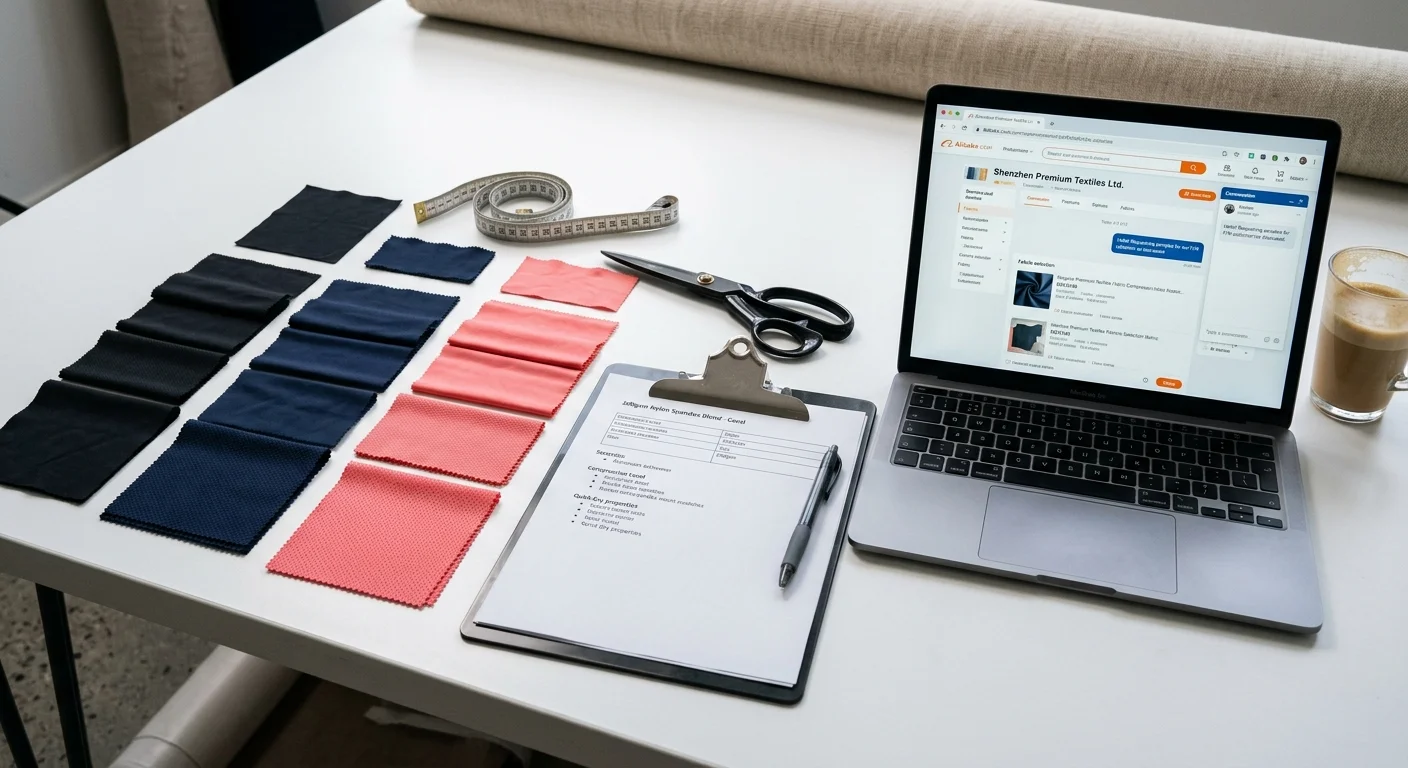
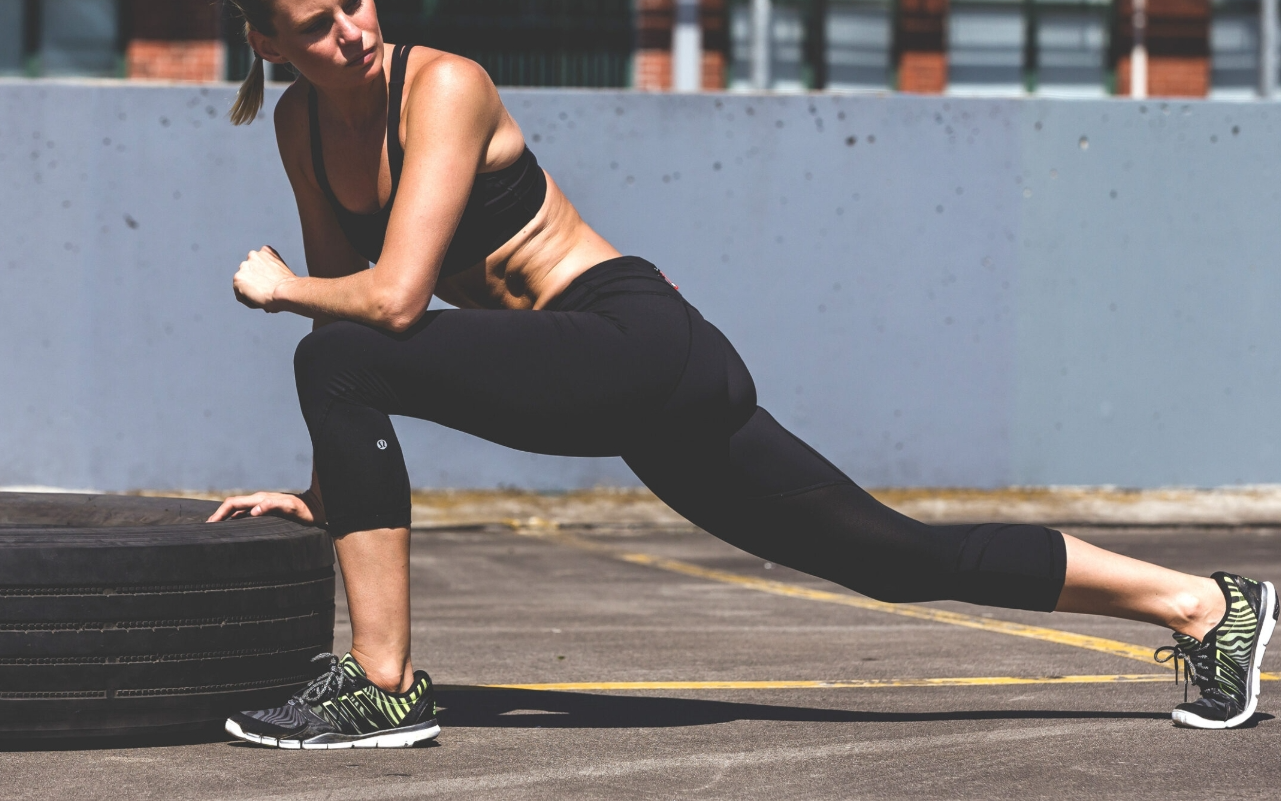
The squat test doesn't lie.
Our first production run of nylon yoga leggings came back from the yoga apparel factory looking solid on paper — clean seams, good hand feel, strong colorways. Then someone bent down in the fitting room. The fabric went sheer. Not a little sheer. See-through sheer.
That one moment kicked off six months of work. We pulled apart every fabric parameter we thought we had figured out — GSM thresholds, denier selection, knit construction, spandex ratios. All of it went back on the table.
This case study breaks down what went wrong, step by step. We diagnosed each issue with data, not guesswork. Then we ran three rounds of sampling to fix it. By the end, we had a legging that holds up in any squat, under any lighting, and in front of any skeptical yoga apparel wholesale buyer shining a phone flashlight straight through the fabric.
Case Background & First-Batch Failure Metrics

Five thousand units. Eight colorways. One spec sheet that looked reasonable — until it didn't.
The V1 formula looked clean on paper: 88% Nylon 6.6 / 12% Spandex , 70D filament , 220 GSM , built on a single jersey (plain knit) base. The line targeted mid-tier activewear pricing. Four dark colorways. Four light/pastels. Fit and squat opacity were called out as top product priorities. The factory had the brief. The mill had the spec. Everyone signed off.
Then the squat test data came back.
The Numbers That Ended the Conversation
Overall squat-test fail rate: 78%. Not a handful of outliers. Not a bad dye lot. Four in five units failed the single most important functional test for a yoga legging.
The color breakdown made it worse:
Black and navy: 45% fail rate
White, light pink, and grey: 95% fail rate
The failure wasn't subtle. At 135° knee flexion , the fabric showed visible panty line at the hip gusset zone — the highest-stretch, highest-visibility area on the garment. Optical transparency spiked at two consistent hotspots: the lateral thigh and the seat panel . Both zones. Every time.
The mill's initial take? "Lightweight trend preference." Their position: the market asked for lighter fabric, and this was the tradeoff.
The development team pushed back — hard. This wasn't a consumer preference issue. It was structural sheerness built into the construction spec itself. The severity gap across colorways confirmed it. A true defect would spread at random. Instead, the failure tracked with color depth. That pointed straight at an opacity risk built into the knit structure itself.
The Financial Case for a Full Redesign
At $4.20/yard , the V1 fabric wasn't expensive. But the risk it created was.
Projected rework and claim costs crossed $18,500 per SKU run . That number alone pushed this out of "adjust the tolerance" territory. It landed squarely in "rebuild the spec from scratch" territory. A patch-and-reorder approach would have burned budget. It would not have fixed the root problem.
The data was clear: this batch failed on opacity under stretch — not on general construction quality. The garment was well-sewn. The problem sat in the fabric itself. Its weight. Its structure. Its behavior under the mechanical load of a deep squat. Everything else was a downstream symptom.
That distinction drove every decision that followed.
5 Critical Fabric Parameter Thresholds Driving the Sheerness Problem
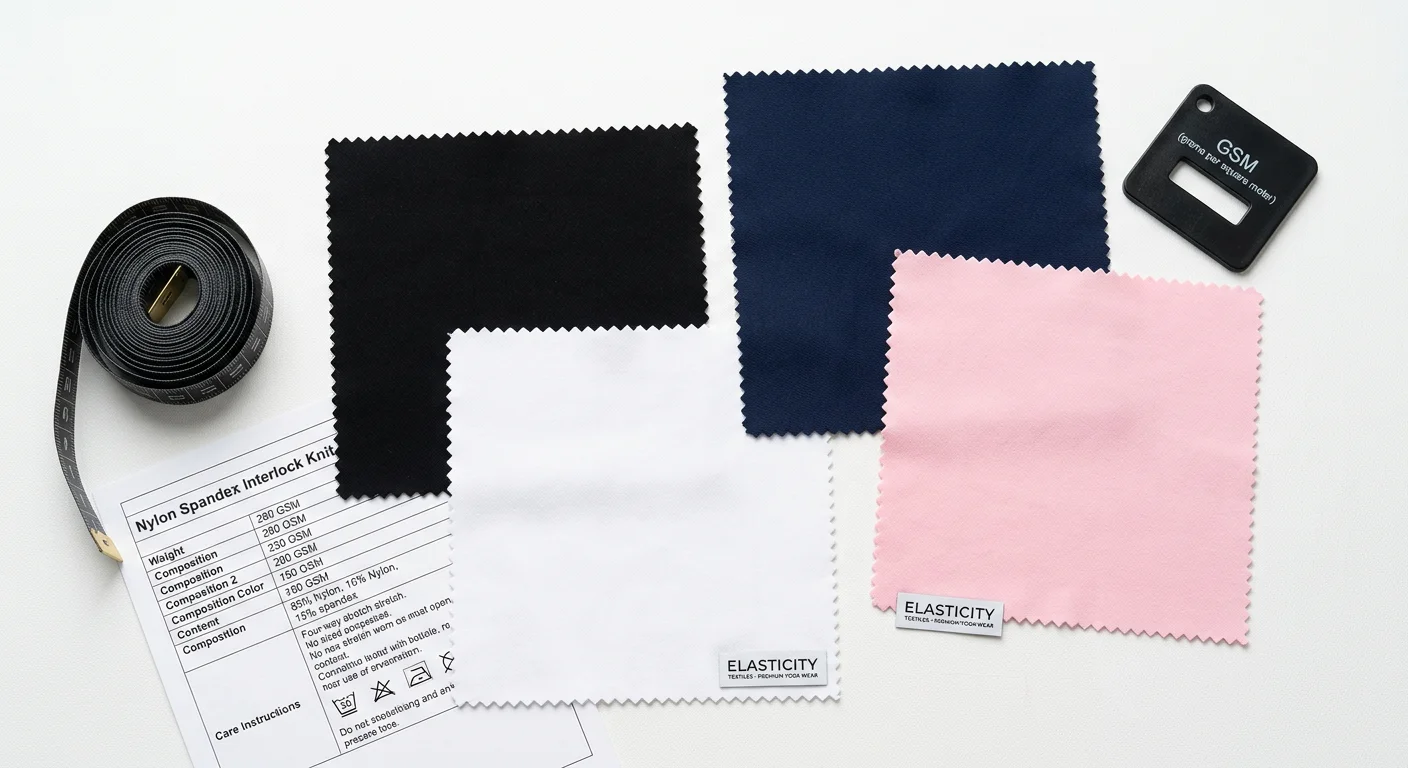
Sheerness isn't random. It's arithmetic.
Once we committed to a full spec rebuild, the first thing we did was stop treating opacity as a gut-feel judgment — something you eyeball in a fitting room and argue about. We built a diagnostic framework around five measurable parameters. Each one has a hard threshold. Cross the wrong line on any single parameter, and you're already in trouble. Stack multiple bad parameters together, and you get what we got: a 78% fail rate on the most important functional test in the category.
Here's where the lines sit.
Threshold 1: GSM — The Number Everyone Gets Wrong
The default assumption in the market is that 220–230 GSM is "fine for leggings." It isn't. Not for squat-proof performance. Not even close.
The critical thresholds break down like this:
Below 230 GSM (single jersey): High sheerness probability at lighting above 1,000 lux with hip stretch above ~130%. This is your fitting room, your gym floor, your yoga leggings wholesale buyer's flashlight test. You will fail.
240–255 GSM: Conditional pass — dark colors only, controlled stretch window. Light colors and pastels? Still at serious risk under studio lighting.
260–280 GSM: Squat-proof baseline for dark colorways, assuming the other parameters are also in range.
≥280–300 GSM: The floor for light colors, pastels, and nudes. Non-negotiable.
There's a mechanical reason the numbers cluster where they do. GSM is measured at rest. Fabric stretches to 130–140% in the seat during a squat. That's just what happens. You lose 15–25% of effective optical coverage at that point. A legging reading 260 GSM on the spec sheet can behave like a 210–220 GSM fabric under load. Our V1 was 220 GSM before stretch. The math was never going to work.
Threshold 2: Denier — What Your Yarn Cross-Section Is Doing
Denier determines how much physical mass each yarn brings to the knit structure. Finer yarns feel luxurious. They also let more light through.
≤70D micro-filament: Beautiful hand feel. Weak opacity barrier. Under stretch, fine filaments create rapid "windowing" between yarns — the knit geometry opens and skin tone becomes visible. To compensate, you need to add +20–30 GSM versus a 150–200D design just to reach the same opacity.
~100D: Moderate improvement, but still vulnerable at 130–140% stretch. Usable for lifestyle and fashion leggings with dark colors and a controlled stretch window.
200–300D core yarn: This is the performance tier. Internal testing across multiple mills shows 35–40% higher coverage and lower light transmittance at full stretch compared to 70D, at the same GSM and knit density. The reason is straightforward: greater yarn cross-section means fewer open paths for light between courses and wales.
Our V1 ran 70D filament. It felt great. It also had no ability to block light under load.
Threshold 3: Spandex Ratio — Where the Stretch Math Breaks Down
Spandex content doesn't just affect feel and recovery. It controls how far the fabric extends in real wear — and how thin the knit structure gets at its most stressed points.
Below 12% spandex: Pattern blocks get drafted smaller to achieve fit. That forces the fabric into hyper-stretch (≥140% extension) at the hip and seat. At 140% extension, loop geometry opens wide. A 250 GSM fabric at 140% stretch will show more skin than a 230 GSM fabric at 120% stretch. The spandex deficit creates the opacity problem before denier or GSM even enter the picture.
15–20% spandex: The functional sweet spot for four-way stretch leggings. At this ratio, pattern blocks can match body dimensions more closely. Working stretch in the hip zone stays at 120–130% — the range where well-specified fabric holds its coverage.
Elastic recovery floor: Spandex brand quality matters as much as percentage. Target ≥90% recovery after 150% extension cycles as your QC threshold. Below ~85% recovery, the knit stretches out over time. Sheerness increases with every wearing cycle — even if the garment passed the squat test brand new.
Threshold 4: Knit Construction — The 45% Opacity Gap Nobody Talks About
This is the variable that gets treated as a cost decision. It's a performance decision.
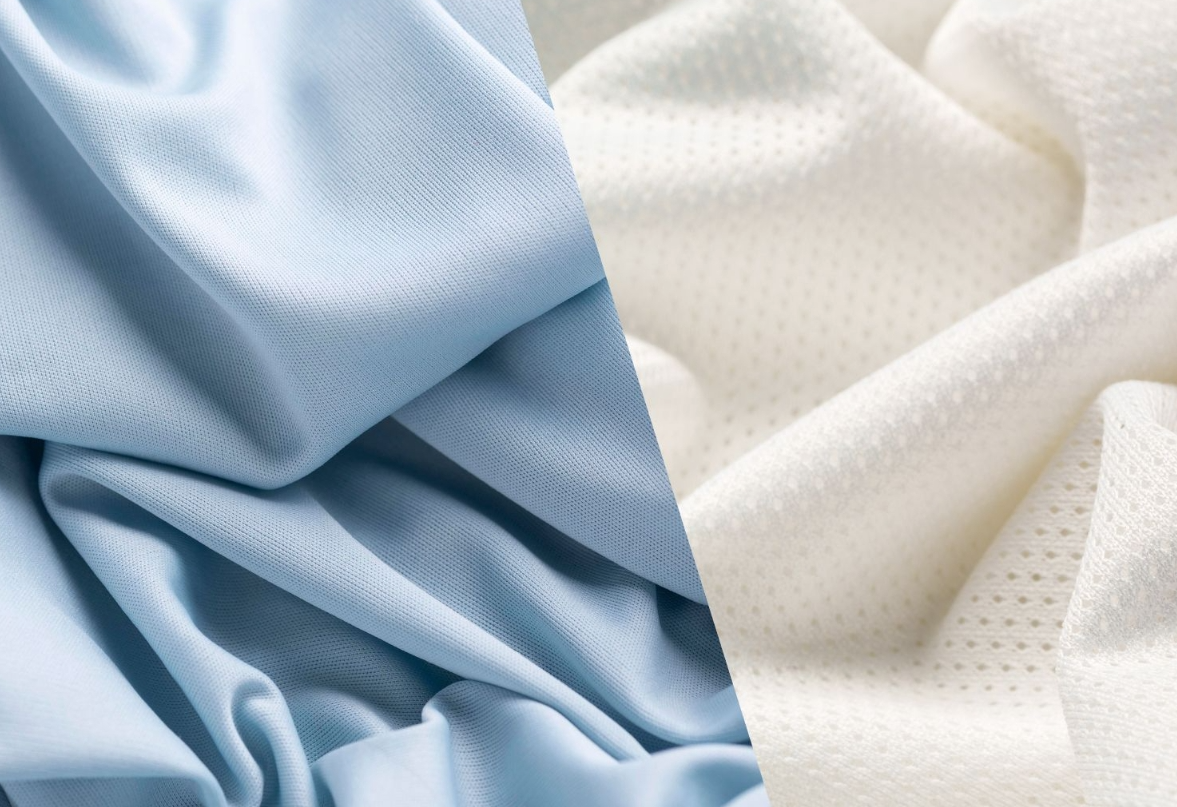
Single jersey and interlock are not interchangeable for squat-proof applications. The structural difference is real:
Single jersey: Loop architecture opens sideways under stress. At the same GSM and stretch levels, single jersey shows 30–40% higher light transmittance at maximum stretch compared to interlock. The "windowing" gaps between wales and courses are built into the structure. You can't engineer around them with GSM or denier alone.
Double-knit / interlock: Symmetrical face-back loops block direct light paths through the fabric. At identical GSM , interlock provides 45% more coverage than single jersey at full stretch. Strain distributes across two knit surfaces instead of one.
Gauge matters too: A 28G interlock at 280–300 GSM delivers better compression and sheerness control than 24G single jersey at the same weight. For squat-proof applications, most mills running performance leggings operate at 24–28G interlock versus 18–24G on basic jersey constructions.
Our V1 was single jersey. That one structural choice made every other parameter weakness worse.
Threshold 5: Dye Depth — The 15–20 GSM Credit You Can Spend Once
Color isn't just aesthetic. It's optical engineering.
Dark dyes absorb light. Light and pastel dyes reflect and transmit it. That gap has a real, measurable value in performance specs:
Dark and neutral colorways (black, navy, charcoal): In controlled internal comparisons, darkness acts as a 15–20 GSM opacity advantage . A 260 GSM black interlock can perform on par with a 280 GSM light pastel under the same stretch and lighting conditions.
Pastels and nudes below 250 GSM: This is a documented high-fail zone. Even with solid denier and spandex specs, structural openness in the knit takes over under studio or gym lighting at 1,000–1,500 lux. VPL and visible skin tone show up fast.
The lab rule for light colors: Interlock construction is mandatory. GSM must reach ≥280–300 . Denier should sit in the 200–300D range. Spandex must be at 15–20% . All four conditions at once. Light colorways in single jersey below 280 GSM belong in non-squat applications only — where sheerness is acceptable by design.
These five thresholds don't work in isolation. They stack. One parameter violation is a risk. Two violations together become a near-certain failure. Three violations together — the V1 combination of 220 GSM, 70D filament, 12% spandex, single jersey, and four light colorways — produces a 95% fail rate on light colors and a 78% fail rate across the line.
The root cause wasn't any one decision. It was five parameters all sitting just below their floors at the same time.
3-Round Sampling Iteration Log: From Squat Test Leggings Fail to Squat-Proof Validation
Three rounds. Six months. One spec that held up under a phone flashlight aimed straight at the seat panel.
This is the unedited iteration log — every parameter we changed, every number we measured, every nylon yoga leggings supplier conversation that forced a decision. We're not glossing over the rough parts. If you're facing a similar failure on your own line, this data could help you skip at least one of these rounds.
Round 1 — The Baseline Failure (88/12, 70D, 220 GSM, Single Jersey)
Squat test result: FAIL
Visibility score: 8/10 in pastels. Light transmission at the gusset: >60% under direct back-light. Dark colors barely scraped by — they passed only if you squinted and hoped the buyer wouldn't look twice.
The core fabric parameters that produced this outcome:
88% Nylon 6 / 12% Spandex
70D filament yarn
220 GSM single jersey construction
High-compression pattern blocks — pushing localized gusset stretch to around 138% during a deep squat
We pushed the mill for a GSM increase to 260. They said no. Their stated concerns: hand-feel degradation, drape issues for XS sizing, lifestyle-wear positioning. The real concern, reading between the lines: retooling cost and production disruption.
That refusal ended the mill conversation. It opened a rebuild conversation instead. Single jersey at 70D and 220 GSM has no path to squat-proof performance. The fine filaments create visible "windowing" between yarns once the fabric hits 120–125% stretch. The over-compression patterning pushed the gusset well past that point on every rep. Nothing here was fixable without a full spec change.
Decision: Full rebuild. Round 2.
Round 2 — The Conditional Pass (80/20, 100D, 250 GSM, Double-Knit, Lycra® 4D)
Squat test result: CONDITIONAL PASS
Dark colors (black, charcoal, deep olive): 0/10 visibility — clean, full pass.
Pastel and light colorways: 4/10 visibility — some shadowing and outline still visible at peak stretch under phone flash.
The spec changes that got us here:
Fiber blend shifted to 80% Nylon / 20% Spandex
Yarn upgraded from 70D to 100D
Construction moved from single jersey to double-knit activewear base
Weight increased to 250 GSM
Elastane upgraded to Lycra® 4D stretch technology
Recovery performance came in at 86% after 50 stretch cycles — improved, but not enough. Premium squat-proof products target ≥90%. At 86%, you get sheerness creep over the garment's life cycle, even if it passes new-out-of-the-bag.
Double-knit construction solved the dark-color opacity problem. The logic is simple: symmetrical face-back loop geometry blocks the direct light paths that single jersey leaves open. For deeper shades, 250 GSM double-knit at 100D closed the gap.
For pastels, it didn't. Two problems remained:
250 GSM is still borderline as fabric stretches into the 130–140% range under a load-bearing squat. Light scatter doesn't disappear — it just shrinks.
100D nylon can't form a dense enough optical barrier in light hues. Fine filaments break down faster in high-transmission colorways.
The Lycra® 4D upgrade improved shape retention. It did not fix transparency in light colors at maximum squat depth.
Decision: Raise denier by a large margin. Push GSM to 280–290. Upgrade elastane spec to ≥92% recovery. Fix gusset pattern at the same time. Round 3.
Round 3 — Full Validation (80/20, 250D Nylon 6.6, 280–290 GSM, Interlock, 18% Premium Lycra®)
Squat test result: FULL PASS — 0/10 visibility across all 8 colorways.
We tested under deep barbell squats, static full squat holds, phone flash back-light, bright window back-light, and multi-angle mirror checks. No visible undergarment outline. No opacity shift from standing to full squat depth. Pastels passed the same protocol as black.
The final production spec:
80% Nylon 6.6 / 20% Elastane
250D Nylon 6.6 yarn — a major jump from 100D; higher tenacity, better durability, and a much denser optical barrier under stretch
Interlock knit construction — high cover factor, symmetric loop structure, the top structural choice for squat-proof opacity in circular knit activewear
280–290 GSM
18% premium Lycra® within the elastane component, targeting ≥92% recovery after 50 standardized stretch cycles
The Nylon 6.6 choice over standard Nylon 6 matters beyond denier. At the same yarn count, Nylon 6.6 delivers higher tenacity and better abrasion resistance. That matters for a garment flexing through hundreds of squat cycles over its life.
The gusset fix ran in parallel. Localized stretch at the seat and gusset had been hitting 138% during deep squats across Rounds 1 and 2. The pattern revision added 1.2 cm to gusset width and adjusted seam shaping to spread stretch across the inner thigh and seat panel. Post-revision localized stretch dropped to ~126% — below the critical transparency threshold for the Round 3 fabric spec. Full range of motion stayed intact.
The cost conversation: Moving to 250D Nylon 6.6 interlock with premium Lycra® added 12% to fabric cost versus the Round 2 spec. We approved the increase based on one comparison: upgrade cost versus the cost of squat-test returns, retailer claims, and see-through complaints — a known margin killer in the leggings category. The math wasn't close. We locked the Round 3 spec as the production standard.
We pulled Round 1 and Round 2 fabrics from mainline squat-proof leggings. Both moved to non-squat-critical products — loungewear and light yoga applications — where structural sheerness under high-load stretch is acceptable by design.
The Iteration Summary at a Glance
Round 1 | Round 2 | Round 3 | |
|---|---|---|---|
Blend | 88/12 Nylon/Spandex | 80/20 Nylon/Spandex | 80/20 Nylon 6.6/Elastane |
Denier | 70D | 100D | 250D |
GSM | 220 | 250 | 280–290 |
Construction | Single jersey | Double-knit | Interlock |
Elastane | Standard | Lycra® 4D | 18% Premium Lycra® |
Recovery | — | 86% / 50 cycles | ≥92% / 50 cycles |
Pastel visibility score | 8/10 | 4/10 | 0/10 |
Dark visibility score | Borderline | 0/10 | 0/10 |
Squat test result | FAIL | CONDITIONAL PASS | FULL PASS |
Each round solved the previous round's main failure. Round 2 fixed the structural problem for dark colors. Round 3 closed the optical gap for light colors and brought recovery performance to a production-grade standard. The gusset pattern change — running alongside Round 3 — cut the localized over-stretch that had been silently pulling both earlier iterations apart from the start.
B2B Fabric Tech Spec Template: Direct Supplier Communication Checklist
Most yoga bottoms supplier talks about fabric opacity end the same way. The mill says "opaque." The buyer moves forward. Three months later, someone stands in a fitting room watching the whole thing fall apart. The fix isn't more trust. It's a better document.
This is the exact template framework we built after Round 3 validation — every field, every threshold, every QC gate. Send this to your mill before sampling begins. If they can't answer these questions in writing, that's your answer.
The Core Spec Fields (Non-Negotiable)
Fiber composition
Target 75–80% Nylon 6.6 / 20–25% Spandex . Name the elastane brand — Lycra® or Creora® certified. Get written confirmation of the exact fiber split, with the certificate tied to the same legal entity. "Nylon/spandex blend" with no brand or percentage is not a spec.
Yarn denier
Ask for 200–300D filament for face yarn. For a reverse or texture layer, 70–100D works there. The mill must state yarn type, denier, and texturing route in writing — not by word of mouth, not on a sample tag.
Fabric construction
Specify double-knit interlock minimum , 28G or higher gauge , no open-loop variants. Get construction photos, machine gauge confirmation, and production route docs — straight from the actual mill, not the trading agent.
GSM targets by colorway
Colorway Group | Target GSM | Tolerance |
|---|---|---|
Black / Navy / Charcoal | 265–280 GSM | ±5 |
White / Light Pastel / Hi-Vis | 285–300 GSM | ±5 |
The mill must run a batch-level GSM scan before greige-to-finish conversion, then again after finishing. One pre-cut reading is not enough.
Stretch and recovery
Four-way stretch, 140–150% elongation , ≥90% recovery after 150% extension . The test report must cite ASTM D3107 or ISO 5080 by name. A recovery number with no test method behind it is an opinion, not data.
Opacity threshold
Set the pass mark at ≤5% light transmission under 1,000 lux at 130% simulated wear stretch . The yoga apparel supplier must provide the test method, stretch condition, and the actual measured result. The word "opaque" on a spec sheet proves nothing.
Surface, shrinkage, and colorfastness
Require 3–5% pre-shrinkage control , silicone-free softener where pore closure matters, and colorfastness ≥4 on grey scale for wash, rub, and light resistance.
Validation Package Before Any Bulk Conversion
Before greige-to-finish conversion or PP approval, the mill delivers three documents — no exceptions:
Batch GSM scan — a measured scan from the production lot, not an estimate
Yarn denier certificate — tied to the exact yarn lot used
5-cycle wash recovery report — proving recovery stays above the 90% floor after repeated use simulation
Any of these three arrives as a verbal assurance or a generic mill cert not tied to your batch? Reject the submission. Restart the gate.
Supplier Qualification Checklist
Before you commit to sampling, the nylon yoga pants supplier needs to answer all of these — clearly, with no vague or deflected replies:
Machine count and gauge range available
Fabric width range in production
GSM range they can hit and hold with consistency
Full finishing route, step by step
Active certifications: OEKO-TEX, GOTS, BCI , or equivalent
Lead time and MOQ for your target spec
Legal entity name — and whether they are a mill, converter, or trader
Also ask for their business license , actual photos of production equipment, and a live yoga leggings factory walkthrough if you have any doubts about their production capability. A trader quoting mill lead times is a risk your supply chain doesn't need.
RFQ Spec Block (Copy-Paste Ready)
Add this block to your request for quotation as-is:
Fiber: 75–80% Nylon 6.6 / 20–25% Spandex (Lycra® or Creora® certified)
Construction: Double-knit interlock, 28G minimum, no open-loop variants
Weight: 265–280 GSM (dark colors) / 285–300 GSM (light/pastel colors), ±5 tolerance
Performance: 4-way stretch, 140–150% elongation, ≥90% recovery after 150% extension
Finish: 3–5% shrinkage allowance, silicone-free softener
QC documents required: Batch GSM scan, yarn denier certificate, 5-cycle wash recovery report
You also need a physical reference sample, lab dips, pre-production sample (PPS) , and a signed sample approval form tied to this spec sheet. Check the sample against bulk on weight, drape, stretch recovery, color, and finish — in that order, with documented results every step.
A yoga leggings supplier who pushes back on any of these isn't protecting their process. They're protecting their margin at your product's expense.
Standardized Squat Test QC Protocol: Leggings Quality Control Testing SOP
Good intentions don't survive a fitting room. What survives is a documented, repeatable process. One that removes subjectivity from the test that matters most.
We built this SOP after three rounds of sampling and one very expensive batch of see-through leggings. It's the protocol we wished we'd had before Round 1.
Step 1: Environment Setup
Lighting
- LED panel or lightbox at ~1,000 lux , neutral ~4,000 K color temperature
- Diffused light source — frosted panel or diffuser sheet. No direct spots that create false hot zones
Background
- Dark colorways: matte black board — surfaces any light bleed around seams
- Light and pastel colorways: matte white board — exposes fabric thinning and grid-pattern stretch artifacts
- Non-reflective in both cases. Back-glare corrupts your transmission readings
Garment Conditioning
Condition all test units 24 hours at 21 ± 2°C, 50 ± 10% RH before testing. Fresh-from-the-bag fabric behaves differently from stabilized fabric. Skipping this step produces unreliable results.
Fitter Setup
- Standard fit model or articulated mannequin, women's M / 170 cm / 60–65 kg baseline
- Seamless solid black underwear — no shapewear, no padding, no extra layers
- Position the waistband at the designed rise before the first rep. No manual adjustments between reps unless slip exceeds 2 cm. Document it if it does.
Step 2: Squat Motion Standard
Most QC processes get sloppy here. Vague squat instructions produce inconsistent results. Use these exact parameters:
Stance: Shoulder-width, toes 5–15° outward, hands on hips
Depth: Knee flexion ≥90°, targeting full deep squat position
Hold: 3 seconds at the bottom position — stable enough for both visual and instrumental readings
Reps: 3 full deep squats, 2–3 seconds rest at top between each
Zones under inspection during each hold:
Zone | Location | Risk Level |
|---|---|---|
Front | Mid-thigh over quadriceps | Moderate |
Side | Lateral hip and outer thigh | Moderate |
Rear — gusset | Crotch/gusset seam junction | Highest |
Rear — seat | Gluteal apex at maximum stretch | Highest |
Step 3: Visual Pass/Fail Criteria
Two trained inspectors. Two angles. Every rep.
- Inspector 1: 0° direct rear , 1 meter
- Inspector 2: 45° side-rear , 1 meter
PASS — all of the following must be true at 1 m:
- No underwear contour, panty line edge, or label outline visible
- No skin tone bleed or color shift suggesting visible skin beneath fabric
- No mesh-grid or screen-door pattern in stretched areas under 1,000 lux
- No seam grinning at gusset or back seam
FAIL — any single occurrence at any rep triggers a fail:
- Distinct panty line or underwear outline
- Skin tone or tattoo visible through fabric
- Fabric color shifts more than 1 tone lighter versus standing reference
- Open stitch pattern or mesh effect at gusset or seat
- Seam gap >1 mm along any seam under squat load
Step 4: Instrumental Stretch Opacity Test
Visual inspection tells you what a buyer sees. The bench test tells you why .
Sample Preparation
Cut 10 cm × 10 cm swatches from three zones: waistband, mid-thigh, and gusset. Mount each on a stretch rig.
Extension Targets
- 150% elongation — standard thigh/seat simulation. This is the baseline pass condition.
- 200% elongation — worst-case stress zones. Required for performance and squat-specific collections.
Measurement
- Light source: 1,000 lux beneath mounted swatch
- Instrument: lux meter or photometer above the fabric
- Record % transmission relative to uncovered light source
Pass: ≤5% light transmission at 150% extension across all three zones, opacity visual grade ≥4/5
Fail: >5% transmission at any single zone. Average opacity grade below 4/5. Any panel — including contrast stripes or color-block sections — that falls below threshold fails, even if the main body passes.
Step 5: Post-Wash Durability Check
A legging that passes new is not guaranteed squat-proof at week six. This step separates durable opacity from first-wear opacity.
Protocol:
- 3–5 units from the sample set
- 5 wash cycles at 40°C , mild detergent, no bleach, line dry
- Re-condition 24 hours at 21 ± 2°C, 50 ± 10% RH
Repeat both the stretch opacity test at 150% and the full lightbox squat test.
Calculate opacity change:
% Transmission Change = (Post-wash − Pre-wash) ÷ Pre-wash × 100
Pass: Opacity degradation ≤10% at all zones. No new transparency issues that weren't present pre-wash.
Fail: Degradation >10% at any critical point. Any new seam grinning or panty-line visibility that appears post-wash.
Step 6: AQL Sampling & Defect Classification
Sampling Rate
- AQL 2.5, normal Level II inspection
- Minimum 8 units per PO per colorway . Scale up per AQL tables if lot exceeds 500 units.
Defect Classification
Severity | Definition |
|---|---|
Critical | Visible underwear or skin during squat; seam burst |
Major | Seam grinning without full gap; localized thinning or shine at seat |
Minor | Slight color lightening that does not reveal outline or skin tone |
One critical defect in the sample set = full colorway hold. No exceptions.
Step 7: Documentation & Sign-Off
Every test unit generates a record. Every record needs three sign-offs before bulk conversion moves forward.
Per-Unit Record Includes:
- Style code, size, colorway, lot number
- Measured GSM from production swatch (target: 265–300 GSM depending on colorway)
- Fiber content confirmation (75–80% Nylon 6.6 / 20–25% elastane; 200–300D yarn)
- Flat measurements: waist, hip, thigh, inseam
- Pre-wash and post-wash light transmission % at front mid-thigh, lateral hip, rear gusset, and center seat
- Visual opacity rating (0–5 scale; ≥4 required for pass )
- High-resolution photographs at 0°, 45°, and 90° — standing reference and peak squat depth. Close-up macro of gusset seam at full stretch.
Sign-Off Chain — required before bulk cutting release:
1. QC Inspector signs Squat Test & Opacity section
2. QA Manager reviews full dataset and confirms AQL decision
3. Product Developer or Technical Designer co-signs
All three signatures are required. Missing one is a hold. This sign-off chain isn't bureaucracy. It's the checkpoint that catches the gap between a sample approval and a production run that quietly drops 10 GSM to hit a margin target.
Quick Reference: Acceptance Thresholds at a Glance
Parameter | Minimum Requirement |
|---|---|
GSM — dark colors | 265–280 GSM |
GSM — light/pastel | 285–300 GSM |
Yarn denier | 200–300D |
Elastane content | 15–20% |
Stretch recovery | ≥90% after 150% extension |
Light transmission at 150% stretch | ≤5% |
Visual opacity grade | ≥4/5 |
Post-wash opacity degradation | ≤10% |
Squat-proof consumer claim | Visual and instrumental both pass with zero critical defects |
Run this protocol before every bulk release. One round of solid pre-production QC costs far less — in time, money, and brand reputation — than one production run that fails the squat test at 78%.
Conclusion
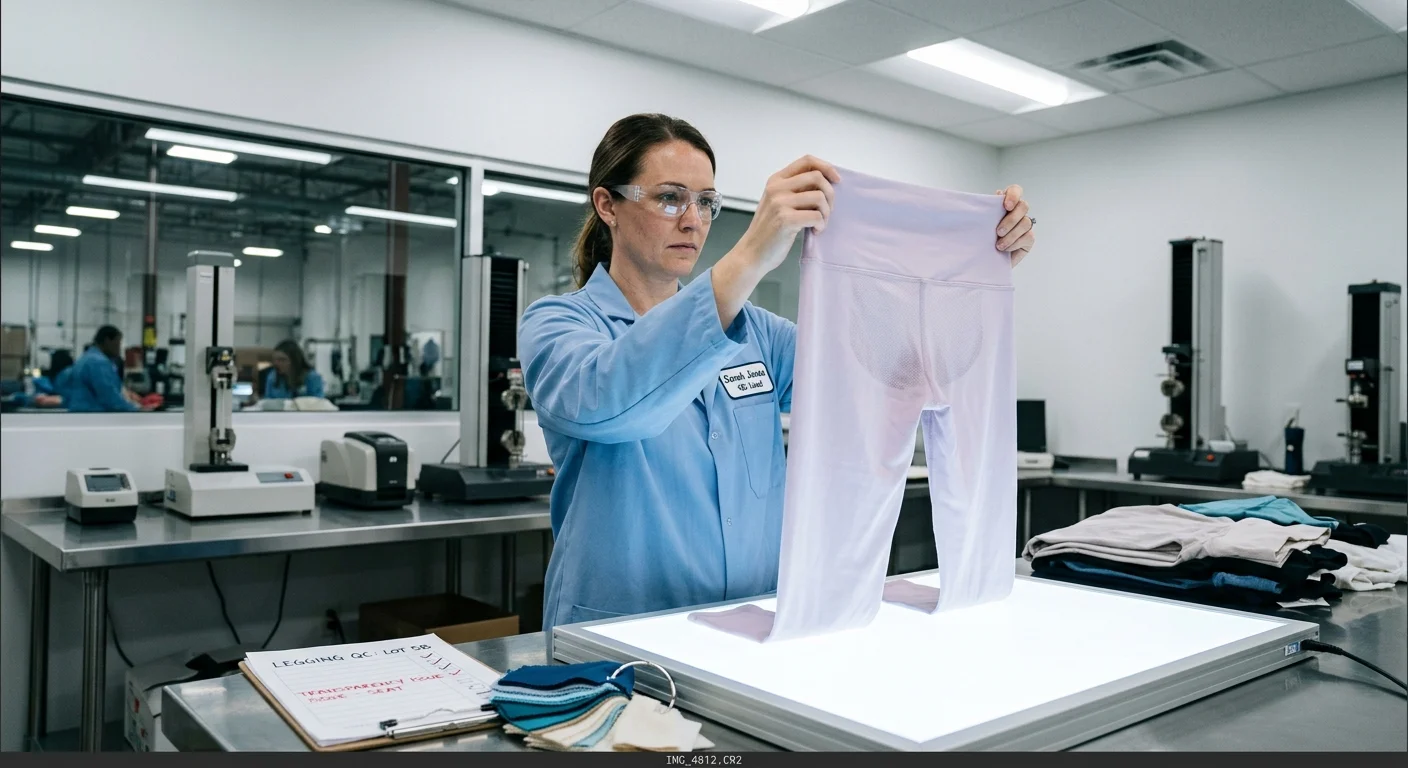
Sheerness isn't a fabric mystery — it's a spec failure with a paper trail.
Every see-through squat traces back to a specific upstream decision. The GSM was five grams too light. The single-jersey construction got picked to save half a cent per yard. The denier count looked fine on a flat swatch — then fell apart under load. The good news? Every one of those decisions is fixable. You just need to know which number to change and why.
This case made one thing clear: squat-proof fabric technology isn't a premium add-on. It's an engineering baseline. Here's what that baseline looks like in practice:
Double-knit construction — not single-jersey
Validated nylon spandex blend opacity across all colorways, not just the core shades
A standardized QC protocol that catches failures before sampling, not after
None of that is over-engineered. That's the minimum viable spec for any legging that will face a real human body in motion.
Take the checklist. Run your current fabric against it this week. You'll save two months of resampling time — and that time is yours to keep.