Brexit didn't just redraw borders — it rewrote the entire cost model for UK yoga brands sourcing overseas.
Since January 2021, founders who once moved stock without friction from European yoga apparel suppliers got hit hard. Unexpected duty bills piled up. Customs delays shattered launch timelines. Compliance requirements appeared out of nowhere, and nobody flagged them in advance.
So, you're building your yoga apparel wholesale UK strategy right now. Maybe you're shifting production from China. Maybe you're weighing up Turkey versus Portugal. Or maybe you're trying to figure out why your landed costs keep coming in higher than quoted. This guide is built for that moment.
What follows isn't a supplier list. It's a working decision framework:
Real tariff rates mapped to HS codes
A full landed cost model across four sourcing regions
A compliance checklist that keeps your shipments moving through customs — not stuck in it
Post-Brexit Tariff Rates by Yoga Apparel Category (HS Code Breakdown)

Here's the number that cuts into UK yoga brand margins more than anything else: 12% .
That's the standard UK Global Tariff (UKGT) ad valorem duty rate on finished apparel from non-preferential origins — China, Bangladesh, most of Asia. It doesn't sound catastrophic. But run it against a £40,000 shipment, stack 20% import VAT on top, and add freight. Suddenly it's the difference between a profitable season and a cash flow crisis.
The duty system itself isn't complicated. What makes it expensive is not knowing where each of your products sits within it.
The HS Code Map You Need
UK customs classifies yoga apparel under Chapter 61 (knitted or crocheted garments) and Chapter 62 (woven garments). This distinction matters. Your leggings and your woven joggers don't share a heading. Misclassification triggers delays, penalties, or wrong duty payments.
Here's how the major yoga apparel categories break down:
Garment Type | HS Heading | Construction Note | UK Duty Rate (No Preference) |
|---|---|---|---|
Women's knit leggings / tights | 6104 | Knit fabric; subheading shifts by fibre content (synthetic vs. cotton) | ~ 12% ad valorem |
Sports bras / crop tops | 6114 or 6212 | Knit = 6114; structured support garment = 6212 | ~ 12% ad valorem |
T-shirts / vests | 6109 | Knit singlets, vests, T-shirts | ~ 12% ad valorem |
Hoodies / sweatshirts | 6110 | Knit pullovers, sweatshirts, similar | ~ 12% ad valorem |
Woven joggers / pants | 6204 | Woven fabric; women's/girls' trousers category | ~ 12% ad valorem |
One detail worth flagging on sports bras: the 6114 vs. 6212 split is not just a technicality. A bra classified as a structured support garment — rather than a general knit top — can shift headings. Some 6212 subheadings carry different treatment based on fibre composition and construction. Get a binding tariff ruling from HMRC if your product sits near that boundary. It costs nothing and removes the ambiguity for good.
The EU Origin Trap
Sourcing from EU-based yoga apparel manufacturers? The UK-EU Trade and Cooperation Agreement offers 0% duty — but your goods must meet the rules of origin (RoO) requirements. For apparel, that means manufacture from yarn. Final assembly alone does not qualify.
This is where many small brands get caught. Asian fabric cut and sewn in Portugal or Lithuania does not qualify as EU origin. The fabric transformation rule must be met. Miss it, and your goods are non-originating. You end up paying the full 12% UKGT rate even though you sourced from within Europe.
The data makes this real: research from UKTPO found that 25% of exports covered by the TCA preference scheme still paid tariffs — not because they were ineligible, but because businesses either failed to claim the preference or couldn't complete the required paperwork. That's a real, avoidable cost.
How VAT Layers onto Duty
Duty is just one part of the import cost. Import VAT at 20% is charged on the CIF value plus import duty — so VAT is calculated on the duty-inclusive amount, not just the goods value.
A straightforward example:
- Goods value (FOB): £10,000
- Freight + insurance to UK port: £800 → CIF = £10,800
- 12% duty on CIF: £1,296
- 20% VAT on (£10,800 + £1,296): £2,419
- Total additional cost: £3,715 on a £10,000 order
One threshold to know: consignments valued at £135 or under follow a different rule — VAT is collected at point of sale rather than at the border. This hits small sample orders and direct-to-consumer drop-ship arrangements more than wholesale yoga apparel volume shipments. Either way, your accountant needs to know about it.
The Actionable Baseline
Set these as your fixed starting points before modelling any sourcing scenario:
Non-EU origin (China, India, most of Asia): budget 12% duty + 20% import VAT on CIF value as a baseline floor
EU origin with valid TCA preference: 0% duty , but proper origin documentation must be secured before the shipment moves
DCTS-eligible countries (certain developing nations): reduced or preferential rates may apply, but check eligibility and product-specific rules on the UK Global Tariff tool for each product
The 12% figure is no surprise if you've planned for it. It only becomes a problem when it's missing from the model entirely.
Total Landed Cost (TLC) Calculation Framework by Sourcing Region
The quote your supplier sends is not your cost. It is the starting point of your cost.
This is the single most expensive misunderstanding in yoga gear wholesale UK sourcing — and it hits hardest in the first year after a brand switches regions. The ex-factory price of yoga apparel lands in your inbox and looks competitive. Then freight gets added. Then duty. Then VAT on top of the duty. Then the broker's fee, the inspection, the pallet delivery to your 3PL. By the time the leggings are sitting in your warehouse, the number has moved — sometimes by 30%, sometimes more.
The fix is a Total Landed Cost (TLC) model. Not a spreadsheet you build once and forget. A live calculation framework you run before committing to any new yoga apparel supplier, any new region, any new product line.
The Core TLC Formula
Every sourcing region goes through the same formula. No exceptions.
Landed Cost per unit = (Ex-Factory + Freight + Insurance) + Duty + Import VAT + Broker Fee + QC Inspection + Inland Haulage + Inventory Carrying Cost
Here is what each component means:
Ex-factory price — what your supplier quotes, FOB or EXW
International freight — sea FCL has run $0.60–$1.50/kg under stable conditions; air freight sits at $5–$8/kg+ , reserved for urgent drops or high-margin SKUs
Cargo insurance — budget 0.2–0.5% of cargo value for sea; standard industry benchmark
= CIF value (this is the base on which duty is calculated — freight and insurance are included)
Customs duty — CIF × applicable HS rate
Import VAT — 20% × (CIF + duty)
Customs brokerage — budget £40–£90 per import entry for standard FCL or LCL shipments in the UK
Pre-shipment QC inspection — £150–£300 per shipment for third-party AQL 2.5 inspection in Asia; non-negotiable if you are not on the ground at the yoga apparel factory
Inland haulage — port to warehouse; benchmark £45–£70 per pallet
Inventory carrying cost — use your cost of capital (around 6–10% p.a. ) against the cash tied up during lead time, including duty and VAT float
Get the total shipment TLC, then divide by units. That gives you your per-unit landed cost. That number goes into your margin model — not the supplier quote.
Region-by-Region Cost Profile
The same formula, four very different outputs.
China / Asia
The ex-factory price advantage is real — 15–25% below EU manufacturing for comparable activewear at 500+ units per style. But that gap erodes fast once trade frictions kick in.
Stack 12% UK duty on CIF. Add 20% import VAT — recoverable, but tied up for 1–3 months. Add higher freight volatility risk and QC overhead. The net TLC advantage over EU sourcing often shrinks to somewhere between 0% and 10% for stable, high-volume runs. For smaller MOQs or seasonal drops, the gap can disappear completely — or flip.
The Sanmina TLC research puts it bluntly: most companies find their real TLC runs 20–70% above the initial offshore quote once rework, coordination time, delays, and compliance costs are counted. That range sounds wide. It stops sounding wide after a failed inspection or a 3-week customs hold.
Best suited for : high-volume, stable core styles with long planning horizons (budget for 6–12 month lead times including development and buffer stock).
Portugal / EU
Ex-factory prices run 10–20% higher than Asia for performance knitwear. But the trade-off is not just duty — it is the entire cash cycle.
Goods that fully qualify as EU origin and meet UK-EU TCA rules of origin requirements enter the UK at 0% import duty. No import VAT at the border on the same basis. Road freight from Portugal to the UK benchmarks at £0.80–£1.50/kg on palletised groupage loads. Production plus transit lands at 4–8 weeks — far shorter than Asia's planning horizon.
That shorter lead time is a working capital advantage that a basic price comparison will miss. Less cash tied up in transit. Less inventory to pre-build. Faster response to demand signals. These gains are real, and they compound across a full season.
Best suited for : fashion-forward styles, smaller repeat drops, brands where "European manufacturing" carries commercial value with end customers.
Turkey
Turkey sits in a solid middle position — but it needs more due diligence on origin documentation than either China or Portugal.
Ex-factory pricing lands around EU parity for basics, sometimes 5–10% cheaper on large runs through mills that control their own fabric production. Freight by road or short-sea container from Istanbul to the UK benchmarks at £0.60–£1.20/kg — competitive. Lead time of 3–6 weeks is noticeably faster than Asia.
The duty risk is the critical variable. Goods that qualify under applicable preference arrangements can drop to 0–4% . Fabric or processing that falls outside origin criteria puts you back at the MFN rate — up to 12%. Model both scenarios before you commit. Get the origin determination in writing from your supplier before the order is placed, not after the shipment arrives.
Best suited for : activewear wholesale UK brands that need a balance of speed, cost, and MOQ flexibility, with the capacity to manage origin compliance.
UK Domestic
Per-unit costs run 30–50% above Asian yoga apparel suppliers for cut-and-sew sportswear, especially at lower volumes. No import duty. No customs brokerage. No import VAT at the border. No cash tied up for 90 days waiting for a VAT reclaim.
The working capital position is cleaner than any import option. Lead times are the shortest available. For brands where "Made in UK" is a genuine marketing asset — not just a label — the premium gets absorbed into positioning rather than into loss.
Best suited for : limited edition runs, rapid-response restocks, and brands where domestic provenance commands a real price premium.
The Hidden Cost Layer
Before you finalise any TLC model, add a hidden cost buffer. Every solid industry framework flags this.
Cost Category | Typical Range |
|---|---|
Customs examination / physical hold | £100–£250 per hold |
Port storage / demurrage beyond free period | £15–£30 per container/day |
HS code reassessment + underpayment penalty | Up to 100% of unpaid duty in serious cases |
Delayed VAT recovery working capital impact | ~18–22% of import VAT tied up per 90-day cycle |
Treat customs examination as a probability event — 2–10% of shipments depending on your risk profile and shipping history. It is not a question of whether it will happen. It is a question of how often.
Your Net Margin Sense-Check
Once you have your TLC per unit, run it through a final margin test before locking in any sourcing decision:
Net Gross Margin (%) = (Retail Price − Landed Cost − Payment Processing − Marketing) ÷ Retail Price × 100
Use UK RRP inclusive of VAT as the retail price. Payment processing adds 2–4% of transaction value. DTC marketing spend for UK yoga brands runs 10–25% of revenue . The margin that does not hold after all four variables are in the model means the ex-factory price was never as competitive as it looked.
Run this across all four sourcing regions using your actual SKUs and volume assumptions. The region that wins on unit price almost never wins on net margin. The region that wins on net margin is the one worth building a supply chain around.
End-to-End Lead Time Timeline: From PO to UK Warehouse
Most UK yoga brands get the cost model wrong first. Then they get the timing wrong — and that second mistake is often the one that kills the launch.
Lead time isn't a single number. It's a chain of five or six distinct phases. Each phase belongs to a different party. Each has its own failure points. Get one phase wrong and the delays stack up. Here's how the full timeline breaks down — from the moment you release a purchase order to the moment stock is scan-confirmed in your UK warehouse.
The Two-Phase Structure
Every inbound shipment has the same anatomy:
Phase 1 — Production: PO release → ex-factory date
Phase 2 — Transit & Clearance: ex-factory → UK warehouse shelf-ready
Both phases carry equal weight. Most brands obsess over production lead time and then get blindsided by the clearance end.
Realistic Lead Time Bands by Origin
Origin | New Style (Phase 1) | Reorder (Phase 1) | Transit & Clearance (Phase 2) | Total Planning Window |
|---|---|---|---|---|
China / Asia | 60–90 days | 40–55 days | 30–49 days (sea) | 90–139 days |
Portugal / EU | 45–75 days | 30–45 days | 3–10 days (road) | 48–85 days |
Turkey | 30–60 days | 25–40 days | 4–10 days (road/Ro-Ro) | 34–70 days |
The reorder compression is real — and most brands leave it on the table. Pre-stock your fabric. Lock your tech packs. Asia production drops from 90 days down to 55. That's 35 days of planning runway recovered by managing your supplier's material pipeline. Nothing more.
The Asia Sea Freight Breakdown
For a new SKU from China on FOB terms, sea freight, the timeline looks like this:
Fabric knitting/dyeing: ~20–35 days
Cutting, sewing, finishing: ~15–25 days
QC, packing, consolidation to port: ~10–15 days
Port-to-port transit (East Asia → UK): 25–40 days
UK port customs + container devanning + inland haulage: 3–7 days
Warehouse inbound processing (GRN, QA, put-away): 1–2 days
Total: 74–124 days. Budget the upper end for any new supplier, new style, or peak season window.
Air Freight: Where It Works
Air costs £5–£8/kg versus sea's £0.60–£1.50/kg — so the numbers work in a narrow set of situations. Ex-factory to UK warehouse shelf runs 6–13 calendar days end-to-end.
Use it for: launch top-ups, size curve corrections, best-seller replenishment. Keep air to under 10–15% of total volume. Push past that and you're not running a supply chain — you're running a crisis response.
Buffer Rules That Hold Up
Peak season (Aug–Oct, pre-Q4): Add +7 days to transit and clearance. Container rollovers and port congestion are not rare surprises during peak. They are the baseline. Plan for them from the start.
First shipment from a new supplier: Add +3 days for HMRC documentation checks, importer record setup, and potential customs queries.
Target deviation: Aim for ≤5 days variance from planned lead time. Get there through pre-filed customs declarations, locked Incoterms responsibilities, and supplier-level lead-time tracking.
That 5-day target is not a stretch goal. It's a practical outcome once pre-filing and carrier discipline are in place. Hit it and you have a confident launch plan. Miss it and you carry a permanent buffer week that quietly inflates your inventory holding costs.
UK Textile Import Compliance & Labelling Checklist
Customs holds don't happen because of bad products. They happen because of bad paperwork and missing labels — problems that cost nothing to fix before shipment and a lot to fix after.
For UK yoga brands importing activewear, compliance breaks into four areas: fibre labelling, product safety, customs documentation, and record-keeping. Each one is manageable on its own. Together, they form the self-check system that keeps your shipments moving.
Fibre Labelling: What the Law Requires
UK textile labelling law applies to any garment where textile fibres make up 80% or more of the product by weight . The label must be durable, legible, written in English, and fixed directly to the garment or its packaging.
For yoga apparel, the key requirements are:
Single-fibre products : state the fibre name and percentage — e.g. "100% cotton"
Multi-fibre blends : list every fibre by percentage weight in descending order — e.g. "78% polyester, 22% elastane" for standard leggings
Shell + lining constructions : declare both parts on their own — e.g. "Shell: 88% polyester, 12% elastane; Lining: 100% polyester"
Minor fibres below 2% per fibre / 5% total can be grouped as "other fibres" where no alternative exists
Garments containing leather, fur, or similar non-textile material must carry the statement: "contains non-textile parts of animal origin"
Care symbols are not a legal must — but every serious UK retailer expects them. Missing symbols will fail most technical file audits. Use symbols that conform to BS EN ISO 3758 . For activewear, a standard care sequence covers: wash at 30°C mild cycle, no bleach, low tumble dry or air dry, cool iron, no dry clean. Symbols must stay legible after repeated washing.
Beyond fibre content, your label should also include:
Brand name and UK importer name and address — required for traceability under GPSR; a non-UK brand must have a UK importer address available to enforcement authorities
Country of origin — e.g. "Made in China" or "Made in Turkey" ; required by UK retailers and Trading Standards
Size designation — UK/EU or alpha sizing; not a legal requirement, but missing it will fail retailer technical file checks
Batch or style code — a short reference that links the physical product back to your technical documentation
One practical note for brands supplying both UK and EU markets from the same stock: put both a UK importer address and an EU-27 importer address on the label or packaging. That one step lets the same carton clear UK customs at Dover and EU customs at Calais — no relabelling needed.
UKCA Marking: Who Needs It
Standard yoga apparel — leggings, sports bras, tops, joggers — does not need UKCA marking. A garment with no protective claim falls under the General Product Safety Regulations (GPSR) as general apparel, not PPE.
UKCA becomes relevant only where your product or marketing crosses into regulated territory:
High-visibility training wear marketed for road visibility → PPE regulation; requires conformity assessment to EN ISO 20471 and a Declaration of Conformity
Impact-protective compression wear with padding or impact claims → PPE regulation; same documentation chain applies
Flame-retardant or FR-rated sportswear → protective clothing category; requires certified testing, notified body involvement, UKCA marking, and ongoing surveillance
Selling standard activewear with no protective claims? UKCA does not apply. The key word here is claims . Your marketing copy moves toward protective performance language — the regulatory category shifts. That's the line to watch.
Under GPSR, all apparel importers must keep a risk assessment and technical file . This file covers chemical test reports for UK REACH limits (azo dyes, formaldehyde, heavy metals), a flammability assessment, label approvals, and the traceability records listed above.
Customs Documentation Per Shipment
Every inbound shipment needs a clean document set. Incomplete or mismatched paperwork is the main trigger for customs examination holds — those cost £100–£250 per event, plus unpredictable delays.
The standard document pack for a UK yoga apparel import:
Document | Key Details Required |
|---|---|
Commercial invoice | HS code per style (Chapters 61–62), fibre description, customs value, Incoterms, freight/insurance breakdown |
Packing list | Carton count, gross/net weights, SKU-to-carton mapping |
Bill of Lading / Air Waybill | Matching shipper/consignee details and shipment marks |
Certificate of Origin / Supplier Declaration | Required to claim 0% duty under UK-EU TCA; keep on file even for non-preference shipments |
GB EORI number | Must appear on the import declaration; no exceptions |
Your commercial invoice description matters more than most brands expect. "Women's clothing" is not enough. "Women's knitted polyester/elastane leggings, 78%/22%, HS 6104" is. Specific descriptions give the examining officer no room for doubt — and that cuts the chance of a hold.
Record-Keeping: The 6-Year Rule
HMRC requires you to keep import records for 6 years . That's the standard UK tax records benchmark. Keep the following per shipment and per style:
Import declarations (CDS entries and acceptance messages)
C79 import VAT certificates and duty payment records
Origin evidence for preference claims (supplier declarations, long-term supplier declarations, Certificates of Origin)
Technical file per style: test reports, label artworks with approved fibre text, risk assessments, GPSR documentation, and UKCA Declarations of Conformity where needed
The Pre-Shipment Label Approval Workflow
Build this four-step process into every new yoga apparel supplier relationship and every new style. It takes a few days upfront. It also removes the risk of an entire production run carrying non-compliant labels — and that's worth the time.
Digital proof — your supplier sends label artwork for the main brand label and the composition/care label before any printing starts
UK compliance check — verify fibre names and percentages, English wording, UK importer address, and country of origin; check that any protective claims have test reports to back them up
Pre-production sample — a physical garment with the sew-in or heat-seal label attached; check legibility and durability in person
Written approval — sign off and file before bulk production begins; store the signed approval in the technical file for that style
One more item that sits outside the label itself but belongs on the same checklist: random batch testing on inbound production lots . Run colourfastness to washing and perspiration (BS EN ISO 105 series) and dimensional stability (shrinkage and spirality). These two tests catch the failures most likely to cause returns or retailer rejection. Neither is expensive. Both cost far less than a recall.
Supply Chain Risk Diversification & Sourcing Strategy

A single-supplier strategy isn't a supply chain. It's a single point of failure with a purchase order attached.
The brands that got through Brexit's disruption without a stock crisis weren't the ones with the biggest budgets. They were spread across multiple origins and factories before the trouble hit. You don't need a trade economist to explain the lesson. One missed launch and an empty warehouse does it.
Here's the structure that holds up in practice:
60% Asia/China — your core margin engine; stable replenishment, scale economics, cost efficiency
30% EU/Turkey — 4–8 week restock cycles, seasonal drops, fast-response colorways
10% UK domestic — urgent production, launch tests, rapid size-curve corrections
Don't chase a perfect split from day one. First, find which SKUs carry the most exposure to late delivery and price swings. Diversify those first. Adding more SKUs without a clear priority order makes the problem worse, not better.
Supplier Vetting: The Filters That Matter
Evaluating an activewear manufacturer for the China-to-UK lane? Treat these as non-negotiable entry criteria — not nice-to-haves:
Current audit certification : BSCI, SEDEX, or ISO 9001. No current audit = no sampling
Private-label capability confirmed upfront : woven labels, silicone heat-transfer, embroidery, custom packaging. This is a standard production requirement, not an upgrade
English-speaking QA contact with a documented escalation path — not a sales rep who forwards questions
Written fabric substitution protocol : what happens when their recycled nylon/spandex blend goes on allocation? No answer from the factory means your production line stops while they sort it out
Digital tech pack compatibility : factories that need repeated clarification rounds add hidden lead time. Test this before you commit
Use a two-step sample process. Proto sample first, pre-production sample second. Each step needs a named contact and a written sign-off before the next one starts.
Inventory and Cash-Flow Buffers
Here's the safety stock formula that reflects real supply chain conditions:
(Average Daily Sales × Lead Time Days) + (Max Daily Sales × Max Lead Time Variance)
Run this per SKU per origin lane. The number on Asian-sourced core styles will catch you off guard — factor in Q4 peak variance and it shifts fast.
For payment structure, a staggered PO approach cuts cash exposure without giving up production priority:
40% deposit on order placement
60% after pre-shipment inspection is passed
Split sea/air where needed to balance stock availability against working capital
Keep a live UK production lane — even a small one. Its job is simple: catch what the import pipeline misses. Stock-outs, emergency restocks, rapid-test runs. Yes, the cost premium is real. So is the revenue you protect when your bestseller doesn't go dark for six weeks.
Contingency and Compliance Controls
Dual-source every critical fabric component — recycled nylon/spandex blends in particular — across both Asia and EU mills. A single-mill dependency on performance fabric stays invisible as a risk right up until the mill shuts down production.
For finished or coated garments, get HMRC Binding Tariff Information (BTI) before your first shipment. It locks your HS classification, removes ambiguity, and cuts out the underpayment penalty risk that can reach up to 100% of unpaid duty.
Keep an alternate logistics bench ready at all times: two freight forwarders and one customs broker . Port disruptions and broker capacity crunches happen on a cycle. A pre-qualified alternate means your contingency plan is already moving before the problem gets worse.
On duty cash flow: a Customs Duty Deferment Account lets you group duty payments rather than settling at each declaration. For brands running regular import volumes, that smoothing effect adds up.
The Sourcing Dashboard to Run Weekly
Stop tracking supplier performance on a quarterly basis. Run this set of metrics every week:
Metric | Why It's Weekly |
|---|---|
Supplier OTIF rate | Drift shows up early before it becomes a late shipment |
Lead time by lane | Catches production or port delays before they compound |
MOQ by trim and packaging | Flags supply tightness before it stops an order |
Audit status | Keeps renewal deadlines visible |
Open quality issues | Prevents small defects becoming a return rate spike |
FX and duty impact on landed cost | Post-Brexit import tariff changes need a quarterly model update at minimum |
Sea vs air split | Air creep above 15% is a supply chain problem, not a logistics decision |
Stock cover in days | The one number that tells you whether the whole chain is working |
Every critical fabric, trim, or packaging component needs a minimum of two approved sources . That's not a conservative rule — it's the baseline for a supply chain you can manage rather than one you're forever chasing.
Conclusion
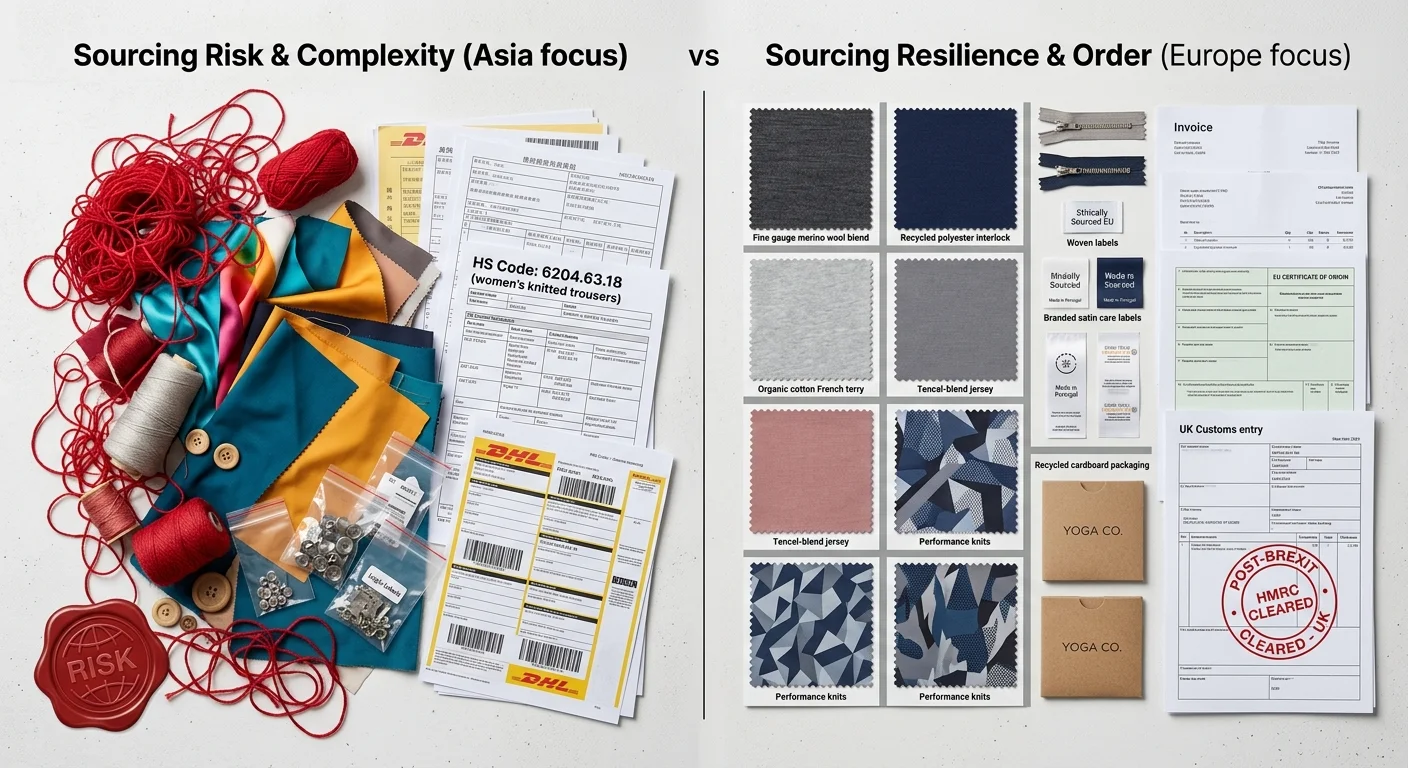
Brexit didn't just redraw borders — it rewrote the cost structure of every yoga brand sourcing outside the UK.
The brands that win here aren't the ones with the flashiest product. They're the ones who know their HS codes. They've run landed cost numbers across at least two sourcing regions. And they've built a supplier mix that holds up — even when a container gets stuck at Felixstowe.
You now have the framework. The tariff tables, the lead time benchmarks, the compliance checklist — none of it is theoretical. Run the numbers on your current supplier. Then run them on an alternative. The gap between what you think you're paying and your true landed cost is almost always where margins bleed out.
Your next move is simple. Pick one variable from your existing yoga apparel wholesale UK supply chain — tariff rate, lead time, or MOQ — and stress-test it this week.
Small audits compound. Start there.