You've already done the hard part — you've decided China isn't the answer anymore. Rising tariffs, 90-day lead times, and that one shipment that showed up three months late and killed your Q4 are reason enough.
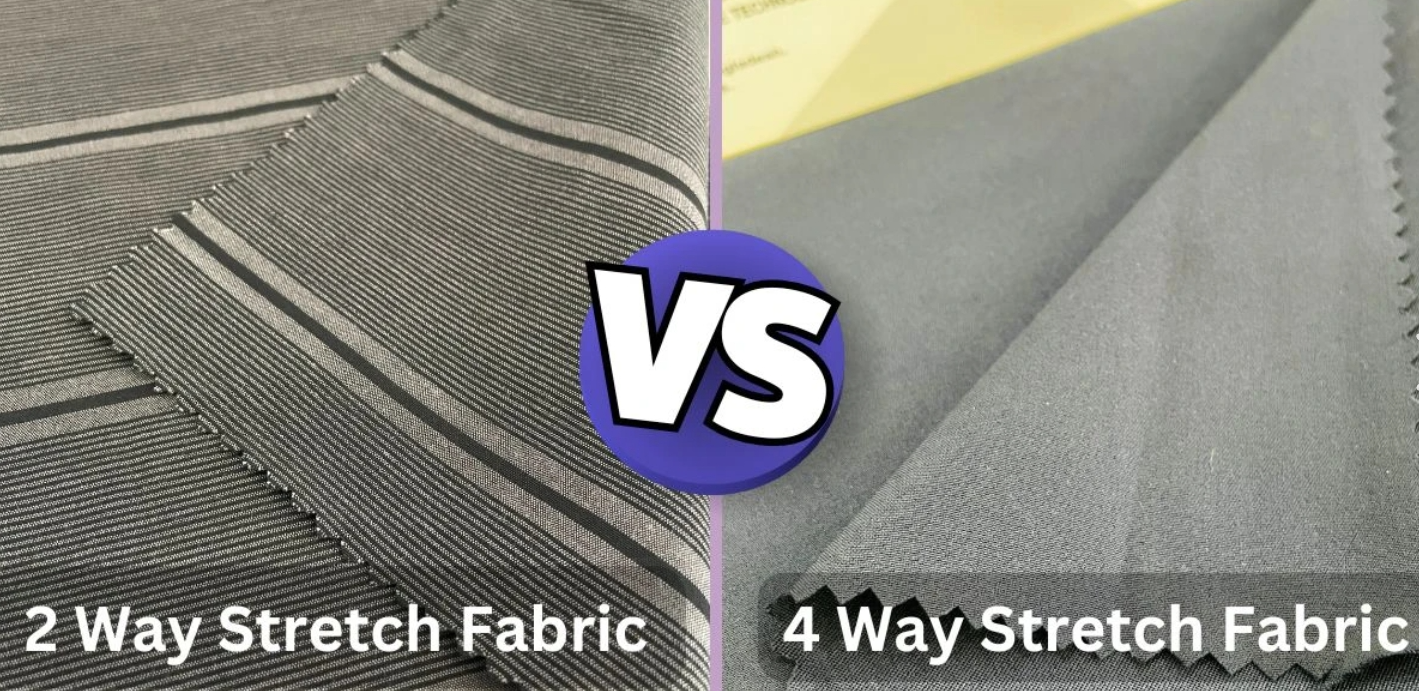
What you haven't found yet is a straight, numbers-first breakdown. Specifically, what yoga leggings nearshoring in Mexico costs, how fast it moves, and whether factories there can handle 4-way stretch compression fabric without tanking your quality standards.
That's what this guide covers:
Real FOB benchmarks
A full landed cost model stacked against your current China numbers
Regional yoga apparel factory capabilities
A USMCA duty-free apparel compliance walkthrough — no buzzwords, just the steps
Finish reading and you'll know two things: whether nearshoring is your next move, and how to execute it.
2024 Mexico Yoga Leggings FOB Pricing & Tiered MOQ Benchmarks
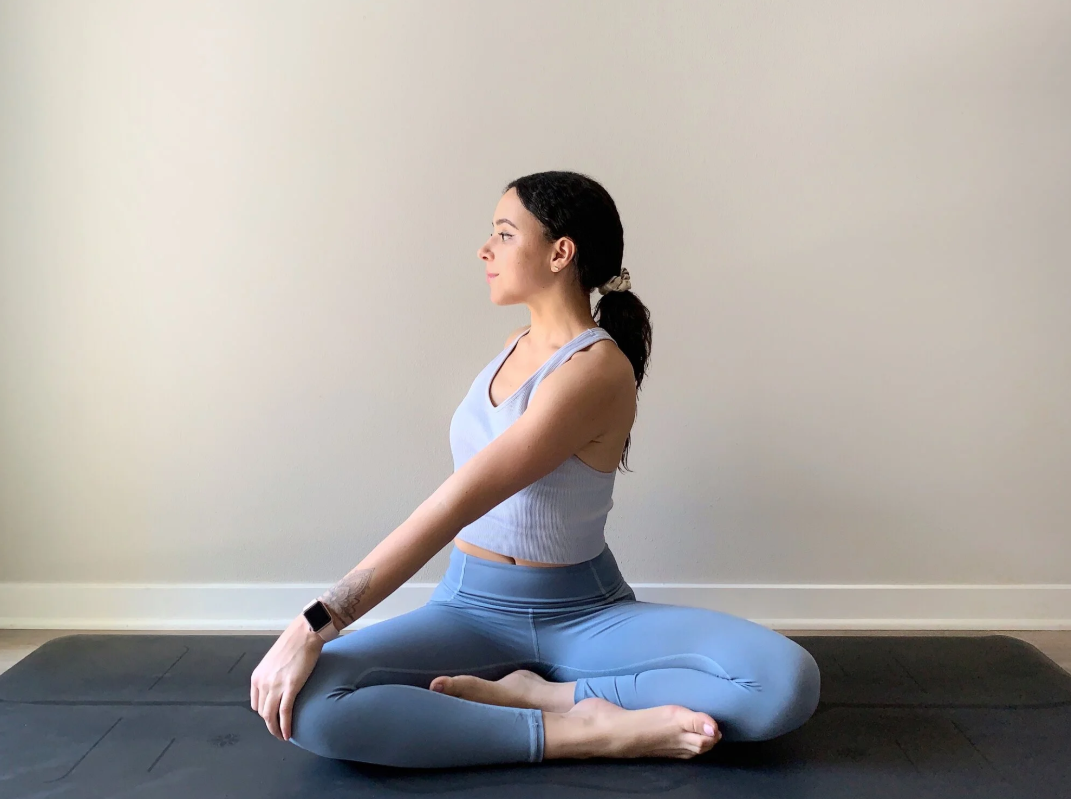
Here's the number most sourcing guides skip: a well-specced nylon-spandex yoga legging — 230 gsm, 4-way stretch, high-waist, gusset, single logo — runs $7.10 to $9.20 FOB at 1,000 units. That's for production in Mexico or through Mexico-aligned supply chains. That's your sweet spot. Most US DTC brands starting a nearshoring evaluation should build their initial model around this range.
But unit cost alone tells you nothing without context. So let's break down the full pricing structure by MOQ tier, fabric type, and what each band supports at retail.
The 2024 Tiered FOB Benchmark Table
The pricing below covers 2024–2025 production for yoga leggings sold into the US market through Mexican nearshore supply chains. This covers solid colors, 7/8 or full-length cuts, standard polybag packaging, basic 1-color heat transfer branding, and no complex mesh paneling.
MOQ (per style/color) | Polyester-Spandex (220–260 gsm) | Nylon-Spandex (230–260 gsm) | Brushed Peach / Supplex Blend (230–280 gsm) |
|---|---|---|---|
100 pcs | $7.20 – $9.20 | $9.50 – $12.80 | $11.00 – $14.50 |
300 pcs | $6.40 – $8.40 | $8.80 – $11.50 | $9.80 – $12.80 |
500 pcs | $6.00 – $7.80 | $8.20 – $10.80 | $9.20 – $12.20 |
1,000 pcs | $5.20 – $6.80 | $7.10 – $9.20 | $8.00 – $10.50 |
3,000+ pcs | $4.50 – $6.10 | $6.00 – $8.00 | $6.90 – $9.20 |
10,000+ pcs | $4.10 – $5.50 | $5.40 – $7.10 | $6.30 – $8.30 |
What these numbers assume:
- In-stock or pre-booked fabric in standard colorways
- No all-over print (add $0.80–$2.00/unit for digital sublimation)
- No eco-yarn upgrade (add $0.60–$1.50/unit for recycled nylon or RPET)
- 40–60 units per carton, standard size curve
What Each Pricing Tier Supports
The FOB number only matters if your retail price math works. Here's how it stacks up:
Testing phase (300–500 pcs/style):
A target FOB of $6.50–$9.50 lands at $11–$16 per unit after freight and duties. At a $29–$39 retail price point, your margin is tight but workable. That's enough to validate the style, collect reorder data, and tighten your size curve before you commit to bigger runs.
Scale phase (3,000–10,000 pcs/quarter):
FOB drops to $4.50–$6.00 for core polyester styles and $6.50–$8.00 for premium nylon/supplex. The economics get strong at this level. You're supporting $24–$45 retail with margin wide enough to run promotions, absorb returns, and still fund paid acquisition.
The MOQ Reality Check
Here's something that catches brands off guard: 100-piece MOQs exist, but the per-unit cost is high and the process is a headache. You pay a small-batch surcharge. Your fabric choices are limited to whatever's already on the shelf. Your size curve flexibility is zero.
300 units per style/color is the first threshold that makes sense. That's where penalty pricing stops and you start getting real yoga clothing factory cooperation on specs. Share waistband specs and fabric across two or three colorways in the same order, and you can often pull the 300-pc price down close to the 500-pc rate.
The 1,000-unit tier is the real turning point. Pricing gets competitive. Customization becomes possible. Your yoga apparel factory starts treating your program as a real account — not a sample run with a payment attached.
Quick benchmark to save to your model: For a mid-tier US DTC activewear brand targeting $35–$55 retail on a premium nylon legging, keep your FOB ceiling at $9.50 at 1,000 units. That's the limit to hold a healthy landed-cost-to-retail ratio. Go above that number and your margin breaks before you've paid for a single Meta ad.
Full Landed Cost Comparison Model: Nearshoring Apparel Production Mexico vs China
Your Mexico quote will look higher than your China FOB. That's where most brands stop reading — and walk away from a decision that would have saved them $3 per unit at landed cost.
Here's the math that changes everything.
A yoga legging sourced from Guangzhou at $10.00 FOB does not arrive at your 3PL for $10. Stack ocean freight, Section 301 tariffs, port handling, and the carrying cost of 75 days of inventory on water. That $10 unit lands closer to $17.85–$18.70. That's an 87% premium over raw FOB — and most brands are not building their margin models around that number.
Mexico's equivalent? A USMCA-qualifying legging at $13.50–$14.80 FOB lands at $14.90–$16.50. Higher starting price. Lower total cost. The math works — but you have to account for every component to see it.
The Full Landed Cost Stack: China vs Mexico, Component by Component
Cost Component | China (Offshoring) | Mexico (Nearshoring) | Mexico Advantage |
|---|---|---|---|
Base FOB Unit (nylon-spandex legging) | $8.50 – $11.00 | $10.00 – $14.80 | –$1.50 to –$3.40/unit |
Ocean / Ground Freight | $1.20 – $1.80 (LCL ocean, LA/LB) | $0.60 – $0.90 (truck, Laredo/Tijuana) | +$0.30–$1.20/unit |
Duties & Tariffs | 16–32% MFN + 7.5–25% Section 301 → $4.60–$5.20/unit effective | $0 (USMCA yarn-forward compliant) | +$4.60–$5.20/unit |
Port & Border Handling | $0.45 – $0.90 (drayage, dwell, chassis fees) | $0.15 – $0.35 (border cross-dock) | +$0.30–$0.55/unit |
In-Transit Inventory Carrying Cost (10–15% WACC) | 60–90 days total → $0.35–$0.55/unit | 10–21 days total → $0.06–$0.12/unit | +$0.27–$0.43/unit |
Emergency Air Freight Risk | $12–$18/unit when a drop misses | $3–$5/unit for Mexico recovery | +$7–$13/unit (when it happens) |
True Landed Cost | $17.85 – $18.70/unit | $14.90 – $16.50/unit | ≈$1.35–$3.00/unit net savings |
Where the Real Money Is: Tariffs and Time
Two line items drive this model. Everything else is rounding.
Tariffs. China apparel carries a combined MFN + Section 301 effective rate that hits 25–40% of customs value. On a $10 FOB unit, that's $2.50 to $4.00 in duty — sometimes more, depending on the HTS code. USMCA-qualifying Mexico production pays zero. That single line item swings the entire landed cost calculation in Mexico's favor — even after absorbing Mexico's higher labor and CMT rates.
Carrying cost of time. This one is easy to miss. At a 10–15% weighted average cost of capital, 75 days of inventory in transit costs $0.45 per unit on a $10 FOB item. That number sounds small. Scale it to 50,000 units per quarter and it becomes $22,500 tied up in floating inventory every cycle. Mexico's 10–21 day total lead time frees that working capital 45–70 days earlier. Your buy curve compresses. You can react to sell-through data before you get locked into a markdown.
The Break-Even Point: Where Mexico Wins Outright
This is the number your sourcing math hinges on:
At 1,500 units per style, Mexico's true landed cost crosses below China's — and stays below it.
Below 500 units: The FOB premium on Mexico can outweigh the duty savings. This is especially true for simpler polyester styles where China's MOQ scale is aggressive.
Above 1,500 units of USMCA-qualifying activewear: Mexico wins on landed cost before you factor in the strategic value of a 21-day replenishment cycle.
At 2,500 units, the numbers get even cleaner. Mexico outperforms China by $3.55 per unit on landed cost. That's not a small efficiency gain. On a 2,500-unit run, that's $8,875 in hard savings per style, per order — just on landed cost alone.
The Hidden Cost China Will Never Show You: Markdown Risk
The landed cost model above misses one of the most damaging line items in DTC activewear: the cost of bad timing.
A China production run misses your drop window. In a 75–90 day supply chain, there are a lot of windows to miss. Your options are:
- Expedite via air freight at $12–$18 per unit
- Discount end-of-season inventory at a 15–25% markdown on wholesale value
Both outcomes destroy margin that a tighter supply chain would have protected.
Mexico's 21–35 day total lead time does more than cut freight cost. It cuts the timing risk that triggers those markdowns. A missed trend, a weather shift, an influencer moment you didn't plan for — these are fixable problems when your activewear factory is a 3-day truck ride away. They become expensive inventory disasters when your goods are 35 days offshore.
Benchmark to use in your internal model: Build your China comparison at a 35% effective duty rate on customs value, $1.50/unit ocean freight, and a 75-day inventory float. Build your Mexico model at 0% duty, $0.75/unit trucking, and a 21-day float. The gap will be larger than your current CFO expects.
End-to-End Lead Time Timeline: Mexico Manufacturing Lead Time vs Asian Offshoring
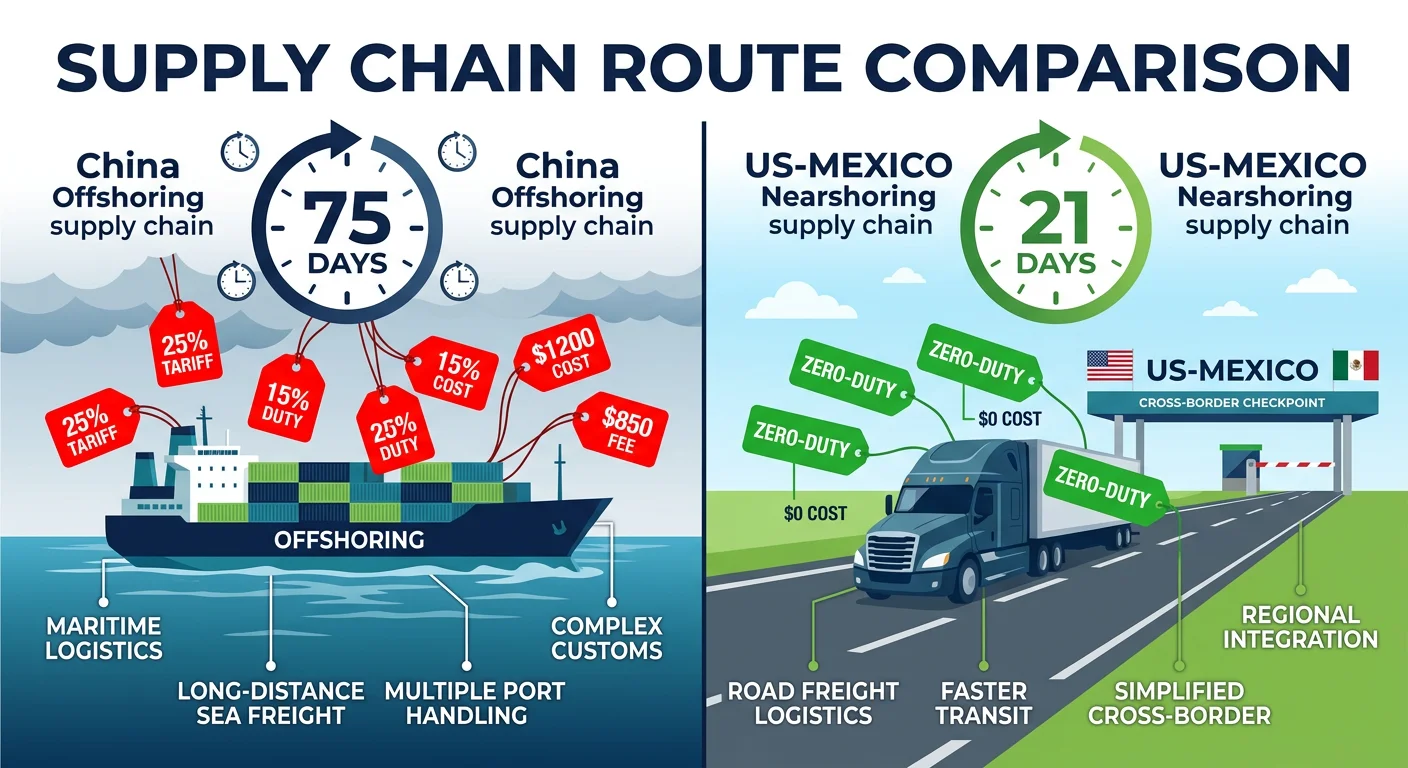
The fastest supply chain wins. Not the cheapest one — the fastest one that's also cheap enough.
Here's what the numbers look like across every phase, from tech pack to US warehouse:
Production Phase | Mexico (Days) | China/Asia (Days) |
|---|---|---|
Tech Pack Review & Proto Sample | 5–10 | 10–18 |
Fit Sample → PP Approval | 7–12 | 14–25 |
Fabric Sourcing & Mill Lead Time | 10–21 | 21–35 |
Trims & Accessories | 7–14 | 14–21 |
Cut & Sew Production (2k–10k pcs) | 10–21 | 20–30 |
Finishing, Packing & QA | 3–5 | 5–10 |
Transit to US Warehouse | 2–7 | 35–55 |
Total: Tech Pack → US DC | 35–60 days | 95–135 days |
That's a 60–75% cycle-time reduction. Not a rounding error. A structural advantage.
Why Every Phase Compresses — Not Just Transit
Most brands fixate on the transit difference. That part is real. Trucking from Monterrey or Guadalajara to a Texas DC takes 2–5 days. Your ocean container from Guangdong floats for 35–55 days at minimum. But transit is one piece of the story, not the whole picture.
The communication advantage compounds across every phase. Mexico runs in close to the same time zones as the US. You get same-day calls for pattern corrections. Same-day QC decisions. That's 1–2 feedback cycles per day instead of sitting on hold for 24–48 hours waiting for Asia to open. A single fit correction burns 7 days in a China iteration cycle. The same fix resolves in 2–3 days with a Mexican yoga leggings factory. Run that across three rounds of sampling, and you've recovered two full weeks before production even starts.
QC failures hurt less, too. A pre-production issue surfaces in Puebla — your technical team boards a 2-hour flight, not a 20-hour haul with jet lag. Problems that would push an Asian order into the next selling season turn into 3-day corrections in Mexico.
The Practical Implication for Your Buy Calendar
A 35–60 day total cycle lets you run 4–6 buying cycles per year instead of 2–3. That's not just an operational stat — it's a different business model at its core. Smaller bets. Faster reads on sell-through. Reorders driven by real demand data, not 90-day-old forecasts.
Your markdown risk drops with every week you shave off that pipeline.
Regional Cut and Sew Manufacturer Mexico Capability Matrix
Mexico has over 20,000 cut-and-sew operations and 254,000 workers in that segment alone. But raw scale doesn't tell you where to source a 4-way stretch nylon legging with flatlock seams and a silicone waistband gripper.
That's a different question — and the answer depends on which region you're working with.
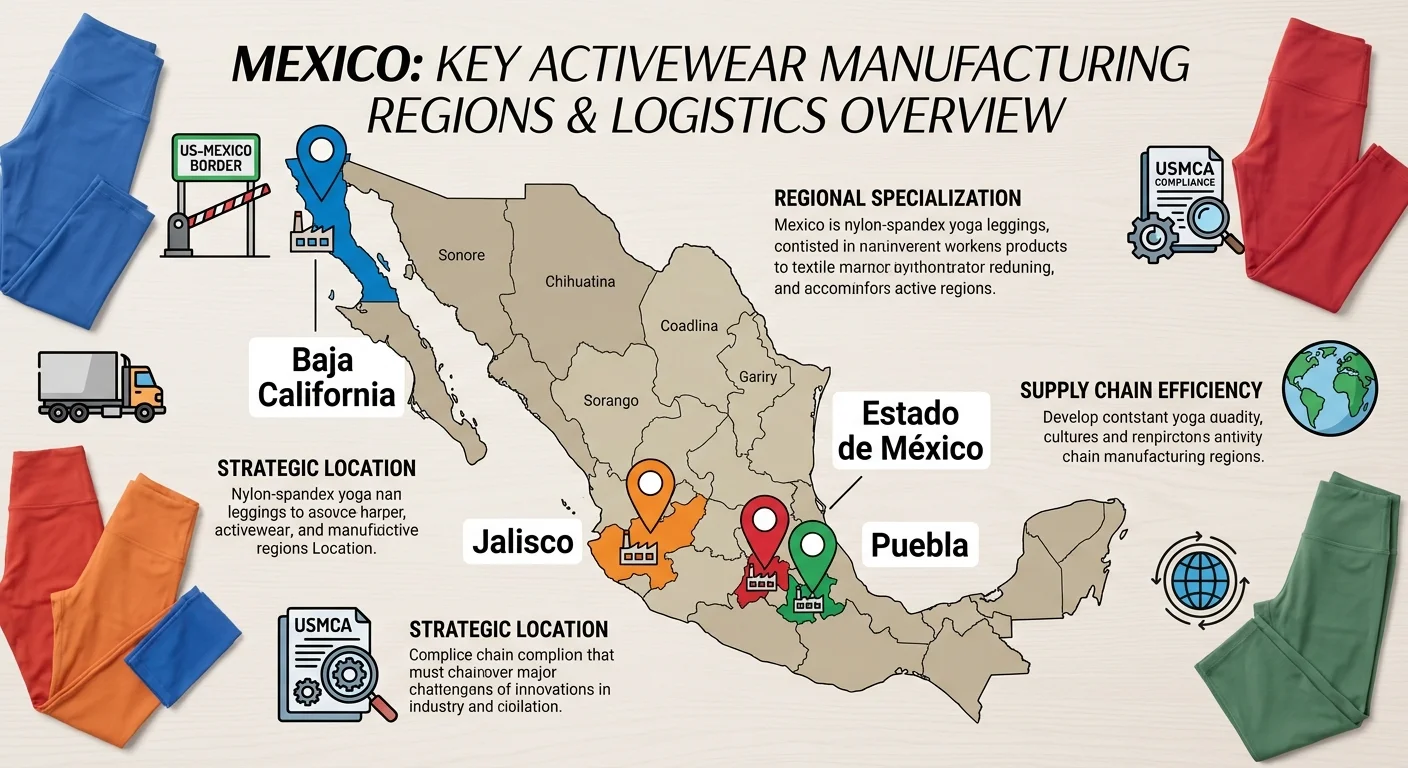
Here's the capability breakdown across Mexico's four main production corridors, focused on activewear fabric sourcing and compression leggings production.
Region-by-Region Factory Capability Matrix
Capability Factor | Puebla / Tlaxcala | Estado de México (CDMX Belt) | Jalisco (Guadalajara) | Coahuila / Baja California |
|---|---|---|---|---|
High-Stretch Flatlock Rating | ★★★★☆ | ★★★★★ | ★★★★☆ | ★★★☆☆ |
Nylon-Spandex / Supplex Experience | Strong | Strong | Moderate–Strong | Moderate |
Minimum MOQ (per style/color) | 1,000–2,000 pcs | 300–1,000 pcs | 300–1,500 pcs | 800–2,000+ pcs |
Vertical Integration (fabric + CMT) | High | Moderate | Moderate | Low–Moderate |
Sublimation / Branding Capability | Moderate | Moderate | Strong | Low |
USMCA Compliance Familiarity | High | High | Moderate–High | High |
AQL Standard (typical) | 2.5 | 1.0–2.5 | 1.5–2.5 | 1.5–2.5 |
Transit Time to US (truck) | 3–5 days | 3–5 days | 2–4 days | 1–2 days |
Puebla / Tlaxcala — The Vertical Integration Hub
Puebla is Mexico's textile heartland. The infrastructure runs deep here. Spinning mills, knit fabric producers, dye houses, and cut-and-sew factories all sit within a 1–2 hour radius of each other. For a yoga leggings program, that density matters.
Factories in this region run elastane blends for workwear and jeanswear on a routine basis. That means flatlock and coverstitch equipment is already on the floor — no retrofitting needed for your program. 4-needle 6-thread, coverstitch, and bartack are standard in mid-to-large Puebla operations.
Put it this way: your legging spec calls for seam durability under high compression — waistband-to-panel joins, crotch gusset construction — Puebla factories handle that without issue.
Best fit for: Brands ordering 1,000+ units per style who want domestic fabric sourcing and a single-region supply chain.
Watch out for: Smaller DTC runs under 500 units will hit minimum friction. These factories are built for volume, not small batches.
Estado de México (CDMX Belt) — The DTC-Friendly Performance Cluster
The Mexico City metro — Tlalnepantla, Naucalpan, and Ecatepec in particular — is your destination for legging-specific performance construction at lower MOQs.
This corridor earns a ★★★★★ rating for high-stretch activewear for a clear reason: factories here already produce shapewear, sports bras, and compression leggings. They're not transitioning from denim. Opacity testing (the squat-proof lightbox test), waistband recovery testing, and dimensional stability across 2–3 wash cycles are built-in standards at established exporters here — not add-ons you have to ask for.
The trim ecosystem is another strong point for private label activewear Mexico programs. Silicone waistband grippers, bra cups, reflective tape, heat-transfer labels — all sourced from within the metro area. That keeps your sampling cycle tight and your lead times short.
MOQ reality: 500–1,000 pcs per style for most factories. Some smaller operators go down to 300 pcs at a premium FOB. Building a capsule collection with three colorways and two styles? You can often combine both styles into one order to hit the lower-MOQ pricing tier.
Best fit for: DTC brands in the 500–2,000 unit per style range who need proven compression and high-stretch construction without committing to large-factory minimums.
Jalisco (Guadalajara / Tlaquepaque) — The Agile Capsule Specialist
Guadalajara doesn't compete with Puebla on scale. It competes on speed and finish quality — and that's exactly what makes it the right match for a specific type of activewear brand.
Small capsule drops, influencer-led collections, styles with heavy branding elements (silicone logos, woven patches, engineered waistbands with bonded details) — Jalisco is where that technical expertise lives.
Sublimation on poly jerseys is well-established here. The print infrastructure is extensive. Local dye and finish specialists offer moisture-wicking and anti-pilling treatments for poly-spandex fabrics. You won't find that combination as easily in other regions.
MOQs run 300–1,500 units per style, with color and print splits available at the lower end. Extended size curves from 2XS to 2XL are negotiable. OEKO-TEX certified fabric sourcing through partner mills is more accessible here than in other corridors — worth noting if you're positioning toward a sustainability-focused consumer.
Best fit for: Brands doing 800–1,500 units per style with significant embellishment or print requirements, or those testing a premium athleisure capsule before scaling up.
Baja California & Coahuila — The Replenishment Play
These two regions serve a different strategic purpose. Don't source your hero legging program here. Use them for replenishment speed and proximity economics.
Tijuana and Mexicali factories cross the US border in under 2 hours. A brand running a tight replenishment program on a core SKU — your black 7/8 legging that never goes out of stock, for example — a secondary yoga leggings supplier relationship in this region pays off fast. MOQs range from 800–1,500 units per style. Quality standards run at AQL 1.5–2.5.
Coahuila and Monterrey lean toward technical textiles and industrial-grade durability. Your activewear line includes outdoor or rugged performance styles — trail running tights or reinforced training shorts? The technical knit access through Monterrey mills is the strongest in Mexico for that category.
Sourcing takeaway: Start your cut and sew yoga leggings manufacturer Mexico search in the Estado de México corridor — that's the right move at under 2,000 units per style with proven legging construction as a priority. Move to Puebla once your volume crosses 2,000+ and vertical integration becomes a cost lever. Add Jalisco for capsule drops and print-heavy styles. Keep Baja California on file for replenishment speed once your core program is stable.
USMCA Duty-Free Apparel Compliance & Yarn-Forward Execution
Most brands learn about the yarn-forward rule after their first Mexico shipment gets hit with a 14.9% duty at the border. Don't be that brand.
USMCA duty-free status on yoga leggings isn't automatic. You earn it — style by style, lot by lot — through a specific chain of manufacturing origin that most sourcing guides cover in a single paragraph. Here's the full picture.
The Yarn-Forward Rule: What It Means for Yoga Leggings
USMCA requires triple transformation for knit activewear (Chapter 61 garments):
Yarn must be spun or extruded in the US, Mexico, or Canada
Fabric must be knit and finished in USMCA territory — from that originating yarn
Cut-and-sew work must happen in USMCA territory
Fibers — raw polyester chips, nylon filament feedstock — can come from anywhere. Everything else in the chain must stay within the three-country zone.
Here's the trap that catches most nearshoring brands: cutting and sewing Chinese or Korean nylon-spandex fabric in Mexico does not qualify. That garment enters the US at standard MFN rates — 14.9% for synthetic knit leggings under HS 6114.30. The full duty advantage of nearshoring disappears. You've paid Mexico's higher CMT rates and still owe US Customs a tariff bill.
The Spandex Problem Most Sourcing Advisors Skip
Performance yoga leggings contain 12–25% spandex by weight. That elastomeric content creates a real compliance problem under USMCA's de minimis rules.
USMCA allows a 10% de minimis threshold — up to 10% of a garment's weight can be non-originating fiber or yarn and the garment can still qualify. But there's a hard cap inside that rule:
Elastomeric yarns (spandex, elastane) cannot exceed 7% of total garment weight within that de minimis allowance.
A high-compression legging with 20% spandex content? De minimis won't save you. Your elastomeric yarn must come from a USMCA-region source — full stop. Confirm your Mexican or US mill sources elastomeric yarn from regional extruders. INVISTA's LYCRA® production in the US qualifies. Some Mexican processors hold qualifying supply agreements too. Get documented proof before you commit your first production lot.
USMCA's Four "Hidden Components" — The Rules Tightened After NAFTA
USMCA added four component-level requirements that didn't exist under NAFTA. All four must be originating for your legging to qualify:
Sewing thread
Narrow elastic fabric (waistband banding, hem elastics)
Coated fabrics (certain HS Chapter 59 materials)
Pocket bag fabric
For yoga leggings, sewing thread and narrow waistband elastics are the two that matter most. Your Mexican factory may buy both from local yoga leggings suppliers — but local doesn't mean USMCA-compliant. Get mill certificates. Confirm the thread and elastic are spun from USMCA-region yarn. This is a one-time qualification step per yoga leggings supplier, not a per-order burden. Skip it, and you're looking at a CBP verification.
Can't Source USMCA Fabric? Two Legitimate Workarounds
Some technical fabrics — a brushed peach supplex, a jacquard compression knit — aren't available from a USMCA-region mill. You have two options:
Short Supply List. USMCA maintains a list of fibers, yarns, and fabrics that aren't available in sufficient quantities within the three-country region. Your fabric qualifies? It can be imported from anywhere, and your finished garment still originates. Check the current list through the USTR portal. Standard polyester-spandex jersey almost certainly won't be on it. Niche jacquard and specialty brushed fabrics sometimes are.
Tariff Preference Levels (TPLs). TPLs give a set annual quota of non-originating apparel made in Mexico the right to enter the US at zero or reduced duty rates. The quota resets each year, fills fast for popular categories, and requires you to check CBP's allocation system in advance. Use this as a short-term bridge while you shift to USMCA-compliant fabric sourcing — not a long-term fix.
The 807A Route: US-Cut Fabric, Mexico Assembly
One path that often gets skipped: 807A-style production flow.
A US mill knits your nylon-spandex fabric from originating yarn and cuts the pattern pieces on US soil. Those cut pieces cross into Mexico for assembly. The finished leggings return to the US duty-free under HTS 9802.00.90.
Brands already working with US textile and yoga apparel suppliers — Burlington, Unifi, Nilit's US operations — can reach compliance faster this way. It also keeps your fabric quality inside a supply chain you've already checked and trusted.
Documentation: What CBP Will Ask For
Zero-duty entry requires a USMCA Certificate of Origin — no fixed government form, but CBP requires specific data elements:
Certifier, exporter, producer, and importer details
Product description and 6-digit HS code
Specific origin criterion (yarn-forward rule reference)
Blanket certification period (up to 12 months per supplier)
Authorized signature (electronic accepted)
That's the front-facing document. Behind it, hold five years of supporting records from the import date:
Document | What It Proves |
|---|---|
Yarn spinner mill certificate | Spinning location, yarn composition, HS heading |
Fabric knitter invoice + production lot records | USMCA-region knitting, lot traceability |
Dyeing/finishing records | Regional finishing confirmation |
Cutting tickets + sewing line output logs | Assembly in USMCA territory |
Bill of Materials (BOM) tied to style/PO | Full input traceability |
USMCA includes a textile-specific verification mechanism (Article 6.6). It lets CBP run "jump visits" — on-site audits of your exporter or producer with as little as 20 days' notice to Mexican customs. Your gym wear factory may get even less warning. Miss that chain-of-custody documentation during a jump visit, and CBP can deny USMCA preference going back to prior shipments from that exporter.
The Pre-Shipment Compliance Checklist (Per Style)
Run this before your first container crosses the border:
HS classification confirmed (Ch. 61 synthetic knit garment)
Yarn-forward requirement verified for that specific HTS subheading
Yarn spinning/extruding: all locations confirmed in US/MX/CA
Fabric knitting, dyeing, and finishing: confirmed in USMCA territory from originating yarn
Sewing thread, narrow elastic, pocketing fabric: USMCA-originating, mill certs on file
Elastomeric content ≤7% of garment weight if using any non-originating fiber
USMCA Certificate of Origin drafted with correct origin criterion
BOM, mill certificates, production records compiled and stored (5-year retention)
Customs broker has reviewed origin logic — binding ruling requested for grey-area classifications
That last item matters more than most brands expect. A binding ruling from CBP locks in your classification and origin determination before your goods move. That's 4–6 weeks of lead time well spent — especially on your first style with a new Mexican yoga leggings supplier.
Supply Chain Reshoring Activewear Fit Profile: Who Should Shift Now
Not every activewear brand should nearshore. Some should. Some shouldn't. Mixing up those two groups is an expensive mistake.
Here's a clear framework to figure out which side you're on.
Brands That Should Shift Now
DTC activewear labels running fast replenishment cycles.
Your bestsellers are selling out before the next shipment arrives. That means your supply chain is costing you real revenue. Consider this: brands managing 20+ SKUs across 4–6 colorways per style need restock cycles under 45 days. Every week they stay on a 90-day ocean pipeline, they're losing money. Mexico fixes this at the structural level — not just at the edges.
Premium technical leggings brands at $75–$125+ retail.
At this price point, customers expect squat-proof opacity, consistent flatlock seaming, and stretch recovery that holds after 50 washes. That kind of construction quality needs close QC oversight. A $1–$2 FOB premium for nearshored production is easy to absorb. Your ASP gives you the room. Plus, defect-driven returns stop eating your margin.
Capsule-drop brands using test-and-repeat economics.
Launch small. Read sell-through. Reorder winners fast. That whole model falls apart on a 120-day offshore pipeline. Mexico's 35–60 day cycle makes test-and-repeat actually work — not just sound good on paper.
Brands already losing $0.50+/unit to freight and tariff volatility.
Section 301 exposure, freight spikes, port congestion surcharges — these are showing up in your landed cost right now. The offshore FOB advantage is disappearing. Run the real numbers. The gap is smaller than you think.
Teams without 6 months of working capital to float transit inventory.
Nearshoring cuts your cash conversion cycle by 45–70 days. That's not a minor tweak. It's the difference between funding your growth and just financing your supply chain.
Brands That Should Wait
Commodity basics with long shelf life, low SKU churn, and price-first customers — stay offshore for now. Same goes for businesses built around 3–6 month replenishment cycles with deep inventory buffers already in place. Mexico's advantages are real, but they don't help a model that doesn't need speed.
The short version: Replenishment speed, quality consistency, or cash efficiency holding your brand back right now? Mexico is your next move. If none of those are a problem, the economics don't yet justify the switch.
7-Day Nearshore Sourcing Decision Checklist & Factory Vetting Questions
Seven days from now, you could have a shortlist of qualified Mexican activewear factories, a landed cost model that reflects reality, and a pilot structure ready to send. Here's how to get there.
Days 1–2: Lock Your Specs Before You Talk to Anyone
Factories waste quotes on brands that don't have their specs ready. Don't be that brand.
Product readiness checklist:
- [ ] Size curve and grade rules finalized (XS–XL, consistent 2" chest grade or equivalent)
- [ ] Measurement tolerances defined — ±0.25" on critical points (waist, outseam), ±0.5" on non-critical
- [ ] Stitch specs per seam type locked:
- Side seams: 10–12 SPI lockstitch
- Hems: 8–10 SPI coverstitch
- Waistbands: 8–10 SPI chainstitch or coverstitch
- [ ] Thread type and Tex specified (Tex 24 for light knits; Tex 27 poly core-spun for heavier constructions)
- [ ] Tech pack complete — BOM with GSM, shrinkage %, colorways, label/packaging instructions, AQL 2.5 target
Trade and cost targets:
- [ ] Fabric origin confirmed — USMCA-qualifying yarn or non-originating? This determines your duty exposure before you get a single quote.
- [ ] Landed cost ceiling set — FOB + truck freight + $0 duty (USMCA) vs FOB + ocean + 25–40% tariff (China)
- [ ] MOQ floor defined per style/color — hard floor and stretch target (typical nearshore range: 300–600 pcs/color, 1,200–2,400/style)
Days 3–4: Shortlist Regions and Send Your RFI
Don't send a generic inquiry. Send a structured RFI that filters out weak factories in the first response.
What your RFI must include:
- 12-month volume forecast by category and size breakdown (e.g., 20% XS / 30% S / 30% M / 15% L / 5% XL)
- FOB pricing request at three volume tiers: 600 / 1,200 / 3,000 pcs
- Separate CMT vs full-package quotes
- Certification request: ISO 9001, WRAP, BSCI, Sedex
- Written confirmation that IP ownership (patterns, tech packs) stays with you
- Sampling lead time benchmark: 7–14 days after tech pack receipt
- Bulk lead time benchmark: 30–60 days after fabric in-house
Region targeting based on your program:
- Under 2,000 units/style → start with Estado de México corridor
- Over 2,000 units/style → add Puebla factories to your RFI list
- Print-heavy or capsule drop → include Jalisco
- Replenishment-focused core SKU → add Baja California for speed
Days 5–6: Factory Vetting Questions That Filter Out the Wrong Partners
Most brand teams ask factories if they "can do" something. The factories say yes. That's the wrong question.
Ask these instead:
Capabilities:
- What share of your current business is compression leggings or performance activewear?
- Which North American or European brands do you produce for right now? Request two references willing to take a call.
- What is your machine count by type? You want to hear flatlock, coverstitch, bartack — not just "we have sewing machines."
Quality process:
- Do you run PP samples, SMS, and TOP? What are your timelines for each?
- What is your 4-point fabric inspection process? Who runs it?
- What is your historical major defect rate on export orders? Target: under 2%.
MOQ and lead time reality:
- What is the lowest MOQ you have delivered — not your policy MOQ — for a comparable client?
- What is your rush order surcharge percentage, and what triggers it?
- How do you handle mid-season chase orders when a colorway sells out faster than projected?
Cost transparency:
- Can you share a cost breakdown by fabric, trims, SAM (standard allowed minutes), overhead, and margin?
- How do you calculate labor cost per style? The answer should reference SAM × minute rate. If they can't explain it, move on.
USMCA compliance:
- Can you provide yarn and fabric mill certificates for the nylon-spandex materials you use?
- Do you produce USMCA-qualifying garments now? Can you provide a sample Certificate of Origin?
- What percentage of your fabric comes from USMCA-region mills?
Communication:
- Who is our dedicated English-speaking contact? What are their working hours relative to US time zones?
- Will you commit to a 3–4 hour overlap window each day, in writing?
Day 7: Structure Your Pilot and Set Your Go/No-Go Threshold
Don't sign a full production agreement. Run a pilot first.
Pilot structure:
- 1–2 styles, 2–3 colorways maximum
- 300–600 units per style
- 4–6 week duration from tech pack sign-off to delivery
The four metrics that determine go/no-go:
1. On-time delivery rate (target: 100% for pilot)
2. First-pass quality rate (target: defect rate under 2% major)
3. Unit cost vs quoted price (tolerance: ±3%)
4. Response time to communication (target: under 24 hours for standard; under 4 hours for urgent)
Score your factory before you sign anything:
Use a 100-point rubric. Break it down like this: category expertise (20 pts), technical capability (15 pts), USMCA compliance readiness (15 pts), MOQ flexibility (10 pts), communication and time-zone overlap (10 pts), workforce stability (10 pts), pricing transparency (10 pts), pilot terms (5 pts), exit and IP handover terms (5 pts).
Go/no-go threshold: 75/100. Below that, don't commit production volume — no matter how good the FOB quote looks.
One more item to lock in before your pilot starts. Add a contract clause requiring full handover of patterns, markers, sewing instructions, and all digital files if the relationship ends. That clause covers your entire sourcing investment — not just the pilot.
Conclusion
The numbers don't lie. Factor in tariffs, freight, and inventory carrying costs — Mexico isn't just "cheaper than you think." It's built to cost less for most US activewear brands under $5M in annual revenue.
You now have the actual FOB benchmarks, the landed cost model, the regional sportswear factory matrix, and the USMCA compliance checklist. A sourcing agent would charge you $3,000 to pull all that together.
So what separates brands that nearshore from those that stay stuck? They start the conversation before they feel ready. Here's your next move:
Request samples from two Puebla or Querétaro factories this week
Run your SKUs through the yarn-forward compliance check
Map your current China lead time against the 35-45 day Mexico timeline
The 2025 tariff environment isn't getting easier. Every quarter you delay private label activewear mexico production, you leave margin on the table.
Your 7-day checklist starts now.