One sizing mistake can wreck your yoga wear launch. It triggers high return rates that cut margins, warehouse overstock that locks up capital, and bad customer reviews that kill conversion — before you've gained traction in a new market.
The real problem isn't that brands ignore sizing. They're using standard apparel conversion logic on a category that needs something different: high-stretch, body-mapping fabrics with zero room for "close enough."
This guide gives you the exact tools to fix that:
A yoga-specific international size conversion chart
Spandex ratio compensation formulas
Market-tested size run allocation data to protect every order you place
Building a private label activewear line from scratch? Aligning OEM tech pack specs of yoga apparel with factories? Dealing with cross-border sizing complaints eating into your wholesale yoga clothing profits? This guide covers all of it — with precision data, not guesswork.
US, EU, and Asian Base Size Architecture for Private Label Activewear
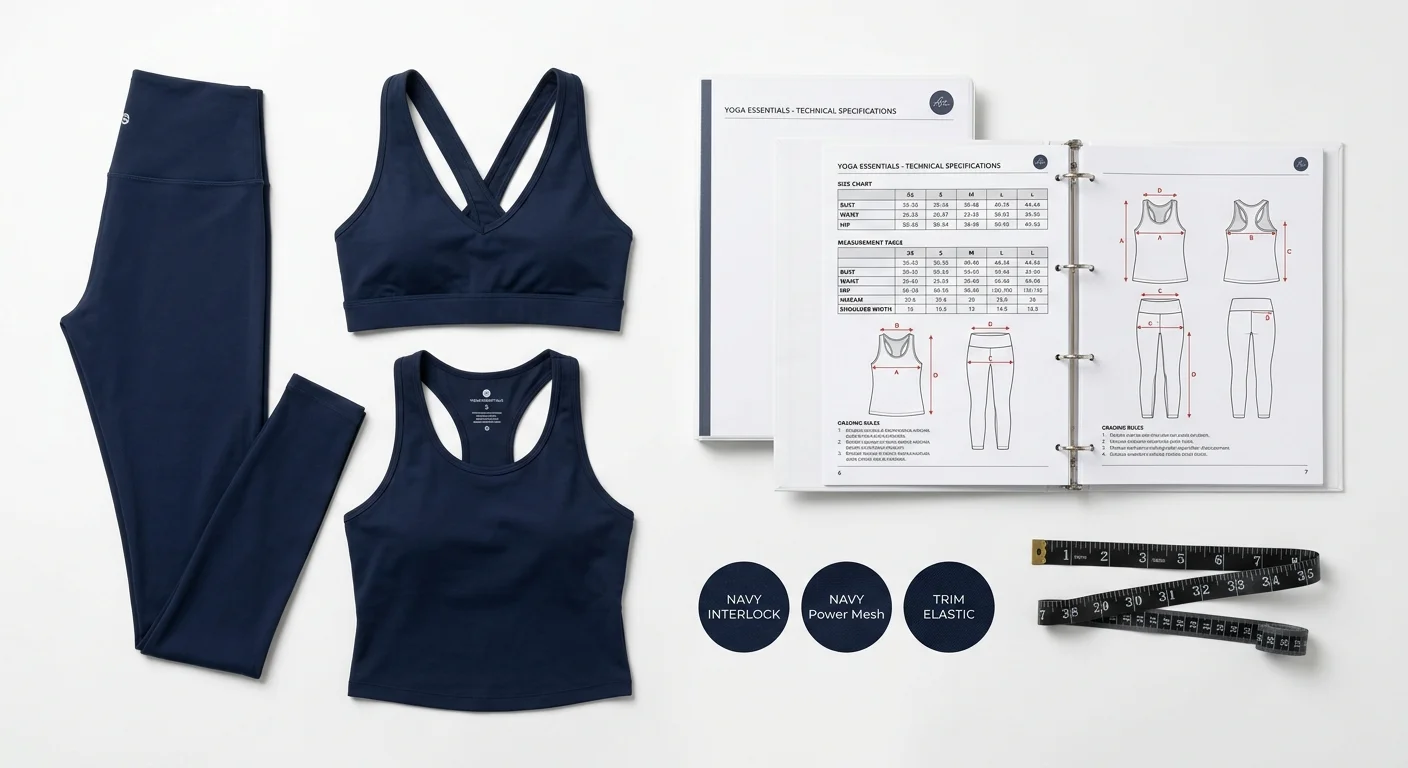
Three markets. Three different bodies. One tech pack that has to work for all of them.
That's the core challenge of private label activewear sizing — and most brands get it wrong. They treat regional differences as a simple label-swap problem. It isn't. The body measurement baselines are built differently at a structural level. Your grading architecture needs to start from scratch for each market.
Here's what the data shows.
The Body Measurement Baselines That Drive Everything
Start here before you touch a size label. Each regional standard is built on different physical reference points. You need to know what those are.
US / EU Women's "M" (Activewear Base Block)
Measurement | US M | EU 38 |
|---|---|---|
Bust | 88–92 cm | 88–92 cm |
Waist | 70–75 cm | 72–76 cm |
Hip | 96–100 cm | 96–100 cm |
Reference Height | 168–170 cm | 168 cm |
US and EU blocks are close to identical at the "M" / size 38 tier. US sizing follows ASTM D5585. EU sizing follows EN 13402. Both standards assume a taller, broader frame as the foundation for grading up and down.
Asian Women's "M" (China / Japan / Korea Composite)
Market | Standard | Bust (M) | Reference Height |
|---|---|---|---|
China | GB/T 1335.2 — "160/84A" | 82–84 cm | 160 cm |
Japan | JIS L 4005 | 79–87 cm | 154–162 cm |
Korea | KS — "66/M" | 82–86 cm | 160–165 cm |
Private Label Baseline | Composite | 80–84 cm | 160–163 cm |
The gap is clear: Asian "M" bust runs 4–10 cm smaller than US/EU "M." But bust circumference is just one piece. Asian body blocks also carry narrower shoulder breadth, reduced hip prominence, shallower armhole depth, and a shorter torso. None of those differences show up in a bust measurement alone.
For yoga wear, those structural gaps matter more than in woven categories. A legging pattern graded for a US/EU block creates excess volume through the hip and seat on an Asian body at the "same" size. That's not a labeling problem. It's a pattern problem.
Regional Grading Increments: Where Fit Breaks Down
Getting the base block right is step one. Getting the grade right between sizes is where most private label programs fail — and it usually goes unnoticed until samples arrive.
US / EU Grading Rules (Per Size Step)
Bust / Hip: +4–5 cm (confirmed across Nike, Lululemon, Athleta, and EU numeric 34–36–38–40 progressions)
Waist: +3–4 cm
Inseam / CB Length: +1.0–1.5 cm
Asian Grading Rules (Per Size Step)
Bust / Hip: +3–4 cm (China GB codes compress vs. Western increment)
Waist: +2.5–3 cm (tighter increments prevent sharp fit jumps in stretch bottoms)
Inseam / CB Length: +1.0–1.2 cm
The difference looks small on paper — about 1 cm per girth increment. Across a five-size run, that adds up to a 4–5 cm total girth gap between a well-graded Asian block and a US block adapted without adjustment. In a high-compression legging, that's the gap between a second-skin fit and a product return.
The Label Inflation Problem Your OEM Factory Won't Tell You
Here's a practical reality that catches almost every first-time cross-regional launch off guard: the same physical garment needs three different size labels depending on where it's sold.
A US S sports bra targeting bust 84–89 cm maps straight to a Chinese M (160/84A) or Korean 66/M . A garment labeled "M" for the US market needs to be re-tagged "L" or even "XL" for many Asian retail channels. That's how local customers read the fit.
This isn't vanity sizing. It's a deliberate market localization strategy — and it has a direct operational impact on your tech pack:
Your OEM tech pack must declare body measurement basis by region. Do not assume your yoga apparel manufacturer reads "M" the same way you do. Factories default to their local standard unless you specify otherwise.
The minimum viable tech pack for cross-regional activewear includes:
- A body measurement table per region (not just finished garment measurements)
- Graded specs for each size in each regional run
- Clear notation: "US fit: M = bust 88 cm, height 168 cm / Asia fit: M = bust 82 cm, height 160 cm"
Skip this step, and your samples will fit your US fit model well — and run two sizes small for your Asian market launch.
Plus Size and Extended Range Architecture
Standard linear grading stops holding up at XL. For brands building inclusive size runs (1X–3X), the grading logic shifts in a major way:
XS–XL range: bust/hip increments of ±4–5 cm, waist ±3–4 cm
XL → 1X transition: bust/hip +5–6 cm, waist +6 cm, rise +1–1.5 cm
1X → 2X → 3X: bust/hip +5–6 cm per step, waist +6–7 cm, length change minimal (+0.5–1 cm) while girth changes accelerate
Most technical design teams treat 1X–3X as a separate block family — not a linear extension of the core misses range. The 1X base body is typically set at bust 112–116 cm, height 165–168 cm, with a modified shoulder slope. So before sourcing inclusive sizing, confirm whether your yoga apparel factory grades from a dedicated plus block or scales up from an XL. Those two approaches produce very different fit results.
Regional Body Measurement Benchmarks and Fit Model Selection

Body data is the foundation of every sizing decision you'll make. Most brands skip straight to label design without ever building it right.
Here's the truth: two fit models can both measure "M" on a size chart and wear entirely different garments. Regional body measurement benchmarks aren't just about overall circumference. They cover proportional relationships between bust, waist, hip, thigh, rise, and inseam. Those relationships split in different directions across the US, EU, and Asian markets.
Get this layer right, and everything downstream — grading, tech packs, size run allocation — becomes systematic. Get it wrong, and no amount of factory communication fixes the fit complaints.
Anchor Your Measurements to ISO Standards — Then Tune by Region
The most reliable approach is to build your body measurement baseline using ISO 8559-1:2017 and ISO 7250-1 definitions. Then pull regional body data from ISO/TR 7250-2 to set your percentile targets per market.
Why ISO? It gives your factory and your design team the same measurement landmarks. Tell a yoga clothing factory "waist girth = 780 mm," and ISO 8559 defines the exact tape position on the body — the narrowest point between the lower ribs and iliac crest. No guessing. No sample surprises.
Working 50th-percentile anchors for a women's "M" by region:
Measurement | US / Western EU "M" | East Asia "M" (China/Korea/Japan) |
|---|---|---|
Height | 163–167 cm | 157–160 cm |
Full Bust | 88–92 cm | 80–84 cm |
Natural Waist | 78–82 cm | 68–72 cm |
Full Hip | 98–102 cm | 90–95 cm |
Thigh Girth | 54–56 cm | 49–52 cm |
Front Rise (body) | 22–24 cm | 20–22 cm |
Back Rise (body) | 30–32 cm | 27–30 cm |
Inseam | 74–78 cm | 70–74 cm |
These are body measurements — not finished garment measurements. That distinction is critical in yoga wear manufacturer briefs. Always specify which one you're referencing.
One ratio worth locking in: back rise runs 35–40% longer than front rise across all markets. This is non-negotiable for squat coverage in yoga leggings. Your factory's base block compresses that gap, and your leggings fail the bend test — no matter how well the waist fits.
Fit Model Selection: The Spec Most Brands Leave Vague
Your fit model is your physical calibration tool. Pick the wrong one, and you build a systematic bias into every sample, every grade, every size run.
Working targets for a core "M" sample:
US / EU women's M: Target height 165–168 cm , weight 58–62 kg — this lands around the 50th–60th height percentile and 40th–60th weight percentile for the target demographic.
East Asia women's M: Target height 160–162 cm , weight 50–52 kg — running just above median height sharpens inseam and rise grading accuracy.
Men's M (US/EU): 176–180 cm, 74–80 kg
Men's M (East Asia): 170–174 cm, 64–70 kg
Three controls that separate professional programs from careless ones:
1. Measurement tolerance thresholds.
During active development, your fit model's key measurements need to hold within: height ±1.5 cm, bust/waist/hip ±10 mm, thigh ±8–10 mm. Any girth drifts beyond 15 mm from baseline for more than two to three weeks — re-baseline or replace. Fitting a garment on a body that's shifted outside spec corrupts your sample data.
2. Posture standardization.
Set a fixed posture: neutral spine, parallel feet at hip width, arms relaxed at sides. This follows ISO 8559 anthropometric posture requirements. Also evaluate fit in four active positions: standing, slight squat, lunge, and seated. Yoga wear that fits only in a standing position is yoga wear that gets returned.
3. Measurement frequency.
For active development blocks, remeasure every two to four weeks. In high-production seasons, many serious brands run waist/hip/thigh checks on their fit model every week. It's not excessive — it's the difference between consistent samples and expensive rework cycles.
Cross-Checking Factory Blocks Against Regional Percentiles
This is where the ISO framework pays off in practice.
Request your yoga apparel factory's base size body spec — not the garment spec, the body spec. Overlay it against ISO 7250-2 regional percentile data for your target market.
A practical example: your factory's women's M body hip is 960 mm , but your target market's median hip is 1000 mm (with the 25th percentile sitting at 960 mm). You have two solid options:
Use that factory block as your Asia-M / EU-S — it fits the right percentile segment for that market
Scale all hip-related grades up by one size for your US/EU rollout
Neither option is wrong. Choosing without running that cross-check, though, is how brands end up with leggings that fit great on a factory floor in China — then flood US fulfillment with "runs small" reviews.
The data setup isn't complicated. But you need to build it before the first sample is cut. Diagnosing it from a returns report six months later costs far more than doing it upfront.
B2B Yoga Wear Sizing Conversion Matrix (Top, Bra, Leggings)

Most brands build one size chart and hope it travels. It doesn't.
The matrix below solves that. You get three separate conversion layers — tops, sports bras, and leggings — because each category follows different measurement logic. Collapse them into a single table, and your tech pack is already broken before the first sample gets cut.
Tops: The Dress-Size Bridge That Factories Understand
For yoga tops, the most factory-readable conversion runs through dress sizing. Your OEM graders already work in this format. It maps across regions without confusion:
Alpha Size | US Dress Size | EU Numeric | Asia Label | Bust Body (cm) | Waist Body (cm) | Hip Body (cm) |
|---|---|---|---|---|---|---|
XS | 00–0 | 32–34 | XS/S | 74–84 | 62–72 | 84–92 |
S | 2–4 | 34–36 | S/M | 82–92 | 70–80 | 90–102 |
M | 6–8 | 38 | M/L | 90–100 | 78–88 | 100–110 |
L | 10–12 | 40 | L/XL | 98–108 | 86–96 | 108–118 |
XL | 14–16 | 42 | XL/2XL | 106–116 | 94–104 | 116–126 |
XXL | 18–20 | 44–46 | 2XL/3XL | 114–124 | 102–112 | 124–134 |
Notice the ranges overlap between sizes. That's by design. Stretch fabric isn't rigid. Those transition zones let your elastic recovery tolerance absorb the difference. Don't try to close those gaps.
Sports Bras: The Band-Cup Matrix Your Label System Needs
Sports bra sizing is where B2B brands get burned most often. A single alpha label — "M" — can cover four to five different band-and-cup combinations, depending on the customer. This matrix clears up that confusion:
Alpha Size | Typical Band + Cup Mapping | Bust Body (cm) | Underbust (cm) |
|---|---|---|---|
XXS | 28A–30A | 73–77 | 62–65 |
XS | 30A–32A | 78–82 | 66–69 |
S | 32B–34B | 83–87 | 70–73 |
M | 32DD–36D | 88–92 | 74–77 |
L | 34DD–38DD | 93–98 | 78–81 |
XL | 40DD–42DDD | 99–104 | 82–85 |
Add this secondary reference to your tech pack for cup-by-band depth. This matters most for bra designs with underwire channels or molded cups:
A cup: XS at 28–30 band, scaling to XL by 40 band
B cup: XS/S at 28–32 band, reaching XL at 38–40 band
C cup: S at 28–30 band, XL at 38–40 band
D/DD cup: S at 28–30 band, XL/XXL at 40 band
Operational note: Producing a single-layer racerback bra with no underwire and 82% nylon / 18% spandex? The alpha size alone covers most production briefs. Running a structured bra with molded padding? Include the full band-cup mapping in your tech pack. Factories can't engineer the correct cup volume from an alpha label alone.
Leggings: Waist, Hip, and Inseam as a Single Spec Unit
Legging sizing depends on three numbers working together: waist girth, hip girth, and inseam length. Most size charts drop the inseam. That's a real problem.
Alpha Size | Waist Body (cm) | Hip Body (cm) | Inseam — Full Length (cm) | Inseam — 7/8 Length (cm) |
|---|---|---|---|---|
XS | 62–72 | 84–92 | 80 | 70 |
S | 70–80 | 90–102 | 80 | 70 |
M | 78–88 | 100–110 | 83 | 72 |
L | 86–96 | 108–118 | 83 | 72 |
XL | 94–104 | 116–126 | 83 | 72 |
XXL | 102–112 | 124–134 | 83 | 73 |
Key data point: inseam length sits at 80 cm for XS and S, then steps up to 83 cm from M through XXL. Top-performing yoga wear brands structure their legging grading this way. The shorter inseam at smaller sizes reflects the lower height baselines that come with those sizes — and this is especially worth noting for brands selling into Asian markets.
For a standard full-length yoga legging, 90 cm finished inseam works as a solid baseline for US/EU fit models. Drop to 83–85 cm finished for an Asian market block.
One rule worth enforcing in every tech pack: specify inseam as a finished garment measurement , not a body measurement. The two differ by 2–4 cm depending on waistband construction and fabric recovery. Factories will default to their own interpretation unless you lock it down in writing.
Stretch Fabric Sizing Tolerance and Spandex Ratio Compensation
Fabric composition isn't just a material spec — it's a sizing variable. Most brands treat it like it isn't.
Here's what that costs you: two leggings with identical finished measurements but different spandex ratios will fit in opposite ways on the same body. The 20% spandex version compresses. The 10% version conforms. Give both the same tolerance bands in your tech pack, and you've already built in inconsistency before a single stitch is sewn.
Standard apparel guides skip this part of sizing strategy. This section covers it.
Measure Stretch First, Then Set Your Negative Ease
Start with a stretch ratio test. Cut a swatch. Mark 10 cm along the crosswise grain. Stretch it to a realistic garment-level extension — not maximum distortion — and record the stretched value.
Your two core formulas:
Stretch Ratio (SR): Stretched length ÷ Original length
Negative Ease %: (1 − 1/SR) × 100
Concrete example: fabric stretches from 10 cm to 13.5 cm → SR = 1.35 → negative ease capacity ≈ 25.9% . That's your ceiling. Keep your pattern reduction well below it.
Run the same test lengthwise. Crosswise and lengthwise stretch behave in different ways. Your grading rules need to reflect that split — wider tolerance horizontally, tighter control vertically.
Spandex Ratio → Practical Negative Ease Targets
Fabric Composition | Typical Crosswise SP | SR Range | Practical Negative Ease (Waist/Hip) | Production Tolerance |
|---|---|---|---|---|
90% Nylon / 10% Spandex | 30–40% | 1.30–1.40 | −6% to −8% | ±1.5 cm |
80% Nylon / 20% Spandex | 50–70% | 1.50–1.70 | −10% to −12% | ±0.8–1.0 cm |
The result might surprise you: higher spandex content means tighter tolerance bands , not looser ones. High-compression fabric hides small cutting variation. But uneven compression across sizes is felt by the wearer right away. Tighten those bands at the spec stage — before it becomes a fit problem.
Vertical Grading: The Dimension Brands Keep Getting Wrong
Most brands manage horizontal grades with care. Then they drop the ball on the vertical dimension.
Two rules that prevent the most common fit failures in yoga leggings:
Keep vertical negative ease between one-third and one-half of your crosswise negative ease. Too much length reduction creates drag lines at the crotch and knee — this shows up most in overlock and coverstitch constructions.
Keep effective vertical length variance between pattern and body at ≤3%. Go beyond that, and seam distortion becomes visible.
Pre-Production Wash Shrinkage Compensation
There's one more variable that doesn't surface until it's too late: wash shrinkage. Nylon/spandex knits shrink 3–5% in length and 2–3% in width after the first wash cycle.
Your pattern compensation formula for hip:
Pattern Hip = Body Hip × (1 − Negative Ease %) × (1 + Expected Shrinkage %)
Running an 8% negative ease legging with 4% expected length shrinkage? Scale the pattern dimensions up before marker creation. Your post-wash finished measurements will land on spec — not a size small, not a return wave, and not a sourcing mystery you'll spend weeks trying to trace.
Wholesale Yoga Clothing Size Runs and Market Allocation Ratios
A perfect size conversion matrix won't save you if your purchase order uses the wrong size ratios. The fit is solved. The allocation isn't. That gap is where margin disappears — stockouts on your best-selling S/M, dead inventory piling up at XL.
Here's a regional size-run baseline per 100 units, built for yoga and activewear sell-through patterns.
Starting Size-Run Allocation Per 100 Units by Market
Size | US / CA | EU | Asia |
|---|---|---|---|
XS | 8 | 10 | 15 |
S | 25 | 28 | 35 |
M | 32 | 30 | 30 |
L | 23 | 22 | 15 |
XL | 12 | 10 | 5 |
XXL+ | 5* | — | — |
*XXL+ applies to inclusive-range lines only. Don't add it by default.
Look at the structure across regions. The Asian allocation leans hard into XS and S — those two sizes alone cover 50% of the order. US/CA centers on M and L, which together make up 55%. EU falls in between. None of this is guesswork. These ratios come from regional body data tied directly to real activewear sell-through behavior.
How to Adjust After Your First Sell-Through Cycle
This starting allocation is not permanent. Think of it as cycle one in a data loop.
After replenishment cycle 2: Shift allocation ±3% per size based on size-specific sell-through rates. S sold out in 18 days and XL is still at 60%? That's your signal. Act on it.
After replenishment cycle 3: Lock S/M/L at 65–70% of total order volume. Cut XS and XL fringe allocations unless your data says otherwise.
Cross-border buffer rule: Reserve a 5% oversize allocation for high-velocity S/M units heading into Q4. A peak-season stockout on your fastest movers costs far more than carrying that buffer ever will.
Build a Return-Rate Control Loop Into Every Order Cycle
Most wholesale buyers track total return rate. That's the wrong metric for size assortment decisions.
Tag every return by reason:
Size mismatch — right product, wrong size
Defect — quality or construction failure
Keep those two buckets separate. Your size-mismatch return share is the clearest signal for rebalancing your next PO. Review your size-assortment matrix each quarter. Size-mismatch returns climbing on M while L sits untouched? Your allocation is the problem — not your product.
Run that loop on a regular schedule, and your size assortment turns into a self-correcting system. No more treating each order cycle as a sourcing gamble.
Athletic Wear Grading Specifications and OEM Tech Pack Alignment
A bad tech pack doesn't just slow down your sampling process — it breaks your grading chain before a single yard of fabric is cut.
Most OEM yoga apparel factories fall back on their local sizing standard unless you tell them otherwise. Your US-M body block ends up read through a Chinese yoga apparel factory's GB/T reference frame. Samples come back two sizes off, and no one can explain why.
Here's how to stop that from the first document you send.
Lock the Grade Chain Before Anything Else
Every grading spec starts with one declaration at the top of your tech pack header: the base market anchor .
State it clearly: "Base US M" or "Base Asia M." That single line tells your factory which size drives the whole grade chain. Skip it, and factories fill in the gap with their own assumptions. Those assumptions cost you rework cycles.
From that base, your graded spec sheet should include:
Front and back sketches with measurement hotspot callouts
POM name, measurement method, and base value in aligned columns
Grade delta columns showing step-by-step changes: Chest +/−, Waist +/−, Hip +/−, Length +/−
Tolerance beside every POM — as tight as your factory capability allows
Construction notes, stitch types, and seam specifications
One document. The factory gets everything needed to build a pattern and cut a first sample — no clarifying emails required.
Activewear-Specific Grading Controls
Standard apparel grading rules don't carry over to compression yoga wear. Stretch and recovery change how size increments behave across the body.
For performance and compression styles, add zoned grading specs to your tech pack. The waistband grades at a different rate than the hip panel. The hip panel grades at a different rate than the inseam. Apply a flat +2 cm increment across every zone, and leggings come back with distorted proportions at the seams — even if the overall measurements look correct.
Also, put fabric stretch and shrinkage compensation in the spec sheet itself — not buried in an email thread. Factories pull up the tech pack during bulk production. They don't check their inbox.
The Pre-Bulk Approval Gate
Before bulk cutting starts, get a fit model sample sign-off . Pull S, M, and L samples and check them against your grading sheet side by side. This cross-size check catches grade drift early — M-to-L might be right, but XS-to-S could be compressed. Catch it now, not at 500 units.
Confirm tolerances, base block origin, and size run with your OEM yoga clothing before you issue the PO. Treat it as a contractual checkpoint — not a courtesy call.
OEM Alignment Checklist — include this in every tech pack submission:
Base block confirmed
Base market declared in header
All POMs documented with measurement method
Grade deltas entered for every POM
Tolerances approved per POM
Stretch and shrinkage compensation noted
Fit sample signed off before bulk cut
Cross-size samples (S/M/L) verified against spec
Size run confirmed before PI issuance
For private label activewear across multiple regions, put an international size conversion chart inside the tech pack itself. For B2C hangtags, link it via QR code. Your factory shouldn't have to guess how your US-M label translates to an Asian retail channel — and your customer shouldn't either.
Compression Fit vs Relaxed Fit Pattern Adjustments and Return Reduction
Brands using a single size block for both compression and relaxed yoga styles report size-related return rates of 9–11%. Brands running separate blocks? That number drops to 6–7%. One structural decision. A real margin difference.
The core issue is negative ease. Compression styles require −5% to −15% girth reduction built into the pattern. Relaxed styles need +2% to +8% positive ease. Swapping fabric and updating marketing language won't close that gap. The block geometry itself has to be different.
Pattern Differences That Matter
Crotch and gusset construction split clearly between the two styles. Compression leggings use a narrower gusset width — 3–6 mm narrower per side. They also use a deeper back crotch curve with 6–12 mm added length. The diamond gusset runs long-axis front-to-back, cutting vertical stress by 10–15% compared to rectangular alternatives. Relaxed cuts use standard trouser-derived crotch curves with 2–4 cm positive ease at the hip.
Rise architecture follows the same split. Compression blocks add 10–25 mm at center front and 15–30 mm at center back compared to a relaxed block of the same nominal size. That extra back rise keeps the waistband anchored during squats. Relaxed fits drop the front rise by −5 to −15 mm for better seated comfort. The trade-off is less coverage during high-movement activity.
Panel count matters more than most brands expect. Brands that moved from 2-panel to 4–6-panel ergonomic seaming on compression leggings saw fit complaints — sagging, twisting, camel toe — drop 18–22% within a single year. That gain came from tension redistribution, not fabric upgrades.
Tech Pack Differentiation by Block Type
Your tech pack needs two separate block IDs: one for compression ( Legging_Block_CMP_001 ), one for relaxed ( Legging_Block_RLX_001 ). Each block carries its own ease targets by zone:
Zone | Compression | Relaxed |
|---|---|---|
Waist | −2% to −6% | 0% to +2% |
High Hip | −5% to −10% | +2% to +4% |
Thigh | −5% to −8% | +4% to +8% |
Link fabric minimums to the block. Compression blocks require at least 20% elastane with ≥75% recovery after 50 wash cycles. Relaxed blocks can run on 8–15% elastane. Brands that skipped this link — using the same block across both styles — saw size exchange rates run 30–40% higher on at least one line.
Fit Messaging That Reduces Returns at the Point of Sale
Good pattern work cuts structural returns. Clear fit language cuts behavioral ones.
For compression styles, use messaging like: "Between sizes? Size up for comfort — or choose your true size for a locked-in training fit." For relaxed styles: "Order your true size for an easy fit. Size down for a closer look."
Dual-fit guidance like this cuts wrong-size returns by 10–15% compared to generic size tables, based on A/B test data. Some brands go a step further. They publish compression scales (1–5) mapped to each style. This gives B2B buyers a positioning tool, not just a measurement chart.
Brands that run the full system — separate blocks, zone-specific ease, fabric minimums, and dual-fit messaging — and refine it across 2–3 seasonal cycles can push cross-regional size-related return rates below 3.5% on core legging programs.
Conclusion
Sizing isn't a footnote in your activewear business. It's the foundation everything else is built on.
Get it right, and you see lower return rates. Conversion improves across US, EU, and Asian markets. Your private label activewear line fits the customers you're selling to. Get it wrong, and no marketing budget will save you. Negative reviews pile up. Reverse logistics costs eat into your margins.
Here's what separates brands that scale from brands that stall:
They treat stretch fabric sizing tolerance as a strategic decision — not an afterthought
They set regional body measurement benchmarks with intent
They plan size run allocation before production starts
You now have the tools to move forward:
The international size conversion framework
The spandex compensation logic
The wholesale size assortment ratios
Use these to make sharper product development decisions from day one.
The next move? Audit your current tech pack against the grading specifications covered in this guide. Find the gaps. Fix them before your next production run ships.
Your customers won't tell you your sizing is off. They'll just return the product and never come back.