Finding a custom activewear sets manufacturer in China seems simple — until you realize most factories are built to produce pieces, not pairs.
A sports bra and leggings set isn't just two SKUs tossed in the same poly bag. It requires color consistency, fabric lot matching, and size-graded construction. Both silhouettes need to align — every time. Get one variable wrong, and you're facing a returned shipment, a missed launch window, or worse — brand damage before you've built any momentum.
This guide gives you a procurement-ready framework with three core tools:
Transparent cost benchmarks broken down by fabric tier
A 5-dimension factory scoring card you can use on your next sourcing call
A 7-point sample verification checklist built for matching workout sets custom production
Placing your first order? Use this to start strong. Rebuilding a supply chain that failed you? Use this to fix what went wrong. Either way, you'll walk away with the operational clarity you've been looking for.
Why Matching Activewear Sets Demand Different Manufacturing Standards
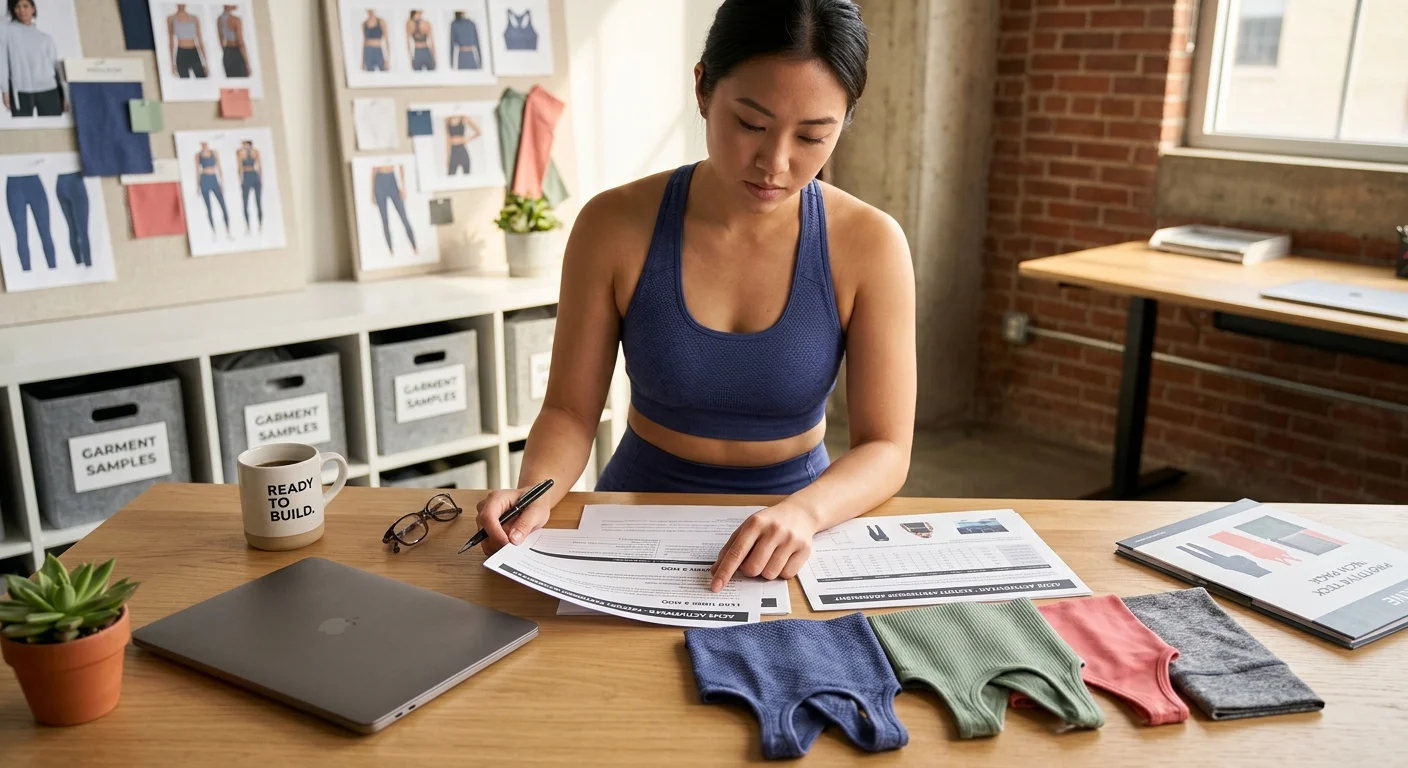
Most factories in China are excellent at making activewear. But they're built to make one piece at a time — and a matching set is a completely different manufacturing challenge.
A sports bra and leggings produced as separate SKUs travel through separate processes. Different fabric lots. Different dye runs. Different grading blocks. Sometimes different buildings. Each piece can pass its own quality inspection and still fall apart as a set once worn together.
Here's where the real friction points live:
Color Consistency Is a Chemistry Problem, Not Just a Visual One
Knit performance fabrics — nylon/spandex, polyester/spandex — show a ΔE color variance of 0.5–1.5 even within the same dye lot. Across separate dye runs, >2.0 ΔE is common. That's not a vendor error. That's physics.
A set-optimized activewear manufacturer controls this by assigning one greige lot and one dye lot per color per set . Tops and bottoms are then cut from the same dyed roll. Factories that skip this step split orders to cut dye batch costs. The result? Leggings that read half a tone darker under store LED lighting. Brands tracking this problem report 10–25% higher return rates on mismatched sets versus separates.
Grading a Set Requires One Unified Body Logic
Sports bras are graded on bust, underbust, and strap tension. Leggings are graded on waist, hip, rise, and inseam. In single-item factories, different pattern teams handle each piece. They work from different base blocks — sometimes built for different fit model heights.
The result: a size M bra and size M legging can both pass fit approval but feel off on the same body. Waistbands hit above the navel. Bra straps dig while the hip has ease. Set-focused activewear manufacturers solve this by grading both pieces against a shared measurement table . They run multi-piece fit trials across at least XS, M, and XL at the same time — treating the two pieces as one product, not two.
Fabric Specs Must Be Coordinated, Not Just Comparable
A "high support bra" and a "buttery soft legging" in matching Midnight Navy sounds like a solid product lineup. In practice, it's a customer complaint waiting to happen.
Parameter | Sports Bra Typical Spec | Legging Risk Zone |
|---|---|---|
Fabric weight | 250–320 gsm | Drops to 190–210 gsm in cost-optimized sourcing |
Spandex content | 20–25% | 12–15% in lower-tier options |
Opacity at stretch | Opaque | Can become see-through at 90%+ elongation |
Strong fitness apparel manufacturing China partners build tops and bottoms from the same base fabric family — same yarn system, same knit construction. They adjust gsm by ±10–15 through knit density, not by switching yarn recipes. Opacity gets tested at use-level stretch on the largest size in the run, not on a flat fabric swatch. That's the standard that actually catches problems before production.
Custom activewear sets manufacturing demands synchronized control across dyeing, grading, and fabric specification. Factories that haven't restructured around set-level coordination will always produce individual pieces — never true pairs.
China's Key Activewear Production Hubs by Set Type
Three industrial belts dominate China's custom activewear sets landscape. They don't compete with each other — they serve different brands at different stages. Pick the wrong hub and you don't just lose money. You lose months.
Here's how each cluster breaks down for sports bra and leggings set production.
Zhejiang (Yiwu): Speed, Print, and Low Entry Points
Yiwu holds about 70% of China's seamless clothing capacity . But for set buyers, its real strength is sublimation. Your activewear sets run on graphic identity — color-blocked panels, gradient prints, team roster customization? Zhejiang factories are built for that.
Best set types: Sublimation cut-and-sew sets, fashion-seamless bra and legging pairs, printed yoga sets
Commercial benchmarks:
- MOQ: 100–300 sets per colorway; drops to 50–150 with stock fabric
- Sample lead time: Physical sublimation samples in 7–15 days
- Bulk production: 15–25 days post-PP approval for orders under 2,000 sets
The trade-off is real. Fabric consistency between batches is weaker here than in Fujian or premium Guangdong lines. GSM tolerance drifts. You're building a performance-first brand where compression grade and opacity must be consistent? This hub will frustrate you. Zhejiang works best for brands where visuals lead and technical specs follow.
Best fit: New DTC brands testing drops, buyers sourcing activewear sets wholesale China with tight budgets and frequent design changes.
Guangdong (Guangzhou/Foshan): Technical Performance, Seamless Mastery
This is where seamless activewear sets factory capability lives at real scale. Guangdong factories run Santoni-type circular knitting machines. These machines handle body-mapped, compression-zoned, tubular seamless construction. They also maintain in-house dye labs. That's the critical differentiator for matching workout sets custom production. Color lot control decides whether your set ships as a matched pair — or a return liability.
Factories like Hucai Sportswear focus on second-skin seamless knitting. Guangzhou Ingor runs GRS-certified fabric chains for sustainable lines. These are specialist operations, not generalist ones.
Best set types: Seamless compression sets, high-waist legging and longline bra pairings, body-mapped yoga sets
Commercial benchmarks:
- MOQ: 500–1,000 sets per color; boutique lines from 200–300 at higher unit cost
- Sample lead time: 20–30 days — knitting programming and dye testing run in sequence, not parallel, so it takes longer
- Bulk production: 25–35 days standard; 40+ days for jacquard or multi-color programs
The trade-off: FOB prices run higher than Yiwu. The development timeline also makes fast-turnaround drop models difficult to maintain.
Best fit: Mid-tier DTC brands building gym clothing set private label collections where consistent sizing, pilling resistance, and seam integrity drive repeat purchases.
Fujian (Jinjiang/Quanzhou): Volume, Sustainability, and Scale Infrastructure
Jinjiang is where global sports brands go for 50,000 units and a clean audit trail. The region's factories are vertically integrated — yarn sourcing, knitting, dyeing, and finishing often under one roof or inside one industrial park. For buyers building sustainable activewear sets , Fujian leads in GRS, OEKO-TEX, and rPET-certified supply chains.
Best set types: Bulk knit training sets, woven/knit tracksuits, recycled-yarn performance sets, team travel sets
Commercial benchmarks:
- MOQ: 1,000–3,000 sets per color; aggressive pricing unlocks at 2,000+ sets
- Sample lead time: 15–25 days standard; 25–30 days for sustainability compliance programs
- Bulk production: 30–45 days; up to 60 days for multi-fabric or outerwear-inclusive sets
The trade-off: Fujian factories are built for long-running programs, not seasonal pivots. Micro-orders and fast-changing graphics don't fit their operating model. Onboarding means real compliance work — testing, audits, documentation — before your first container ships.
Best fit: Scaling brands moving into wholesale or retail channels who need performance fabric activewear China production backed by solid quality documentation.
Hub Selection at a Glance
Production Hub | Core Set Strength | MOQ Range | Bulk Lead Time | Best Brand Stage |
|---|---|---|---|---|
Zhejiang – Yiwu | Printed & fashion-seamless sets | 100–300 sets | 15–25 days | New DTC, test drops |
Guangdong – Guangzhou | Seamless compression sets | 200–1,000 sets | 25–35 days | Mid-tier DTC, premium positioning |
Fujian – Jinjiang | Bulk knit & sustainable sets | 1,000–3,000 sets | 30–45 days | Scaling brands, wholesale, retail |
Try to source seamless compression sets out of Yiwu, or run 150-unit test drops through a Jinjiang mega-factory — you'll hit a wall fast. Match your brand stage to the hub's real infrastructure, not its marketing page.
Transparent Cost Breakdown for Custom Gym Sets by Fabric & Process
Budget talks with Chinese activewear factories go wrong fast. Not because factories are dishonest — but because most brands show up without a cost framework. The factory quotes a number. You don't know what it covers. Three samples later, you're still negotiating blind.
Here's what an activewear set costs to build — broken into components you can verify.
The Three Tiers of Custom Activewear Set Pricing
Performance fabric activewear China production falls into three cost tiers. Each tier ties to a specific fabric system, construction process, and brand position:
Tier | FOB Price / Set | Fabric Specs | Key Processes | Best For |
|---|---|---|---|---|
Basic | US$8–12/set | 220–260 GSM nylon/spandex or poly/spandex, ~20% spandex | Flatlock + overlock seams, single-color piece dye, basic care label | Amazon basics, high-volume wholesale, limited colorways |
Mid-Tier | US$12–18/set | 230–280 GSM brushed interlock or poly/nylon blend | Brushed inner, double-layer panels, removable pads, silicone grippers, private label woven/heat-transfer | DTC brands, 2–3 seasonal drops, moderate customization |
High-End Seamless | US$15–22/set | 260–320 GSM seamless circular knit, ECONYL® or Repreve, 3+ color jacquard | 3D circular knitting, engineered compression zones, bonded edges, advanced wicking/anti-odor | Premium retail, sculpting sets, complex patterns |
Standard activewear MOQ China factory benchmarks: 300–800 sets per color for cut-and-sew; 600–1,200 sets per color for seamless circular knit.
Where the Money Goes
Fabric dominates the bill. For technical performance fabric activewear China production, fabric and yarn eat up 45–55% of your FOB unit cost — well above general apparel norms. Here's the full cost structure:
Cost Component | Share of FOB | US$10 Basic | US$16 Mid-Tier | US$20 High-End |
|---|---|---|---|---|
Fabric / Yarn | 45–55% | US$4.5–5.5 | US$7–8.5 | US$9–11 |
Cutting & Assembly (CMT labor) | 20–25% | US$2–2.5 | US$3–4 | US$4–5 |
Dyeing / Printing / Finishing | 10–15% | US$1–1.5 | US$1.5–2.5 | US$2–3 |
Trims & Packaging | 5–8% | US$0.5–0.8 | US$0.8–1.3 | US$1–1.6 |
QC, Factory Margin & Admin | ~10% | ~US$1 | ~US$1.6 | ~US$2 |
On a US$16 mid-tier gym clothing set private label , the factory margin lands at US$1–1.5 after QC and overhead. That's far from the 40% markup brands often assume.
What Drives Costs Up (And By How Much)
These are the specific levers that shift your unit price — each with a real number attached:
Fabric Upgrades
- Standard stretch performance fabric runs US$6–10/m . Switch to ECONYL® or technical recycled nylon ( US$15–25/m ) and you add +US$3–5 per set , based on a yield of 1.4–1.8m per cut-and-sew set.
- Moving from 220 GSM to 260–300 GSM compression fabric adds +US$0.5–1.2 per set .
Construction Complexity
- Upgrading from flatlock cut-and-sew to seamless jacquard circular knit carries a machine programming surcharge of +US$0.8–1.5 per set at 1,000–2,000 unit MOQs.
Color & Print Decisions
- All-over sublimation vs. solid piece dye: +US$1–1.8 per set .
- Split a 300-unit MOQ across 3 colorways (100 sets each) and dye-lot inefficiency adds +US$0.3–0.8 per set .
- High-stretch silicone heat-transfer logo: US$0.25–0.45 per placement .
Functional Finishes
- Moisture-wicking + antibacterial treatment package: +US$0.25–0.60 per set .
- Mechanical peach-skin brushed inner: +US$0.4–0.9 per set .
Trims & Branding: The Hidden Line Items
Most brands underestimate this bucket. For yoga sets OEM supplier production, a realistic trims and packaging allowance runs US$0.8–1.6 per set , broken down like this:
Removable bra cups: US$0.30–0.60/pair
Custom jacquard logo elastic waistband: US$0.20–0.45
Cotton/poly gusset liner: US$0.10–0.25
Silicone gripper on waistband or hem: US$0.25–0.50
Woven main label + care label: US$0.05–0.13
Private label hangtag: US$0.06–0.15
Printed poly bag (logo): US$0.05–0.12 ; recycled/compostable version: US$0.15–0.35
Mid-tier sets with full branding — pads, gusset, two logo placements, and branded packaging — land at US$0.8–1.3 in this category alone.
One Hidden Charge Worth Flagging
Pantone color-matching lab dips run US$30–80 flat per color at most custom activewear sets manufacturers . Spread across 1,000 units, that's US$0.03–0.10 per set extra — small at scale, but it stacks up fast across four colorways at 200 units each. Know this charge exists. Get it listed as a line item before you sign off on the tech pack.
End-to-End Sourcing Workflow: From Tech Pack to Bulk Delivery
Get it right, and the full journey from tech pack submission to cargo-ready bulk delivery takes 45–60 days . Get it wrong — vague approvals, skipped gates, a payment structure that hands away your leverage too soon — and you're looking at 90 days. You end up with a container you're not sure you want to open.
Here's the exact sequence, with the decision points that matter most.
Phase 1: RFQ to Factory Lock-In (Day 1–7)
Submit your tech pack on Day 1. A complete package includes graded size specs, stitch types, GSM targets, fabric composition (e.g., 73% polyester / 27% spandex, 250–280 GSM), print files, colorways, and branding trims. Factories with real custom activewear sets capability will quote back within 24–72 hours — not a week.
Before sharing detailed CADs or print files, get an NDA signed. Two to three pages covering patterns, logos, and digital files is standard for gym clothing set private label buyers. Don't skip this step just because you want to move fast on sampling.
Fabric sourcing confirmation runs in parallel on Days 2–4. For nylon/spandex or poly/spandex performance materials:
Lab dip MOQ: 50–100m per color for custom-dyed standard base
Bulk MOQ: 500–1,000m per color , giving you 200–500 sets per color depending on cut efficiency
Greige in stock: ready in 0–3 days ; custom knitting or specialty yarns: 7–15 days before dyeing begins
Decision Gate 1 — where brands lose leverage fastest: Don't approve your target FOB and MOQ before locking tolerance ranges on key POMs (waist stretched, inseam, front rise). Don't approve before you receive fabric composition test reports either. Fix this by building a costing sheet with clear change triggers — any fabric GSM shift over 10% requires a full re-costing.
Phase 2: Sampling and Fit Approval (Day 8–25)
Proto Sample #1 arrives around Day 12 via air courier — 3–5 days of factory sewing time plus 2–4 days shipping. Most brands need 2–5 days to run measurements, fit on a model, and issue a structured comment sheet.
Focus your fit review on three things:
Waistband tension and elastic recovery under compression vs. comfort wear
Squat-proof opacity tested on the largest size in the run, under LED lighting
Crotch and seat seam placement — the two most-returned construction details in leggings
Color lab dips (3–5 days per color submission) and sublimation strike-offs (2–4 days) run in parallel with the fit review. Start both at the same time. Don't wait on one before kicking off the other.
Decision Gate 2 — the delay multiplier: Every extra proto round adds +7–10 days to your critical path. Cap this in the contract at two rounds. A second failure on the same issue? Your contract should spell out either PO cancellation rights or a US$0.05–0.10 per piece FOB penalty on the final balance.
The Pre-Production Sample (PPS) is completed around Day 25. It's built from bulk fabric, bulk trims, and the finalized production pattern. Your PPS approval email must call out the pattern version, fabric batch number, and trim version by name. That document becomes your quality baseline for every bulk inspection that follows.
Phase 3: Bulk Production and In-Line QC (Day 28–42)
No cutting starts before written PPS sign-off. Build that clause into the contract before placing the order. Factories will push to start cutting to "save time." That shortcut causes color lot problems and measurement drift — more often than you'd expect.
Once cutting gets authorized, the sequence runs like this:
Fabric relaxation: 24 hours minimum for knit performance fabrics before spreading — non-negotiable for shrinkage control
Cutting window: 1–2 days for 1,000–3,000 sets
Sewing and in-line QC: 5–7 days; line output runs 600–1,200 pieces per line per day depending on construction complexity
In-line inspectors need to check every bundle for seam strength (4-point stretch), stitch density (10–12 SPI for overlock seams), and color shading between top and bottom panels. In custom activewear sets manufacturer production, panel color shading is the failure point most factory QC teams miss or underweight. Flag it directly.
Three inspection checkpoints are standard:
Checkpoint | Timing | What Gets Checked |
|---|---|---|
Pre-production | Before cutting | Fabric, trims, PPS vs. tech pack |
DUPRO | 20–40% sewn | Stitching, measurements, color consistency |
Pre-shipment | 80–100% packed | AQL 2.5 final random inspection |
First-time activewear MOQ China factory buyers should run both DUPRO and pre-shipment through a third-party inspector — Intertek, SGS, or QIMA. That costs US$250–350 per man-day . It pays for itself the first time it catches a rework before the goods ship.
Phase 4: Final Inspection, Packaging, and Shipment (Day 42–60)
Final inspection follows AQL 2.5 for major defects, AQL 4.0 for minor . For a lot of 1,200 pieces, you're sampling 80 units — reject the lot if more than 5 carry major defects. Plan for one day on-site plus one day for the formal report.
Packaging specs to nail down in advance:
Inner polybag: 30–40 microns with warning text and size sticker; recycled/biodegradable options add US$0.02–0.05 per piece
Export cartons: 5-ply, packing 40–60 sets per carton depending on size mix
Outer marks must include style, color, size range, carton number, country of origin, and PO reference
Book your cargo ready date 7–10 days before the vessel sailing to hold space during peak season. Transit benchmarks:
China → US West Coast (sea): 14–18 days port-to-port
China → EU Hamburg/Rotterdam (sea): 25–35 days
Air freight: 3–7 days airport-to-airport at US$5–8 per kg — best kept for urgent drops or late-season replenishment
Payment Structure That Protects Your First Order
Standard 30/70 T/T (30% deposit, 70% against copy documents) is common — but it hands over most of your financial leverage before any independent inspection has run. For first-time fitness apparel manufacturing China partnerships, a stronger structure looks like this:
30/30/40 T/T with quality triggers:
30% on PO confirmation plus PPS approval
30% after DUPRO passes — or when 50–60% of finished goods clear in-line inspection
40% after pre-shipment inspection passes AQL 2.5, released before Bill of Lading
That final 40% is your real leverage once goods are made. Tie it to independent inspection results — not just factory sign-off. That's what keeps production standards from slipping on the back half of the run.
Set remediation terms upfront: measurement tolerance of ±1 cm on critical POMs, with defined remedy options — rework, FOB discount ( 2–5% for minor issues ), or full remake rights for systemic failures.
Full Workflow at a Glance
Stage | Key Approval | Timeline | Red Flag |
|---|---|---|---|
Tech pack + RFQ | NDAs signed | Day 1–2 | Quote issued without full tech pack |
Fabric + trims locked | Spec + test methods confirmed | Day 2–4 | No lab test reports or lot traceability |
Proto #1 | Fit + color lab dips reviewed | Day 12–15 | Factory requests deposit before proto approval |
PPS approval | Written sign-off with batch # | Day 25–27 | Factory starts cutting before written approval |
DUPRO inspection | 3rd-party pass required | Day 33–36 | Internal QC only offered, no external access |
Pre-shipment inspection | AQL 2.5 pass | Day 42–44 | Inspection report delayed until payment cleared |
Cargo ready + booking | BL issued post-payment confirmation | Day 45–60 | Sailing booked before inspection report finalized |
The 5-Dimension Factory Scoring Card for Private Label Activewear Sets
Gut instinct built on a factory tour and a polished showroom will get you burned. A reliable custom activewear sets manufacturer in China isn't defined by location, website design, or WhatsApp response time. It comes down to five measurable capabilities. Most brands never think to ask about these — until after the first failed shipment.
Score every factory against these five dimensions. Do this before you commit to a single sample payment.
The Scoring Framework
Score each dimension 1–5 using hard, observable evidence — not promises. Use the weights below to calculate a total. Any factory that can't clear 4.0 weighted shouldn't be cutting your fabric.
Dimension | Weight | Pass Threshold | Instant Disqualifier |
|---|---|---|---|
1. Set Color-Matching Capability | 25% | ≥ 4 | No in-house color lab; can't show ΔE records for past matching workout sets custom orders |
2. Fabric Library Depth & Data | 25% | ≥ 3.5 | Only 5–10 generic market fabrics with zero lab data |
3. MOQ Flexibility | 20% | ≥ 4 (pre-launch brands) | Requires ≥ 3,000 sets/color with no pilot option |
4. Sampling Speed & Development Process | 15% | ≥ 4 (fast-launch brands) | Quoted lead time > 35–40 days; paper patterns only |
5. QC System Rigor | 15% | ≥ 4 (mid–high positioning) | No written QC procedure; no wash or fatigue testing records |
What a Score of 5 Looks Like
Color-Matching (25%): The factory runs an in-house spectrophotometer with a written SOP. Lab dips are standard practice. Post-wash ΔE between bra and legging stays ≤ 3. Every roll gets tracked by dye lot and PO. You can ask for color test reports from at least three recent yoga sets OEM orders — and get them on the spot, not "later."
Fabric Library (25%): You'll find 50+ activewear-specific knits on hand. Each one comes with a full spec sheet covering GSM, stretch and recovery in both directions, Martindale pilling rating, and colorfastness to sweat. At least ten fabrics carry GRS or rPET certification. Factories that supply Alo-tier performance fabric activewear China programs keep this level of depth as a standard — not a special request.
MOQ Flexibility (20%): Standard runs sit at 300–500 sets per color. Pilot orders are accepted at 150–200 sets per color with a modest surcharge. Fabric pooling across multiple styles in one dye lot is treated as normal — not an exception they need convincing to offer.
Sampling Speed (15%): Prototype turnaround takes 7–10 days from your tech pack. The factory uses a digital pattern system — Gerber, Lectra, or equivalent — with style codes saved and easy to pull up. Video fit sessions are available within 24 hours of sample completion. Serious activewear MOQ China factory partners serving DTC brands offer this as a baseline.
QC System (15%): There's a written SOP covering AQL 2.5 for both in-line and final inspection. Specific checkpoints cover set-level shade matching under D65 and TL84 light sources. Records go back at least two years per style and batch.
How to Run the Calculation
Score each dimension 1–5. Multiply each score by its weight. Add up the results:
(Color × 0.25) + (Fabric × 0.25) + (MOQ × 0.20) + (Sampling × 0.15) + (QC × 0.15)
Real example:
Factory | Color | Fabric | MOQ | Sampling | QC | Weighted Total |
|---|---|---|---|---|---|---|
Mid-size custom activewear sets manufacturer | 4 | 4 | 5 | 4 | 4 | 4.25 — proceed |
Large-volume gymwear exporter | 2 | 3 | 1 | 3 | 3 | 2.35 — disqualify |
Factory B scores just high enough on individual dimensions to look credible on a sourcing call. Run the weighted math and the problem shows up fast. Weak color control plus a 3,000-set MOQ floor puts them out of reach for any brand running gym clothing set private label collections under 3,000 units. The numbers make that clear.
Hard disqualify on any of these — regardless of total score:
- Mismatched set samples in the showroom with no numeric color control in place
- Refusal to share inspection or test records for any reason
- MOQ > 3,000 sets per color, no pilot flexibility, no fabric pooling discussion
Pre-Bulk Verification: 7-Point Sample Risk-Control Checklist
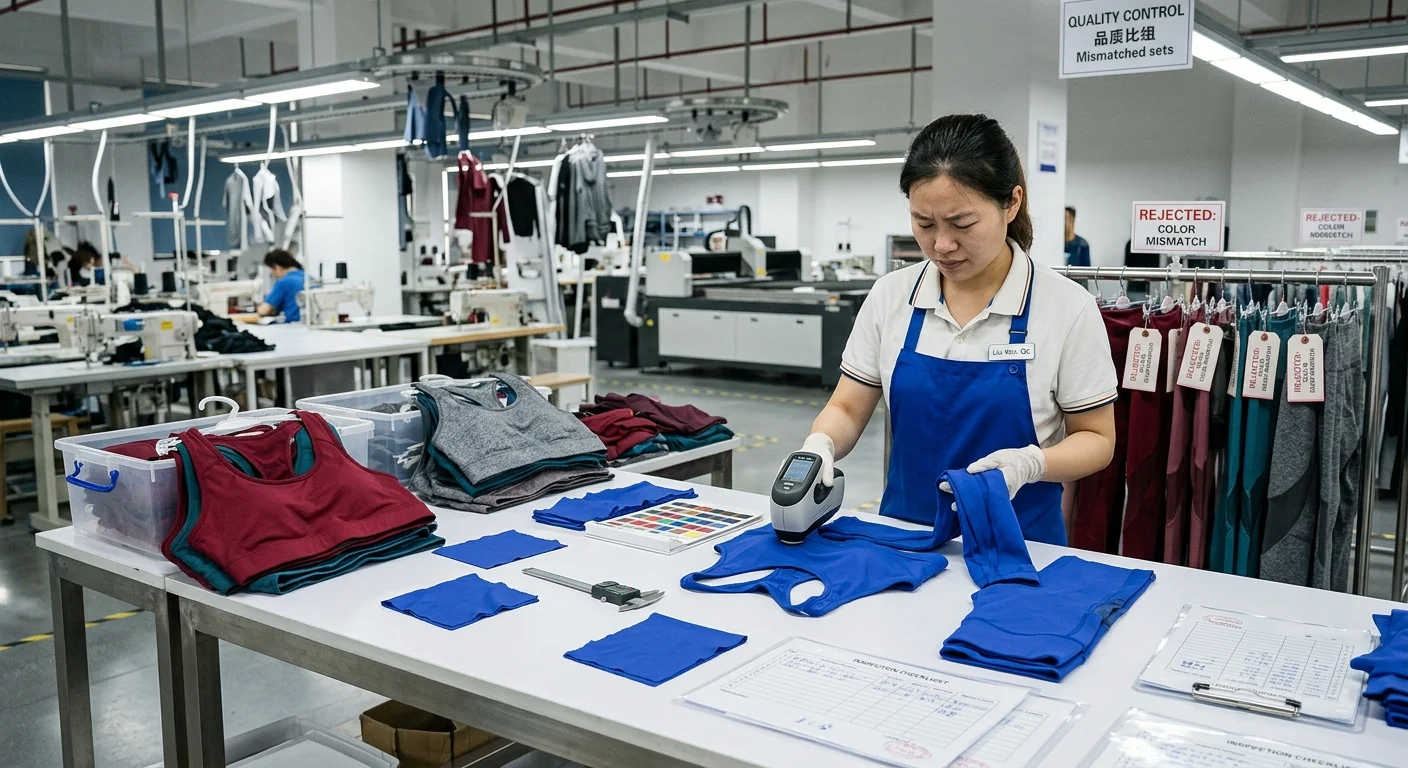
Samples lie. Not on purpose — but a sample built under controlled factory conditions, with hand-picked fabric and a senior machinist, is not the same product your customer will wear six months from now. Stress-test the sample before it becomes 1,200 units in a container. That's the only way to close that gap.
These seven checkpoints are the standard. Run all of them. Every one.
The 7-Point Checklist
# | Checkpoint | Test Method | Pass Standard | Red Flag | Required Action |
|---|---|---|---|---|---|
1 | Delta E Color Deviation | Cut swatches from the bra and leggings from the same set lot. Measure under D65 daylight, TL84 fluorescent, and LED 4000–5000K using a spectrophotometer. Compare against the approved PP sample. | ΔE ≤ 3.0 between top and bottom across all three light sources. No visible tint shift at 60–70 cm side-by-side. Watch black, red, burgundy, and forest green closely — these are the highest-drift tones in activewear sets production. | ΔE > 3.0 in any light source. Metamerism: looks fine under daylight but shows a clear shift under LED (top reads cooler; bottom reads warmer). | Lock one dyehouse and one recipe per color for all set components. Move all parts into the same bulk dye batch. For high-risk shades, require a pilot bulk of ≥100m and a full shade band review before mass cutting. |
2 | Post-Wash Shrinkage Consistency | Mark reference points on both pieces: chest, waist, hip, inseam. Machine wash 3× at 30°C, gentle cycle, line dry. Measure before and after. | ≤5% absolute shrinkage at each critical dimension. Top-vs-bottom differential ≤3% at paired points (waistband vs waist, hip vs hip). Seams stay straight. Hems don't flare. | Any dimension shrinks or grows >7%. Differential between top and legging >5% — e.g., legging inseam at −6% while bra length sits at −1%. Side seams twist after three washes. | Reject the fabric if repeat tests still exceed 7%. Require a compacted or pre-shrunk lot. For matching workout sets custom production, demand the same mill and same finishing line across all set components. |
3 | Waistband & Strap Elastic Recovery | Mark a 10 cm gauge on the legging waist, bra underband, and shoulder straps. Stretch to 130% of original length and release — 5 full cycles, 10 seconds per cycle. Measure final length. | Final length ≤111% of original (≥90% recovery). No waistband rolling or strap buckling. No audible cracking under stretch. | Final length >112% (recovery <90%). Waistband waves or collapses after 5 cycles. Strap holds its stretched shape. | Increase elastic width or raise spandex content (e.g., 8% → 12–15%). For women activewear sets wholesale production, write the minimum elastic spec into the tech pack: width, GSM, spandex %, and the required lab recovery report. |
4 | Stitch Tension & Seam Slippage | Inspect flatlock and overlock seams at the inner leg, gusset, side seams, straps, and underband. Run a 1.5m manual thread pull. Try to separate panels at high stretch. Check needle size against fabric weight. | No puckering under light tension. No thread breakage under a firm hand pull. Gusset seams hold at full squat and hip flexion. | Laddering appears on a light overlock stretch. Elongated needle holes on dense knits. Flatlock floats open at the crotch or inner thigh. | Fix the needle spec — ballpoint 75/11 for 250–280 GSM nylon-spandex is the baseline. Run a seam strength test on bulk PP: minimum 70–100N at the legging crotch seam before shipment sign-off. |
5 | Opacity & Stretch Parity | Fit on a live model under directional store lighting. Film a full squat, lunge, and bend in 4K. Hand-stretch both pieces to 120% width and compare resistance. | Zero visible skin or underwear at the hip, glute, and knee at the intended size. Stretch feel within one tension grade across top and bottom — no stiff bra paired with an over-soft legging. Fabric GSM balanced: bra 260–300 GSM, legging 230–260 GSM, same base yarn. | Legging goes sheer at the glute during a squat on target size. Top and bottom feel like different products under stretch. Mélange or marl colors thin out at full stretch next to a solid bra. | For pale or high-risk colors, require a lab opacity test at 30% extension before bulk approval. Align yarn count and knit structure across both pieces. Don't pair a heavy scuba bra construction with ultralight legging fabric unless that's a deliberate product decision. |
6 | Hardware & Trims Durability | Tensile pull on hooks, rings, and adjusters to 15–20N. Rub the silicone gripper 50× with firm pressure, then simulate 50 wash cycles. Salt-sweat test: 24 hours in 5% saline spray, then dry. | Hook and ring holds >15N without deformation. No rust, discoloration, or flaking after sweat exposure. Silicone strip keeps ≥90% coverage with no edge peeling after 5 real washes. | Hooks bend under pull. Coating chips on sliders. Metal stains green or black after the sweat test. Silicone rolls, breaks, or leaves residue. | Switch to nickel-free, rust-proof alloy or nylon hardware across all sports bra and leggings set production. Put the minimum plating standard on the trim card. Get a wash test report from your silicone supplier. Reject if peel strength falls below 2N/cm. |
7 | Size Grading Accuracy (Set Cohesion) | Measure the PP sample in all graded sizes against the approved spec: bust, underbust, waist, high hip, low hip, thigh, inseam, front rise, back rise, strap length. Compare bra band to legging waist progression across each size. Fit at least two adjacent sizes on a model that matches your target customer. | All key points within ±0.5 cm of spec on the top sample size; ±0.7 cm on smallest and largest. Band-to-waist progression stays consistent — e.g., +2 cm per size on underbust should track to +2–3 cm on legging waist. The bra fits true. The legging in the same size fits true on the same body. | Any key point drifts >1 cm from spec. Legging graded wide while the bra grades tight — customers end up mixing sizes. More than 30% of fit testers report "bra fits, legging doesn't" in the same declared size. | Force a full size run re-cut before bulk if any point exceeds 1 cm drift. Put it in the PO in plain language: "Set-top and set-bottom must fit the same size customer. No grading changes without written approval." |
Three-Gate Verification Structure
Don't run all seven checkpoints at once and hope for the best. Split them across three decision gates. Each gate is a hard stop before the next phase starts.
Gate 1 — Lab/Office (Before Fabric Bulk Confirmation)
Resolve color (ΔE), fabric GSM and composition, shade continuity, shrinkage, and elastic recovery here. Not a single meter of bulk fabric gets booked for your custom activewear sets order until these pass.
Gate 2 — PP Sample / Fit Session
Validate stitch tension, opacity, squat test, and grading accuracy on a real fit model. Run trim pull tests and wash tests again here. Don't carry assumptions over from Gate 1.
Gate 3 — Pre-Bulk TOP Size Run
Re-check checkpoints 1, 2, 5, and 7 on TOP samples across all sizes. Any failure triggers a stop-cut instruction — no matter how good the set looks on a hanger or in a flat lay photo. "Looks good" is not a pass standard. Numbers are.
A factory that pushes back on any of these gates — citing time pressure, cost, or trust in their own QC — is telling you something important. Believe them.
Choosing Your Production Partner: Large OEM vs. Specialized Mid-Size vs. Agile Small-Batch
Three factory types dominate China's custom activewear sets supply chain. Each one is good — just not for every brand, every stage, or every order volume. Picking the wrong one isn't bad luck. It's a mismatch: a startup's cash cycle forced into a mega-factory's model, or a scaling brand's hero SKU handed to a workshop that hits capacity in November.
Here's how the three types differ where it counts.
The Three-Type Breakdown
Large OEM (3,000–10,000+ sets per color)
These factories run on certainty. Fixed sewing lines, ISO-audited QA systems, documented AQL protocols — the infrastructure is solid. The tradeoff is rigidity. Tech pack changes mid-cycle get pushed to "next season." Non-standard fabrics or experimental paneling? You'll face pushback unless your volume justifies the change. At 5,000+ units per style, unit costs run 20–40% lower than mid-size. The cash commitment is steep, though: 3,000 units at $15 landed = $45,000 locked per colorway before a single piece sells. Direct access to the pattern room or line supervisors is rare. Most communication routes through an account manager.
Best for: Brands with stable hero SKUs, low forecast error, and annual volume above 30,000 units per style. Use this tier once your size curve and fit are locked — not before.
Specialized Mid-Size Sets Factory (500–1,500 sets per color)
Most serious gym clothing set private label brands belong here during their growth phase. These factories focus on activewear sets — dedicated sewing sequences for top-and-bottom coordination, in-house wear testing, direct access to QA leads and production managers. A stitch-popping issue on size L+? A mid-size specialist adjusts needle spec, thread weight, and bar-tack points within one production cycle. A large OEM routes the same problem through three departments.
Pricing runs 10–25% cheaper than small-batch . Sampling turnaround is 15–30 days , with bulk delivery in 35–60 days . Cash exposure per colorway sits at $8,500–$19,000 — far more manageable for DTC cash cycles than a large OEM commitment.
Best for: Brands running 2–10 core sets, 3–6 drops per year, with steady sell-through building toward scale. Make this your primary custom activewear sets manufacturer in China once repeat orders start coming in.
Small Flexible / Agile Supply Chain (100–300 sets per color)
This tier runs less like a factory and more like a network — pattern room, sampling workshop, and two or three small sewing units sharing capacity. Prototype turnaround hits 7–14 days . Three to four fit iteration rounds before committing to 200–300 sets is normal. Full silhouette development from reference garments, new fabric blends, limited-edition seasonal prints — all accessible at volumes most factories won't touch.
The real tradeoffs: highest cost per set , lead times that can double during peak season without pre-booking, and QC consistency that depends on your own SOPs and measurement specs. Cash exposure per colorway runs $2,000–$7,500 — low enough to test positioning and pricing without serious inventory risk.
Best for: Early-stage brand validation, launch drops, collabs, and new fit testing. Move winning SKUs to a mid-size partner after two or three sellouts confirm repeatability.
Comparison at a Glance
Factory Type | MOQ (per color) | Sampling → Bulk | Unit Cost vs. Peers | Best Brand Stage |
|---|---|---|---|---|
Large OEM | 3,000–10,000+ | 30–60 → 60–120 days | Lowest at scale | Stable SKUs, >30k units/yr |
Mid-Size Specialist | 500–1,500 | 15–30 → 35–60 days | Mid-range | Scaling DTC, 3–6 drops/yr |
Small Agile | 100–300 | 7–14 → 14–30 days | Highest/set | Validation, launches, R&D |
The Three-Phase Progression
Brands that build lasting fitness apparel manufacturing China relationships don't stay with one factory type. They move through phases with a clear plan:
Phase 1 — Validate with a small-batch partner at 100–300 MOQs. Run three to four fit rounds across three to five colorways. Confirm a winner at 200–300 units.
Phase 2 — Scale winning styles to a specialized mid-size sports bra and leggings set manufacturer at 500–1,000 MOQs. Keep the agile partner for limited editions and collabs.
Phase 3 — Optimize stable, high-volume SKUs through a large OEM at 3,000+ units. Lock in the lowest activewear MOQ China factory pricing. Use mid-size and small-batch for the innovation pipeline — test new constructions there first, then graduate them to OEM-level production.
The factory that wins your first order shouldn't win your tenth by default. Match the partner to the phase — not the other way around.
Conclusion
Finding a custom sports wear sets manufacturer in China isn't one decision. It's a series of decisions, made one step at a time.
Brands that scale past the sample stage share one thing in common: preparation. They know their cost floor before sitting down to negotiate. They run the 7-point checklist before approving bulk orders. They match their production volume to the right factory tier — not just whoever replies to their email first.
You now have the tools to do the same:
The 5-dimension scoring card to rank factories objectively
The cost benchmarks to know if a quote is fair or a red flag
The regional production map to target the right manufacturing hub from the start
Use these as your pre-qualification filter. Don't wait until something goes wrong to pull them out.
Your next move is straightforward. Pick two to three candidate factories from China's key activewear hubs. Send a structured RFQ with your full tech pack attached. Request matched-set samples with Delta E color tolerance specs stated in writing.
That's it. Three steps.
The brands that win in activewear don't stumble onto better factories. They show up with better questions from day one — and that's exactly what you're now set up to do.