Ordering too little leaves you scrambling to restock mid-launch. Ordering too much ties up capital in boxes of leggings collecting dust in your garage.
For new yoga brands, nailing your custom yoga wear MOQ is one of the most critical decisions you'll make before a single garment gets sewn. Most founders get it wrong because nobody gave them a straight answer. The activewear industry has real numbers, real trade-offs, and real negotiation room — but most manufacturers won't share that upfront.
Here's what this guide covers:
What MOQ looks like across different production tiers
How to structure your first run without overcommitting
How to talk to a yoga clothing supplier and land a number that works for your budget
No guesswork. Just the practical breakdown you need to move forward with confidence.
How Many Pieces Should a New Yoga Brand Order for Their First Run?
The honest answer depends on one thing most yoga wear suppliers won't ask you: what stage of business are you in?
There's no universal "right number." But there is a right number for you — based on your budget, how validated your product is, and how much inventory risk you can handle if the first run doesn't sell as planned.
Here's a practical framework broken down by founder type.
The Three Founder Types (And Their Starting Numbers)
Type 1: The Lean Tester — 50 to 100 pieces per style
You're running a side project, a studio-based brand, or a passion project with a tight budget. Your goal isn't to flood the market — it's to find out if your product has legs .
At this level, a typical first run looks like:
- 2 styles × 60 pieces each = 120 pieces total
- Landed cost at around £12/piece = ~£1,440 in inventory
That's a number you can absorb if things go sideways. The trade-off? Unit costs run 20–50% higher than bulk production. A functional yoga legging that costs $7–9/piece at 300+ units can jump to $9–13/piece at the 50–100 unit level . Your margins shrink. Your retail price needs to go up — or you accept a thinner cut.
This approach makes sense only with a pre-sell strategy . Lock in 20–30 confirmed orders before you place the production run. That alone turns a 50-piece gamble into a 50-piece order with 40–60% already spoken for.
Type 2: The Balanced Launcher — 100 to 150 pieces per style, 300–600 total
You've done the research. You have a clear customer in mind. Now you want a real product line — not just a test.
A workable setup at this tier:
- Leggings (2 colorways × 80 pieces) = 160 pieces
- Sports bra (2 colorways × 60 pieces) = 120 pieces
- Tank top (1 colorway × 80 pieces) = 80 pieces
- Total: 360 pieces | Est. value: ~£4,320
Most mid-sized activewear manufacturers work comfortably at this range. The standard MOQ you'll see is 80–100 pieces per style per colorway, mixed sizing . So you get real flexibility in how you split your size run within that total.
On size splits: don't overthink it. Put at least 60% of your units in M and L . Keep XS and XL combined under 25% of total. That ratio matches how most yoga apparel brands sell in practice.
Type 3: The Growth Brand — 300+ pieces per style, 1,000–3,000 total
You have distribution lined up. A gym partnership, a KOL pre-launch, a yoga clothing wholesale account. You need volume to justify the unit economics and you can move through inventory within 3–6 months.
Larger OEM factories require 200–300 pieces minimum per style per colorway , with a blanket order floor of 1,000–2,000 pieces across the whole run . At that scale, your cost per unit drops noticeably. You also get room to build real margin into your pricing.
Don't jump here on your first run unless the demand signal is already there. Warehouse rent and tied-up capital are not abstract risks — they're real constraints that have killed otherwise solid brands.
Keep Your SKU Count Simple
No matter which tier you're in, start with 1–3 core styles maximum .
The first-run combination that works:
- 1 high-waist core legging (your flagship, highest reorder potential)
- 1 medium-support sports bra (complements the legging, enables set pricing)
- Optional: 1 cropped top or tank if budget allows
On colorways: black does the heavy lifting. Industry data shows basic colors — black and navy — drive 50–70% of activewear sales volume. Add one secondary color (slate grey, burgundy, or a muted Morandi tone) as a complement. Save the trendy colors for after you know what your customer buys.
The Real Cost of Going Too Small
Fifty-piece minimums are real. Factories in China, Vietnam, and Europe do offer them — particularly if you use their existing patterns and fabrics. But the costs aren't just financial.
Three things happen at low MOQ that most guides don't mention:
Lead times get unpredictable. Small orders get treated as fill-in work between large runs. A normal 30–45 day production window can stretch to 45–60 days — right when you need the stock for a launch event.
Quality variance goes up. Factories don't invest in multi-round process checks for a 50-piece run. The gap between your sample and your production batch is wider at low volumes.
Unit economics make retail pricing harder. Say your landed cost is £13/piece and you need a 60–65% gross margin to build a sustainable brand. Your retail price has to reflect that — even if the market expects a lower number.
The smarter move many early-stage brands use: two small batches of 50–80 pieces , run in sequence. Batch one validates fit, fabric, and sizing. Batch two uses that feedback and scales up a bit. Yes, it costs more per unit than going straight to 300. But it cuts the risk of ending up with 300 pieces of the wrong product — and that risk is very real.
5 Practical Strategies to Negotiate a Lower MOQ With Your Yoga Wear Manufacturer
Most brands walk into supplier negotiations and lead with the wrong question. They ask: "Can you lower your MOQ?" The factory says no. Done.
The real problem? You're asking the factory to absorb all the risk with nothing in return. Negotiation moves forward only when you give the factory a reason to say yes. Here's how you do that.
Strategy 1: Switch to Stock Fabric and Basic Colors
Fabric MOQ is often the hidden wall behind your finished goods MOQ. Factories that quote 300–500 pieces per style on custom yoga clothing fabric will drop to 80–150 pieces once you remove that constraint.
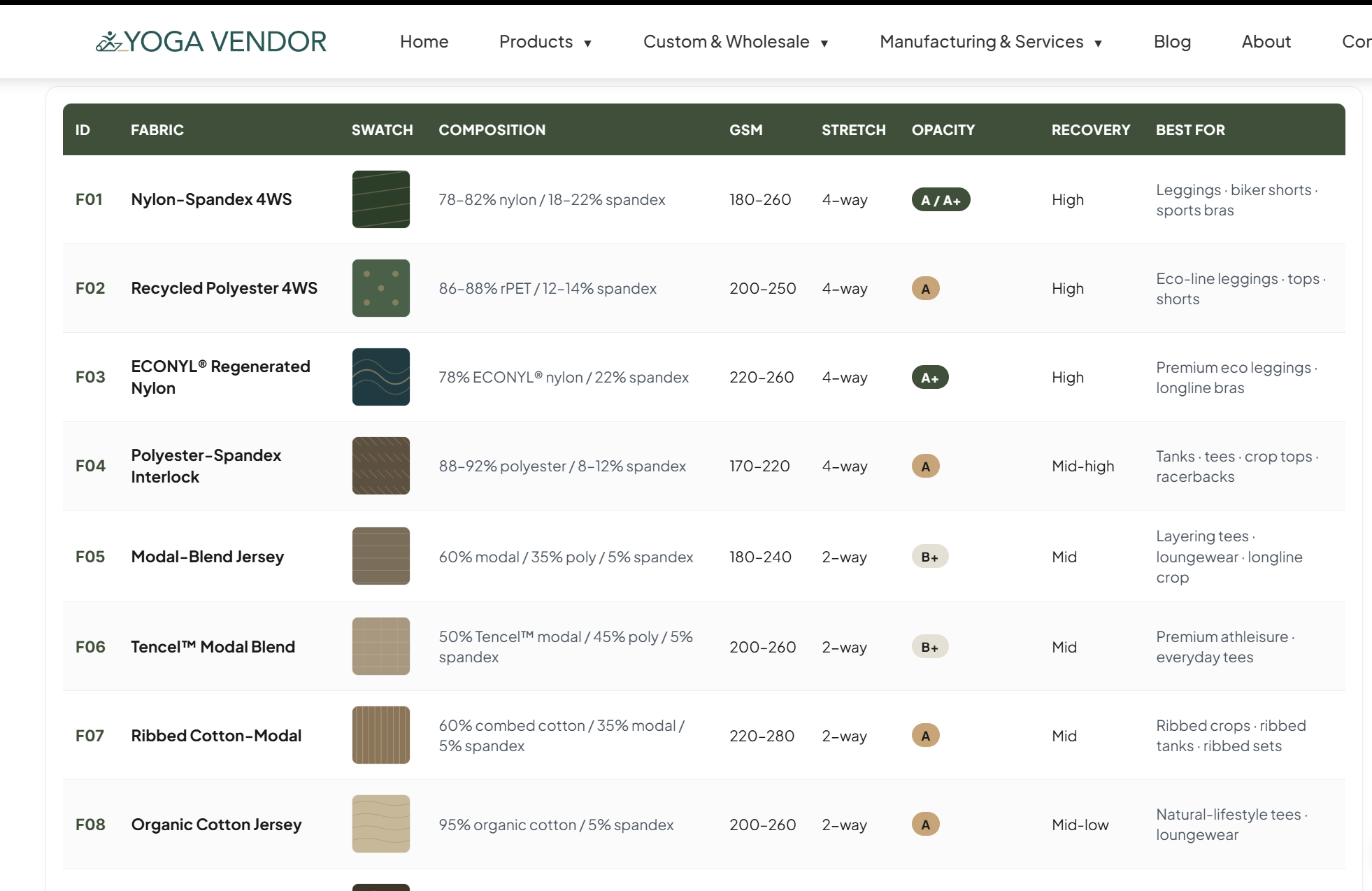
Here's the lever: ask if they carry stock fabric in standard activewear weights. Look for 220–260gsm nylon-spandex — the go-to material for yoga leggings . Stick to their in-house black, charcoal, or navy, and you've cut out the biggest cost risk on their side.
The script that works:
"If I use your stock fabric and stick to black and grey, what does your MOQ look like on a basic high-waist legging?"
You're not asking for a favor. You're restructuring the deal so their exposure shrinks. Most factories respond well to that.
Strategy 2: Consolidate Your Total Volume Across Styles
Here's a structure most new brands miss: total order MOQ vs. per-style MOQ .
Many factories care about total production output — not whether that volume sits in one style or four. A factory with a 400-piece minimum might accept:
4 styles × 100 pieces each
Or 2 styles × 2 colorways × 100 pieces each
There's one key condition: all styles need to share the same fabric and core construction. Your legging, biker short, and sports bra all run on the same nylon-spandex base with the same waistband technique? The factory treats it as one production batch. That's the logic you're working with.
Ask straight out: "Is your MOQ per style, per color, or total order quantity? My total hits 400 pieces — can I split that across four styles?"
Strategy 3: Trade a Higher Unit Price for a Lower Quantity Floor
This sounds counterintuitive until you run the numbers. A factory quoting 300 pieces at $8/unit can still hold their margin at 100 pieces — as long as the unit price goes up to $10–11.
The move: stop pushing them down on price. Offer to pay more per piece in exchange for a smaller run.
"Your standard MOQ is 300 — I get that. If I come in at 100 pieces for this first run, what would the unit price need to be for that to work for you? I'm open to 15–20% above your standard rate."
Here's the industry reality: small-batch runs of 50–100 pieces are available from many activewear OEM factories. The unit cost runs 15–30% higher than bulk pricing. That's the real trade-off. Your retail price and margins need to absorb it — but for a first production run, this is a solid path forward.
Strategy 4: Simplify Your Design to Reduce Their Production Risk
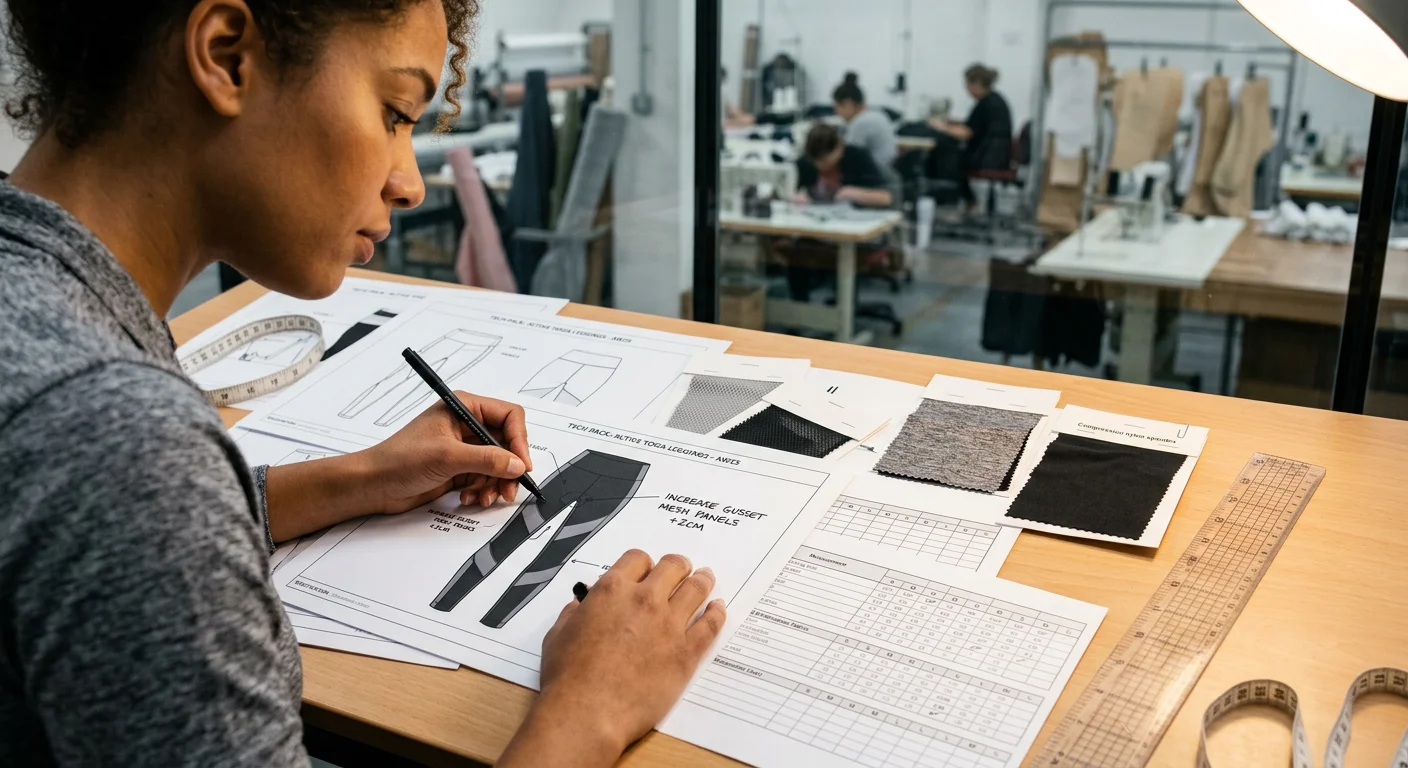
Every detail that makes your yoga wear stand out — mesh paneling, multi-piece construction, heat-bonded seams, laser perforations, custom zipper pulls of yoga wear — adds production complexity. More complexity means a higher MOQ threshold.
Factories run small quantities more on low-complexity styles. The process risk is lower, so the minimum drops. A five-panel legging with mesh inserts and reflective print? That's a 300-piece minimum. A clean high-waist legging in single-fabric construction? That's an 80-piece minimum.
Ask the factory to help you find what's driving the number up:
"On this design, which specific details are pushing the MOQ higher — is it the fabric sourcing, the mesh panels, or the print process? If I simplified those elements, where could we land on quantity — and what would the unit price adjustment look like?"
You're pulling them into the problem-solving process. Factories respond well to that. It shows you're a professional, not just a buyer trying to squeeze them.
Strategy 5: Use a Staged Order Plan as Leverage
A single 100-piece order doesn't excite most factories. A 100-piece order with a written commitment to 300 pieces in 60 days? That's a different conversation entirely.
The structure that works for early-stage yoga brands:
First order : 1–2 styles, 100–150 pieces, stock fabric, premium unit price, 30–50% deposit upfront
Second order : Same styles, scale to 300–400 pieces within 60–90 days if sell-through hits target
Third order : Expand colorways or add a new style, same fabric base
Put it in writing. A simple email with projected quantities by quarter carries real weight. Factories are businesses. Show them a growth trajectory. Add a meaningful deposit upfront. They stop seeing you as a "one-time small order" and start seeing you as an account worth building.
"We're testing the market with an initial run of 120 pieces. Our second order will be 350 pieces of the same styles, provided we hit our sales target in the first 8 weeks. We're also happy to increase our deposit to 40% to help you manage material costs on your end."
That's not a negotiation tactic. That's a business relationship offer — and it's the framing that turns a factory's "no" into a "let's figure this out."
Three Questions You Must Ask Before Finalizing Any MOQ
Before you sign off on a production agreement, get clear answers to these three:
"Is your MOQ per style, per colorway, or total order?" — This one question can restructure the entire deal in your favor.
"Can I mix sizes within the MOQ, and is there a per-size minimum?" — Most factories allow proportional size mixing (a common starting ratio: XS 10% / S 20% / M 30% / L 25% / XL 15%), but some require a minimum of 20–30 units per size cut.
"Do you offer a trial production option at a higher unit price?" — This tells you whether a small-batch run is on the table and what it costs.
The factory that answers all three without hesitation — that's the one worth working with.
Private Label Yoga Wear MOQ: Is It Lower Than Full Custom Production?
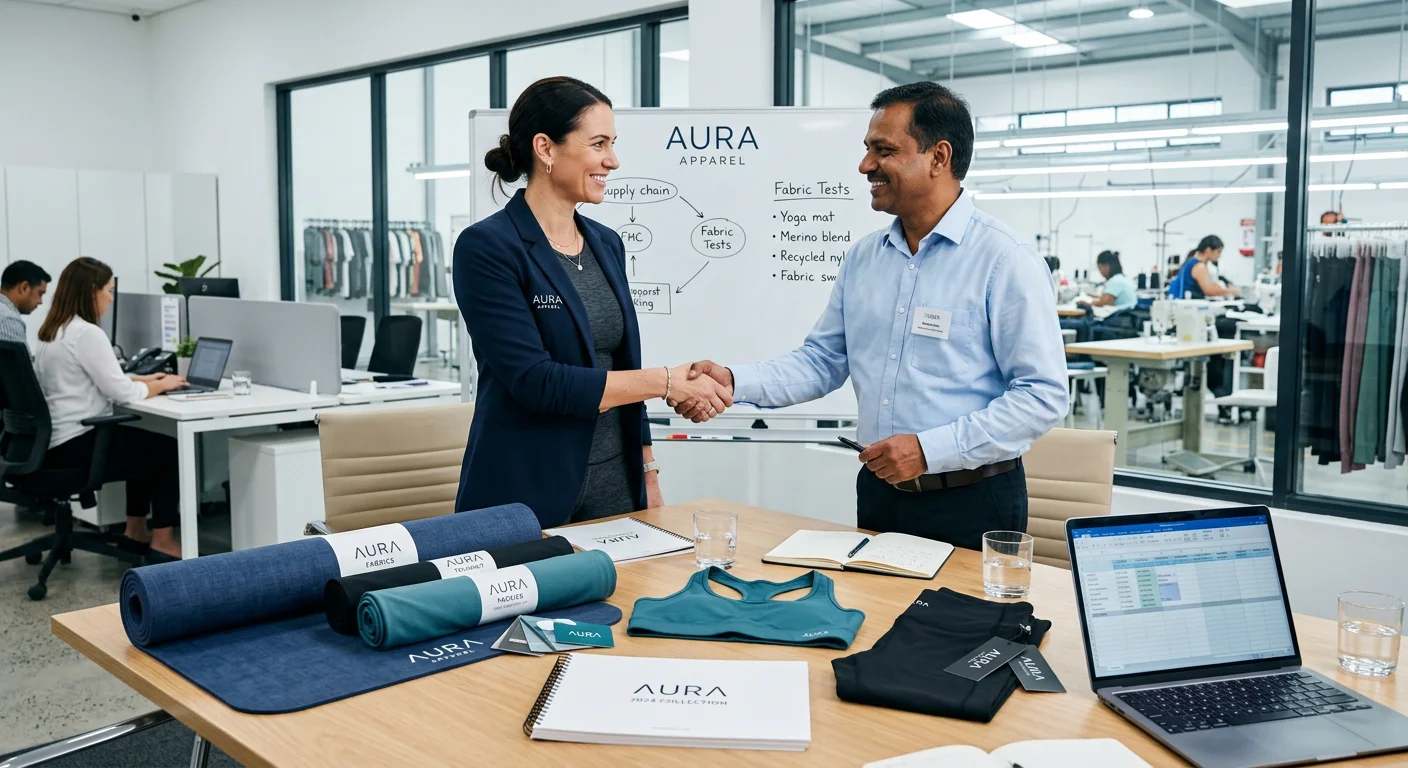
The short answer is yes — often by 50–80%. The more useful answer explains why , so you can use that gap to your advantage.
Private label and full custom OEM are two different production models at their core. That difference is what drives the MOQ gap.
Private label yoga wear means putting your brand on an existing factory catalog style — your logo, your hang tags, your packaging. The factory has already done the hard work: patterns are graded, fabrics are stocked in bulk, trims are on the shelf. Their overhead spreads across dozens of clients, so they can offer 50–100 pieces per style — sometimes with no MOQ at all on stocked catalog items.
Full custom OEM yoga wear means building something new. New patterns. Custom fabric. Unique colorways. The factory sources fabric for your order, develops samples from scratch, and runs a dedicated production setup. All that setup cost spreads across your batch. That's why OEM factories require 150–500 pieces per style per colorway — and some quote 1,000+ pieces when custom fabric blends are involved.
Here's a real example: one yoga OEM factory offers no MOQ for private labeling its existing catalog items — but quotes 150–200 pieces the moment you want a full custom design. Same factory. Two very different thresholds.
A Quick Reference Comparison
Private Label | Full Custom OEM | |
|---|---|---|
Base style | Existing catalog | New patterns & grading |
Typical MOQ | 50–100 pcs/style | 150–500 pcs/style/color |
Fabric | Stock (no per-client fabric MOQ) | Custom (mill minimums ~500–1,000m) |
Best for | Brand validation, first 6–12 months | Scale-up, differentiation |
Inventory risk | Lower | Higher |
Which Path Fits Your Stage?
Choose private label if:
- You're in pre-launch mode and need to test market fit without locking up capital
- Your realistic 3–6 month sell-through per style is under 150 units
- Your total first-run budget supports 300 units or fewer
A practical starting point: 2–3 catalog yoga styles × 50–100 pieces each = 150–300 total units . That's a manageable first run, and real private-label yoga wear supplier options exist at this range.
Choose full custom OEM when:
- You're reordering the same style at 150+ pieces — demand is proven
- You need proprietary features: zoned compression panels, recycled nylon blends, custom waistbands
- You're planning seasonal collections where each style can move 300+ units per colorway
Most growing yoga brands follow this upgrade path:
Phase 1 — Private label, 2–3 styles at 50–100 pcs each
Phase 2 — Hybrid: keep 1–2 private-label staples, add 1–2 OEM styles at 150–200 pcs with a flexible factory
Phase 3 — Majority OEM once monthly sell-through supports 300–500 pcs per style per colorway
One real limitation with private label: it comes with a design ceiling. Multiple brands pull from the same catalog, so style overlap in the market is real. A customer might spot your legging on another brand's label — and that makes your premium pricing harder to defend. OEM is where you build something competitors can't copy.
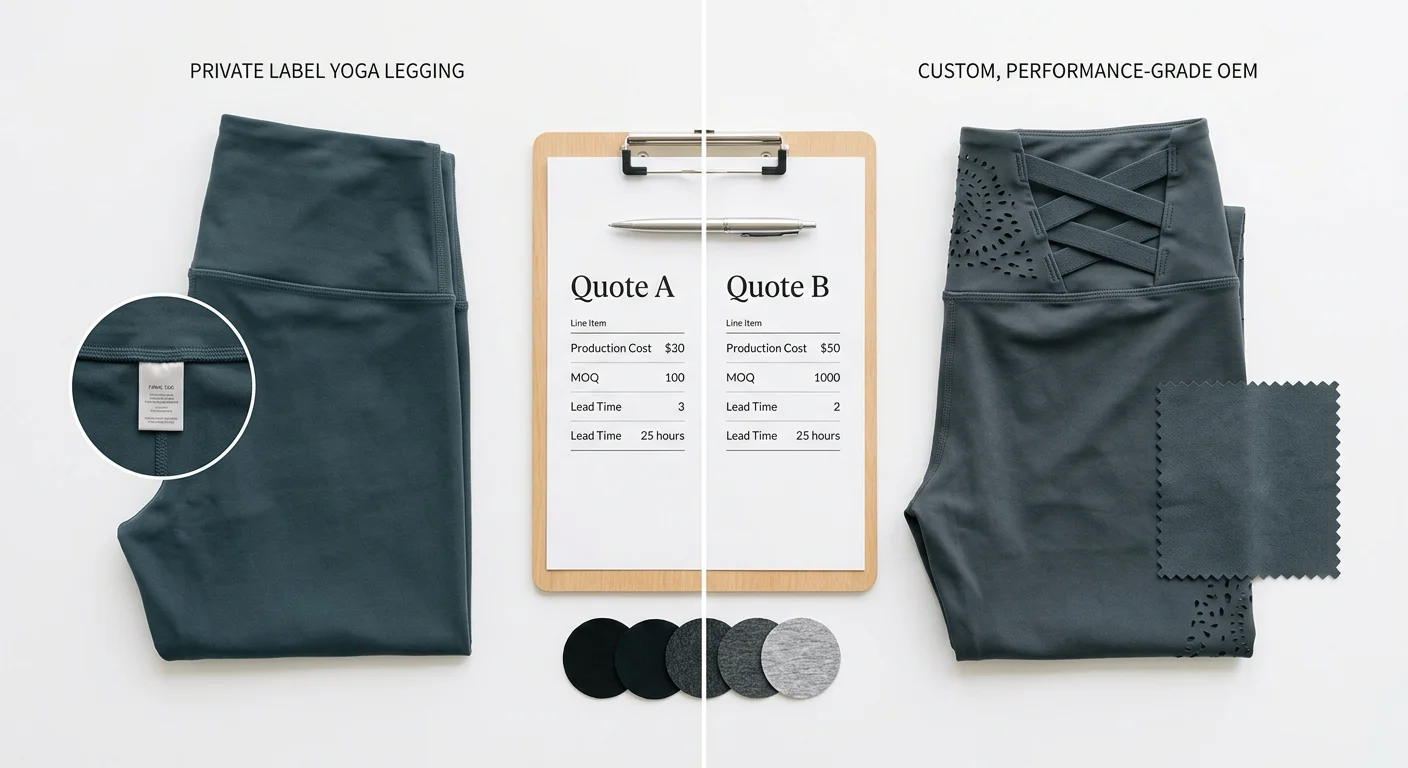
Before committing to either path, ask your factory for two quotes side by side. Quote A — private label of an existing yoga legging (target: 50–100 pcs/style). Quote B — full custom pattern and fabric (target: 150–300 pcs/style/color). That comparison shows you what differentiation costs at your volume — no guessing needed.
How to Structure Your First Yoga Wear Production Run: Style, Color & Size Breakdown Template
Here's what separates founders who reorder with confidence from those sitting on dead stock: a first run built around data collection, not optimism.
Your first production run isn't a launch. It's a structured experiment. The setup determines the quality of the results you get back.
Two Templates That Work
Plan A — Low-Risk Market Validation
2 styles × 2 colorways × 100 pcs per style/color = 400 pieces total
Split each style/color combination into 50 units. You're not trying to dominate. You're trying to learn which combination your customer buys.
Plan B — Single-Style Focus
1 hero style × 3 colorways × 120 pcs per color = 360 pieces total
Fewer variables. Simpler logistics. Less tooling complexity. Not sure about your customer yet? Focusing on one well-chosen style cuts down the number of things that can go wrong.
For style selection in either plan: prioritize high-waist leggings and fitted sports bras first. These are the core units in women's activewear — high-stretch, body-contouring, moisture-managing. They drive repeat purchases and reorder decisions better than any trend piece.
The Size Ratio That Matches Real Demand
Stop guessing on sizing. Use this as your default starting split:
XS : S : M : L : XL = 1 : 2 : 3 : 2 : 1
On a 100-piece color run, that breaks down to: XS 10 / S 20 / M 30 / L 20 / XL 10
M is your anchor. S and L are your volume drivers. XS and XL are test allocations — enough to catch edge demand, not enough to get you stuck if they don't move.
Color Strategy: Fewer Colors, Lower Risk
Every new colorway triggers a new MOQ unit. Add three colors and you've tripled your capital commitment — before you've proven anything sells.
First run rule: maximum 2–3 colors per style. Stick to low-risk neutrals: black, charcoal, and burgundy. These work across seasons, appeal to the widest audience, and move fast on reorders. Trend colors — coral, lilac, gradient prints — belong in your third production run, not your first.
Use the First Run as a Data Engine
This is the shift that changes everything. Treat your first 400 units not as inventory to sell, but as a measurement tool that shows you what to scale up in round two.
Track these five metrics closely:
Which size sells out first → Increase that size ratio by 5–10% next run
Which colorway converts higher → Shift allocation to 50–60% of that color
Return reasons → "Runs small" means shift your size curve right on the next order
Sell-through rate at 30 days → Below 40%? Don't expand. Above 60%? Prepare your reorder brief now
A single color drops below 30% of opening stock → That's your reorder trigger
The fastest-moving yoga brands in China's OEM ecosystem have cut reorder windows to 72 hours with a 500-piece minimum . But that speed is useless without clean first-run data to act on.
Keep it simple: 2 styles. 2 colors each. 5 sizes per color. Everything else is noise until the numbers tell you otherwise.
Conclusion
Your first production run doesn't have to feel like a high-stakes gamble.
The brands that launch well aren't the ones who ordered the most — they're the ones who ordered smart . Start with a manageable quantity (50–100 pieces per style). Use the tactics covered above to negotiate from a position of strength. Structure your SKUs so every unit you produce has a real chance of selling.
Here's what most suppliers won't tell you upfront: MOQ is almost always negotiable. Come prepared. Ask the right questions. Pick a manufacturer who wants to grow with your brand — not just fill your order.
That's what we do at YogaVendor. Placing your first custom activewear run? We help you find an order quantity that makes business sense. Scaling an existing line? Same approach — no unnecessary risk, no pressure to over-order.
Ready to get started? Request your yoga wear custom quote today and let's build something worth wearing.