Your packaging isn't just protection — it's the first physical conversation your brand has with a customer. That conversation can build instant trust or damage everything you've worked to create. So getting it right matters.
Launching a private label yoga wear line? Scaling an existing activewear business? The choices you make around custom yoga wear labels , hang tags, poly bags, and sustainable materials carry more weight than most founders expect.
This guide breaks down every major yoga clothing packaging option. You'll see what each one costs, what it communicates, and how to combine them into a brand experience that holds up from factory floor to your customer's doorstep.
Custom Labels for Yoga Apparel: Woven, Printed & Heat Transfer Options
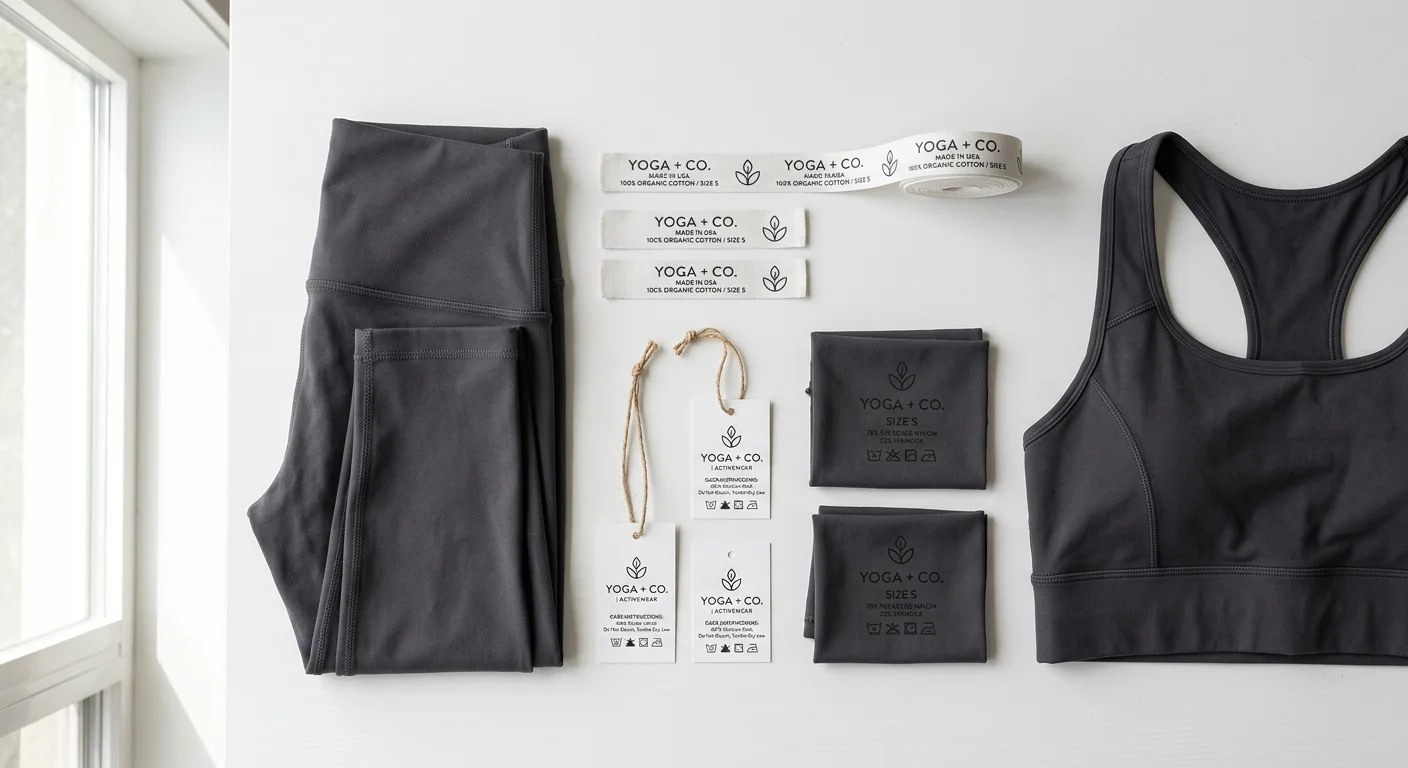
Three label types dominate activewear manufacturing — woven, printed, and heat transfer. Picking the wrong one for the wrong garment is one of the most common (and avoidable) mistakes new yoga brands make.
Here's how they differ:
Woven labels : The logo or text is woven directly into the label fabric using yarn. They're durable, textured, and feel premium. The tradeoff: they add physical thickness. That matters on a waistband sitting against skin through a 60-minute flow class.
Printed labels: Ink on a ribbon — satin, cotton, or nylon. Cleaner for small text, lighter to the touch, and lower cost. This is your go-to for care instructions and size callouts.
Heat transfer labels (tagless): No physical label at all. The design is pressed onto the fabric. Zero bulk, zero scratching, maximum skin-contact comfort.
Matching Label Type to Garment
Let the garment type drive the decision — not just aesthetics:
Garment | First Choice | Notes |
|---|---|---|
Leggings | Heat transfer | Waistband and inner seam placements benefit most from tagless construction |
Sports bra | Heat transfer | Underbust and back straps are high-friction zones |
Yoga top (performance) | Printed or heat transfer | Keep it flat, keep it light |
Yoga top (lifestyle/premium) | Woven | A small woven label on the hem elevates perceived quality |
The most widely used combination across professional yoga wear lines: woven label for external brand placement, heat transfer for the inner waistband, printed label for care and composition info. Each format has a clear job to do.
Design Specs That Matter
Going into label production without knowing the technical limits gives you blurry logos and unreadable washing instructions. A few rules worth keeping in mind:
Heat transfer colors: Most yoga apparel suppliers cap this at 4 spot colors . Gradients and multi-tone artwork don't hold up well under the press.
Font selection: Go with sans-serif typefaces with heavier stroke weight and open letter-spacing. Thin fonts lose detail at small sizes — on woven labels and heat transfers especially.
Logo complexity: Clean, high-contrast marks work across every format. Fine-line logos with lots of detail suit heat transfer or high-density printed labels better. Woven labels need bold, defined edges.
Size labeling: Most manufacturers support per-size label runs (S/M/L/XL). You're not sorting by hand after production.
For heat transfer application, standard parameters sit at 160°C / 320°F , a press time of 12–20 seconds , and medium-to-firm pressure. Let the label cool fully before handling or washing. Skipping this step is the main reason labels peel early.
The Compliance Layer You Can't Skip
Selling in the US or EU? Care labels are legal requirements — not optional styling details.
US (FTC): Garments must display fiber content, country of origin, and care instructions . These must be clear and stay attached for the life of the product.
EU textile regulations: Labels must show accurate fiber names and percentages . The information must stay legible and intact throughout the product's life.
For any yoga wear going to Western markets, the inner label must include composition, size, country of origin, and washing instructions . Miss any one of these and you create real customs and platform compliance problems.
The Fastest Decision Framework
Not sure which label type fits your situation? Use this:
Comfort is the priority → Heat transfer, no question
Brand equity and longevity matter → Woven label
You need detailed care info at low cost → Printed label
You want all three covered → Use them in combination, each in its right position
One mistake worth avoiding: don't skip fabric testing before committing to heat transfer. Stretch fabrics, coated materials, and moisture-wicking treatments all respond to heat press adhesion in different ways. Good yoga wear suppliers test on scrap fabric before full production. If yours doesn't offer this, ask for it.
Hang Tags for Activewear: Turning a Small Card Into a Brand Statement
Most customers glance at a hang tag for three seconds. Those three seconds are doing more work than you think.
A hang tag is the one branded touchpoint a customer holds before deciding to keep the product. It carries your logo, your price, your story — plus a direct line back to your community. Get the hierarchy right. That's what separates forgettable from memorable.
What Goes on the Tag (and In What Order)
Order matters. Front of card, top to bottom:
Brand name / logo — instant recognition, nothing competes with it
Product name — be specific: "High-Support Yoga Legging," not just "Legging"
Key performance callouts — "4-way stretch / sweat-wicking / compression fit"
Supporting details — fabric composition, size, country of origin, price
Call to action — social handle, QR code, or a short registration prompt
The brand story block — if you include one — should run 30–60 words maximum . Keep it tight. Lead with your mission, founding reason, or one strong impact statement. "Empower women through movement" hits harder than three paragraphs nobody reads.
For QR codes: minimum 12×12 mm , with enough quiet zone around it to scan without errors. Place it on the back, lower half. Link it to a product demo video, a welcome offer, or your brand story page. Brands that embed a first-order discount into the QR ("scan for 10% off") see conversion lifts in the 3–8% range .
Choosing Your Material
The card stock you pick signals your brand tier before anyone reads a single word.
Material | Cost per Tag | Best For |
|---|---|---|
Coated cardstock | $0.03–0.08 | Mid-range activewear, bold color printing |
Kraft paper | $0.02–0.06 | Sustainable/natural yoga lines |
Recycled eco cardstock | $0.03–0.10 | Premium eco brands, circular fashion positioning |
Specialty (soft-touch, textured) | $0.06–0.20 | High-end, limited-run, collab series |
PVC / clear card | $0.20–0.50 | Performance-tech lines, not eco-focused |
Kraft paper reads as sustainable before you print a single word. Recycled cardstock with visible fiber texture backs that up. PVC clear cards communicate performance technology — but they carry real environmental baggage. Today's more informed buyers notice that.
Finishes That Move Price Perception
Your finish choice shapes how much a customer thinks the product is worth.
Foil stamping (gold/silver): Adds $0.02–0.06 per tag. Brands using foil on premium line hang tags report 5–15% higher retail yoga wear price acceptance — that's real leverage on an $80 legging.
Spot UV on matte stock: $0.01–0.04 per tag. High-contrast gloss over your logo pops hard under retail lighting.
Emboss / deboss: Setup runs $40–100 for the die; per-tag cost adds $0.03–0.08. Tactile texture is one of the clearest "premium" signals in apparel.
Double-sided printing: Adds about 10–25% to print cost. Front for brand and product; back for story, social, QR, and care notes. Clean separation, no clutter.
For high-end yoga lines, a strong combination is: thick specialty paper + debossed logo + small foil accent + double-sided print . Total tag cost moves from around $0.05 to $0.20–0.30. On a $90–120 retail item, that's about 0.3–0.5% of product value — a solid trade for the brand equity it builds.
Poly Bags for Yoga Clothing Packaging: Clear, Matte, Frosted & Printed Options
The poly bag is the last thing standing between your product and your customer's hands — and most brands treat it like an afterthought.
That's a mistake. The bag type you choose signals your brand tier before anyone unzips it. Clear says "functional." Frosted says "considered." Printed says "we thought about every inch of this."
Here's what each option does — and who it's for.
Clear, Matte, and Frosted: Matching the Bag to Your Brand Position
Clear PE bags are the workhorse of activewear packaging. Colors show through right away, fabric texture is visible, and the cost stays low. For entry-level yoga lines, promotional sets, or basic SKUs going into FBA warehouses, clear bags are the practical default.
Matte and frosted bags do something different. The partial opacity softens the look — less "stock room," more "boutique shelf." That shift in perception matters when you're positioning above $60 retail. Frosted works well for minimalist yoga brands and women's activewear with a premium or wellness aesthetic.
Semi-translucent frosted bags sit in the middle. The product silhouette shows through the film, but the full detail stays hidden. It's a clean option for brands that want visual presence without full exposure.
Quick positioning guide:
Bag Type | Brand Tier | Best Use |
|---|---|---|
Clear PE | Entry / Basics | High-visibility retail, FBA, promo kits |
Frosted / Matte | Mid to premium | Branded unboxing, boutique, lifestyle yoga |
Semi-translucent | Mid-range | Gift sets, reusable packaging, clean aesthetic |
Printed Poly Bags: Getting Your Brand Onto the Film
A printed bag puts everything on one surface — logo, brand color, size callout, barcode, and compliance copy. No separate sticker, insert, or label needed.
Two printing methods dominate apparel packaging:
Screen printing: Best for small runs, clean logo marks, and limited color work. Typical MOQ: 500–1,000 pieces . Setup cost is lower, so small brands testing packaging design get more flexibility.
Flexographic printing: Built for scale. Reproduction is cleaner on large runs, and per-unit cost drops at volume. MOQ starts at 5,000–10,000 pieces . This is the right move once you've locked in a design and need consistency across thousands of units.
The cost structure is simple. Bag thickness, dimensions, number of print colors, plate fees, and zipper or self-seal features all affect the price. The baseline: unprinted clear bags are cheapest . A single-color logo print adds a moderate cost step. Full-coverage or multi-color designs cost the most — but they also do the most brand work.
Functional Specs That Matter for Yoga Wear Logistics
The bag's job doesn't end at the shelf. For yoga clothing, a few features carry real operational value:
Self-seal / adhesive closure: This cuts down secondary packaging time. It keeps leggings, bras, and single-piece SKUs secure during cross-border shipping and return processing. It's standard on anything going through a 3PL or FBA chain.
Moisture and dust resistance: Light-colored yoga wear — white crops, pale-grey leggings — takes damage during long sea freight or multi-leg warehouse transfers. A solid poly bag stops arrival damage that would require rework or replacement.
Thickness (mil): Mid-to-premium apparel packaging uses 3 mil film as a standard. It holds its shape, feels firm to the touch — which customers read as quality — and protects against puncture during transit.
A practical tiering system based on brand stage:
Entry-level: Clear PE + self-adhesive seal + single-color sticker label
Growth-stage brand: Semi-frosted bag + brand-color print + self-seal
Premium / lifestyle brand: Full matte bag + multi-point printed branding + heavier film or reusable design
Recyclable Poly Bags and the Compliance Shift
This is no longer optional background research — it's active purchasing pressure.
EU Single-Use Plastics (SUP) regulations are changing how brands selling into European markets choose their film. The requirement isn't just to reduce plastic. You need to document material claims, prove recyclability, and cover EPR (Extended Producer Responsibility) costs. Brands entering EU markets without a clear packaging material strategy end up absorbing compliance costs they never planned for.
California SB 54 is pushing the same direction in the US market. Single-use packaging must move toward higher recyclability, renewable materials, or reusable formats. For cross-border yoga wear brands, material choices made today affect yoga wear supplier certifications and long-term sourcing strategy.
Most brands are responding with these moves:
Switching to recyclable LDPE (resin code #4) as the base film — accepted across most film-recycling streams
Using mono-material construction (one material type only) so the bag is genuinely recyclable, not just labeled that way
Reserving print space for recycling icons, material callouts, and regulatory warnings that more markets now require
Choosing lighter-weight bag designs that cut total material use without dropping protection
Four Questions to Ask Your Supplier Before You Order
At the quoting stage, four parameters drive everything else:
Size: Standard yoga wear bag sizes run 12"×15" for folded leggings and tops. Soft-handle gift formats run around 16"×5"×12" . Know your folded garment dimensions before asking for a quote.
Thickness: 3 mil is the baseline for mid-range and above. Thinner saves cost. Thicker adds perceived quality and transit protection.
Print method: Screen or flexographic — and how many colors? Each extra color adds plate cost and per-unit price.
MOQ: Your tier (500, 1,000, 5,000, or 10,000 units) sets your per-bag cost and determines how plate fees get spread out. New brands testing a design should start with screen print at a lower MOQ before moving to flexo volumes.
Get these four numbers right. The rest of the conversation with your supplier falls into place.
Sustainable Yoga Wear Packaging: Eco-Friendly Materials That Match Your Brand Values
Global sustainable packaging material usage crossed 84 million metric tons in 2024 . That number isn't a forecast — it's already happened. Mainstream consumer brands have made the switch. Your yoga wear packaging still runs on virgin plastic with no recyclability story? You're not just behind the trend. You're building a compliance liability.
Here's what the material options look like, and what each one does.
Four Materials Worth Knowing
Recycled kraft paper bags are the lowest-cost entry point into sustainable apparel packaging. Paper fiber cycles through 5–7 times before the fibers shorten too much to reuse. Pair with FSC-certified stock and water-based inks. You get a credible recyclable claim that holds up in most markets. For basic e-commerce fulfillment, this is your default.
PLA / starch-based compostable bags are where brands get tripped up most often. PLA is bio-based — but breaking it down requires controlled industrial composting conditions . It does not decompose in landfills or oceans. To make a public claim, align with ASTM D6400 (US) or EN 13432 (EU). No certification? Putting "biodegradable" on your packaging puts you in greenwashing territory.
FSC-certified paperboard boxes give mid-to-premium yoga lines a structured unboxing format with solid certification backing. The FSC mark shows responsible forestry sourcing. It's a recognized proof point for ESG positioning in both US and European retail channels.
Mycelium (mushroom-based) cushioning carries the highest unit cost of the four. But it carries the strongest story for high-AOV gift sets or limited-edition drops. It composts fully and works as a direct foam replacement.
Three Terms Brands Confuse
Get these wrong in your product copy and you have a greenwashing problem:
Recyclable — the material can enter a recycling stream, assuming local infrastructure handles it
Biodegradable — breaks down under specific conditions, not just "in nature"
Compostable — specify industrial or home composting; the two are not interchangeable
Write "FSC-certified paperboard" or "industrially compostable inner bag." Don't write "100% eco-friendly." The first is a claim you can defend. The second draws regulatory scrutiny.
Packaging Combinations by Brand Stage
Brand Stage | Recommended Combination | Primary Benefit |
|---|---|---|
E-commerce basics | Recycled kraft mailer + water-based ink + paper tape | Cost control, recyclable claim |
Mid-premium brand | FSC box + recycled paper insert + partial foil | Quality signal + certification proof |
High-ESG / limited edition | FSC box + mycelium cushioning + compostable outer bag | Brand story, premium positioning |
What to Confirm With Your Supplier
Before locking in any sustainable apparel packaging spec, verify four things:
What certifications does your supplier hold — FSC, GRS, or third-party compostability testing ?
Can they provide samples with documented material claims before full production runs?
What is the per-unit cost delta vs. standard packaging at your required MOQ?
What are the MOQ, sampling lead time, and bulk production timeline for each material type?
That last point matters most for scaling yoga wear brands. A yoga clothing supplier who can't deliver consistent certification documentation across bulk orders creates real long-term compliance exposure. That's not a minor inconvenience — it's a structural risk to your brand claims.
How to Choose the Right Packaging Combination for Your Yoga Brand
Packaging decisions stack up. A label choice made at launch shapes every reorder, every unboxing video, and every retail conversation for years. So before you lock anything in, build a clear framework. Connect your price point, your sales channel, and your brand position into one packaging plan that holds together.
Three variables drive everything: what you charge, where you sell, and who's watching.
Match Your Packaging Tier to Your Price Point
These numbers come from real, active yoga wear supply chains — not guesswork.
Entry-level (under $40 retail, 100–1,000 units/month)
Keep it simple. Go with a heat transfer or single-color woven label + basic hang tag + clear self-seal poly bag + standard mailer. Total packaging cost per unit lands at $0.13–$0.22 . That's the right range for FBA, Shopee, and low-budget DTC operations. Your focus here is compliance — fiber content, sizing, origin, care — not presentation.
Mid-range ($40–$80 retail, 300–5,000 units/month)
At this tier, packaging starts doing real brand work. Add a double-sided hang tag with a short brand story, a printed LDPE inner bag, a custom mailer in one or two brand colors, and a small thank-you card. Per-unit cost moves to $0.31–$0.50 . This tier fits DTC brands building Instagram and TikTok presence. The unboxing moment is part of what the customer is buying.
Premium ($80+ retail, 200–2,000 units/month)
Think structure, texture, and ritual. Go with a woven or metal logo label + coated hang tag with foil accent + cotton drawstring dust bag + rigid drawer-style gift box + tissue paper + personalized card. Per-unit cost: $1.03–$2.13 . That sounds steep. On a $120 legging, though, it's under 2% of retail value. It also backs up the price your customer already agreed to pay.
Channel Changes Everything
Your sales channel matters just as much as your price point.
DTC / your own website: Lead with the unboxing sequence. Outer branded mailer → single inner poly bag → tissue wrap → insert card with discount code. Cap layers at 2–3. Package cost should sit at 5–8% of product value for mid-range brands, up to 10% for premium.
Amazon FBA: Strip it back. Every extra layer adds dimensional weight fees. Use one poly bag per unit — minimum 1.5 mil thickness , barcode unobstructed on the outer surface, suffocation warning printed if the bag opening exceeds 5 inches. Hang tags are optional here. Compliance labels are not.
Retail / yoga studios: The hang tag becomes a silent salesperson. Brand name, size, material, price, and care instructions must all be readable from 1–1.5 meters away. Use color blocking to separate sizes at a glance. A resealable inner bag helps with try-on and returns.
Three Mistakes Worth Avoiding
Over-layering. A poly bag inside a paper sleeve inside a cotton bag inside a gift box — for a $35 legging — is a logistics cost problem, not a brand win. Packaging costs above 12–15% of product value eat into margins fast.
Missing compliance copy. Fiber percentage, size, country of origin, care symbols, and brand information are all required. One missing element can trigger platform warnings, customs holds, or return requests. Logo label sorted but no care label in production? That's an incomplete spec.
Inconsistent visual language across touchpoints. The hang tag reads minimalist wellness. The woven label uses a bold streetwear typeface. Customers won't notice it directly — but they won't remember the brand either. Lock in two to three brand colors, one font pairing, and a logo usage guide before you produce a single label. Use them across every piece.
Before You Contact Any Supplier
Have these ready:
Brand tier and target packaging cost as a percentage of retail price
Logo files in vector format (AI / EPS / PDF), including single-color and reversed versions
Average folded garment dimensions and weight per SKU
Fiber composition percentages for care label production
Primary sales channel and unit volume per month
Target markets (US, EU, or both — compliance requirements differ)
A qualified supplier can give you an accurate quote in the first conversation — not the fifth — once you walk in with this information.
Custom Packaging MOQ, Lead Time & Design Specs: What to Know Before You Order
Most packaging mistakes don't happen at the design stage. They happen six weeks before launch. A founder finds out their hang tag MOQ is 1,000 units — but they planned to make 300 garments. No one said anything upfront.
Here are the three things that derail custom packaging orders: minimums, timelines, and file specs.
MOQ by Packaging Type
Each packaging type has its own minimum order quantity. Know these numbers before you build your launch plan:
Packaging Type | Standard MOQ | Low-MOQ Option |
|---|---|---|
Printed poly bags | 1,000–5,000 pcs | 300–500 pcs (1–2 color, simple logo) |
Hang tags | 500–1,000 pcs | 300–500 pcs (digital print) |
Custom labels | 500–1,000 pcs | Lower than bags — good starting point |
Branded mailer/color box | 100–500 pcs | 50–100 pcs (1-color brown box) |
One solid workaround: share one packaging design across multiple SKUs . Four yoga wear styles can use the same hang tag with the same print file — different garments, one plate run. That's how small brands hit MOQ without locking up too much inventory.
The Real Timeline: D0 to Shipment
Most brands underestimate the sampling loop, not the production time. That's where the real time goes.
A realistic end-to-end timeline:
D0–D3: Submit design files → digital proof
D7–D14: First physical sample
D14–D28: Review rounds (most brands need 2–3 iterations)
D28–D30: Final approval + deposit
D30–D50: Bulk production
D50–D70: Packing integration + shipment
Adding custom packaging to an existing garment production run adds 7–14 days . It takes longer if your packaging and apparel factories are separate. Build that buffer in from day one.
Design File Specs That Prevent Delays
Artwork issues cause the most production delays, by far. The wrong file format or a missing bleed margin sends your order back to square one.
Check these before you upload anything:
File format: AI, PDF, EPS, or CDR. PSD works only if all layers are intact and resolution is ≥ 300 dpi
Colors: Use Pantone Solid Coated numbers for each brand color. Use CMYK for full-color work — don't submit RGB and expect accurate output
Bleed: 3 mm beyond the cut line for boxes, cards, and labels. 3–5 mm for poly bags and pouches
Fonts: Convert every text element to outlines before submitting. Font-substitution errors don't show up until print — and by then it's too late
Barcodes/QR codes: Minimum 300 dpi, black on a light background, with a 2–3 mm quiet zone
What Sampling Costs
Sampling fees are real costs. Don't treat them as formalities:
Simple digital-printed box or hang tag: $30–$100 per design
Complex gravure pouch: $100–$300 , often bundled with cylinder fees
Good news: most suppliers offer plate and die fee credits once bulk orders pass a certain threshold. Common structures include a 50% sample fee credit on first bulk orders ≥ 3,000 pcs, or a full plate fee credit at 10,000 cumulative units. Get those credit terms in writing before you pay a single sample invoice.
At low MOQs — say, 100–300 boxes — per-unit packaging cost runs 2–3× higher than at 1,000+ pcs. Digitally printed bags close that gap somewhat. Expect a 20–40% cost drop moving from 300 to 1,000 units. Traditional gravure printing drops faster at volume — but the setup costs hit harder upfront.
Pre-Order Checklist
Confirm these in writing with your supplier before you lock in any packaging order:
Per-item MOQ for labels, hang tags, poly bags, and boxes — and whether SKUs can share one design
Day-count estimates for each stage: artwork check, digital proof, first sample, revision, bulk production, and shipping
Itemized cost breakdown: unit price, sample fee, plate/die fee, and credit thresholds
Physical color swatches or printed samples for brand-critical colors — this matters for premium or lifestyle-positioned yoga lines
One clear conversation upfront cuts out most of the surprises that hit mid-production.
Why Source Yoga Wear Packaging From a Full-Service Activewear Manufacturer
Splitting production and packaging across two suppliers sounds fine — until week six. Your leggings sit in a warehouse. Your hang tags are still on a ship.
That's the real cost of fragmented sourcing. Not the price difference. The wait.
A full-service activewear manufacturer handles fabric, sampling, garment production, packaging customization, and QC under one roof. That setup does three things separate suppliers can't match:
Communication stays tight. One team owns the label spec, the hang tag copy, the poly bag size, and the garment dimensions — all at once. No version-control errors. No "the tag says M but the bag says Medium" surprises at goods receipt.
Timelines stay in sync. Packaging runs in parallel with production — not after it. Your branded poly bags arrive when your leggings do.
Quality stays consistent. Print color, barcode accuracy, seal integrity — these get checked against the same production batch, not weeks later by a third party.
The QC checkpoints that matter most happen at three stages: packaging print color delta vs. approved sample , hang tag data accuracy (size, composition, care symbols, SKU), and poly bag seal strength under transit pressure . A manufacturer running integrated QC can standardize all three. A split-vendor sourcing setup cannot.
Brands targeting North America should pay attention here. North America holds 40% of global yoga wear market share . Speed is a real edge in that market. China's activewear supply chain can move a new style from concept to finished, packaged unit in 5–7 days . That pace breaks down fast when packaging is a separate coordination problem.
yogavendor.com covers the full chain: fabric sourcing, pattern development, garment production, custom packaging, and pre-shipment QC. One contact. One timeline. Raw material to retail-ready unit.
Evaluating suppliers? Ask for these numbers upfront: sampling cycle under 7 days, packaging version match rate at 100%, and hang tag error rate near zero. A manufacturer who can answer those questions with hard data is worth your time.
Real Packaging Samples & Brand Showcase Gallery
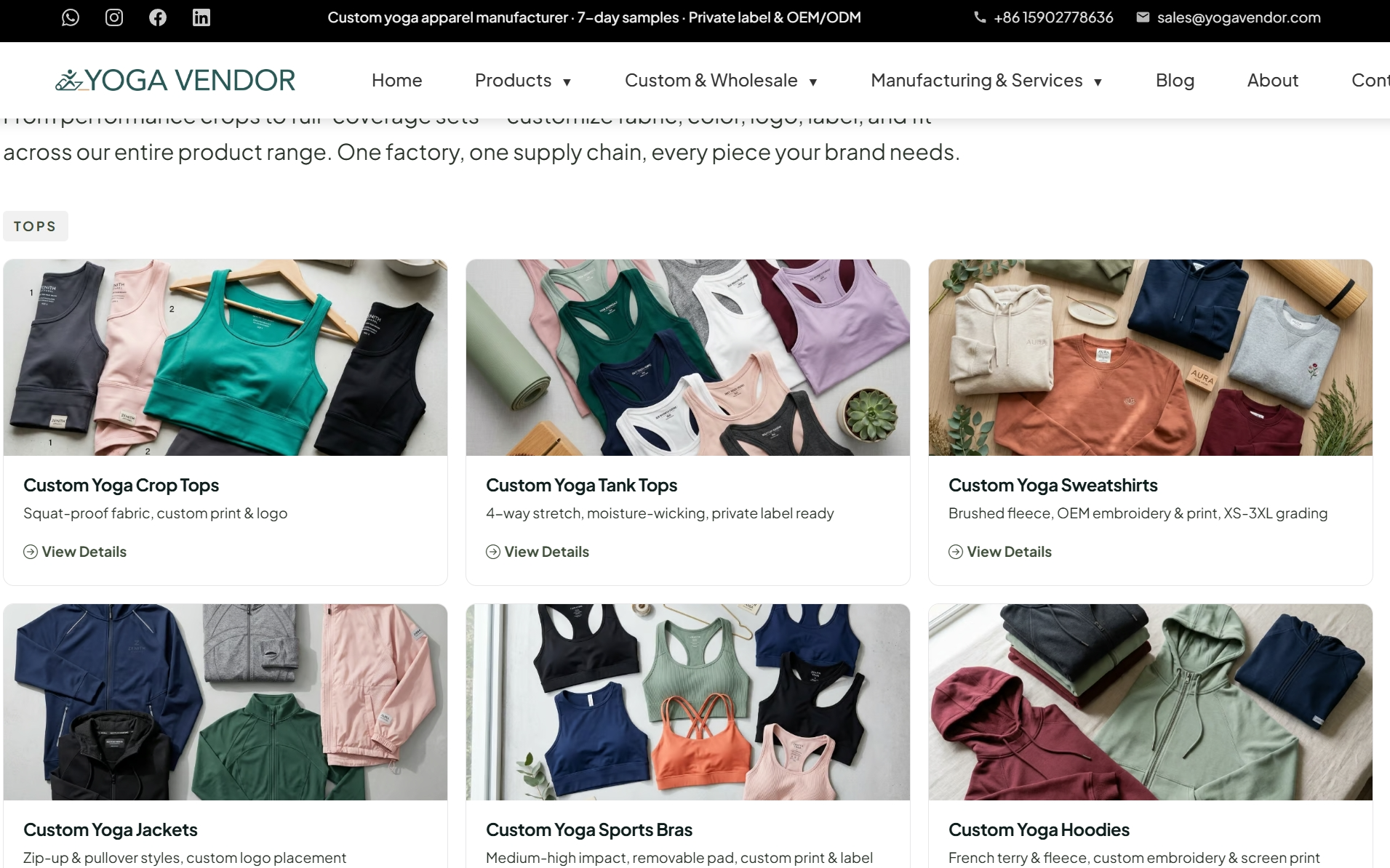
Specs on a page only go so far. Seeing finished production work is what moves a buyer's decision — real labels, real tags, real bags pulled from a completed order.
The gallery below shows packaging components from yogavendor.com's Guangzhou facility. You'll find:
Woven label thread detail
Hang tag foil stamping edges
Frosted poly bag surface texture
Full-set flat lays showing every branded touchpoint in one frame
Every image is a production output. Not a mockup.
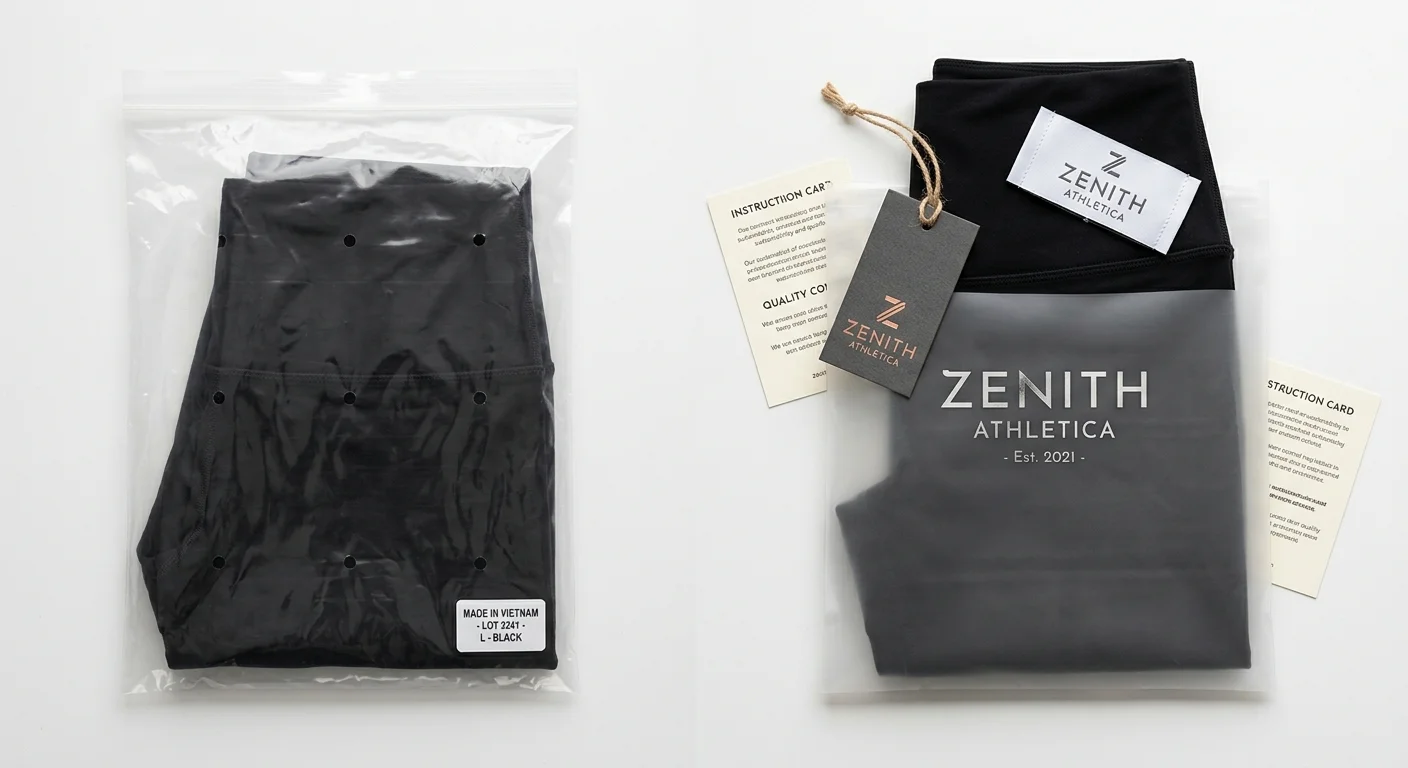
Check the before/after comparison — a plain OEM yoga bag on one side, a coordinated private-label set on the other. That gap is where brand equity lives.
Get Your Custom Yoga Wear Packaging Quote
Ready to move from research to production? Here's how it works at yogavendor.com — quotes are fast, specific, and sized to your actual order.
Tell us five things upfront:
Packaging types needed (hang tags, plastic bags, labels, gift boxes)
Quantity range (100–299 / 300–999 / 1,000–4,999 / 5,000+)
Per-unit budget target (≤$0.10 / $0.10–$0.30 / $0.30–$0.80 / $0.80+)
Primary sales channel (Amazon FBA, Shopify DTC, retail studio)
Whether you need apparel production bundled in
Send those five details. We'll return a full quote — unit pricing, sample fees, and tiered volume discounts — within 24 hours. Sampling takes 3–7 days. Bulk packaging production runs 10–20 days. We schedule it alongside your garment run, so both ship out together.
Boxes start at 100 units. Garments start at 100 pieces per style.
[→ Get Your Free Packaging Quote on yogavendor.com]
Conclusion
Your packaging isn't an afterthought — it's the first physical conversation your brand has with a customer.
Woven labels whisper quality before the fabric even speaks. Biodegradable plastic bags signal your brand's values before the box is opened. Every packaging decision adds up. Get it right, and you build the kind of brand recognition that turns a one-time buyer into a loyal advocate.
The good news? You don't need five different vendors, five different MOQs, and five different timelines. Yogavendor.com handles custom yoga clothing brand packaging from start to finish — labels, hang tags, plastic bags, sustainable options — all coordinated with your production order. One place, one process, no juggling.
So here's your next move: gather your logo files, jot down your brand colors, and request a custom yoga clothing packaging quote today. The yoga market is crowded. Your packaging is one of the fastest, most affordable ways to stand out.
Make it count.