One Floor Builds Your Whole Line — Custom Yoga Apparel From First Sketch to Full Collection.
From yoga leggings and sports bras to hoodies, joggers and bodysuits — one factory, every silhouette. Every customization dimension your brand touches runs through one D0-to-D7 workflow: brief in, engineered first-piece out.


Volume tier set per custom SKU · start from a sketch or a full tech-pack.
Every Yoga Silhouette, Fully Customizable
From performance crops to full-coverage sets — customize fabric, color, logo, label, and fit across our entire product range. One factory, one supply chain, every piece your brand needs.
Tops


Bottoms


Sets & One-Pieces


D0: your brief picks its lane — sketch, tech-pack, or mood board.
Pencil sketch on tracing paper, full tech-pack PDF, or a mood-board with three reference shots — we route each starting point to the right engineering lane on day one. The third lane (reverse-engineer a competitor sample) is the one we always send back.
-
Lane 1 · Sketch → Tech-Pack
Pencil sketch or mood-board lands D0. Pattern engineer builds the tech-pack with you in D0–D2, then we cut. ODM lane — OEM ODM yoga apparel for sketch-only briefs →
-
Lane 2 · Tech-Pack → First-Piece
Full tech-pack with GSM, stretch ratio, decoration zone? D0 engineering kicks off. Pattern desk starts grading the same business day. OEM lane — private label yoga apparel for low-tech-pack briefs →
-
Lane 3 · Reverse-Engineer — We Decline
Sending us a competitor SKU to copy-and-cost? We send it back D0. One C&D ends two businesses. Bring your own pattern or sketch instead.


Tech-pack to first-piece, D0 to D7 — every stage stamped, every stage watchable.
Three documented stages with day stamps, sign-off windows, and a daily 15-minute stand-up. No vague “we’ll get back to you soon” — every milestone has a deliverable, a channel, and a name on the other end.
-
Stage 1 D0
Brief intake + gap-list email
Process engineer reads your tech-pack the same business day, replies with a plain-text gap-list flagging GSM, stretch ratio, and decoration-zone data missing. We never start work against an incomplete brief.
Channel: email + Slack · Sign-off window: 24h -
Stage 2 D1
Tech-pack ack + pattern grading
Daily 15-min stand-up on Slack/WeChat/email — engineer pick, signed off in writing same day. Pattern engineer starts grading XS–3XL on D1, lab-dip color match Day 2.
Channel: Slack / WeChat / email · Daily 15-min stand-up -
Stage 3 D7
First-piece + wear-test
Fit-sample courier-shipped D7. Wear-test by an in-house yoga teacher covers squat, forward-fold, and inversion. You sign off in writing before any bulk run starts.
Stage sign-off · Wear-test covered


“Our process engineer flags GSM, stretch ratio and decoration-zone gaps in the first reply, before any pattern is cut.”— Process engineering team Yogavendor · in-house OEM intake desk
Want to see how the same engineering desk runs a wholesale program after first-piece? See yoga apparel manufacturer with in-house pattern engineering for the floor-level handoff between OEM sampling and bulk production.
What actually happens on each of the seven days — no black box between D1 and D7.
Most factories quote a sampling window and go silent inside it. Ours is documented day by day because the loop runs entirely in-house on Line D — a sampling-only line producing 700–900 sample sets a month, which never queues behind bulk orders for machines or hands.
D1Pattern draft opens, grading rules set
The pattern engineer translates your tech-pack into a first block: ease distribution, seam allowances, and the XS–3XL grading rules are decided here, before any cloth moves. Decisions made on D1 are the ones every later day inherits, so this is also when we phone you about anything ambiguous rather than guessing.
D2Lab dip starts, base cloth pulled
Colour work begins in parallel: your Pantone or HEX references go to the dip lab while the sample's base cloth is pulled from the in-house fabric library — one reason the loop never slips is that we are not waiting on a mill for sampling yardage.
D3Process sign-off and first cut
The process engineer signs the stitch map — which seams run flatlock, which coverstitch, what density per body zone — and the first panels are cut. From this point the garment exists physically; everything before D3 was paper and cloth selection.
D4–D5Sewing and decoration on Line D
Assembly runs on the dedicated sampling line, where operators are rotated specifically for short-run versatility. Logos, heat-press marks, and label placement go on during D5 so the piece you receive is decoration-complete — a blank sample tells you nothing about how branding interacts with seams.
D6Internal wear-test and measurement audit
The fit engineer — a certified yoga teacher — wears the piece through the full movement battery while a colleague logs measurements against the graded spec. Anything that pops, sheers, or rolls gets red-penned now, so the sample you open already carries our own critique attached.
D7Courier out, annotated pack attached
The first piece ships with photographed call-outs of every point our internal review flagged. Your sign-off — or your revision notes — restarts the loop, and because the whole cycle is in-house, a revision round costs days rather than the month it takes when sampling is subcontracted.
What Can We Customize for Your Brand?
Every element of your yoga apparel line is fully configurable — from base fabric to final packaging, we build it to your exact specification.
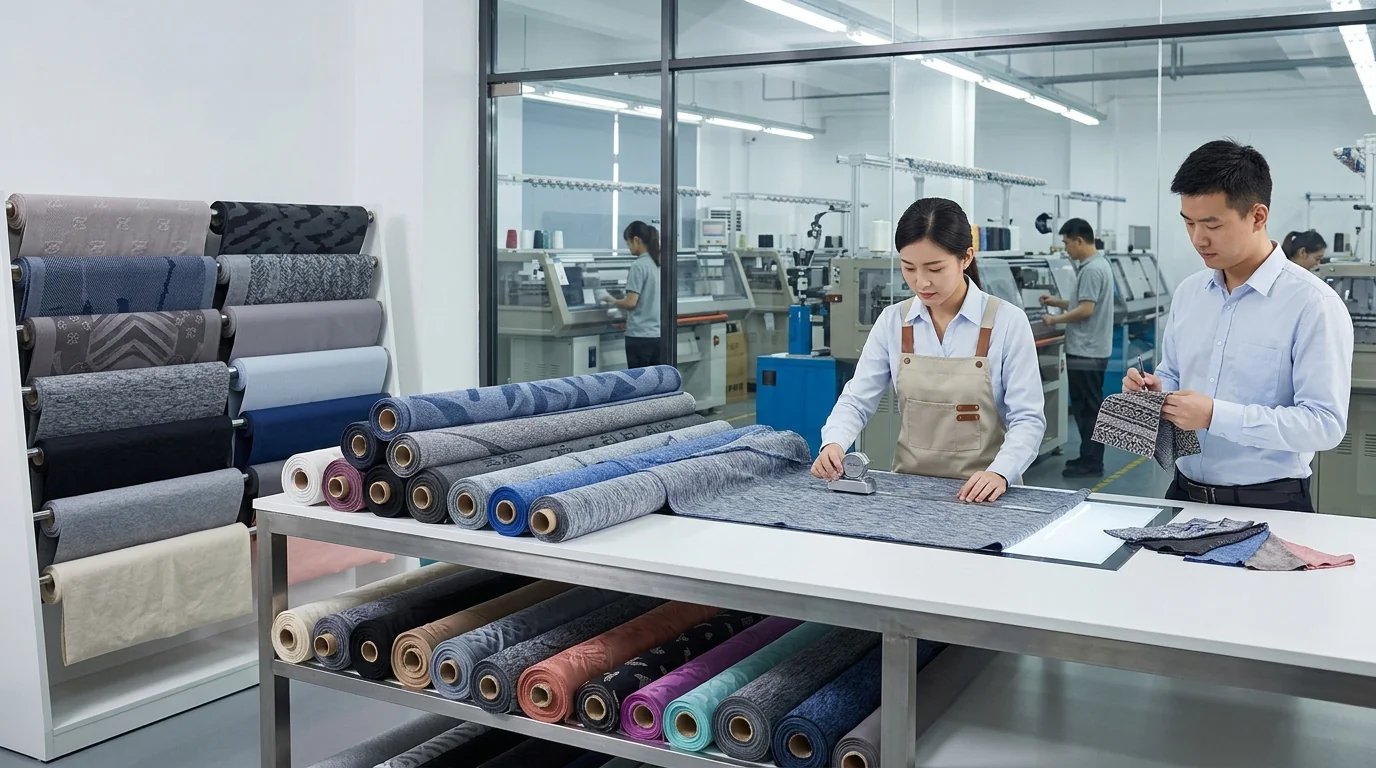
Fabric
Choose GSM, stretch ratio, fiber blend — nylon, poly, recycled, bamboo & more

Color
Pantone-matched dyeing, colorblock, ombre & sublimation print available

Logo
Screen print, embroidery, heat transfer, sublimation — all in-house

Label
Woven, printed & hang tags — private label with your brand name

Packaging
Polybag, box, eco-mailer — branded & retail-ready packaging

Stitching
Flatlock, coverstitch, overlock & bonded seams — spec-driven construction

Pattern
All-over sublimation, block print & engineered print patterns

Fit
XS–3XL grading, compression to relaxed fit, your exact silhouette
Fabric & Performance Features
Technical fabrics engineered for yoga performance — choose your base, we spec the rest to your brief.
Fabric Types
Nylon Spandex
High stretch recovery, ultra-soft hand, premium performance feel
Polyester Spandex
Cost-effective, moisture-wicking, ideal for sublimation printing
Recycled Fabric
GRS-certified recycled nylon/polyester — sustainability-forward
Brushed Fabric
Peach-skin brushed interior, ultra-cozy for lounge & winter styles
Performance Features
Fabric Comparison
| Fabric | Composition | GSM Range | Best For |
|---|---|---|---|
| Nylon Spandex | 80% Nylon / 20% Spandex | 160–220 GSM | Leggings, bodysuits, bras |
| Polyester Spandex | 88% Polyester / 12% Spandex | 180–240 GSM | Sublimation print styles |
| Recycled Nylon | 78% rNylon / 22% Spandex | 160–200 GSM | Eco-conscious brands |
| Brushed Fleece | 85% Polyester / 15% Spandex | 280–340 GSM | Hoodies, joggers, sweatshirts |
Every stage carries a signature — pattern at D1, process at D3, fit at D7, QC at D14.
Four named engineering checkpoints between brief and bulk. Each one signs the file before it moves — pattern grading at D1, process detail at D3, fit by yoga-action at D7, and a sampled final inspection at D14. Nobody hands work over without writing their name to it.
-
Checkpoint 1/4
D1 Pattern Engineer
Grading rule check (XS–3XL ISO 8.5), balance verification, seam allowance audit. Sign-off before any cloth is touched.
See revision rules → -
Checkpoint 2/4
D3 Process Engineer
Flatlock vs coverstitch routing, stitch density per zone, decoration tooling pre-flight. The detail nobody else writes down.
See 32-day timeline → -
Checkpoint 3/4
D7 Fit Engineer
Deep-knee bend, forward-fold, inversion — fail any one (seam pop, fabric sheer, waistband roll) and it goes back to pattern desk same day.
In-house engineering team → -
Checkpoint 4/4
D14 QC Engineer
Final sampling inspection: measurement, stitch density, color ΔE, packing, labeling. PDF report shared before balance request.
Sign-off rules →


Revision rounds land free at D7, D10, D14 — the fourth is paid, and the rule is signed before we cut.
Revision policy public, signed before sample-fee invoice. Five clauses cover free rounds, paid round, scope-creep, sign-off windows, and NDA timing. The first and third clauses are the two everyone asks about — both expanded by default.
Development sample fee: $80–180 per SKU, credited back on a sliding scale that reaches 100% once bulk hits 1,000 pcs — full schedule on the sample policy page.
1 Three free revision rounds (D7 / D10 / D14)
3 rounds free — D7 fit / D10 wear-test / D14 grading. Fees for paid rounds follow the same sliding credit-back scale as the sample fee (see our wholesale yoga apparel pricing tier matrix).
2 Fourth round paid — per-round fee, credited back to bulk PO
Beyond the third free round, every additional revision is invoiced as a per-round engineering fee. The fee is fully credited back to your bulk PO when you place it — not a hidden margin grab, just a discipline switch on scope.
3 Scope-creep policy — rewriting spec counts as new brief
If a revision rewrites the silhouette, fabric base, or decoration method, we treat it as a new brief and the round counter resets. We’ll flag it in writing the same day so nobody discovers the change at QC. See full clause text in OEM yoga apparel revision standard.
4 Sign-off window — 24 business hours per stage
Sign-off window: 24 business hours per stage. No reply = clause auto-approved, timeline keeps moving. We hold the calendar; you hold the veto — both clocks visible to both sides on the daily stand-up board.
5 NDA disclosure — mutual, signed before tech-pack opens
NDA goes out with our first reply — mutual, signed before we open your tech-pack. Your IP stays yours; our patternmaker’s notes stay ours. Records destroyed within 24 months of last PO unless you renew.

A block releases only when the fit protocol clears — typically by round three, never past round five.
A new yoga silhouette typically converges in three to five pattern iterations before we release grading for bulk. That number isn't padding — it's what it takes for a stretch garment to behave identically on paper, on a mannequin, and on a moving body. Here is what a round contains and what the test actually measures.
Anatomy of a revision round
Each round starts from your written notes plus our internal red-pen file, and only the deltas are re-cut — if the issue is strap width, we don't re-make the gusset. Changes are logged on the tech-pack itself, so by round three the document reads as a fit history: what moved, by how much, and why. That paper trail is what makes round four rare; most briefs converge at the second or third pass because nothing is being re-litigated from memory.
Where a change touches dyed cloth — say a colour-blocked panel boundary shifts — the lab dip is re-confirmed inside the same round rather than spawning a separate approval thread.
The squat-test, operationally
The fit engineer takes the sample through a timed sequence — full-depth squat held under direct light, forward fold, and an inversion hold — while a second engineer photographs three things: fabric sheer at maximum stretch, seam behaviour at the gusset and waistband, and whether any edge rolls or migrates. The garment is then re-measured to confirm it returned to spec dimensions after load.
A block does not leave sampling until it passes clean, and its fabric carries a recovery score from a 100-cycle stretch-and-wash protocol — so "it fit in the showroom" is never the standard your bulk run is built to.
OEM and ODM workflow
Two workflows, one factory floor — pick the path that fits your brief and follow the dedicated service page for the full gate-by-gate breakdown.
The signatures belong to in-house people — averaging 6.5 years on a yoga-apparel floor.
Four engineering roles, four sign-off chips, all in-house — not outsourced to a separate workshop. Fit engineer doubles as a certified yoga teacher, which is why pose-based fit checks and inversion sit inside our review checklist instead of an outside lab.

-
Pattern Engineer
Grading + balance
8 yrs in-house Sign-off: D1- XS–3XL grading rule (ISO 8.5)
- Pattern balance + ease distribution
- Seam allowance audit pre-cut
-
Process Engineer
Stitch + decoration tooling
6 yrs in-house Sign-off: D3- Flatlock vs coverstitch routing
- Stitch density per body zone
- Decoration tooling pre-flight
-
Fit Engineer (Yoga Teacher)
Squat + fold + inversion
5 yrs in-house Sign-off: D7- Certified 200-hour yoga teacher
- Pose sequence: bend, fold, inversion
- Waistband roll + sheer-out audit
-
QC Engineer
AQL 2.5 final inspection
7 yrs in-house Sign-off: D14- Sampled lot inspection
- Color ΔE + measurement audit
- Pre-shipment PDF report w/ photos
Tools photographed at our floor, Q1 2026 — engineer faces redacted for personal privacy.
Every dimension has a lock day — miss it, and the calendar pushes back, not the factory.
The customization dimensions above don’t freeze all at once. Each one locks on the day the sampling loop consumes it — which is why a late colour change costs nothing and a late fit change costs a round. Plan your internal approvals against this map.
D0 · Fabric & fit intent
Fiber blend, GSM target, and compression-to-relaxed positioning enter with the brief. The gap-list reply exists precisely to chase these — D1 cannot open without them.
D1 · Silhouette & size span
Ease, fit numbers, and the XS–3XL span freeze when the block opens. Rewriting them later is, by the signed clause, a new brief — the round counter resets.
D2 · Colour
Pantone or HEX references go to the dip lab. Colour stays adjustable while dips are live; once bulk dyeing is scheduled, a recipe change means a new lot, not a tweak.
D3 · Stitching
Flatlock-versus-coverstitch routing and per-zone density are signed at the stitch map, and decoration tooling is pre-flighted in the same pass — seam decisions and branding hardware travel together from here.
D5 · Logo, label & print placement
Decoration is applied to the sample itself, so you approve branding as sewn rather than as a mockup. A placement shift after D5 re-runs only the decoration step, never the pattern.
D7 · Packaging & presentation
Polybag, hangtag, and eco-mailer specs ride along with first-piece sign-off, so the bulk PO opens with retail presentation already decided instead of trailing it by a courier cycle.
What a Toronto DTC founder signed off on — second PO at 3,200 pcs.
One DTC founder, four-SKU sublimation legging line, two POs in one quarter. The kind of ramp that only happens when first-piece doesn’t miss and the third revision round catches a strap-width gap before the bulk run.

- DTC founder
- Toronto, CA
- 4 SKU sublimation legging
- 800 → 3,200 pcs ramp
“Tech-pack ack same day, first-piece in 7. Three free revisions caught a strap-width issue we missed.”
DTC founder · Toronto, CA · Q-current
Name and brand redacted under mutual NDA — verifiable under NDA on request.