Asking for a quote before you understand pricing puts you at a disadvantage from the start. It's like negotiating a car price without knowing the difference between MSRP and dealer cost — you're already behind.
Most yoga brand founders learn this the hard way. custom yoga wear pricing is not a single number. It's a layered formula built on fabric grade, order volume, construction complexity, and a dozen variables your supplier won't always share upfront.
Launching your first private label collection or scaling an existing line — either way, gaps in your knowledge about activewear manufacturing price breakdowns will cost you. That means budget overruns, margin miscalculations, or a product that simply doesn't perform.
This guide breaks down the pricing wall completely. You'll get:
Real cost structures behind activewear manufacturing
Honest MOQ benchmarks you can actually use
The exact information you need to walk into any supplier conversation with confidence
The Real Price Formula: What Every Quote Covers
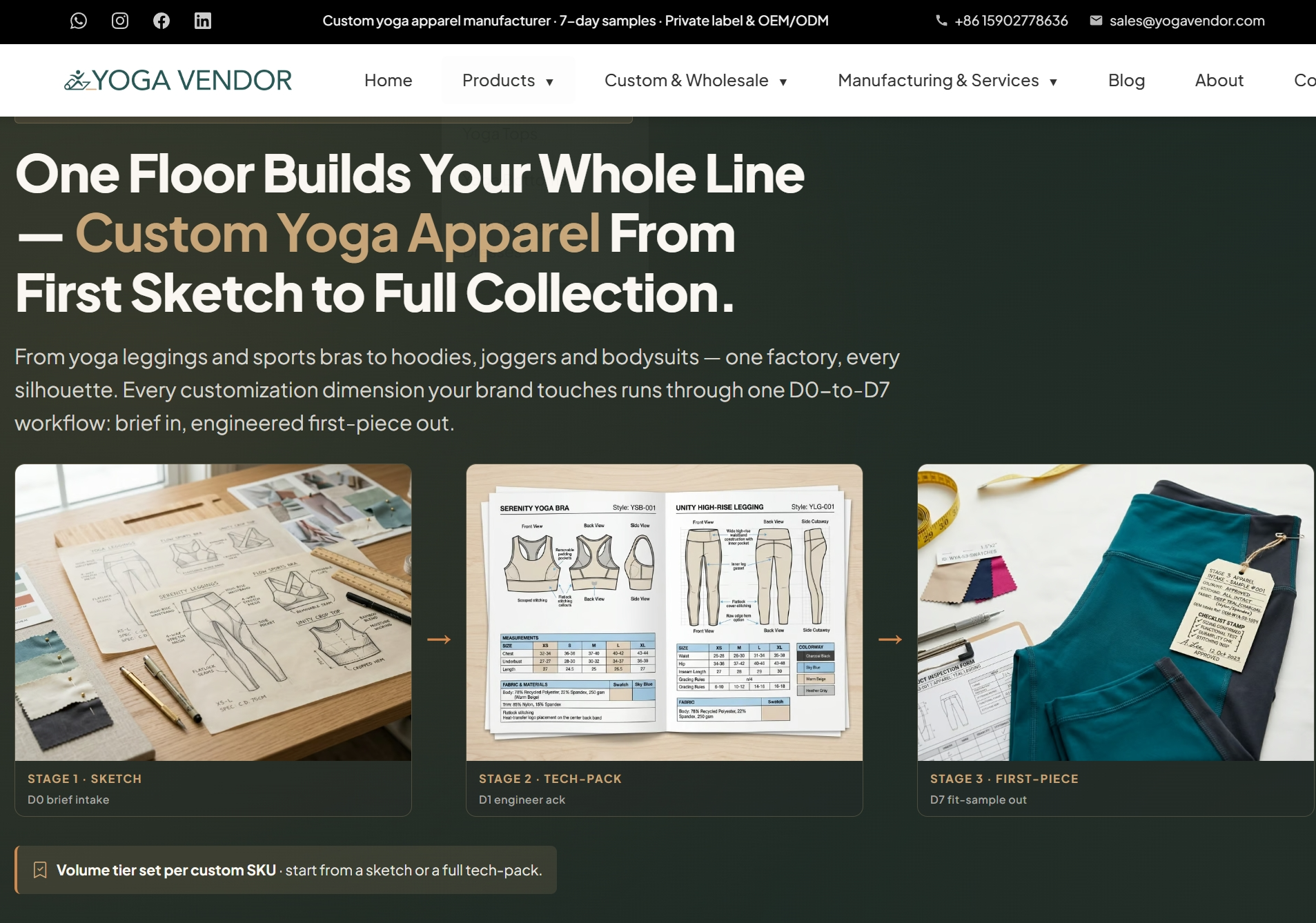
Every supplier quote runs on the same underlying formula — whether they show you the math or not.
Here's what that formula looks like:
Unit Cost = (Fabric + Labor + Trims & Hardware + Print/Embroidery + Packaging + Waste Allowance) ÷ Order Quantity × (1 + Factory Overhead & Margin)
Six cost layers. Every single one affects your final number.
Here's how each layer breaks down in real percentages:
Fabric: 40–60% of total cost — the single biggest variable in any activewear manufacturing price breakdown
Labor: 15–25% — goes up fast with more structural complexity
Trims & brand hardware: 5–10% — labels, elastic, chest pads, zippers
Print/embroidery: 5–15% — costs drop at higher volumes
Packaging: 2–5%
Waste & quality losses: 3–8%
Factory overhead + profit margin: 15–25% added on top
Run a real example. A 1,000-unit custom yoga top in mid-grade nylon-spandex fabric comes to ¥46–52 EXW per unit . That's before shipping, duties, or development costs touch the number.
That's your factory price. Not your landed cost. Not your true yoga clothing production cost . These are two very different numbers. Mixing them up is where most startup budgets fall apart.
Fabric & Materials Cost Breakdown: The #1 Price Driver in Yoga Activewear
Fabric doesn't just influence your price — it is your price.
In activewear manufacturing, fabric and trims together account for 35–55% of total FOB garment cost on a standard pair of yoga leggings. That's more than labor. More than packaging. More than every other line item combined. Don't understand what's driving that number? You can't evaluate a quote — period.
Here's what you need to know.
The Three Fabric Tiers (And What Each One Costs You)
1. Polyester-Spandex — The Economy Workhorse
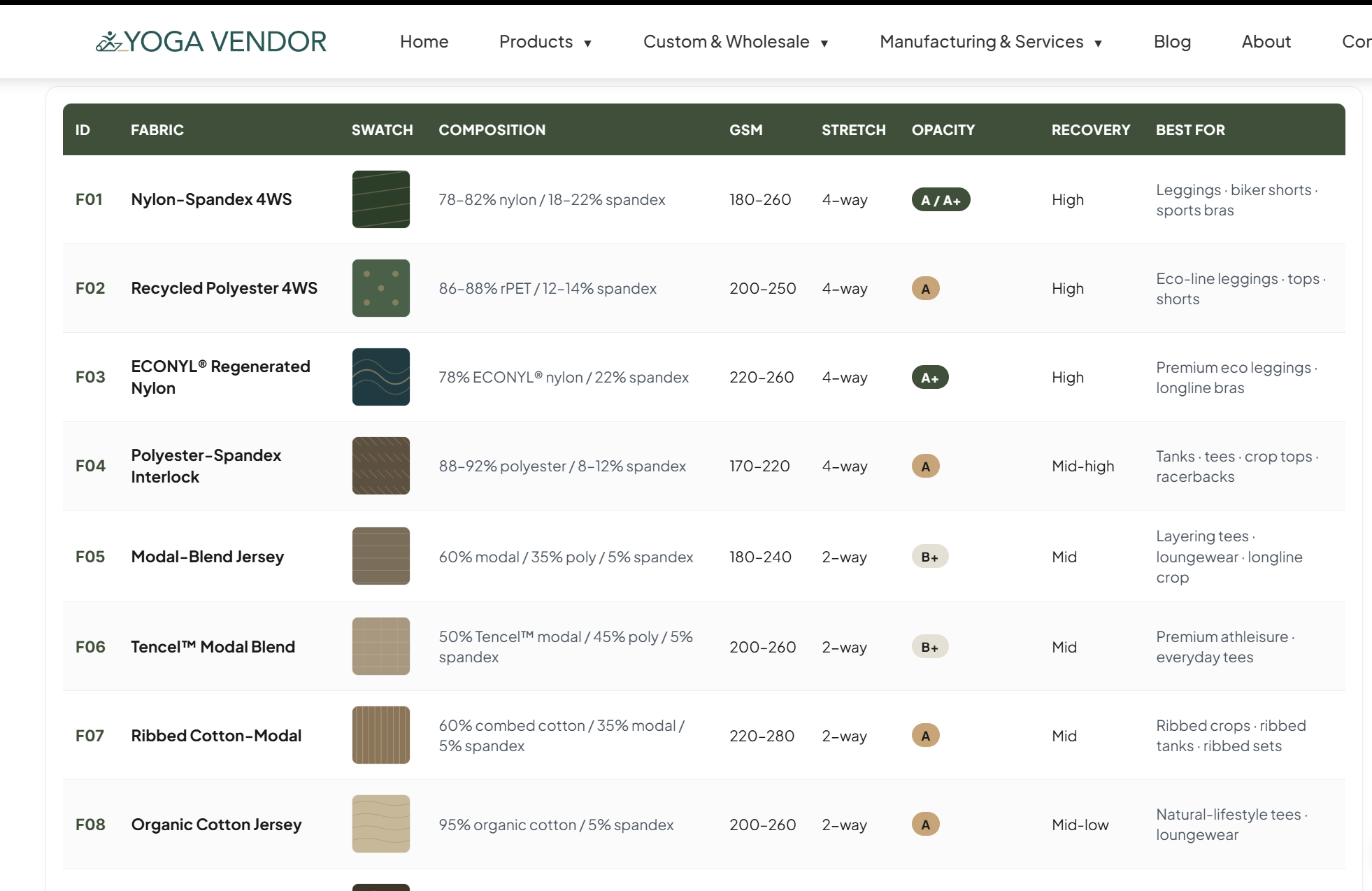
This is the most common composition in mass-market yoga wear: 73% polyester / 27% spandex , at 200–240 GSM .
Bulk mill pricing: ~US$3–6/yard
Fabric cost per legging (0.8–1.1 yard): ~US$2.40–4.40/piece
Starting FOB at 300–500 units: ~US$5–7/piece
Strong moisture-wicking, quick-dry, sublimation-friendly. The tradeoff? Handfeel. You won't get that buttery, second-skin sensation premium customers expect.
2. Nylon-Spandex — The Premium Standard
This is where serious yoga brands live. Typical composition: 75–85% nylon, 15–25% spandex , at 250–300 GSM .
Retail fabric pricing: ~US$15–25/yard
Fabric cost per legging: ~US$12–22/piece depending on GSM
Starting FOB at 300–500 units: ~US$8–12/piece
That's 1.5–2× the fabric cost of an equivalent polyester blend. You get superior softness, opacity, and abrasion resistance. Plus, you get the squat-proof performance that high-end customers pay for. The premium is real — and so is the customer loyalty it builds.
3. Recycled / Eco Blends (rPET-Spandex)
rPET-spandex sits between the two tiers in both cost and performance.
Mill pricing: ~US$4–8/yard
Starting FOB: ~US$7–10/piece
Performance: comparable to polyester, not nylon
It runs 10–30% higher than virgin poly-spandex. The sustainability story supports mid-to-premium price positioning. But be honest: if your target customer expects a luxury handfeel, rPET won't deliver it the way nylon does.
Why GSM Changes Everything
GSM (grams per square meter) is the most misunderstood variable in yoga wear fabric cost per meter discussions. Most brands overlook it — and it ends up costing them.
Here's the direct relationship:
GSM Range | Performance | Squat-Proof Rating | Cost Impact |
|---|---|---|---|
Below 200 gsm | Lightweight, breathable | ⚠️ Transparency risk | Lower |
220–260 gsm | Balanced feel + coverage | ✅ Good opacity | Moderate |
270–310 gsm | High compression, premium | ✅✅ Excellent | Higher |
For yoga pants, 250–320 GSM is the industry benchmark for squat-proof performance.
The cost math is simple. Upgrading from 220 GSM to 280 GSM nylon-spandex adds US$3–5 in fabric cost per piece . Run standard margin multipliers across a retail chain, and that one GSM decision can mean a US$10–20 difference in retail price .
That's not a small call. It's a positioning decision.
Your Quick Fabric Budget Framework
Before you contact any yoga apparel supplier, lock in these four decisions:
Target tier — Economy (poly-spandex, US$5–7 FOB) or Premium (nylon-spandex, US$8–12+ FOB)?
GSM band — Minimum 250–320 GSM for squat-proof yoga pants; below 230 GSM for shorts or lightweight collections only
Fabric consumption — Budget 0.8–1.1 yards per legging ; target fabric share at 35–55% of FOB
Spandex ratio — Higher spandex (20–30%) increases stretch, compression, and cost; 80/20 or 85/15 nylon-spandex hits the sweet spot for premium studio wear
Know these numbers before your first conversation. Suppliers will respect the preparation. Plus, you'll spot right away whether a quote reflects the fabric grade you asked for — or something cheaper.
Workmanship, Construction & Design Complexity: Where Hidden Costs Live
Two yoga leggings can look identical on a flat lay. Same colorblock. Same silhouette. Same minimalist aesthetic. But the construction tells a different story. One uses basic flatseams with zero structural reinforcement. The other has flatlock stitching, contoured pattern pieces, gusset reinforcement, and mesh panel inserts at four seams.
The price difference? 20–40% more per unit. Most brands never see it coming.
This is where activewear manufacturing costs turn brutal — fast.
The Stitching Beneath the Surface
Flatlock (4-needle 6-thread) stitching runs about 30% more expensive than standard flatseam construction. It's the industry benchmark for high-stretch yoga and performance wear. It lays flat against the skin, cuts friction, and holds up under repeated movement cycles. That price premium comes from two places: specialized equipment and longer sewing time per piece.
On its own, the per-unit impact is manageable. Stack flatlock with three other complexity upgrades, though, and your unit labor cost climbs fast.
These are the construction details that drive up your yoga clothing production cost:
Gusset reinforcement — Adds one or more extra seaming passes at the crotch panel. Quote this as a separate line item. Factories often fold it into "standard construction" — which means it gets underpriced, then corrected after sampling.
3D / contoured pattern cutting — More pattern pieces, more fit iterations, more steps on the floor. The hidden cost lives in sampling time and sewing hours, not in the fabric itself.
Mesh panel inserts — Every splice point adds fabric switching, alignment work, and rework risk. More panels means higher labor and a higher defect rate.
Pocket structures — Side pockets, hidden waistband pockets, internal zip pockets. Each one needs cutting, binding, securing, and inspection. A single functional pocket adds real per-piece labor time. At lower order volumes, that cost hits harder because there's less volume to spread it across.
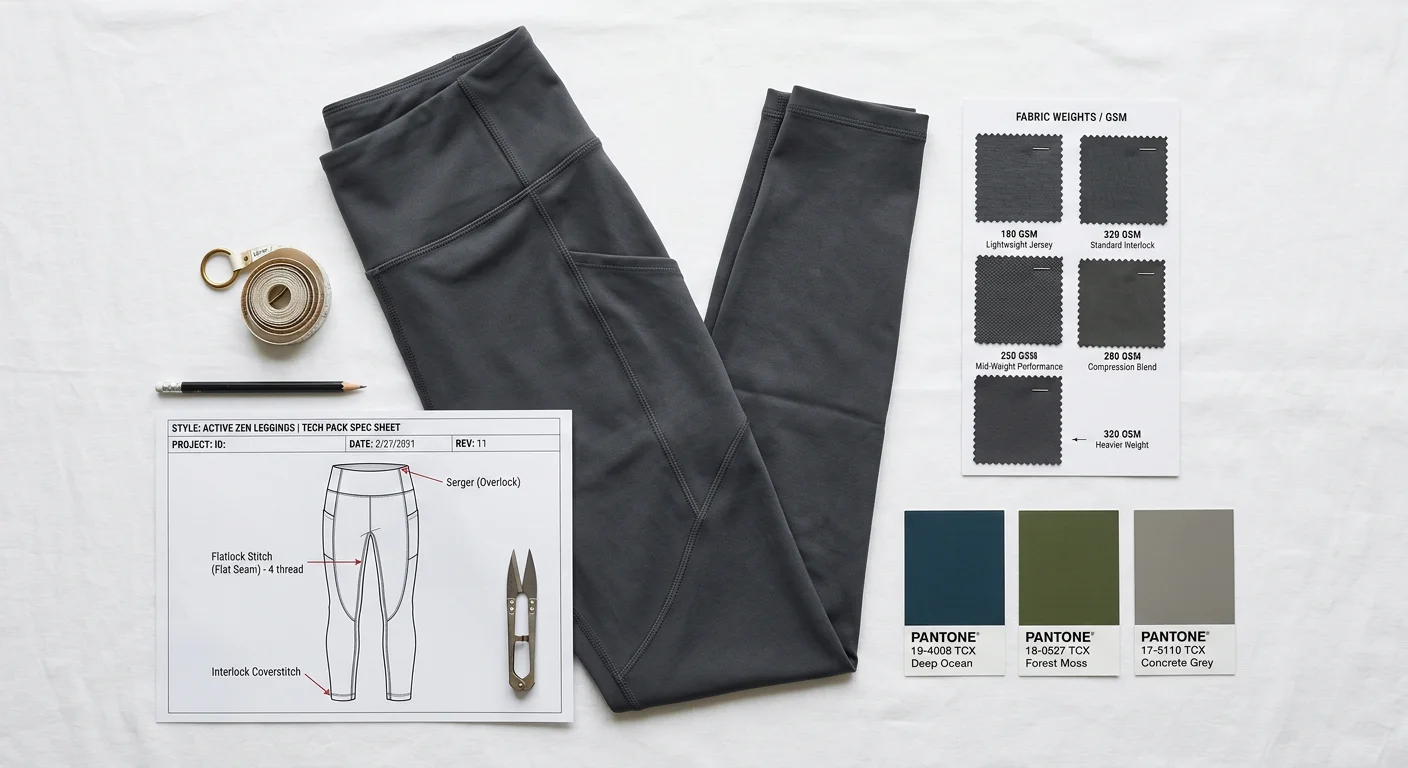
The Tech Pack Is Your Cost Control Tool
Here's the core problem: send a supplier a photo instead of a Tech Pack, and they quote you their default version of that garment. Not yours. Theirs.
Default means the cheapest construction that matches the visual. Your sample arrives with flatlock and reinforced stitching — because that's what the photo suggested. So the quote gets revised. Higher. Always higher.
These are the Tech Pack fields that control quote accuracy:
Tech Pack Field | What to Specify |
|---|---|
Stitch type | Flatlock / coverseam / flatseam / double-needle |
Panel splicing | Number of panels, position, color break points |
Reinforcement | Gusset, shoulder, high-stress zones — needle count |
Pocket structure | Type, opening direction, concealed or visible |
Pattern complexity | Contoured vs. flat; number of fit iterations required |
Split every design into two versions before you talk to any factory: a baseline construction BOM and a full-spec BOM. Get separate quotes on each. The gap between those two numbers shows you what your design complexity is actually costing — before you commit to a purchase order.
Visual complexity and construction complexity are not the same thing. The sharpest cost-control move at the design stage is sorting which details create perceived premium value and which ones just drive up labor cost. Protect the first group. Negotiate the second.
Printing, Branding & Embellishment: What Each Technique Costs
Your logo is three inches wide. It sits on the left hip of a matte-black legging. Simple, right?
Wrong. That three-inch logo is a procurement decision with at least five viable execution paths — and a cost range that spans from $0.15 to $3.00 per unit depending on which one you choose. Pick the wrong technique for your volume, and you're either overpaying at scale or burning setup costs on a run too small to justify them.
Here's every major technique broken down, with real numbers.
Screen Printing: High Volume, Low Per-Unit Cost
Screen printing is the cost-efficient workhorse once your volumes climb. The economics are straightforward: you pay a fixed setup cost per color, then a low incremental cost per piece.
Setup (screens): $15–30 per color for a simple chest logo; $50+ per color for large, complex artwork
Per-unit cost at 500–1,000 pieces:
1-color small logo: $0.15–0.35/piece
3–4 color chest graphic: $0.30–0.60/piece
Large front or back panel print: $0.50–1.00/piece
The volume threshold matters. Screen printing starts making financial sense at 500–1,000 pieces per colorway . Below that, you're paying heavy setup costs spread across too few units — and your effective per-piece cost balloons.
DTG / DTF Printing: Flexibility Without Tooling Fees
No screens. No minimums. No waiting.
DTG (direct-to-garment) and DTF (direct-to-film) cut out setup costs completely. That makes them the go-to for early-stage brands testing colorways or doing limited drops.
Per-unit cost on light fabrics:
Small logo: $0.80–1.50/piece
Full chest / half-panel graphic: $1.50–3.00/piece
Dark fabrics require a white ink underbase — expect a 30–60% cost premium on top of those figures
The crossover point sits at 200–500 pieces per design . Under that number, DTG/DTF wins on total cost. Above 500 units, screen printing undercuts it on per-piece cost — even after setup fees.
All-Over Sublimation: Built for Polyester, Built for Yoga
Sublimation is the technique that makes gradient colorblocks and edge-to-edge prints possible. It's the default choice for polyester-dominant yoga wear.
The process works print-before-cut: heat transfers ink into the fabric roll, then panels are cut and sewn. Pattern alignment across seams becomes a real production variable — and a real source of rework cost.
Sublimation ink and paper cost: ~$0.80–1.50/m²
Per-legging print cost (0.7–1.0 m² fabric area): $0.70–1.50/piece
Finished garment sublimation add-on: $1.00–2.50/piece depending on design complexity and batch size
One hard constraint: sublimation bonds with polyester fibers at a chemical level. On nylon or cotton blends, the color fades fast. So if you're working with premium nylon-spandex fabric for its superior handfeel, sublimation is off the table. You'll need to rethink your branding approach from the ground up.
MOQ runs 300–500 meters per colorway , or around 300–500 finished pieces per design.
Silicone & Rubber Patches: The Premium Hardware Signal
Molded silicone logos do something no print technique can: they add tactile dimension. That three-dimensional chest badge communicates premium quality before the customer reads a single word.
The cost structure has two components — tooling and per-unit.
Mold/tooling fee: $50–150 for single or dual-color; $200+ for complex multi-color 3D logos
Per-patch cost (at 500–1,000+ pieces):
Small logo (20–40mm): $0.10–0.30/patch
Large badge or dimensional logo: $0.30–0.80/patch
Heat-press application labor: add $0.05–0.15/piece per placement
MOQ runs 500–1,000 patches per design per colorway . The mold fee is a one-time investment. Spread across larger runs, the per-piece premium shrinks fast.
Embroidery: Durability at a Per-Stitch Price
Embroidery signals craftsmanship. It also costs more than most brands expect — because you're paying per stitch, not per square inch.
Digitizing fee: $10–30 per logo design
Per-unit cost at 500+ pieces:
Simple logo (5,000–8,000 stitches): $0.40–0.80/piece
Large lettering or badge (10,000–20,000 stitches): $0.80–1.50/piece
Complex large-format embroidery: up to $2–3/piece
Minimum runs start as low as 50–100 pieces, but you won't hit the per-unit costs above until you're at 500+. The durability is unmatched — embroidery outlasts wash cycles that will degrade any heat-transfer technique over time.
Foil Stamping & Heat Foil Transfer: High Visual Impact, Modest Cost
Gold and silver foil is a premium visual signal at an accessible price point. Research from the print industry shows foil treatment can increase perceived product value by 24–89% compared to standard printing — making it one of the highest ROI embellishment choices for brand packaging and labels.
On garments:
Setup/tooling fee: $20–50 per design
Per-unit cost at 500+ pieces:
Small logo: $0.15–0.40/piece
Large lettering or graphic: $0.40–0.80/piece
MOQ: 300–500 pieces; some factories require 1,000+ for mid-range pricing
Branding Hardware: The Per-Piece Cost of Looking Like a Real Brand
The logo on the outside is obvious. The brand identity built into the garment itself — that's what separates private label from a generic yoga wear manufacturer's blank.
Branding Component | Setup Cost | Per-Unit Cost | MOQ |
|---|---|---|---|
Woven waistband label (small) | $20–50/design | $0.08–0.20/piece | 1,000–2,000 pcs |
Jacquard logo elastic waistband | $50–150/design | $0.40–0.90/piece | 1,000+ pcs |
Tagless heat-transfer inside label | $15–30/design | $0.05–0.20/piece | 500–1,000 pcs |
Printed hangtag (standard) | $20–50/design | $0.03–0.08/piece | 5,000 pcs |
Hangtag with foil / UV / emboss | $20–50/design | $0.08–0.20/piece | 1,000–3,000 pcs |
A complete branded package — woven waistband label, tagless inside label, printed hangtag, and a small silicone chest logo — adds $1.00–2.50 per finished piece at a 500–1,000 unit run. That's your baseline budget for branding hardware before a single stitch of the garment itself is cut.
The Technique Selection Framework
Don't choose a technique based on what looks good. Choose based on three variables: volume, fabric type, and positioning tier.
Technique | Best For | Volume Sweet Spot | Avoid If |
|---|---|---|---|
Screen print | Bold graphics, flat colors | 500–1,000+ pcs | Low-run tests |
DTG / DTF | Complex art, small batches | Under 200–500 pcs | Dark fabrics at scale |
Sublimation | All-over patterns | 300–500 pcs minimum | Nylon or cotton blends |
Silicone patch | Premium tactile branding | 500–1,000+ pcs | Tight per-unit budgets |
Embroidery | Durability, heritage positioning | 500+ pcs | High-stitch count at low MOQ |
Foil transfer | Luxury signal, packaging | 300–500+ pcs | Repeated wash cycles |
The fastest way to overspend on embellishment is picking a high-volume technique for a small order — or spending on a premium method that your price tier can't support. Know your volume. Know your customer. Then choose your technique.
MOQ & Order Quantity: How Volume Controls Your Unit Cost
Volume isn't just a number on a purchase order. It's the single most powerful lever you have over your unit cost.
Here's the brutal truth about minimum order quantity yoga wear : factories don't set MOQs at random. Every MOQ is a fixed-cost recovery threshold. The factory needs a minimum dollar value of production to cover cutting setup, fabric procurement, dye batches, and screen fees. Say a single-piece cost is $50 and the factory needs $5,000 to break even on fixed costs. Your MOQ is 100 units. Simple math. No room to argue.
How the Numbers Move
The cost drop between a small run and a standard batch is steeper than most brands expect. It also doesn't scale in a straight line.
Order Volume | Typical Unit Cost Premium | Notes |
|---|---|---|
50–100 units | +20–40% above standard | Fixed costs spread across fewest pieces |
100–300 units | Approaching standard pricing | Most Asian OEM yoga apparel factories' entry range |
300–500+ units | Standard MOQ pricing | Cost curve flattens past this point |
1,000+ units | Volume discount territory | Marginal savings shrink beyond this point |
The sharpest cost reduction in yoga leggings bulk pricing almost always hits in that first jump — from a low-MOQ small order up into standard production range. Push from 60 to 300 units and you can expect a 15–25% unit cost reduction . In some cases, that gap stretches to 40%.
After that? The curve flattens. Doubling your order from 500 to 1,000 pieces won't get you anywhere near the same proportional savings.
Why Factories Can't Just "Make It Work" on Small Orders
Four hard constraints sit behind every MOQ. Understand them and you'll have real negotiating leverage:
Fabric minimum cut quantities — Mill fabric procurement needs a minimum yardage to keep waste ratios viable. Drop below that threshold and cutting loss pushes up your per-unit fabric cost fast.
Dye batch minimums — Color dyeing runs in batches. A small order means your batch cost per piece spikes. Consolidating colorways across SKUs is one of the fastest ways to take pressure off this number.
Print plate and setup fees — Screen fees, sublimation plate costs, and mold fees are fixed. Fewer pieces absorb those costs, so each piece gets more expensive.
Upstream supplier MOQs — Your custom yoga wear manufacturer has their own fabric and trim suppliers — each with their own MOQs. Those upstream requirements flow straight down into your finished goods minimums.
Three Negotiation Moves That Work
Most brands try to negotiate MOQ by asking for a lower number. That approach falls flat. These three moves get results:
Trade unit price for MOQ flexibility. Factories will often lower minimums if you absorb the fixed cost through a higher per-piece price. Run the total spend math. A smaller order at a 20% premium can still cost less overall than overcommitting on inventory.
Consolidate SKUs around shared materials. Use the same fabric, same trims, and same packaging across multiple styles. This cuts the factory's upstream procurement needs and softens their MOQ floor.
Ask the factory to itemize why the MOQ exists. Is it fabric? Dyeing? Print setup? Packaging? Once you know the root constraint, you can adjust your specs to tackle it head-on. That's far more effective than pushing back on a number with no context behind it.
The bottom line on private label activewear MOQ : low MOQ doesn't mean lower cost. Pay a 20–40% unit price premium to hit a 100-piece minimum instead of 300 and your total production spend can end up higher — not lower. Run the full order economics before you optimize for flexibility alone.
Benchmark Price Ranges by Business Model (Reference Table)
The single biggest mistake yoga brand founders make reading yoga wear supplier quotes? Comparing numbers across different business models as if they're the same thing.
A $4 EXW unit cost and a $40 EXW unit cost can both be "correct" — it depends on how you're producing and who you're producing for. The number makes sense only inside its context.
Here's every major production model mapped to real MOQ ranges and EXW unit costs.
The Four Production Models — Side by Side
Business Model | Typical MOQ | Typical EXW Unit Cost | Best For |
|---|---|---|---|
Print on Demand (POD) | 1 piece minimum; 50–100 orders/month recommended | $3–12/piece (varies by product type and print complexity) | Early-stage testing; content-driven or influencer brands |
US Small-Batch OEM | 30–500 pieces/style | $8–60/piece (basic to premium construction) | Funded startups needing "Made in USA" positioning; fast turnaround |
Asian Mid-Volume OEM | 500–2,000 pieces/style (some factories accept 200–500) | $2–20/piece (basics to mid-high end) | Scaling brands; mass-market e-commerce |
High-Complexity OEM | 300–1,000+ pieces/style | $20–200+/piece (complex fashion, leather goods, footwear) | Premium or luxury positioning; mature brand hero SKUs |
What These Numbers Mean for Custom Yoga Wear
For a standard custom yoga legging , here's your realistic price range:
POD route: $7–12/piece — no tooling, no inventory risk, but no pricing power at scale
Asian OEM yoga wear at 300–500 units: $8–12/piece in nylon-spandex (mid-grade); $5–7/piece in poly-spandex
Asian OEM at 1,000+ units: $6–10/piece for premium construction — you're in volume discount territory, but the curve flattens fast
US small-batch OEM yoga wear: $15–30/piece for equivalent specs — you pay for proximity and the "Made in USA" story
The EXW-to-Retail Math You Cannot Skip
Every number in this table is an EXW factory price . That's not your landed cost. It's not your true custom yoga pants unit cost . It's just the starting line.
Here's what stacks on top before a single unit reaches your customer's doorstep:
Air freight (small batches): +$0.80–3.00/piece
Ocean freight (bulk): +$0.20–0.80/piece
Import duties: +5–20% of declared value (country-dependent)
Domestic fulfillment and warehousing: +5–15% of product cost
Platform fees + payment processing: +10–20% of selling price
Run the full math using this framework:
Retail Price = EXW Cost × Cost Multiplier (1.5–2.2) × Retail Markup (2–6×)
Premium yoga brands price at 6–10× EXW . Mass-market e-commerce runs closer to 3–4× . Your margin model not working at those multiples? The problem sits upstream. Either your production model or your MOQ is wrong for where your brand stands right now.
Pick the model that matches your current stage. Then build your pricing backward from there.
5 Variables That Will Push Your Quote Higher (Or Lower)
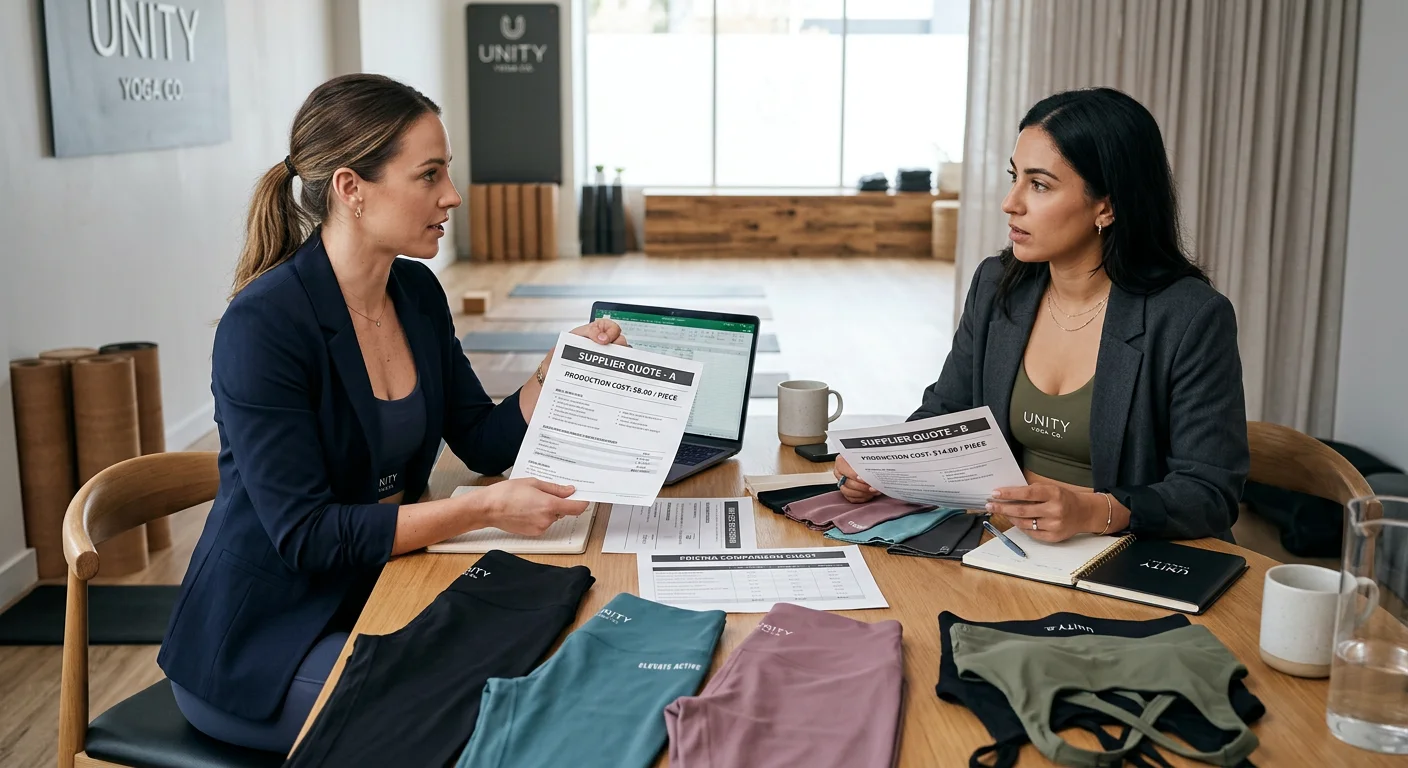
Two brands send the same RFQ to the same yoga apaprel factory. One gets a quote of $8/piece. The other gets $14/piece. Same silhouette. Same colorway. Different specs — and a $6 gap that neither founder can explain.
That gap doesn't come from nowhere. It comes from five variables. Master them, and you can predict where your quote lands before a supplier ever runs the numbers.
Variable 1: Fabric Grade and GSM
You already know fabric dominates your cost structure. What most brands miss is how much GSM actually moves the number.
Every 20–30 GSM increase in the same fiber and yarn count adds 8–15% to your per-piece fabric cost . That's not a rounding error — that's a margin decision.
The same logic applies across fiber grades. Moving from a standard C20 ring-spun cotton to a C40 combed cotton raises your raw fabric cost by 40–70% per piece — before a single stitch is sewn. On nylon-spandex yoga wear, going from 220 GSM to 280 GSM adds $3–5 in fabric cost per piece . Multiply that across 500 units. You're looking at a $1,500–$2,500 swing on fabric alone.
Dyeing method stacks on top. Reactive-dyed fabrics at basic colorfastness (Grade 3–4) sit at standard cost. Push to Grade 4–5 — which performance sportswear and children's activewear often require — and fabric cost climbs another 5–10% . Plus, third-party colorfastness testing adds $0.02–0.05 per piece in amortized lab fees.
Variable 2: Design and Construction Complexity
Sewing labor runs 20–35% of total garment cost . Every added operation cuts straight into that number.
A standard short-sleeve top takes about 10–12 sewing operations, 30–35 seam passes, and 8–10 minutes of floor time. Add shoulder splicing, side panel inserts, and chest patchwork. Now you're at 16–20 operations, 45–55 passes, and 40–60% more sewing time per piece . At $25 RMB/hour, your sewing cost moves from $3.30/piece to $5.30/piece — on labor alone, before fabric is touched.
Construction choices that push quotes higher:
Three-piece or structured sleeves vs. a single-piece dropped shoulder
Full lining (jacket, windbreaker) — doubles cutting and sewing time across both shell and lining layers
Contoured seaming and bust darts on women's fits — tighter tolerances push rework rates from 1–2% up to 3–5%
Specialty finishing adds another layer. Sandblasting, enzyme washing, or distressing on denim-adjacent pieces adds $0.30–1.50/piece in outsourced processing fees. Plus, there's an internal coordination cost most brands never budget for.
Variable 3: Embellishment and Print Technique
The technique selection table in the previous section covers the mechanics. Here's what most brands overlook: defect and rework rates are not equal across techniques.
Heat-applied rhinestones and foil lettering carry wash adhesion failure rates of 3–5% in production. The industry standard most factories use for scrap estimates is 1–2% . Your supplier quotes against 1–2% scrap. Your actual rejection rate runs 4%. That gap gets absorbed somewhere — a revised quote on your next order, or a quality dispute on the current one.
High-density silicone prints require mandatory performance testing: stretch resistance, peel adhesion, abrasion durability. Third-party test fees come out to $0.02–0.05 per piece , depending on order volume. Small orders take a harder hit on that cost per piece.
The cost range across techniques is wide:
Basic single-color screen print on a chest logo: $0.10–0.20/placement
Full-front digital direct print: $1.20–2.00/piece
3D embroidery badge (10×10 cm): $0.40–0.80/piece , rising 20–30% for complex multi-color versions
Pick a high-cost technique for a low-volume run, or a volume technique for a small test batch — that's where embellishment budgets break.
Variable 4: Branding Hardware and Trim Specification
Trims and hardware run 5–10% of total garment cost on standard mass-market production. On a branded mid-to-premium piece, that share climbs to 10–20% .
The gap between generic and branded hardware is bigger than most founders expect:
Zippers: Generic nylon zip at $0.05–0.10/piece vs. YKK metal at $0.30–0.80/piece. A single jacket with three zippers can carry a $1.00+ hardware premium per unit from this one component alone.
Buttons: Commodity plastic at $0.01–0.03/button vs. custom logo metal at $0.05–0.15/button. Eight to ten buttons on a shirt — that's a $0.40–$1.20/piece swing.
Packaging: Standard OPP poly bag plus plain hangtag: $0.05–0.08/piece. Custom printed box, branded tissue, foil hangtag, and brand story insert: $0.30–0.80/piece.
A complete branded hardware package — custom zipper pulls, logo elastic waistband, woven neck label, and branded hangtag — can add $0.80–1.50/piece on top of the garment itself. At a retail price of $20–30, that's a real percentage of your total cost structure. Not a rounding line.
Variable 5: Order Volume and Timeline Pressure
You've seen the MOQ cost curve. Here's the variable that works alongside it: urgency.
Standard production lead times run 45–75 days for Asian OEM on a mid-volume order. Cut that to 15–25 days and you're facing rush surcharges of 15–30% on labor costs , prioritization fees on fabric procurement, and potential air freight that adds $0.80–3.00/piece over standard ocean shipping.
The volume side works the same way. Fabric mills, trim manufacturers — they all run their own MOQs. A fabric mill with a minimum dye lot of 300 meters needs that quantity to keep per-meter processing costs viable. Drop below that, and the mill either charges a short-run premium or the factory absorbs the leftover yardage and spreads the cost across your order.
That's why the same legging in the same fabric at 100 units vs. 500 units can carry a 15–25% unit cost difference . The factory isn't gouging you. Four upstream cost structures — fabric, dyeing, print setup, trim procurement — are all recovering fixed costs across fewer pieces.
So here's the practical point: rushing a small order is the most expensive combination in activewear manufacturing. You pay the low-volume premium and the urgency surcharge at the same time. Timeline flexibility is one of the most underused negotiating levers a brand has. Use it.
Common Pricing Misconceptions That Can Wreck Your Budget
Four beliefs follow yoga brand founders into their first supplier conversations. Each one costs real money.
Let's kill them one by one.
Misconception #1: "Asian OEM Is Always the Cheapest Option"
This was true in 2005. It's not the full story anymore.
Chinese manufacturing wages rose 2–3× between 2010 and 2020 . Coastal factory workers in Guangdong and Jiangsu now earn $600–$900/month — figures that rival parts of Mexico and Vietnam. Add the US tariff increases from 3% pre-2018 to 10–25% on many apparel categories, and your landed cost math shifts fast.
Here's what the actual cost structure of a Chinese export factory looks like:
Raw materials: 40–60%
Labor: 10–20%
Management and depreciation: 10–20%
Inspection and certification: 5–10%
"Cheap labor" alone no longer explains the cost advantage. There's also a trap hiding in plain sight: many "factories" listed on Alibaba are trading companies or middlemen. They collect 3–15% commission on every order. You're not getting factory pricing — you're getting factory pricing plus a markup dressed up as factory pricing.
The real savings from Asian OEM still exist. But they're narrower than most brands assume. Sometimes the gap is 10–15% below comparable landed cost from nearshore alternatives — not the 30–40% difference buyers expect.
Misconception #2: "The Lowest Quote Is the Best Value"
A quote of $3.80/piece on a legging that every credible supplier prices at $5.00–$5.50 isn't a deal. It's a bill arriving later.
Here's the math behind that gap. A quote 20–30% below market has to cut costs somewhere. In activewear manufacturing, it almost always comes from one of three places:
Fabric or material cost reduced by 20–30%
Construction or inspection processes cut by 30–50%
Both, at the same time
Here's a real example. Two factories quote the same yoga top. Factory A comes in at $5.20/piece — BSCI-certified, OEKO-TEX fabric, full inspection. Factory B quotes $3.90/piece . Factory B hits that number by dropping fabric GSM from 180 g/m² to 140 g/m² , switching from full inspection to random sampling, and cutting wash testing out completely.
The result? Factory B's return rate runs 8–10% versus Factory A's 1–2% . Add up returns, replacements, and customer service costs — Factory B's "cheaper" order ends up costing 12–15% more in total than Factory A's quote.
Wharton pricing research confirms the logic: at a 30% gross margin , a supplier forced to cut just 5% on price needs volume to jump 20–40% to hold the same profit. That pressure has to go somewhere. It goes into your product.
Misconception #3: "I Can Always Negotiate MOQ Down"
You can push. But know what you're pushing against.
Standard Asian OEM minimums for knit activewear run 500–1,000 pieces per style per colorway . These aren't arbitrary numbers. They're fixed-cost recovery thresholds. Force them lower, and the math hits back hard.
Here's how it works. Sampling fees, pattern costs, and machine setup losses stay fixed no matter how many units you order. At 1,000 units , those fixed costs might add $0.40/piece . Drop the order to 200 units , and that same fixed cost burden jumps to $1.60/piece — a $1.20/unit increase from volume reduction alone.
Factories pushed below their natural MOQ floor don't absorb that cost. They recover it through:
Substituting cheaper base fabric
Cutting sewing operations and inspection steps
Delaying your order to batch it with another client's production run
The most dangerous signal in any supplier conversation: "We can do very low MOQ at our best price." That combination doesn't add up from a cost standpoint. Low MOQ and lowest unit price can't coexist — the fixed-cost math doesn't allow it.
Misconception #4: "All Styles Cost About the Same"
Two leggings. Same silhouette on the flat lay. Costs that differ by 30–60% in production.
Fabric weight alone moves the number fast. A garment cut from 200 g/m² fabric uses 43% more raw material than the same pattern cut from 140 g/m² . Fiber composition adds another layer: 100% combed cotton runs 15–30% more expensive in raw material cost than an equivalent cotton-poly blend.
Construction complexity stacks on top of that. Reinforced double-needle with flatlock and serged edges adds 20–40% more sewing time per piece compared to standard stitching. Mesh inserts, contoured pattern cutting, and pocket structures each add more operations on top.
A quote giving you a single "category price" with no GSM, fiber composition, or construction method isn't telling you the real cost. It's a placeholder. Expect it to get revised — upward — once sampling begins.
How to Spot a Suspicious Quote Before You Commit
A quote lands in your inbox. Run it through this four-point check before you respond:
Are specs fully itemized? The quote needs to state fabric GSM, fiber composition percentages, size range, stitch density, seam reinforcement type, and pre-shrink treatment. "High-quality fabric" with no numbers attached is a red flag.
Is quality inspection documented? Look for a stated AQL standard (e.g., AQL 2.5 or 4.0), inspection level (100% full inspection vs. random sampling), and specific tests covered — colorfastness, shrinkage, formaldehyde/heavy metal limits. A low price with zero mention of testing is not a bargain.
Does it address your target market compliance? A serious supplier asks where you're selling before quoting. EU and US markets have specific certification requirements — OEKO-TEX, REACH, CPSIA. A quote that skips that question and jumps straight to a total price never included compliance costs.
Does the MOQ-to-unit-price ratio make sense? A supplier quoting near-1,000-unit pricing on a 100–200 unit order doesn't add up. Standard pricing ladders move $0.20–$0.50/piece per MOQ tier reduction. Anything outside that range needs a clear explanation — or your skepticism.
The goal isn't to distrust every supplier. It's to know what a legitimate quote looks like before you sit down to talk — so you can spot the difference before a purchase order gets signed.
How to Prepare Your RFQ Package for an Accurate Custom Activewear Quote
The difference between a quote that says "$6–12/piece" and one that says "$8.20–8.80/piece" is not luck. It's information.
Vague RFQs produce vague quotes. Send a supplier "yoga leggings, black, good quality, not too expensive" and they can't price your order. They guess. That guess spans a range so wide it's useless for budget planning.
Here's what to include in your RFQ package to get a precise, itemized number back.
The Six-Part RFQ Checklist
1. Product Type and Quantity Breakdown
Don't just say "500 units." Say "Style A: 300 units black, 200 units grey. Style B: 150 units per colorway." Factories need per-style, per-colorway quantities to calculate fabric procurement and dye batch costs. The standard Chinese activewear MOQ sits at 150 pieces per style per colorway . Structure your numbers around that.
2. Fabric Specs: Fiber, GSM, and Performance Requirements
This single field narrows your quote range more than anything else. Specify:
Fiber composition (e.g., 75% nylon / 25% spandex for yoga tops; 80% polyester / 20% spandex for training tights)
GSM target (200–260 gsm for training leggings; 260–320 gsm for compression-heavy styles)
Performance benchmarks: four-way stretch ≥120% elongation, wash/sweat/rub colorfastness ≥ Grade 4, pilling resistance ≥ Grade 4 (Martindale)
Without these specs, a factory can't tell the difference between a $5 legging and a $12 legging. Both are just "yoga pants."
3. Branding and Embellishment Details
List every logo placement with dimensions and technique:
"Left chest screen print logo, 6 cm wide, 1 placement"
"Full back sublimation graphic, 28 cm wide, 1 placement"
"Woven main label + side seam size label + printed hangtag"
Each placement adds to unit cost. A full branded package — screen-print chest logo, woven waistband label, tagless inside label, printed hangtag — runs $1.00–2.50 per piece at 500–1,000 units. Put it all in the RFQ upfront. The factory prices it as part of the quote, not as a surprise line item after sampling.
4. Size Range and Size Ratio
Include your full size run (e.g., XS–XL, 5 sizes) and the distribution ratio. A realistic breakdown for a 1,000-unit women's order: XS 10% / S 25% / M 30% / L 25% / XL 10%. Also attach a basic measurement chart — bust, waist, hip, inseam, garment length in centimeters. This stops fit revisions from blowing up your sampling timeline.
5. Target Price and Trade Terms
Put your target EXW or FOB price in writing: "Target unit price: USD 7–9/piece, FOB China, 1,000–1,500 units per style." Open to tiered options? Say so: "Please quote baseline version without reflective trim, and upgraded version with reflective trim as a separate line." A clear price target filters out suppliers who can't hit your range — before you spend time on samples.
6. Destination Country and Compliance Requirements
Selling into the US or EU? Say it clearly. Compliance costs are real line items. REACH testing, OEKO-TEX certification, CPSIA requirements — none of these show up in a standard quote unless you ask for them. A supplier who quotes without asking where you're selling has already left those costs out. That quote gets revised later. You don't want that surprise.
No Tech Pack? Here's What Still Works
A complete Tech Pack is ideal. No tech pack? A reference sample plus clear written notes is a solid alternative.
Attach a physical or photo reference, then annotate:
- What to keep ("same waistband structure")
- What to change ("higher rise, narrower leg opening, add side pocket")
- Fabric performance goal ("a bit heavier than reference, stronger compression, suitable for winter outdoor training")
A well-annotated reference sample lets a factory measure actual fabric consumption and count sewing operations. The result: a quote accurate to within ±5–10% of final production cost.
What a Complete RFQ Gets You
Here's the practical difference in quote output:
RFQ Quality | Quote Output |
|---|---|
Vague ("yoga set, 500 units, mid quality") | USD 15–25/set — a 67% range |
Complete (fiber, GSM, logo specs, size ratio, destination, target price) | USD 17.8–18.5/set — actionable for budget planning |
That narrower range isn't just tidier. You can compare suppliers on individual cost lines — fabric vs. labor vs. print — and see where the money goes. Cut one leg logo? Save $0.20–0.30/piece. Remove reflective trim? Total cost drops 3–5%. Those decisions stay invisible until your RFQ forces the factory to itemize each line.
Send a complete package. Get a real number. That's the entire point.
Ready to Request a Quote? Here's What to Do Next
This guide has covered everything you need. Now it's time to act.
Before you hit send on that first inquiry, run this quick self-check. Can you confirm all five of these?
✅ You have 1–2 target styles defined (silhouette, size range, target market)
✅ You know at least 2 of these 3 fabric specs : GSM target, fiber composition, functional requirements
✅ You have a quantity range in mind — even a rough one (e.g., 300–1,500 units total)
✅ You have a target EXW price tier (e.g., USD 8–10/piece for core styles)
✅ You have 3–5 reference images plus a logo file ready to attach
Checking four or five boxes? You're ready. Send the inquiry now.
At two or three? That's still enough to start. Most first-time buyers come in with 60–70% of the information needed. A good OEM partner works through the gaps with you.
[→ Request your custom quote here — share your basics, get a real number back within 24–72 hours. No commitment required.]
Conclusion
Pricing transparency isn't a nicety in custom activewear manufacturing. It's your competitive advantage — before you send a single email to a supplier.
Here's what this guide comes down to: your custom yoga wear pricing gets decided long before a factory reads your inquiry. Fabric selection, MOQ commitments, design complexity, and branding techniques all lock in your unit costs at the planning stage — not the negotiation stage. Brands that know this walk into supplier conversations with real leverage. Brands that don't burn budget learning expensive lessons.
You now have the framework to read a quote with a sharper eye. You can ask better questions. You can build a realistic budget that holds up past the first sample invoice.
The next move is yours. Prepare your RFQ package using the checklist in this guide. Then reach out to yogavendor.com for a clear, itemized quote built around your brand's actual specs.
The brands that win aren't the ones who spend the most — they're the ones who plan the smartest.